


08 Aug CPI Warns AP Over Telangana’s Krishna Lift Irrigation Project: UPSC Exam Perspective
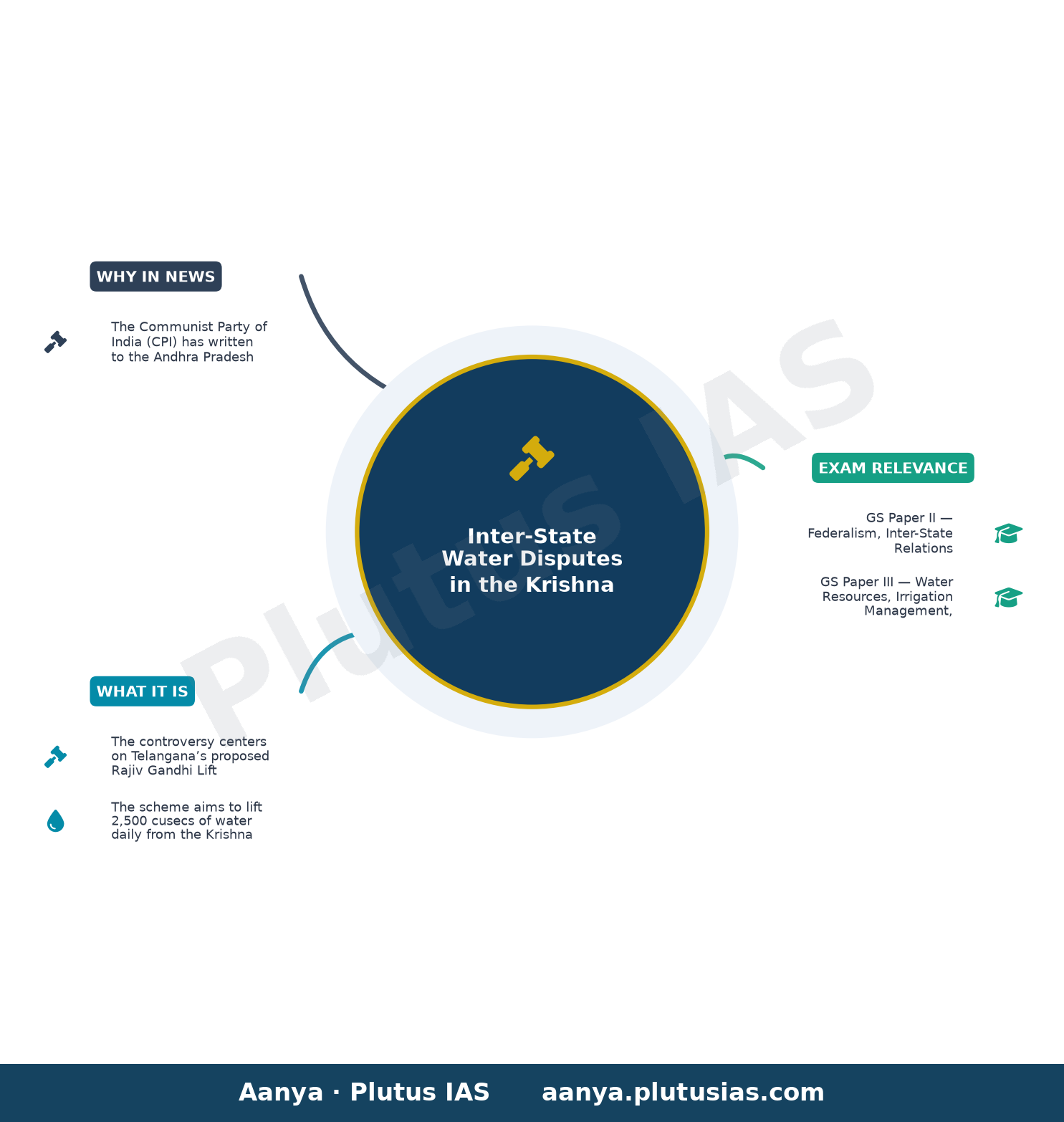
✎ The Pulichintala controversy exemplifies the constitutional and institutional framework governing inter-state water disputes, where Sections 84 and 85 of the Andhra Pradesh Reorganisation Act, 2014, mandate KRMB and Apex Council…
Subject Relevance — Where This Topic Fits
- GS Paper II — Federalism, Inter-State Relations | GS Paper III — Water Resources, Irrigation Management, Environmental Governance
- Prelims: Krishna River Basin, Andhra Pradesh-Telangana water dispute, Pulichintala project, Rajiv Gandhi Lift Irrigation Scheme, Krishna River Management Board (KRMB), Andhra Pradesh Reorganisation Act (2014), Sections 84 and 85 of the Andhra Pradesh Reorganisation Act, Apex Council for Water Disputes, lift irrigation, cusecs, ayacut, inter-state water sharing, constitutional provisions on water disputes
- Essay: Federalism and cooperative governance in India: Lessons from inter-state river disputes, Water as a resource: Balancing agricultural needs, ecological sustainability, and inter-state equity
Quick Revision: The Pulichintala controversy exemplifies the constitutional and institutional framework governing inter-state water disputes, where Sections 84 and 85 of the Andhra Pradesh Reorganisation Act, 2014, mandate KRMB and Apex Council approvals for new lift irrigation schemes in the Krishna basin to ensure equitable water sharing and prevent unilateral actions.
Why is this in the news?
The Communist Party of India (CPI) has written to the Andhra Pradesh Chief Minister urging immediate intervention to halt the Telangana government’s construction of the Rajiv Gandhi Lift Irrigation Scheme near the Pulichintala reservoir on the Krishna River. The CPI alleges that the project, lacking requisite approvals under the Andhra Pradesh Reorganisation Act, 2014, could disrupt existing lift irrigation schemes, drinking water supplies, and agricultural land across seven districts in Andhra Pradesh, thereby escalating an inter-state water dispute in the Krishna basin.
Background
- The Krishna River, India’s third-largest river by discharge, is a critical water source for Maharashtra, Karnataka, Telangana, and Andhra Pradesh, necessitating regulated inter-state water sharing.
- The Pulichintala project is a multi-purpose dam on the Krishna River in Andhra Pradesh, designed to regulate river flow, provide irrigation, and ensure drinking water security across seven districts.
- The Andhra Pradesh Reorganisation Act, 2014, which bifurcated the state and created Telangana, included Sections 84 and 85 to govern water resource management in the Krishna and Godavari basins, mandating approvals from the Krishna River Management Board (KRMB) and the Apex Council for new irrigation projects.
- Telangana’s Rajiv Gandhi Lift Irrigation Scheme, proposed near the Pulichintala reservoir, aims to lift 2,500 cusecs of water daily to irrigate 14,000 acres under the Nagarjunasagar Left Canal system, raising concerns over downstream water availability and existing lift irrigation schemes in Andhra Pradesh.
- The dispute underscores the recurring challenges in inter-state water governance, where competing demands for irrigation, drinking water, and ecological sustainability often lead to legal and political friction.
- Historically, the Krishna basin has witnessed multiple inter-state disputes, including the Krishna Water Disputes Tribunal (KWDT) awards and subsequent conflicts over project construction and water allocation.
What is the Pulichintala Lift Irrigation Controversy?
- The controversy centers on Telangana’s proposed Rajiv Gandhi Lift Irrigation Scheme near the Pulichintala reservoir, which Andhra Pradesh alleges violates the Andhra Pradesh Reorganisation Act, 2014, by lacking KRMB and Apex Council approvals.
- The scheme aims to lift 2,500 cusecs of water daily from the Krishna River to irrigate 14,000 acres, potentially diverting water from downstream Andhra Pradesh’s existing lift irrigation and drinking water schemes.
- Andhra Pradesh contends that the project could disrupt irrigation for 1.3 million acres in its delta regions and affect 50,000 acres of agricultural land, exacerbating water scarcity in the Krishna basin.
- Sections 84 and 85 of the Andhra Pradesh Reorganisation Act, 2014, mandate that any new lift irrigation scheme in the Krishna basin must secure approval from the KRMB and the Apex Council before implementation, which Telangana’s project allegedly lacks.
- The Pulichintala project itself is a key infrastructure in Andhra Pradesh’s water management, designed to regulate the Krishna River’s flow and ensure irrigation and drinking water security across seven districts, including Guntur, Palnadu, and NTR districts.
- The dispute highlights the broader challenge of balancing inter-state water equity with developmental aspirations, where upstream projects can have downstream impacts on agriculture, livelihoods, and ecological balance.
- Legal recourse under the Inter-State Water Disputes Act, 1956, and the constitutional framework for inter-state relations (Article 262) provides mechanisms for resolving such disputes, including reference to tribunals or the Supreme Court.
- The controversy also reflects the need for robust institutional mechanisms like the KRMB and Apex Council to enforce water-sharing agreements and prevent unilateral project implementations.
UPSC Value Addition
Keywords for Mains Answer-Writing
Inter-State Water Disputes · Krishna River Basin · Andhra Pradesh-Telangana Water Conflict · Pulichintala Project · Rajiv Gandhi Lift Irrigation Scheme · Krishna River Management Board (KRMB) · Andhra Pradesh Reorganisation Act, 2014 · Inter-State River Water Disputes Act, 1956 · Apex Council for Water Disputes · Lift Irrigation Projects · Water Sharing Agreements · Federalism and Water Governance
Prelims Practice Questions
Q1. Consider the following statements regarding the Pulichintala project and its implications:
1. The Pulichintala project is designed to regulate the flow of the Krishna River and ensure irrigation and drinking water supplies to downstream areas.
2. The Rajiv Gandhi Lift Irrigation Scheme proposed by Telangana is estimated to lift 2,500 cusecs of water daily and stabilise irrigation over 14,000 acres.
3. The Andhra Pradesh Reorganisation Act, 2014, mandates prior approval of the Apex Council and the Krishna River Management Board (KRMB) for any new lift irrigation scheme in the Krishna basin.
How many of the above statements are correct?
- Only one
- Only two
- All three
- None
Answer: All three — Statements 1 and 3 are correct. Statement 2 is factually accurate in terms of capacity and area but does not specify that the Andhra Pradesh government has raised concerns about its impact on existing projects.
Q2. Assertion (A): The Krishna River Management Board (KRMB) is empowered to regulate and supervise the Krishna River basin under the provisions of the Andhra Pradesh Reorganisation Act, 2014.
Reason (R): The KRMB was constituted to ensure equitable distribution of water resources between Andhra Pradesh and Telangana post-bifurcation.
- Both A and R are true, and R is the correct explanation of A.
- Both A and R are true, but R is NOT the correct explanation of A.
- A is true, but R is false.
- A is false, but R is true.
Answer: Both A and R are true, and R is the correct explanation of A. — Both the Assertion (A) and Reason (R) are correct, and the Reason (R) correctly explains the Assertion (A). The KRMB was established under Section 85 of the Andhra Pradesh Reorganisation Act, 2014, to manage the Krishna River basin.
Q3. Which of the following is NOT a provision under the Inter-State River Water Disputes Act, 1956, for resolving water disputes between states?
- Establishment of a Tribunal for adjudication of disputes
- Mandatory consent of the Union Government for any inter-state water project
- Constitution of a River Board for the regulation of river waters
- Direct appeal to the Supreme Court against the Tribunal’s award
Answer: Direct appeal to the Supreme Court against the Tribunal’s award — The Inter-State River Water Disputes Act, 1956, does not provide for a direct appeal to the Supreme Court against the Tribunal’s award. The award is final and binding, and appeals are not permitted under the Act.
Mains Practice Question
✍ The construction of the Rajiv Gandhi Lift Irrigation Scheme by Telangana near the Pulichintala project on the Krishna River raises critical issues of federalism, water governance, and inter-state cooperation. Critically examine the legal and institutional framework governing inter-state water disputes in India, with particular reference to the Krishna River basin. Also, analyse the role of the Krishna River Management Board (KRMB) and the Apex Council in resolving such disputes. (15 Marks)
Approach: MODEL-ANSWER SKELETON:
1. **Introduction (2 Marks)**
– Briefly introduce the Pulichintala project and the Rajiv Gandhi Lift Irrigation Scheme as the backdrop.
– State the significance of the Krishna River basin for Andhra Pradesh and Telangana.
2. **Legal Framework for Inter-State Water Disputes (5 Marks)**
– **Inter-State River Water Disputes Act, 1956**: Key provisions, including the establishment of Tribunals, their powers, and the binding nature of their awards.
– **Constitutional Provisions**: Article 262 (exclusion of jurisdiction of courts in inter-state water disputes) and Article 253 (treaties and agreements with foreign countries).
– **Andhra Pradesh Reorganisation Act, 2014**: Sections 84 and 85, which mandate the establishment of the Krishna River Management Board (KRMB) and the Apex Council.
– **Relevant Case Laws**: Mention landmark judgments such as *Krishna Godavari Basin (2013)* and *Karnataka v. Goa (2018)* to illustrate judicial interpretations.
3. **Institutional Framework (5 Marks)**
– **Krishna River Management Board (KRMB)**: Composition, functions (regulation, supervision, and dispute resolution), and its role in ensuring equitable distribution of water.
– **Apex Council**: Composition (Union Jal Shakti Minister, Chief Ministers of Andhra Pradesh and Telangana), functions (policy-making, conflict resolution), and its authority under Section 85 of the Reorganisation Act.
– **Limitations and Challenges**: Issues such as lack of autonomy, delays in decision-making, and political interference.
4. **Critical Analysis and Way Forward (3 Marks)**
– Assess the effectiveness of the existing framework in addressing inter-state water disputes, citing the Pulichintala-Telangana conflict as a case study.
– Suggest reforms: Strengthening the KRMB’s autonomy, expediting Tribunal processes, and fostering cooperative federalism through data-sharing and joint projects.
– Conclude with the need for a balanced approach that respects federal principles while ensuring sustainable water governance.
Source: The Hindu
Generated by AanyaAi for educational purpose.

- आईआईडब्ल्यूडब्ल्यू 2026: जल सुरक्षा के लिए नवाचार, जलवायु-लचीलेपन और डिजिटल समाधान - September 24, 2026
- IIWW 2026: AI & Climate-Resilient Water Solutions for UPSC Mains - September 24, 2026
- राजस्थान पंचायत चुनाव 2026: सरपंच-वार्ड पदों की आरक्षण लॉटरी आज, जानिए आरक्षण तय करने की प्रक्रिया - September 24, 2026

No Comments