


08 Aug CPI Warns AP Over Telangana’s Lift Irrigation Project Near Pulichintala
✎ The Rajiv Gandhi Lift Irrigation Scheme in Telangana is contentious because it risks violating Sections 84 and 85 of the Andhra Pradesh Reorganisation Act, 2014, by proceeding without Apex Council and KRMB approvals, thereby…
Subject Relevance — Where This Topic Fits
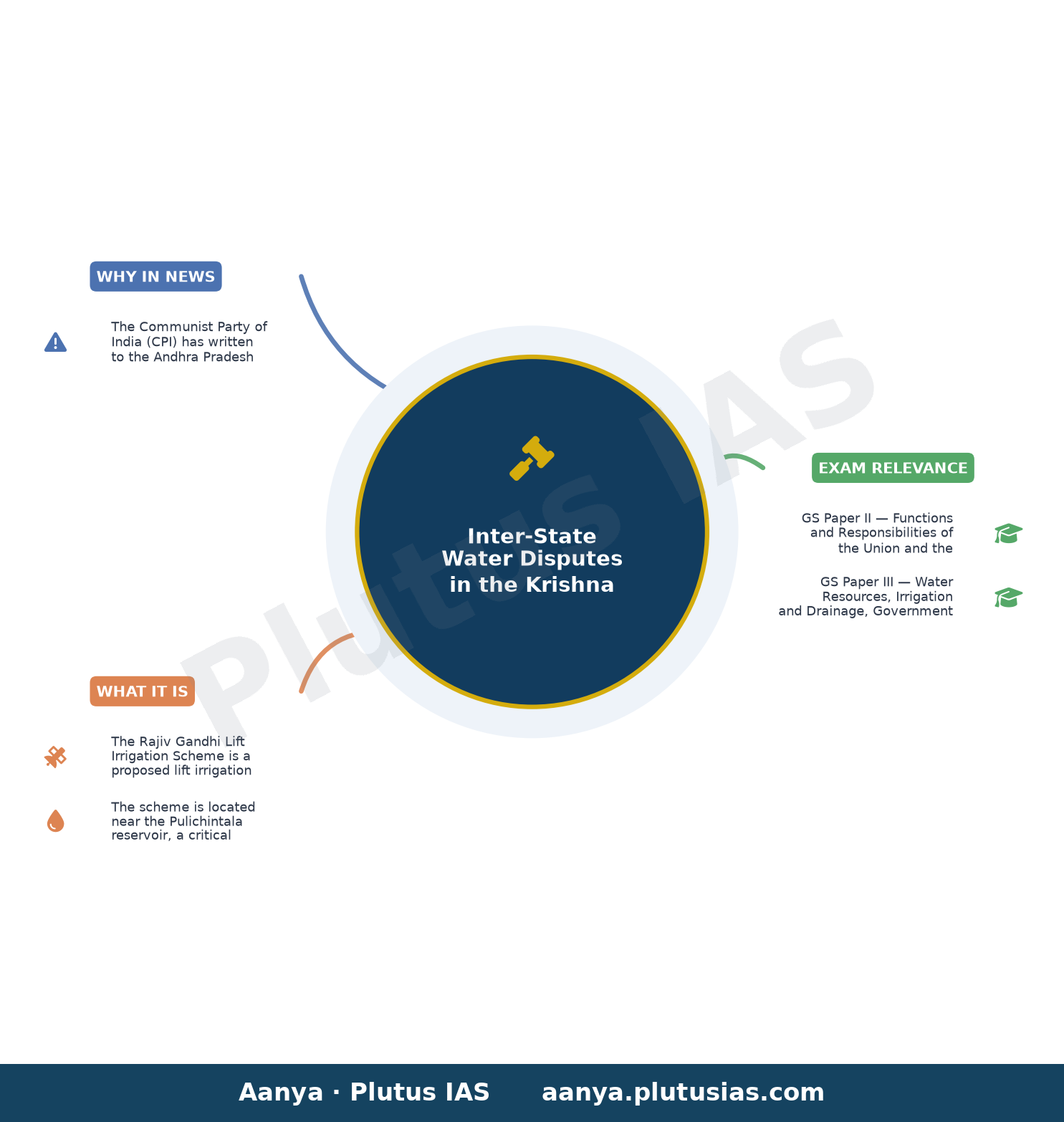
- GS Paper II — Functions and Responsibilities of the Union and the States, Federalism | GS Paper III — Water Resources, Irrigation and Drainage, Government Policies and Interventions
- Prelims: Krishna River Basin, Andhra Pradesh Reorganisation Act, 2014, Krishna River Management Board (KRMB), Pulichintala Project, Lift Irrigation Schemes, Apex Council under the Jal Shakti Ministry, Inter-State Water Disputes Act, 1956
- Essay: Federalism and Cooperative Federalism in India: Balancing State Autonomy and National Integration, Water Security and Sustainable Development: The Challenge of Inter-State River Disputes
Quick Revision: The Rajiv Gandhi Lift Irrigation Scheme in Telangana is contentious because it risks violating Sections 84 and 85 of the Andhra Pradesh Reorganisation Act, 2014, by proceeding without Apex Council and KRMB approvals, thereby threatening Andhra Pradesh’s irrigation and drinking water security in the Krishna delta.
Why is this in the news?
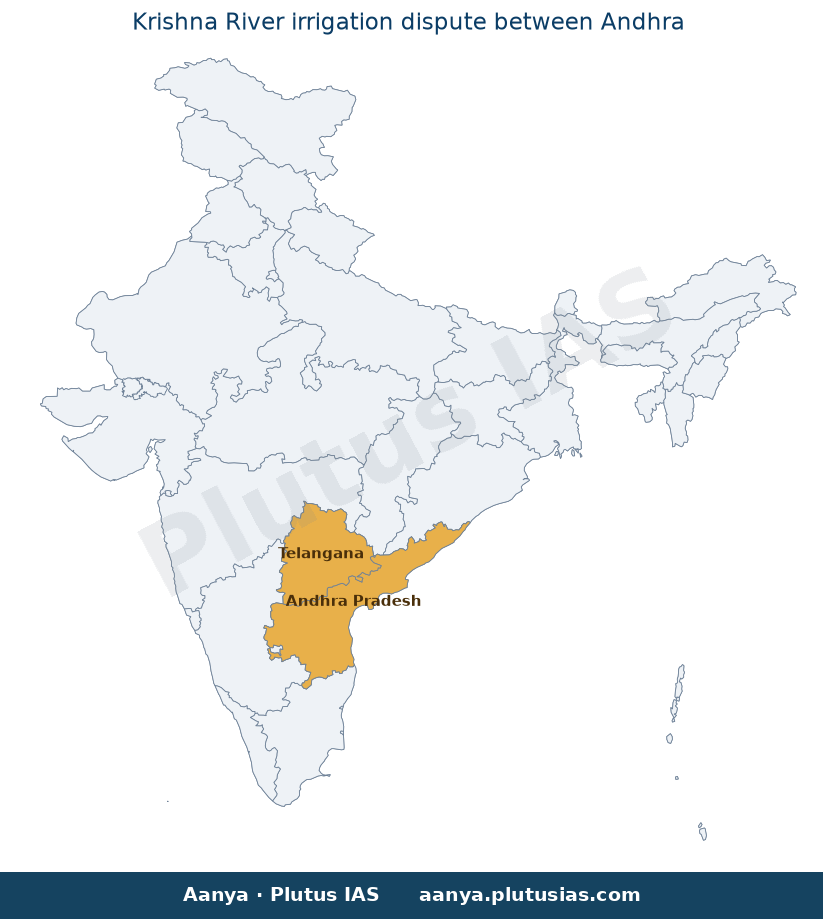
The Communist Party of India (CPI) has written to the Andhra Pradesh Chief Minister urging immediate intervention to halt the Rajiv Gandhi Lift Irrigation Scheme being executed by Telangana near the Pulichintala project on the Krishna River. The scheme, estimated at ₹394 crore, is alleged to threaten the irrigation and drinking water security of over 1.3 million acres in Andhra Pradesh’s delta regions, thereby highlighting the persistent inter-state water disputes in the Krishna Basin and the legal ambiguities under the Andhra Pradesh Reorganisation Act, 2014.
Background
- The Krishna River is the second-largest east-flowing peninsular river in India, originating in Maharashtra and flowing through Karnataka, Telangana, and Andhra Pradesh before draining into the Bay of Bengal.
- The Andhra Pradesh Reorganisation Act, 2014, bifurcated the erstwhile Andhra Pradesh into Telangana and residual Andhra Pradesh, necessitating the establishment of the Krishna River Management Board (KRMB) under Section 85 to regulate water sharing and resolve disputes.
- The Pulichintala Project is a major lift irrigation scheme on the Krishna River designed to stabilize irrigation for 1.3 million acres across seven districts in Andhra Pradesh, including Guntur, Palnadu, and Krishna.
- Inter-state water disputes in the Krishna Basin have historically been governed by the Krishna Water Disputes Tribunal (KWDT) and its subsequent awards, which allocate water shares among Maharashtra, Karnataka, and Andhra Pradesh/Telangana.
- The Apex Council, headed by the Union Jal Shakti Minister, was constituted under Section 84 of the Andhra Pradesh Reorganisation Act to oversee the implementation of water-sharing agreements and resolve disputes between Telangana and Andhra Pradesh.
- Telangana’s proposal to construct the Rajiv Gandhi Lift Irrigation Scheme near Pulichintala has raised concerns in Andhra Pradesh over potential diversion of water, disruption of downstream flows, and violation of procedural safeguards under the Reorganisation Act.
What is the Rajiv Gandhi Lift Irrigation Scheme and why is it contentious?
- The Rajiv Gandhi Lift Irrigation Scheme is a proposed lift irrigation project in Telangana’s Suryapet district, designed to lift 2,500 cusecs of water daily to stabilize irrigation over 14,000 acres under the Nagarjunasagar Left Canal system.
- The scheme is located near the Pulichintala reservoir, a critical infrastructure in Andhra Pradesh’s Krishna delta irrigation network, which supplies water to 1.3 million acres across multiple districts.
- The project is alleged to divert water from the Krishna River, potentially reducing downstream flows to Andhra Pradesh’s existing lift irrigation schemes, including 21 in Palnadu and 51 in NTR district, affecting 50,000 acres of agricultural land and rural drinking water supplies.
- Under Sections 84 and 85 of the Andhra Pradesh Reorganisation Act, 2014, any new lift irrigation scheme in the Krishna Basin requires prior approval from the Apex Council and the Krishna River Management Board (KRMB) to ensure compliance with water-sharing agreements.
- The absence of such approvals raises legal and procedural concerns, as the scheme may contravene the principles of equitable water sharing and the constitutional framework for inter-state river disputes.
- The controversy underscores the broader challenge of balancing state-level developmental imperatives with the need for cooperative federalism in managing shared river basins.
- The scheme’s potential impact on Andhra Pradesh’s irrigation security highlights the vulnerability of delta regions, which are critical for agricultural productivity and food security in the state.
- The dispute also reflects the ongoing tensions between Telangana and Andhra Pradesh over water allocation, exacerbated by the bifurcation of the erstwhile state and the subsequent reorganisation of river basin governance.
UPSC Value Addition
Keywords for Mains Answer-Writing
Krishna River dispute · Pulichintala project · Rajiv Gandhi Lift Irrigation Scheme · Andhra Pradesh-Telangana water disputes · Krishna River Management Board (KRMB) · Andhra Pradesh Reorganisation Act, 2014 · Apex Council under Jal Shakti Ministry · Inter-state river water disputes · Lift irrigation projects · Water sharing agreements · River basin management · Constitutional provisions for inter-state water disputes · Section 84 and 85 of Andhra Pradesh Reorganisation Act, 2014 · Inter-state water governance · Agricultural water security
Prelims Practice Questions
Q1. Consider the following statements regarding the Pulichintala project and the Rajiv Gandhi Lift Irrigation Scheme:
1. The Pulichintala project is designed to regulate the flow of the Krishna River and ensure irrigation and drinking water supplies to downstream areas.
2. The Rajiv Gandhi Lift Irrigation Scheme is being constructed by Telangana between Bugga Madaram and Dondapadu villages in Suryapet district.
3. The Pulichintala project provides irrigation security to nearly 1.3 million acres of Krishna delta ayacut.
4. The Rajiv Gandhi Lift Irrigation Scheme has the capacity to lift 2,500 cusecs of water a day and stabilise irrigation facilities over nearly 14,000 acres.
How many of the above statements are correct?
- Only one
- Only two
- Only three
- All four
Answer: All four — Statements 1, 2, 3, and 4 are all correct as per the provided news article and static syllabus knowledge on the Pulichintala project and the Rajiv Gandhi Lift Irrigation Scheme.
Q2. Assertion (A): The Andhra Pradesh Reorganisation Act, 2014, mandates that any new lift irrigation scheme in the Krishna basin must obtain approval from the Apex Council headed by the Union Jal Shakti Minister and the Krishna River Management Board (KRMB).
Reason (R): The Act aims to prevent unilateral water resource projects by states that may disrupt the equitable distribution of water resources in inter-state river basins.
Options:
A. Both A and R are true, and R is the correct explanation of A.
B. Both A and R are true, but R is not the correct explanation of A.
C. A is true, but R is false.
D. A is false, but R is true.
Answer: ? — Assertion (A) is true as Sections 84 and 85 of the Andhra Pradesh Reorganisation Act, 2014, require such approvals. Reason (R) is also true and correctly explains the rationale behind the provision, which is to ensure equitable water distribution and prevent unilateral projects.
Q3. Match the following pairs related to inter-state water disputes in India:
Column I
1. Pulichintala project
2. Rajiv Gandhi Lift Irrigation Scheme
3. Krishna River Management Board (KRMB)
4. Apex Council under Jal Shakti Ministry
Column II
A. Regulates flow of Krishna River and ensures irrigation and drinking water supplies
B. Constructed by Telangana to lift 2,500 cusecs of water daily
C. Statutory body under the Andhra Pradesh Reorganisation Act, 2014, for Krishna basin management
D. Headed by the Union Jal Shakti Minister to resolve inter-state water disputes
Options:
A. 1-A, 2-B, 3-C, 4-D
B. 1-B, 2-A, 3-D, 4-C
C. 1-C, 2-D, 3-A, 4-B
D. 1-D, 2-C, 3-B, 4-A
- A
- B
- C
- D
Answer: A — 1-A: Pulichintala project regulates Krishna River flow and ensures water supply. 2-B: Rajiv Gandhi Lift Irrigation Scheme is being constructed by Telangana to lift 2,500 cusecs daily. 3-C: KRMB is a statutory body under the Andhra Pradesh Reorganisation Act, 2014. 4-D: Apex Council is headed by the Union Jal Shakti Minister to resolve inter-state water disputes.
Mains Practice Question
✍ The Pulichintala project in Andhra Pradesh and the Rajiv Gandhi Lift Irrigation Scheme in Telangana exemplify the recurring inter-state water disputes in India’s federal structure. Critically examine the constitutional and institutional mechanisms designed to resolve such disputes, with particular reference to the Krishna River basin. Also, analyse the potential socio-economic consequences of unilateral water resource projects by states on downstream regions. (15 Marks)
Approach: Define inter-state water disputes in India, citing the Pulichintala project and Rajiv Gandhi Lift Irrigation Scheme as contemporary examples. Highlight the federal nature of water governance and the need for equitable distribution. Discuss Articles 262 and 263 of the Constitution, which provide for the adjudication of inter-state river water disputes and the establishment of inter-state councils. Explain the role of the Inter-State Water Disputes Act, 1956, and the establishment of tribunals (e.g., Krishna Water Disputes Tribunal-I and II). Elaborate on the Krishna River Management Board (KRMB) and the Apex Council under the Union Jal Shakti Ministry, as mandated by the Andhra Pradesh Reorganisation Act, 2014 (Sections 84 and 85). Discuss their composition, functions, and limitations in resolving disputes. Analyse the role of the Supreme Court in adjudicating inter-state water disputes, citing recent judgments (e.g., State of Karnataka v. State of Tamil Nadu, 2023). Discuss the challenges posed by unilateral projects and the lack of consensus among states. Examine the potential adverse effects of unilateral lift irrigation schemes, such as disruption of downstream irrigation (1.3 million acres in Andhra Pradesh), drinking water supply (50,000 acres), and agricultural livelihoods. Highlight the broader implications for federalism, trust deficit among states, and the need for cooperative federalism. Conclude with a balanced view: while states have legitimate water needs, unilateral projects undermine cooperative federalism. Emphasise the need for robust institutional mechanisms, data transparency, and political will to resolve disputes amicably.
Source: The Hindu
Generated by AanyaAi for educational purpose.

- महाराष्ट्र में त्योहार जुलूसों पर बॉम्बे हाईकोर्ट का बड़ा फैसला: पटाखे, लेजर और संगीत पर रोक - September 24, 2026
- Bombay HC Bans Firecrackers, Music in Maharashtra Processions: Key UPSC Analysis - September 24, 2026
- तमिलनाडु में महिला कर्मचारियों के लिए सवैतनिक माहवारी अवकाश नीति पर HC का आदेश - September 24, 2026

No Comments