


07 Aug CPI(M) opposes linking women’s quota with delimitation: Key concerns for UPSC
✎ The Women’s Reservation Bill seeks to reserve one-third of seats for women in the Lok Sabha and State Legislative Assemblies, but its implementation is contingent on resolving the delimitation process, which is governed by the…
Subject Relevance — Where This Topic Fits
- GS Paper II — Polity and Governance (Constitutional Amendments, Representation of Women) | GS Paper II — Governance (Reservation Policies, Delimitation Process)
- Prelims: Women’s Reservation Bill 2023, Delimitation Commission, Article 334 (Reservation of Seats), Article 82 (Readjustment of Representation), Constitutional Status of Women’s Reservation
- Essay: The Intersection of Social Justice and Electoral Reforms in India
Quick Revision: The Women’s Reservation Bill seeks to reserve one-third of seats for women in the Lok Sabha and State Legislative Assemblies, but its implementation is contingent on resolving the delimitation process, which is governed by the Constitution (84th and 87th Amendments).
Why is this in the news?
The CPI(M) has publicly opposed the Centre’s proposal to link the implementation of the Women’s Reservation Bill with the delimitation exercise, arguing that such a linkage lacks consensus among political parties and undermines the legislative intent of the Bill. This stance highlights the broader constitutional and political challenges in operationalising reservations for women in legislatures, particularly in the context of the pending 2023 Women’s Reservation Bill, which seeks to reserve one-third of seats for women in the Lok Sabha and State Legislative Assemblies.
Background
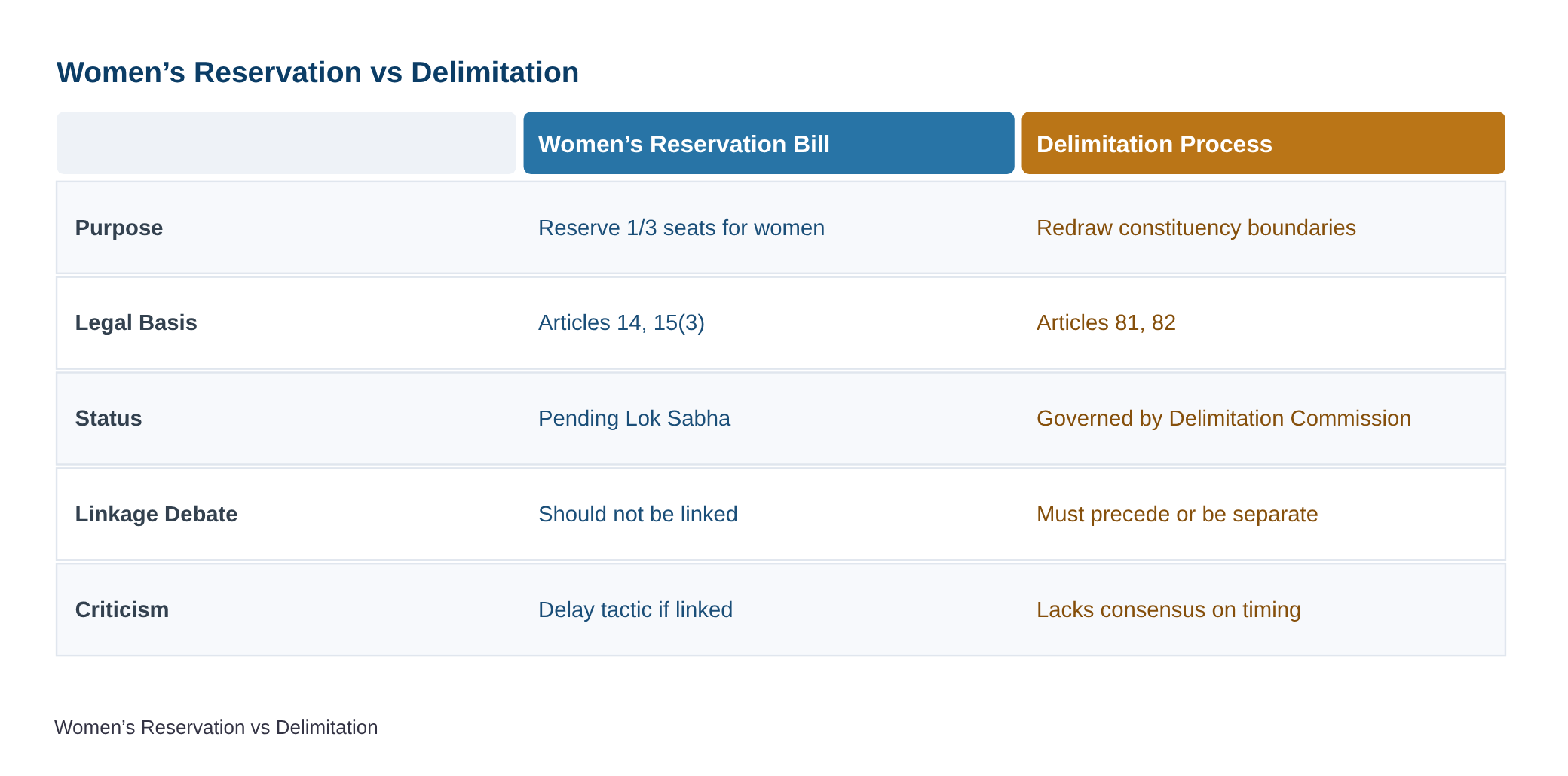
- The Women’s Reservation Bill, originally introduced in 1996 and passed by the Rajya Sabha in 2010, remains pending in the Lok Sabha. The Bill proposes to reserve one-third of seats for women in the Lok Sabha and State Legislative Assemblies.
- Delimitation refers to the process of redrawing the boundaries of electoral constituencies to reflect changes in population distribution. This process is governed by the Delimitation Commission, which is constituted under Article 82 of the Constitution.
- The linkage between women’s reservation and delimitation has been a subject of debate, with some arguing that delimitation must precede the implementation of the Bill to ensure equitable representation, while others contend that the two issues should be treated independently.
- The CPI(M) has consistently advocated for the immediate implementation of the Women’s Reservation Bill without linking it to delimitation, citing the lack of consensus on the latter issue and the need for urgent legislative action to address gender disparities in representation.
- The Centre’s proposal to link the two issues has been criticised by opposition parties, who argue that it is a tactic to further delay the implementation of the Bill, which has been pending for nearly three decades.
Women’s Reservation and Delimitation: Constitutional and Legal Framework
- The Women’s Reservation Bill aims to reserve one-third of seats for women in the Lok Sabha and State Legislative Assemblies, thereby addressing the underrepresentation of women in India’s legislative bodies.
- Delimitation is governed by Article 82 of the Constitution, which empowers Parliament to readjust the boundaries of constituencies based on the latest census data. The Delimitation Commission, constituted under this provision, is responsible for this process.
- The linkage between women’s reservation and delimitation stems from the requirement that reserved seats must be rotated periodically to ensure fair representation across constituencies. This rotation necessitates a delimitation exercise.
- The Constitution (84th Amendment) Act, 2001, froze the delimitation process until after the first census post-2026. This freeze was extended by the Constitution (87th Amendment) Act, 2003, to ensure that delimitation is based on the 2031 census data.
- The Women’s Reservation Bill does not specify whether delimitation should precede its implementation. This ambiguity has led to divergent interpretations, with some arguing that delimitation must occur first to avoid disrupting the electoral process.
- Political parties are divided on the issue. While some support the immediate implementation of the Bill without linking it to delimitation, others advocate for a phased approach that includes delimitation to ensure equitable representation.
- The CPI(M)’s stance reflects a broader concern that linking the two issues could further delay the implementation of the Bill, which is seen as a critical step toward achieving gender parity in India’s political institutions.
Key Features
| Feature | Significance |
|---|---|
| Proposed Women’s Reservation Legislation | Aims to reserve 33% of seats in the Lok Sabha and State Legislative Assemblies for women, enhancing gender representation in elected bodies. |
| Delimitation Exercise | Process of redrawing electoral boundaries to reflect population changes, which may alter seat distribution among states. |
| Opposition’s Stand on Separate Introduction | CPI(M) advocates for the women’s reservation Bill to be introduced independently of the delimitation process, ensuring timely implementation. |
| Consultation with Political Parties | Emphasises the necessity of pre-legislative discussions with opposition parties to build consensus and avoid procedural delays. |
| Gen Z Protests and Police Response | Highlights concerns over excessive use of force by police against student protesters, demanding accountability from the Union Home Minister. |
Why it Matters
Political
- The linkage between women’s reservation and delimitation introduces procedural complexities, risking delays in the implementation of the Women’s Reservation Act, 2023.
- The opposition’s willingness to support the Bill if introduced separately demonstrates potential for cross-party consensus on gender representation.
- The allegation of the BJP attempting to frame opposition as obstructive underscores the politicisation of the women’s reservation issue.
- The CPI(M)’s critique of the delimitation process reflects broader concerns about the Centre’s lack of consultation with stakeholders.
Constitutional
- The Women’s Reservation Act, 2023, is rooted in the constitutional mandate for equality (Article 14) and affirmative action (Article 15(3)), though its implementation is contingent on delimitation.
- Delimitation is governed by Articles 81 and 82, which require periodic readjustment of electoral boundaries based on census data.
- The demand for consultations aligns with the constitutional principle of cooperative federalism (Article 263) and participative democracy.
Social
- Enhancing women’s political representation is critical for addressing gender disparities in decision-making and policy formulation.
- The protests by Gen Z students highlight intergenerational conflicts over governance, free speech, and state repression, reflecting societal tensions.
- Caste eradication, as discussed in the released book, underscores the intersectional challenges of social justice in India.
Challenges
1. Procedural Delay in Women’s Reservation Implementation
- Linking women’s reservation with delimitation risks indefinite postponement, as delimitation itself is a contentious and time-consuming process.
- The absence of consensus on delimitation further complicates the legislative timeline, potentially stalling the women’s reservation Act.
- Opposition parties’ demand for separate introduction of the Bill may face resistance from the ruling dispensation, leading to parliamentary logjams.
UPSC Link: GS-II: Parliament and State Legislatures
2. Politicisation of Delimitation
- The delimitation exercise has historically been a contentious issue, with state-specific demands (e.g., Andhra Pradesh, Telangana) creating political friction.
- The Centre’s alleged lack of consultation with opposition parties violates the spirit of cooperative federalism and undermines democratic accountability.
- Partisan narratives (e.g., framing opposition as obstructive) can erode public trust in institutional processes.
UPSC Link: GS-II: Federalism and Centre-State Relations
3. Excessive Use of Force Against Protesters
- The police’s response to Gen Z protests raises concerns about the violation of fundamental rights (Article 19(1)(a)) and the right to peaceful assembly.
- Failure to address these grievances may exacerbate youth disillusionment with democratic institutions and governance.
- Demands for accountability from the Union Home Minister highlight the need for transparent and proportionate policing.
UPSC Link: GS-II: Fundamental Rights and DPSP
4. Economic Discontent in Andhra Pradesh
- Allegations of job losses in key sectors (steel, textiles, dairy) and discrepancies in employment generation data undermine public confidence in economic policies.
- The demand for a White Paper on employment reflects the need for evidence-based policymaking and transparency in economic governance.
- Failure to ensure remunerative prices for farmers (e.g., tobacco sector) exacerbates agrarian distress and rural unemployment.
UPSC Link: GS-III: Employment and Agriculture
Challenges — UPSC Perspective
| Issue | Concern |
|---|---|
| Women’s Reservation and Delimitation Linkage | Risk of indefinite postponement of women’s political representation due to procedural complexities. |
| Lack of Consensus on Delimitation | Centre’s failure to consult opposition parties undermines democratic legitimacy and cooperative federalism. |
| Police Response to Gen Z Protests | Excessive use of force violates fundamental rights and escalates youth disillusionment with governance. |
| Employment Data Discrepancies in Andhra Pradesh | Allegations of job losses and opaque economic policies erode public trust in governance. |
| Agrarian Distress in Andhra Pradesh | Failure to ensure remunerative prices for farmers exacerbates rural unemployment and economic inequality. |
Way Forward
- The Centre must initiate separate legislative action on women’s reservation, decoupling it from the delimitation process to ensure timely implementation.
- Convene an all-party meeting chaired by the Prime Minister to build consensus on the delimitation exercise, ensuring transparency and inclusivity.
- Establish an independent committee to investigate allegations of excessive police force during Gen Z protests, with a mandate to recommend accountability measures.
- Release a White Paper on employment generation in Andhra Pradesh, detailing sector-wise job creation, losses, and future policy interventions.
- Reform agrarian policies to ensure remunerative prices for farmers, particularly in the tobacco sector, and strengthen rural employment schemes.
- Strengthen mechanisms for pre-legislative consultations (e.g., draft Bills in public domain) to enhance participative democracy and reduce procedural delays.
- Address intergenerational grievances by engaging with youth-led movements through structured dialogue, ensuring their concerns are integrated into policy frameworks.
UPSC Value Addition
Keywords for Mains Answer-Writing
Women’s Reservation Bill · Constitution (108th Amendment) Bill, 2008 · Delimitation Commission · Article 82 of the Constitution · Article 330A · Women’s Reservation Act, 2023 · Political consensus on constitutional amendments · Federalism and Centre-State consultations · Parliamentary procedures for constitutional amendments · Opposition parties and legislative processes · CPI(M) political stance · Constitutional morality and legislative intent · Reservation policies in India · Delimitation exercise and its constitutional framework
Constitutional & Policy Linkages
- Article 14: Right to Equality (Gender-based discrimination in political representation)
- Article 15(3): Empowerment of women through affirmative action
- Article 81: Composition of the Lok Sabha (Delimitation and seat allocation)
- Article 82: Readjustment of electoral boundaries (Delimitation process)
- Article 19(1)(a): Freedom of speech and assembly (Police response to protests)
Concept Flow
Women’s Reservation Act, 2023 → Requires delimitation for implementation → Centre links the two → Opposition demands separate introduction → Procedural delay ensues → Delimitation exercise → Historically contentious → Centre’s lack of consultation → Opposition alleges undemocratic approach → Erosion of cooperative federalism → Gen Z protests → Police crackdown → Allegations of excessive force → Demand for Home Minister’s statement → Youth disillusionment with governance → Employment data discrepancies → Allegations of job losses → Demand for White Paper → Scrutiny of economic policies → Public trust deficit → Agrarian distress → Failure to ensure remunerative prices → Farmer protests → Policy paralysis → Rural unemployment persists
Prelims Practice Questions
Q1. Consider the following statements regarding the Women’s Reservation Bill:
1. The Bill seeks to reserve one-third of the seats in the Lok Sabha and State Legislative Assemblies for women.
2. The Bill was introduced in the Parliament in 2023 and received Presidential assent.
3. The Bill is linked to the delimitation exercise as per constitutional provisions.
How many of the above statements are correct?
- Only one
- Only two
- All three
- None
Answer: Only two — Statement 1 is correct as the Bill aims to reserve one-third of seats for women. Statement 2 is incorrect because the Bill was introduced in 2023 but is still pending legislative approval. Statement 3 is incorrect as the Bill does not mandate linkage with delimitation.
Q2. Assertion (A): The delimitation exercise in India is conducted by the Delimitation Commission under Article 82 of the Constitution.
Reason (R): The Delimitation Commission is a statutory body constituted by the President of India to readjust the division of territorial constituencies.
Options:
A. Both A and R are true, and R is the correct explanation of A.
B. Both A and R are true, but R is not the correct explanation of A.
C. A is true, but R is false.
D. A is false, but R is true.
- A
- B
- C
- D
Answer: B — Both Assertion (A) and Reason (R) are true. The Delimitation Commission is indeed constituted under Article 82, and its role is to readjust territorial constituencies. However, R is not the correct explanation of A as it does not directly explain the constitutional basis of the assertion.
Q3. Match the following provisions with their respective constitutional articles:
Column I (Provision)
A. Reservation of seats for women in Panchayats and Municipalities
B. Reservation of seats for Scheduled Castes and Scheduled Tribes in the Lok Sabha
C. Power of Parliament to readjust the division of territorial constituencies
D. Reservation of seats for women in the Lok Sabha and State Legislative Assemblies
Column II (Article)
1. Article 243D
2. Article 330
3. Article 82
4. Article 330A
Options:
A. A-1, B-2, C-3, D-4
B. A-2, B-1, C-4, D-3
C. A-3, B-4, C-1, D-2
D. A-4, B-3, C-2, D-1
- A
- B
- C
- D
Answer: A — The correct matches are: A-1 (Article 243D for Panchayats and Municipalities), B-2 (Article 330 for SC/ST reservation in Lok Sabha), C-3 (Article 82 for delimitation), and D-4 (Article 330A for women’s reservation in Lok Sabha and State Assemblies).
Mains Practice Question
✍ Critically examine the constitutional and political implications of linking the Women’s Reservation Bill with the delimitation exercise. Also analyse the arguments presented by the CPI(M) and other opposition parties in this context. (15 Marks)
Approach: MODEL-ANSWER SKELETON:
1. **Constitutional Framework**:
– Brief on the Women’s Reservation Bill (Constitution (108th Amendment) Bill, 2008) and its provisions under Article 330A.
– Delimitation exercise governed by Article 82 and the Delimitation Act, 2002.
– Constitutional mandate for delimitation post-census (Article 82) and its linkage with census data.
2. **Arguments for Linkage**:
– Government’s rationale: Ensuring equitable representation with updated constituency boundaries.
– Efficiency in implementation: Avoiding repeated delimitation exercises.
– Legal precedent: Similar linkages in past constitutional amendments (e.g., 73rd and 74th Amendments).
3. **Arguments Against Linkage**:
– **CPI(M) stance**: Lack of consensus on delimitation and inadequate consultations with opposition parties.
– **Federalism concerns**: States may face disproportionate impact due to uneven population distribution.
– **Political consensus**: Opposition parties argue that women’s reservation should be implemented independently to ensure timely enactment.
– **Legal ambiguity**: No explicit constitutional provision mandates linkage between the two.
4. **Judicial and Political Precedents**:
– Reference to judicial interpretations on constitutional amendments (e.g., Kesavananda Bharati case).
– Political precedents: Opposition’s role in legislative processes (e.g., Triple Talaq Bill).
5. **Conclusion**:
– Weigh the balance between constitutional mandates and political expediency.
– Emphasise the need for consensus-building and adherence to federal principles.
– Highlight the potential consequences of delaying women’s reservation due to delimitation linkage.
Source: The Hindu
Generated by AanyaAi for educational purpose.

- सुप्रीम कोर्ट ने चुनाव आयोग को दिल्ली में ‘यांत्रिक’ SIR नोटिस पर सावधानियां बरतने को कहा - September 22, 2026
- ‘स्वच्छता ही सेवा-2026’ अभियान: सरकारी विभागों में स्वच्छता क्रांति, जानिए मुख्य बिंदु - September 22, 2026
- DFPD Launches ‘Swachhata Hi Seva-2026’ Campaign for Clean India Mission - September 22, 2026

No Comments