


20 Aug CPI(M) Slams EC Over Electoral Roll Discrepancies in Andhra Pradesh
✎ The Special Intensive Revision (SIR) is a focused exercise under the Representation of the People Act, 1950, aimed at updating electoral rolls, but voters must be given adequate opportunity to correct discrepancies to prevent…
Subject Relevance — Where This Topic Fits
- GS Paper II — Constitutional and Non-Constitutional Bodies (Election Commission of India) | GS Paper II — Fundamental Rights (Right to Vote under Article 326) | GS Paper III — Electoral Reforms and Administrative Efficiency
- Prelims: Electoral Roll, Special Intensive Revision (SIR), Form 8A, Election Commission of India (ECI), Right to Vote, Draft Electoral Roll, Transliteration Errors, Voter Verification
- Essay: Electoral integrity and democratic accountability in India: Balancing administrative efficiency with citizens’ rights, The role of constitutional institutions in protecting democratic rights: A case study of the Election Commission
Quick Revision: The Special Intensive Revision (SIR) is a focused exercise under the Representation of the People Act, 1950, aimed at updating electoral rolls, but voters must be given adequate opportunity to correct discrepancies to prevent disenfranchisement.
Why is this in the news?
The issuance of notices to voters by the Election Commission of India (ECI) over discrepancies in electoral rolls during the Special Intensive Revision (SIR) process has drawn criticism from political quarters, highlighting concerns over the potential disenfranchisement of eligible voters due to administrative or clerical errors. The allegation of large-scale deletions and notices being issued to millions of voters in Andhra Pradesh underscores the tension between electoral purity and the preservation of the franchise, raising questions about the procedural safeguards and corrective mechanisms available to affected citizens.
Background
- The Election Commission of India (ECI) conducts periodic revisions of electoral rolls to ensure accuracy, completeness, and elimination of duplicate or erroneous entries, as mandated under the Representation of the People Act, 1950, and the Conduct of Elections Rules, 1961.
- The Special Intensive Revision (SIR) is a focused exercise undertaken by the ECI to update electoral rolls with the latest demographic data, including new voters, corrections in existing entries, and removal of ineligible or deceased individuals.
- Discrepancies in electoral rolls often arise from clerical errors, data-entry mistakes, transliteration issues (especially in multilingual states), or outdated records, which can inadvertently lead to the exclusion of eligible voters.
- The ECI has historically faced challenges in maintaining updated and error-free electoral rolls, particularly in states with high population mobility or linguistic diversity, necessitating periodic corrective measures.
What is the Special Intensive Revision (SIR) and Electoral Roll Discrepancies?
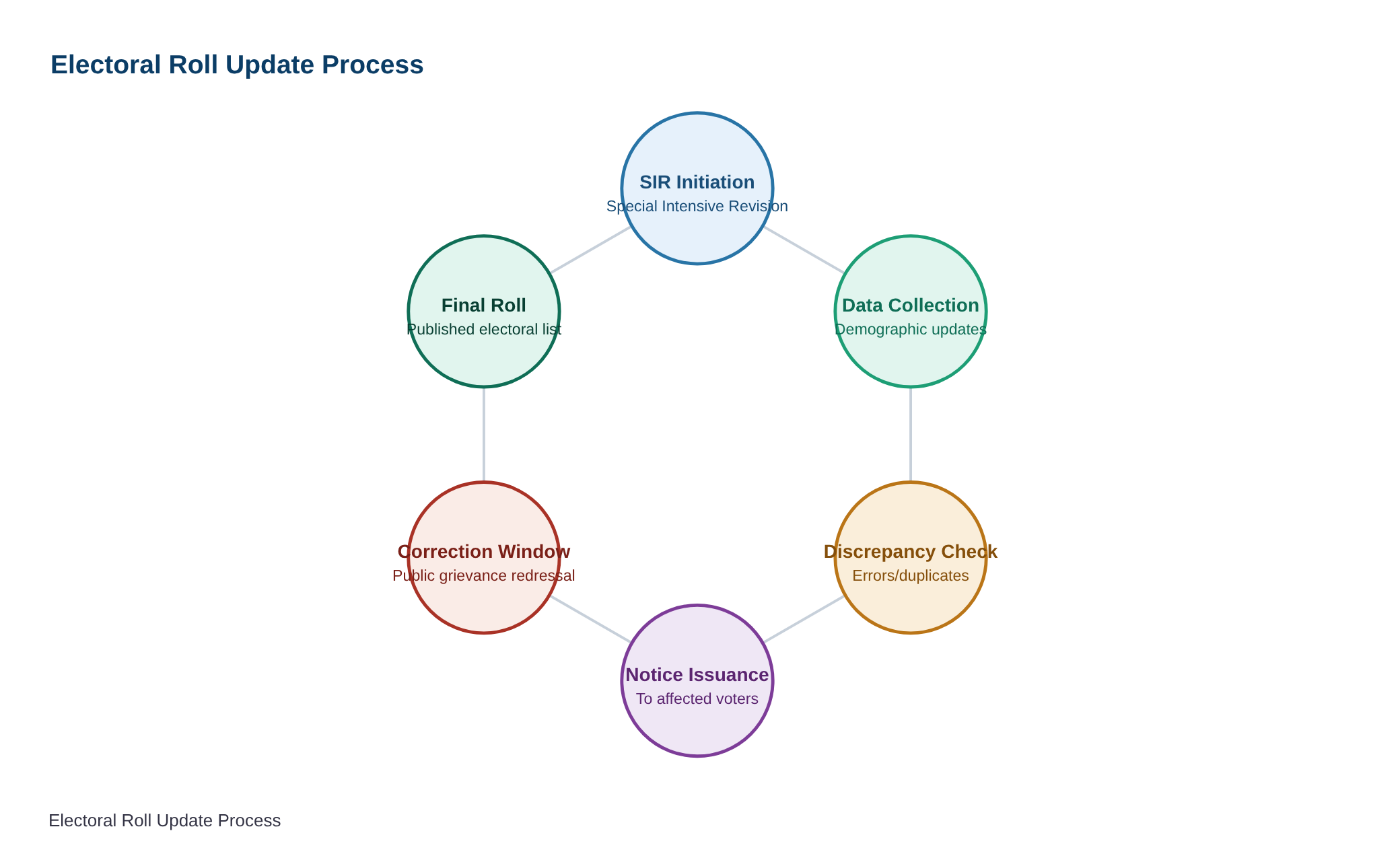
- The Special Intensive Revision (SIR) is a targeted, time-bound exercise conducted by the Election Commission of India (ECI) to update electoral rolls by incorporating new voters, correcting existing entries, and removing ineligible or duplicate names.
- The SIR process involves the preparation of a draft electoral roll, which is published for public scrutiny, followed by a period for filing claims, objections, and corrections (typically 2-4 weeks).
- Discrepancies in electoral rolls may include errors in names (e.g., spelling variations, transliteration issues), ages, addresses, or the inclusion of deceased individuals, which can lead to the issuance of notices to voters for verification.
- Voters receive notices through local election officials when discrepancies are detected, requiring them to appear before designated authorities with supporting documents (e.g., Aadhaar, birth certificate, or school records) for verification.
- The ECI has emphasized the use of technology, such as the Electoral Photo Identity Card (EPIC) linkage with Aadhaar and the development of the National Electoral Roll Purification Programme (NERP), to reduce errors and improve accuracy.
- The Representation of the People Act, 1951, provides legal safeguards to ensure that the SIR process does not disenfranchise eligible voters, including provisions for appeals and grievance redressal.
- Historically, the SIR process has faced criticism for being overly bureaucratic, time-consuming, or prone to errors, particularly in states with high population density or linguistic diversity.
UPSC Value Addition
Keywords for Mains Answer-Writing
Electoral Rolls · Special Intensive Revision (SIR) · Election Commission of India (ECI) · Voter Disenfranchisement · Electoral Discrepancies · Right to Vote · Constitutional Provisions on Elections · Electoral Reforms · Transliteration Errors · Data-Entry Errors · Draft Electoral Rolls · Door-to-Door Verification · Article 324 of the Constitution · Model Code of Conduct · Voter Awareness · Electoral Justice
Prelims Practice Questions
Q1. Consider the following statements regarding the Special Intensive Revision (SIR) of electoral rolls in India:
1. The SIR is conducted under the supervision of the Election Commission of India (ECI) to ensure accuracy in electoral rolls.
2. The SIR process involves door-to-door verification of voters’ details.
3. The ECI has the constitutional authority to delete names from electoral rolls due to discrepancies.
4. The SIR process is exempt from judicial review under Article 324 of the Constitution.
How many of the above statements are correct?
- Only one
- Only two
- Only three
- All
Answer: Only three — Statements 1, 2, and 3 are correct. The SIR is conducted by the ECI to ensure accuracy in electoral rolls, includes door-to-door verification, and the ECI has the authority to delete names under Article 324. Statement 4 is incorrect as judicial review is available for electoral matters.
Q2. Assertion (A): The Election Commission of India (ECI) has the power to issue notices to voters for discrepancies in electoral rolls.
Reason (R): The ECI derives its authority from Article 324 of the Constitution of India, which empowers it to supervise and conduct elections.
Options:
A) Both A and R are true, and R is the correct explanation of A.
B) Both A and R are true, but R is not the correct explanation of A.
C) A is true, but R is false.
D) A is false, but R is true.
Answer: ? — Both the assertion and reason are true. The ECI indeed has the power to issue notices for discrepancies in electoral rolls under Article 324, which empowers it to supervise elections. The reason correctly explains the assertion.
Q3. Match the following pairs related to electoral processes in India:
Column I
1. Special Intensive Revision (SIR)
2. Draft Electoral Rolls
3. Transliteration Errors
4. Door-to-Door Verification
Column II
A. Process to ensure accuracy in electoral rolls
B. Preliminary list of voters prepared for public scrutiny
C. Errors arising from incorrect conversion of names between scripts
D. Method to verify voter details through physical visits
Options:
1-A, 2-B, 3-C, 4-D
1-B, 2-A, 3-D, 4-C
1-C, 2-D, 3-A, 4-B
1-D, 2-C, 3-B, 4-A
- 1-A, 2-B, 3-C, 4-D
- 1-B, 2-A, 3-D, 4-C
- 1-C, 2-D, 3-A, 4-B
- 1-D, 2-C, 3-B, 4-A
Answer: 1-A, 2-B, 3-C, 4-D — The correct matches are: 1-A (SIR is a process to ensure accuracy), 2-B (Draft Electoral Rolls are preliminary lists), 3-C (Transliteration Errors occur due to incorrect script conversion), and 4-D (Door-to-Door Verification is a method to verify details).
Mains Practice Question
✍ The integrity of the electoral process in India is contingent upon the accuracy of electoral rolls. In light of recent controversies surrounding the Special Intensive Revision (SIR) of electoral rolls and the issuance of notices to voters for discrepancies, critically examine the constitutional and administrative safeguards that exist to protect the franchise of eligible voters. Also, analyse the potential consequences of large-scale deletions from electoral rolls on democratic participation. (15 Marks)
Approach: MODEL-ANSWER SKELETON:
1. **Constitutional Framework**:
– Article 324 of the Constitution empowers the Election Commission of India (ECI) to supervise, direct, and control elections, including the preparation of electoral rolls (Art. 324(1)).
– The ECI’s authority is derived from the Representation of the People Act, 1950, and the Conduct of Elections Rules, 1961.
– The ECI is mandated to ensure that electoral rolls are accurate, inclusive, and free from errors.
2. **Administrative Safeguards**:
– **Special Intensive Revision (SIR)**: A periodic exercise to update electoral rolls with door-to-door verification (Rule 21 of the Conduct of Elections Rules, 1961).
– **Draft Electoral Rolls**: Publicly displayed for scrutiny, allowing voters to raise objections (Section 22 of the Representation of the People Act, 1950).
– **Appeal Mechanism**: Voters can appeal against deletions or discrepancies to designated authorities under the Act.
– **Judicial Review**: The Supreme Court has held that electoral rolls are subject to judicial scrutiny (e.g., *Krishna Kumar v. Union of India*, 2017).
3. **Challenges Highlighted in the News**:
– **Transliteration/Data-Entry Errors**: Errors in names, ages, or addresses due to clerical mistakes or transliteration between scripts (e.g., English to regional languages).
– **Large-Scale Deletions**: Allegations of mass deletions (e.g., 45 lakh names in Andhra Pradesh) and notices to 44 lakh voters, raising concerns about voter disenfranchisement.
– **Lack of Uniformity**: Inconsistencies in verification processes across states.
4. **Consequences of Large-Scale Deletions**:
– **Erosion of Democratic Participation**: Disenfranchisement of eligible voters undermines the principle of universal adult franchise (Article 325).
– **Distrust in Institutions**: Perceptions of bias or inefficiency in the electoral process can erode public trust in democratic institutions.
– **Legal and Political Ramifications**: Potential litigation, protests, and calls for electoral reforms.
– **Impact on Marginalised Groups**: Women, minorities, and rural voters may face disproportionate challenges in proving eligibility.
5. **Way Forward**:
– Strengthening **technology-driven verification** (e.g., Aadhaar-based authentication, GIS mapping).
– **Simplifying grievance redressal** mechanisms (e.g., online portals, helplines).
– **Ensuring transparency** in the SIR process (e.g., public audits, real-time tracking of deletions).
– **Judicial and Parliamentary Oversight**: Regular reviews by the ECI and parliamentary committees.
Balance of Views:
– **ECI’s Perspective**: Emphasises the need for accurate rolls to prevent fraud and ensure fair elections.
– **Critics’ Perspective**: Argue that procedural lapses (e.g., clerical errors) should not disenfranchise voters and that the burden of proof should not fall solely on citizens.
Source: The Hindu
Generated by AanyaAi for educational purpose.

- CBN Rajasthan celebrates National Anti-Drug Day with Gandhi Jayanti events - October 4, 2026
- महाराष्ट्र में ग्रीन इंडिया मिशन: सीएजी ने बताए पौधों के मरने के कारण - October 4, 2026
- Odisha Extends EV Policy Validity Till 2026 for UPSC & PCS - October 4, 2026

No Comments