


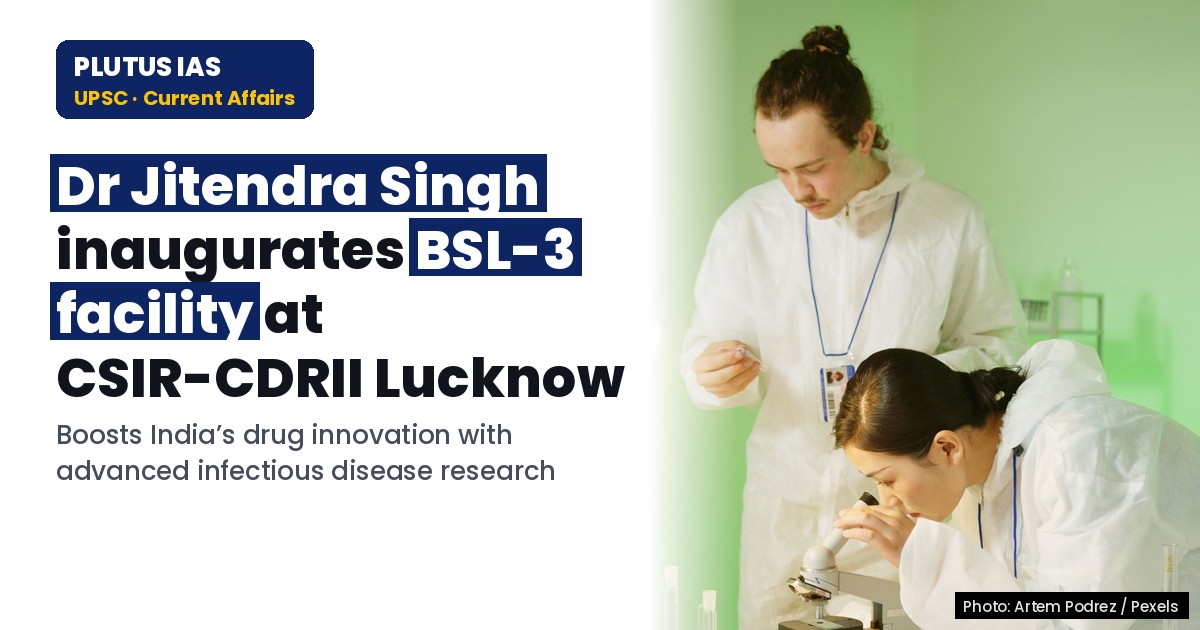
28 Nov CSIR-CDRII’s BSL-3 Facility: India’s Leap in Drug Innovation & Research
✎ The CSIR-CDRI’s BSL-3/ABSL-3 facility enhances India’s capacity for safe and advanced research on high-risk pathogens, supporting indigenous drug discovery and strengthening pandemic preparedness under the ‘Viksit Bharat 2047’…
Subject Relevance — Where This Topic Fits
- GS Paper II — Science and Technology | GS Paper III — Science and Technology—Developments and their Applications and Effects in Everyday Life | GS Paper III — Biotechnology and its Applications
- Prelims: Biosafety Level-3 (BSL-3), CSIR-CDRI, Zoonotic diseases, Drug discovery, Clinical trials, Patents, Public-private partnerships in healthcare, Tuberculosis, Non-tuberculous mycobacteria (NTM), Vaccine development
- Essay: The Role of Indigenous Innovation in Public Health: Lessons from CSIR-CDRI, From Generics to Innovation: India’s Pharmaceutical Evolution
Quick Revision: The CSIR-CDRI’s BSL-3/ABSL-3 facility enhances India’s capacity for safe and advanced research on high-risk pathogens, supporting indigenous drug discovery and strengthening pandemic preparedness under the ‘Viksit Bharat 2047’ vision.
Why is this in the news?
The inauguration of a state-of-the-art Biosafety Level-3 (BSL-3)/Animal Biosafety Level-3 (ABSL-3) facility at the CSIR-Central Drug Research Institute (CDRI), Lucknow, by Union Minister Dr. Jitendra Singh on 27 November 2026 underscores India’s strategic push toward indigenous drug discovery, advanced infectious disease research, and self-reliance in pharmaceutical innovation. This development aligns with the broader national vision of ‘Viksit Bharat 2047’ and positions CDRI as a key institutional player in transforming India from a global supplier of generic medicines to a leader in innovative drug development.
Background
- The CSIR-Central Drug Research Institute (CDRI), established in 1951 under the Council of Scientific and Industrial Research (CSIR), is a premier autonomous research institute dedicated to drug discovery, development, and translational research in India.
- India’s pharmaceutical sector has historically been a global leader in the production of generic medicines, contributing significantly to affordable healthcare access worldwide.
- The COVID-19 pandemic exposed vulnerabilities in global supply chains and highlighted the need for robust indigenous research infrastructure to address emerging and re-emerging infectious diseases.
- The Government of India, through initiatives like the National Medical Devices Policy, 2023 and the National Biopharma Mission, has emphasized the importance of indigenous innovation, clinical research, and public-private partnerships in healthcare.
- The BSL-3/ABSL-3 facility is a critical component of India’s preparedness for handling high-risk pathogens such as Mycobacterium tuberculosis and non-tuberculous mycobacteria (NTM), which are responsible for severe infectious diseases.
- The CDRI has a legacy of developing 13 marketed drugs, licensing over 80 process technologies, and filing over 1,000 patents, demonstrating its role as a hub for pharmaceutical innovation in India.
What is a Biosafety Level-3 (BSL-3)/Animal Biosafety Level-3 (ABSL-3) Facility?
- Biosafety Level-3 (BSL-3) facilities are designed to conduct research on infectious agents that may cause serious or potentially lethal diseases through inhalation exposure, such as Mycobacterium tuberculosis, SARS-CoV-2, and certain strains of influenza.
- These facilities operate under strict containment protocols, including negative air pressure, HEPA filtration, and specialized personal protective equipment (PPE) to prevent pathogen escape and ensure worker safety.
- Animal Biosafety Level-3 (ABSL-3) facilities extend these protocols to include animal models for studying infectious diseases, enabling researchers to model human infections and test potential vaccines or therapeutics.
- BSL-3/ABSL-3 facilities are essential for studying zoonotic diseases, antimicrobial resistance, and emerging pathogens, thereby strengthening national biosecurity and pandemic preparedness.
- The newly inaugurated facility at CDRI will facilitate research on Mycobacterium tuberculosis and non-tuberculous mycobacteria (NTM), which are significant causes of tuberculosis and other chronic infections in India.
- Such facilities are critical for India’s ‘Atmanirbhar Bharat’ initiative in healthcare, reducing dependence on foreign research infrastructure and accelerating indigenous drug discovery.
- The facility aligns with global standards set by the World Health Organization (WHO) and the Centers for Disease Control and Prevention (CDC) for biosafety and biosecurity in infectious disease research.
Key Features
| Feature | Significance |
|---|---|
| Biosafety Level-3 (BSL-3)/Animal Biosafety Level-3 (ABSL-3) Facility | Enables safe research on high-risk pathogens such as Mycobacterium tuberculosis and Non-Tuberculous Mycobacteria (NTM), strengthening India’s capacity to address emerging and re-emerging infectious diseases under controlled containment protocols. |
| Indigenous Drug Development Pipeline | CSIR-CDRI has successfully developed 13 market-available drugs, demonstrating India’s capability to transition from generic manufacturing to innovation-driven pharmaceutical research and development. |
| Licensing of Process Technologies and Diagnostic Methods | Over 80 process technologies and six diagnostic techniques have been licensed, fostering industry-academia collaboration and accelerating translational research into clinical applications. |
| Patent Portfolio and Research Output | Filing of 1,000+ patents (456 international and 586 domestic) and publication of 12,000+ research papers, reflecting robust scientific output and intellectual property generation. |
| Advanced Analytical and Toxicological Facilities | Specialized infrastructure for drug safety, toxicity testing, and molecular analysis supports high-precision research essential for regulatory compliance and clinical translation. |
Why it Matters
Health Security
- Strengthens India’s preparedness against high-containment infectious diseases by enabling research on pathogens requiring BSL-3/ABSL-3 containment, reducing dependence on foreign laboratories.
- Facilitates development of indigenous diagnostic tools and therapeutic interventions for diseases such as tuberculosis, which remains a major public health challenge in India.
- Supports the ‘One Health’ approach by integrating human, animal, and environmental health research under controlled biosafety protocols.
Economic and Industrial Impact
- Accelerates India’s transition from a global supplier of generic medicines to a leader in innovation-driven drug discovery, enhancing export competitiveness and reducing reliance on imported pharmaceuticals.
- Promotes high-value biopharmaceutical innovation, attracting investment in research and development, and fostering start-ups in drug discovery and diagnostics.
- Enhances the pharmaceutical sector’s alignment with global standards, facilitating faster regulatory approvals and market access for Indian-developed drugs.
Scientific and Institutional Capacity
- Demonstrates the efficacy of CSIR’s decentralized research model, where national laboratories like CDRI act as hubs for high-impact, mission-driven science with direct societal applications.
- Serves as a model for collaborative research ecosystems, integrating public health institutions, academic centers, and private healthcare providers to translate research into clinical practice.
- Reinforces India’s position in global health innovation, aligning with the ‘Viksit Bharat 2047’ vision of self-reliance and technological leadership.
Policy and Governance
- Highlights the role of public funding and institutional autonomy in fostering high-risk, high-reward research that may not attract immediate private investment.
- Demonstrates the integration of science, technology, and innovation (STI) into national development agendas, as reflected in the government’s emphasis on mission-mode research.
- Showcases the importance of regulatory science in ensuring drug safety and efficacy, bridging the gap between laboratory research and patient care.
Challenges
1. Regulatory and Clinical Translation Bottlenecks
- Lengthy and complex regulatory pathways for new drug approvals in India can delay the translation of laboratory research into clinical applications.
- Limited clinical trial infrastructure and patient participation in India may hinder the conduct of large-scale, multi-centric trials required for regulatory validation.
UPSC Link: GS3: Science & Tech – Regulatory frameworks for drug approvals
2. Funding and Sustainability of High-Containment Research
- Establishing and maintaining BSL-3/ABSL-3 facilities requires significant capital investment, specialized manpower, and continuous operational funding, posing sustainability challenges.
- Dependence on government funding for long-term research projects may limit flexibility and innovation compared to private sector-driven models.
UPSC Link: GS3: Science & Tech – Public-private partnerships in R&D
3. Industry-Academia Collaboration Gaps
- Despite licensing of technologies, the commercialization of indigenous innovations remains limited due to weak industry-academia linkages and lack of venture capital in biotech start-ups.
- Intellectual property management and technology transfer mechanisms need strengthening to ensure equitable benefit-sharing and rapid adoption by industry.
UPSC Link: GS3: Science & Tech – Technology transfer and IPR
4. Human Resource Development
- Shortage of trained personnel in biosafety protocols, clinical research, and regulatory affairs constrains the effective utilization of advanced facilities.
- Need for interdisciplinary training programs to bridge gaps between basic science, clinical research, and industry requirements.
UPSC Link: GS3: Science & Tech – Skill development in STI
5. Global Competitiveness and Collaboration
- Competing with global pharma hubs (e.g., US, EU, China) requires sustained investment in infrastructure, talent, and innovation ecosystems to attract and retain top-tier researchers.
- International collaborations, while beneficial, must be structured to prevent brain drain and ensure equitable knowledge-sharing.
UPSC Link: GS2: International relations – Science diplomacy
Challenges — UPSC Perspective
| Issue | Concern |
|---|---|
| Regulatory delays | Extended timelines for new drug approvals reduce the incentive for innovation and delay patient access to novel therapies. |
| Clinical trial participation | Low awareness and participation in clinical trials limit the generation of robust evidence required for regulatory approvals. |
| Funding sustainability | High operational costs of BSL-3/ABSL-3 facilities pose long-term financial sustainability challenges for public institutions. |
| Technology transfer gaps | Weak linkages between research institutions and industry hinder the commercialization of indigenous innovations. |
| Talent shortages | Lack of specialized manpower in biosafety, regulatory affairs, and clinical research constrains research output and quality. |
| Global competition | Competing with established global pharma hubs requires continuous innovation and investment to retain talent and attract funding. |
Way Forward
- Strengthen industry-academia partnerships through structured technology transfer offices and joint R&D programs to accelerate commercialization of indigenous innovations.
- Expand clinical trial infrastructure and streamline regulatory approvals by adopting international best practices while maintaining rigorous safety standards.
- Enhance human resource development through specialized training programs in biosafety, regulatory science, and clinical research, in collaboration with national and international institutions.
- Increase public and private funding for high-containment research facilities and translational projects, with a focus on sustainability and long-term impact.
- Promote international collaborations in drug discovery and diagnostics while ensuring equitable knowledge-sharing and preventing brain drain.
- Develop a national innovation ecosystem that integrates public health institutions, academic centers, and private sector stakeholders to foster end-to-end drug development.
- Leverage artificial intelligence and data analytics to optimize drug discovery processes, reduce costs, and improve the success rate of clinical trials.
- Establish a dedicated fund for high-risk, high-reward research in infectious diseases and neglected tropical diseases to support mission-driven science.
UPSC Value Addition
Keywords for Mains Answer-Writing
CSIR-Central Drug Research Institute (CDRI) · Bio-Safety Level-3 (BSL-3) facility · Innovation-driven drug discovery · Self-reliance in pharmaceuticals · Public-private partnerships in healthcare · Clinical research and development · Atmanirbhar Bharat in healthcare · CSIR-CDRI achievements · Regulatory approvals and patents · Tuberculosis and non-tuberculous mycobacteria research · Developed India 2047 · CSIR-CDRI contributions to public health · High-containment laboratories · Drug development pipeline · Licensing of process technologies · Affordable healthcare innovations
Concept Flow
High-risk pathogen research requires BSL-3/ABSL-3 containment → Government invests in advanced research infrastructure (CSIR-CDRI BSL-3 facility) → Indigenous drug development pipeline strengthens → Regulatory and industry linkages accelerate commercialization → Public health outcomes improve (e.g., tuberculosis diagnostics and therapies) → India’s global leadership in innovation-driven pharmaceuticals advances → Alignment with ‘Viksit Bharat 2047’ vision.
Prelims Practice Questions
Q1. Consider the following statements regarding the CSIR-Central Drug Research Institute (CDRI):
1. CDRI has developed 13 drugs that are currently available in the market.
2. The institute has filed over 1,000 patents, both international and domestic.
3. CDRI operates under the Ministry of Health and Family Welfare.
4. The newly inaugurated BSL-3 facility is designed to handle research on Mycobacterium tuberculosis only.
How many of the above statements are correct?
- Only one
- Only two
- Only three
- All
Answer: Only three — Statements 1 and 2 are correct as per the press release. Statement 3 is incorrect because CDRI functions under the Council of Scientific and Industrial Research (CSIR), which reports to the Ministry of Science and Technology. Statement 4 is incorrect because the BSL-3 facility is designed to handle research on both Mycobacterium tuberculosis and non-tuberculous mycobacteria (NTM).
Q2. Assertion (A): The newly inaugurated BSL-3/ABLS-3 facility at CSIR-CDRI is equipped to conduct research on highly contagious pathogens under stringent biosafety protocols.
Reason (R): BSL-3 laboratories are designed to handle agents that may cause serious or potentially lethal diseases through inhalation exposure.
- Both A and R are true, and R is the correct explanation of A.
- Both A and R are true, but R is not the correct explanation of A.
- A is true, but R is false.
- A is false, but R is true.
Answer: Both A and R are true, but R is not the correct explanation of A. — The assertion is correct as BSL-3 facilities are indeed designed for research on pathogens that pose significant health risks. The reason correctly explains the purpose of BSL-3 laboratories, which handle agents causing serious diseases through inhalation exposure, such as Mycobacterium tuberculosis.
Mains Practice Question
✍ Critically examine the role of CSIR-Central Drug Research Institute (CDRI) in advancing India’s pharmaceutical innovation ecosystem. How does the inauguration of the BSL-3 facility contribute to this objective? Substantiate your answer with reference to CDRI’s achievements and the broader policy framework of ‘Atmanirbhar Bharat’ in healthcare. (15 Marks)
Approach: MODEL-ANSWER SKELETON:
1. **Introduction (2 marks)**
– Briefly define CSIR-CDRI as a premier drug research institute under CSIR, Ministry of Science and Technology.
– State its mandate: drug discovery, development, and commercialization, with a focus on public health needs.
2. **CDRI’s Contributions to Pharmaceutical Innovation (5 marks)**
– **Drug Development**: Highlight its track record of 13 marketed drugs (e.g., Centchroman/Ormeloxifene for contraception).
– **Process Technologies**: Mention licensing of 80+ process technologies and 6 diagnostic techniques to industry.
– **Intellectual Property**: Note 12,000+ research papers, 456+ international patents, and 586+ Indian patents filed.
– **Infrastructure**: Describe its molecular library (90,000+ molecules), animal models (50+), and advanced analytical tools.
3. **Policy Framework: Atmanirbhar Bharat in Healthcare (3 marks)**
– Link CDRI’s work to the broader goal of reducing import dependence in pharmaceuticals.
– Discuss the shift from generic drug manufacturing to innovation-driven drug discovery.
– Reference the ‘Developed India 2047’ vision and the role of public-private partnerships (PPPs) in achieving this.
4. **Role of BSL-3 Facility (3 marks)**
– Explain the significance of BSL-3/ABLS-3 for handling pathogens like Mycobacterium tuberculosis and NTM.
– Discuss how this facility strengthens India’s capacity to research and combat infectious diseases.
– Highlight its role in accelerating clinical trials and regulatory approvals for novel drugs.
5. **Challenges and Way Forward (2 marks)**
– Acknowledge gaps: funding constraints, regulatory delays, and the need for stronger industry-academia collaboration.
– Suggest measures: increased budgetary support, streamlined approval processes, and incentivizing PPPs.
**Balanced View**: Acknowledge CDRI’s achievements while critiquing systemic challenges that may hinder its full potential.
Source: PIB (Press Information Bureau)
Uttar Pradesh PCS (UPPSC) — State PCS Practice
Prelims: Which of the following statements is correct regarding the inauguration of the BSL-3 facility at CSIR-CDRI, Lucknow, by Dr. Jitendra Singh?
- The BSL-3 facility at CSIR-CDRI, Lucknow, was inaugurated by Dr. Jitendra Singh to boost India’s capacity in high-risk pathogen research and drug development.
- The BSL-3 facility was inaugurated to exclusively cater to the development of traditional Ayurvedic medicines in Uttar Pradesh.
- The facility was inaugurated to support the manufacturing of COVID-19 vaccines exclusively for export purposes.
- The BSL-3 facility was established to replace the existing BSL-2 labs across all CSIR laboratories in India.
Answer: The BSL-3 facility at CSIR-CDRI, Lucknow, was inaugurated by Dr. Jitendra Singh to boost India’s capacity in high-risk pathogen research and drug development. — The BSL-3 facility at CSIR-CDRI, Lucknow, was inaugurated to enhance India’s capability in researching high-risk pathogens and developing innovative drugs, aligning with the goal of making India a global hub for drug discovery.
Mains: Discuss the significance of the BSL-3 facility inaugurated at CSIR-CDRI, Lucknow, in the context of Uttar Pradesh’s healthcare infrastructure and its potential to position the state as a leader in innovation-driven pharmaceutical research. (200 words)
Generated by AanyaAi for educational purpose.

- Karnataka’s Gram Panchayat Libraries: A Shift to Public Libraries Department - November 28, 2026
- विंध्यगिरि युद्धपोत सौंपा गया: परियोजना 17ए के अंतर्गत आत्मनिर्भर भारत की उपलब्धि - November 28, 2026
- NHRC takes suo motu cognizance of rising TB cases in Bhopal - November 28, 2026

No Comments