


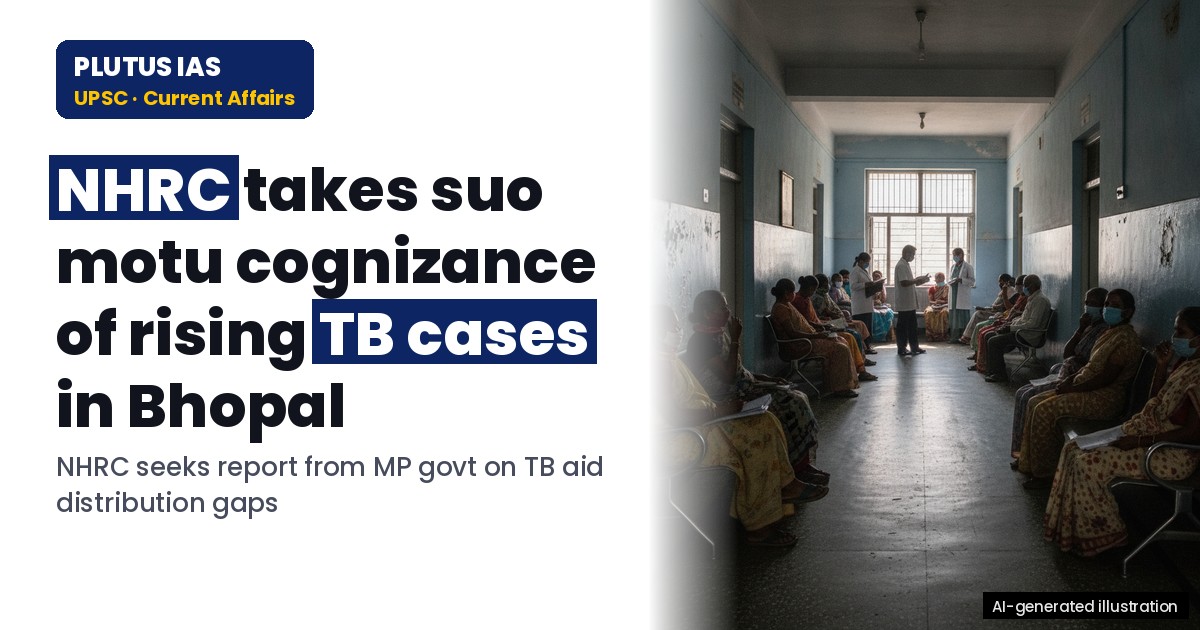
28 Nov NHRC takes suo motu cognizance of rising TB cases in Bhopal
✎ The NHRC’s suo motu cognizance of rising TB cases in Bhopal underscores the critical link between public health governance, human rights, and the effective implementation of welfare schemes like the Nikshay Poshan Yojana under…
Subject Relevance — Where This Topic Fits
- GS Paper II — Governance, Transparency and Accountability | GS Paper II — Human Rights | GS Paper III — Health, Environment, and Disaster Management | GS Paper IV — Ethics and Human Interface
- Prelims: National Human Rights Commission (NHRC), TB Mukt Bharat Abhiyaan, Nikshay Poshan Yojana, Direct Benefit Transfer (DBT), Article 21 (Right to Life and Personal Liberty), Suo Motu Cognizance
- Essay: Public Health Governance in India: Challenges and Reforms, Human Rights and Healthcare Accessibility in Marginalized Communities
Quick Revision: The NHRC’s suo motu cognizance of rising TB cases in Bhopal underscores the critical link between public health governance, human rights, and the effective implementation of welfare schemes like the Nikshay Poshan Yojana under the TB Mukt Bharat Abhiyaan.
Why is this in the news?
The National Human Rights Commission (NHRC) has taken suo motu cognizance of a media report highlighting a persistent rise in tuberculosis (TB) cases in Bhopal, Madhya Pradesh, despite the national TB elimination campaign. The Commission has issued a notice to the Madhya Pradesh Chief Secretary, seeking a detailed report within two weeks on the alleged gaps in the implementation of the Nikshay Poshan Yojana, which provides financial assistance to TB patients. This development underscores critical governance challenges in public health delivery, financial inclusion, and human rights protection in the context of TB elimination efforts.
Background
- Tuberculosis (TB) remains a significant public health challenge in India, accounting for approximately 27% of the global TB burden, as per the World Health Organization (WHO).
- The Government of India launched the ‘TB Mukt Bharat Abhiyaan’ (TB-Free India Campaign) in 2018, aiming for a TB-free India by 2025, with a focus on early diagnosis, treatment adherence, and social support mechanisms.
- The Nikshay Poshan Yojana, launched under the National TB Elimination Programme (NTEP), provides a monthly financial assistance of ₹1,000 to registered TB patients to address nutritional deficiencies and improve treatment outcomes.
- The NHRC, established under the Protection of Human Rights Act, 1993, is mandated to protect and promote human rights, including the right to health, and can take suo motu cognizance of violations reported in the media.
- Madhya Pradesh reported 1.72 lakh TB cases and 4,733 deaths in 2025, reflecting the persistent burden of the disease in the state.
- The discrepancy in the disbursement of financial assistance under the Nikshay Poshan Yojana—where only 1.43 lakh of 1.77 lakh registered TB patients received a single installment in 2024—raises concerns about administrative efficiency and equity in welfare delivery.
Key Aspects of the Issue: TB Mukt Bharat Abhiyaan, Nikshay Poshan Yojana, and NHRC’s Role
- TB Mukt Bharat Abhiyaan: A centrally sponsored initiative under the National TB Elimination Programme (NTEP), launched in 2018, with the goal of eliminating TB by 2025. The campaign emphasizes early diagnosis through molecular diagnostics, universal drug susceptibility testing, and adherence to the 6-month treatment regimen under the Directly Observed Treatment Short-course (DOTS) strategy.
- Nikshay Poshan Yojana: A component of the NTEP, this scheme provides a monthly financial incentive of ₹1,000 to all registered TB patients for the duration of their treatment. The scheme aims to mitigate the socioeconomic impact of TB by addressing malnutrition, a key risk factor for disease progression and treatment failure.
- NHRC’s Suo Motu Powers: Under Section 12 of the Protection of Human Rights Act, 1993, the NHRC can take cognizance of human rights violations suo motu if the matter is brought to its attention through media reports or other credible sources. This mechanism ensures proactive oversight of governance failures affecting fundamental rights.
- Human Rights and TB: The right to health, enshrined under Article 21 of the Constitution, encompasses access to timely and affordable healthcare. The NHRC’s intervention highlights the intersection of public health governance and human rights, particularly for vulnerable populations such as TB patients, who often face stigma, economic hardship, and delayed treatment.
- Challenges in Implementation: The reported gaps in the disbursement of financial assistance under the Nikshay Poshan Yojana suggest systemic issues such as inadequate beneficiary identification, delays in fund transfer, and administrative bottlenecks. These challenges undermine the scheme’s intended impact on treatment adherence and recovery.
- Role of State Governments: The Madhya Pradesh government’s response to the NHRC’s notice will be critical in addressing the reported deficiencies. This includes strengthening the monitoring of Nikshay Poshan Yojana, ensuring last-mile delivery of benefits, and addressing structural barriers in TB care.
- Public Health Surveillance: The rise in TB cases in Bhopal, despite national efforts, underscores the need for robust surveillance systems, real-time data integration, and targeted interventions in high-burden districts. The integration of digital platforms like the Nikshay portal is essential for tracking patient outcomes and ensuring accountability.
- Policy Coherence: The NHRC’s intervention aligns with broader governance principles of transparency, accountability, and citizen-centric service delivery. It also highlights the importance of inter-sectoral coordination between health, finance, and social welfare departments to achieve public health goals.
Key Features
| Feature | Significance |
|---|---|
| NHRC’s Suo Motu Cognizance | Demonstrates the institutional role of the National Human Rights Commission in monitoring and addressing public health concerns, particularly when media reports suggest potential human rights violations. |
| Tuberculosis (TB) Incidence in Bhopal | Indicates a 19% rise in registered TB cases in Bhopal from 2022 to 2024, raising questions about the effectiveness of public health interventions despite the ‘TB-Mukt Bharat Abhiyaan’. |
| Government Nutrition Support Scheme | Highlights the provision of ₹1,000 monthly financial assistance to TB patients under the nutrition support scheme, with only 80.7% coverage in 2024, leaving a significant gap in welfare delivery. |
| State-Level Economic Survey Data | Provides empirical evidence of TB case registration and financial assistance distribution, serving as a critical input for policy evaluation and corrective action. |
| NHRC Notice to State Government | Reflects the use of constitutional and statutory powers to seek accountability from the state administration within a stipulated timeframe, ensuring adherence to human rights norms. |
Why it Matters
Public Health Governance
- The incident underscores the importance of monitoring and evaluating public health programs like ‘TB-Mukt Bharat Abhiyaan’ to ensure equitable access to diagnostics, treatment, and nutritional support for affected populations.
- The rise in TB cases in Bhopal despite national initiatives suggests potential gaps in implementation, surveillance, or social determinants of health, necessitating a multi-sectoral response.
- The NHRC’s intervention highlights the role of human rights institutions in safeguarding the right to health, particularly for vulnerable groups such as TB patients.
Welfare Delivery Mechanisms
- The incomplete coverage of the nutrition support scheme (only 80.7% of registered TB patients receiving assistance) reveals systemic inefficiencies in welfare delivery, including identification, enrollment, or fund disbursement delays.
- The disparity between registered cases and financial assistance distribution raises concerns about bureaucratic bottlenecks, digital divide, or administrative capacity constraints in the state machinery.
Human Rights and Social Justice
- The NHRC’s suo motu cognizance reflects the constitutional mandate to protect and promote human rights, including the right to health, as enshrined in Article 21 of the Constitution.
- The potential human rights violation pertains to the failure to provide timely and adequate nutritional support to TB patients, which is critical for treatment adherence and recovery.
Challenges
1. Implementation Gaps in TB Control Programs
- Inadequate coverage of the nutrition support scheme for TB patients, with 19.3% of registered cases in 2024 receiving no financial assistance, indicating systemic inefficiencies in welfare delivery.
- Rise in TB cases in Bhopal (19% increase from 2022 to 2024) despite the ‘TB-Mukt Bharat Abhiyaan,’ suggesting potential gaps in surveillance, diagnostics, or treatment adherence.
UPSC Link: GS2: Health, Welfare Schemes
2. Administrative and Bureaucratic Bottlenecks
- Delays or failures in disbursing financial assistance to eligible TB patients, as evidenced by the incomplete coverage of the nutrition support scheme.
- Potential lack of coordination between health departments, welfare agencies, and local authorities in identifying and enrolling beneficiaries.
UPSC Link: GS2: Governance, Public Administration
3. Social Determinants of Health
- Nutritional deficiencies among TB patients, which are critical for treatment success and recovery, remain unaddressed due to incomplete coverage of the nutrition support scheme.
- Socio-economic disparities may exacerbate TB incidence and hinder access to healthcare and welfare services, particularly in urban areas like Bhopal.
UPSC Link: GS2: Social Justice, Health
4. Institutional Accountability and Oversight
- The need for robust monitoring and evaluation mechanisms to assess the effectiveness of TB control programs and welfare schemes at the state and district levels.
- Strengthening the role of human rights institutions like the NHRC in addressing public health concerns and ensuring accountability of state governments.
UPSC Link: GS2: Constitutional Bodies, Health Governance
Challenges — UPSC Perspective
| Issue | Concern |
|---|---|
| Incomplete Coverage of Nutrition Support Scheme | 19.3% of registered TB patients in 2024 received no financial assistance, raising concerns about welfare delivery inefficiencies. |
| Rise in TB Cases in Bhopal | 19% increase in registered TB cases from 2022 to 2024, despite national initiatives, indicating potential gaps in implementation or surveillance. |
| Administrative Delays in Welfare Disbursement | Failure to disburse ₹1,000 monthly assistance to eligible TB patients, suggesting bureaucratic bottlenecks or capacity constraints. |
| Lack of Multi-Sectoral Coordination | Potential gaps in coordination between health departments, welfare agencies, and local authorities in addressing TB and its social determinants. |
| Human Rights Implications of Welfare Gaps | Failure to provide nutritional support to TB patients may constitute a violation of the right to health, necessitating institutional oversight. |
Government Initiatives — Must-Memorise for Prelims
- TB-Mukt Bharat Abhiyaan
Way Forward
- Conduct a state-wide audit of TB case registration and financial assistance disbursement to identify gaps in implementation and coverage.
- Strengthen inter-departmental coordination between the health department, welfare agencies, and local authorities to ensure timely and equitable disbursement of nutritional support.
- Enhance surveillance and diagnostic capacities in Bhopal and other high-burden districts to address the rising trend in TB cases.
- Expand the coverage of the nutrition support scheme to ensure 100% enrollment of eligible TB patients, with mechanisms for real-time monitoring and grievance redressal.
- Conduct a socio-economic analysis of TB incidence in Bhopal to identify underlying risk factors, such as malnutrition, overcrowding, or occupational hazards.
- Leverage community health workers and ASHAs to improve awareness, early diagnosis, and treatment adherence among TB patients.
- Establish a grievance redressal mechanism for TB patients to report delays or denials in financial assistance, ensuring accountability of state officials.
- Collaborate with civil society organizations and NGOs to enhance outreach and service delivery for TB patients, particularly in underserved urban areas.
UPSC Value Addition
Keywords for Mains Answer-Writing
National Human Rights Commission (NHRC) · Tuberculosis (TB) in India · TB Mukt Bharat Abhiyaan · Public health governance · Right to Health · Direct Benefit Transfer (DBT) · Nutritional support for TB patients · Human rights violations in healthcare · MP Economic Survey 2024 · Automatic cognizance by NHRC · Accountability in public health schemes · Social determinants of health · Universal Health Coverage (UHC) · Public health infrastructure
Constitutional & Policy Linkages
- Article 21: Right to Health (as part of the right to life and personal liberty)
Concept Flow
Rising TB incidence in Bhopal (2022–2024) → Inadequate coverage of nutrition support scheme → Potential human rights violation → NHRC’s suo motu cognizance → State government accountability → TB-Mukt Bharat Abhiyaan implementation → Surveillance and diagnostic gaps → Rise in cases → Welfare scheme inefficiencies → Administrative bottlenecks → Registered TB patients → Eligibility for nutrition support → Disbursement delays → Incomplete coverage → Right to health concerns → Media report on welfare gaps → NHRC intervention → State government notice → Policy evaluation and corrective action → Public health governance → Welfare delivery mechanisms → Human rights oversight → Institutional accountability
Prelims Practice Questions
Q1. Consider the following statements regarding the National Human Rights Commission (NHRC) of India:
1. The NHRC is a statutory body established under the Protection of Human Rights Act, 1993.
2. The NHRC can take suo motu cognizance of human rights violations.
3. The NHRC has the power to enforce its recommendations through judicial orders.
4. The Chairperson of the NHRC is appointed by the President of India.
How many of the above statements are correct?
- Only one
- Only two
- Only three
- All
Answer: Only three — Statements 1, 2, and 4 are correct. The NHRC is a statutory body under the Protection of Human Rights Act, 1993 (amended in 2019). It can take suo motu cognizance of human rights violations. The Chairperson is appointed by the President. However, the NHRC does not have the power to enforce its recommendations through judicial orders; it can only make recommendations to the government.
Q2. Assertion (A): The TB Mukt Bharat Abhiyaan aims to eliminate tuberculosis in India by 2025.
Reason (R): The National Strategic Plan for TB Elimination (2017-2025) sets the target of eliminating TB in India by 2025.
- Both A and R are true, and R is the correct explanation of A
- Both A and R are true, but R is not the correct explanation of A
- A is true, but R is false
- A is false, but R is true
Answer: ? — Assertion (A) is false. The TB Mukt Bharat Abhiyaan aims to eliminate tuberculosis in India by 2025, but the National Strategic Plan for TB Elimination (2017-2025) sets the target of eliminating TB in India by 2025. The reason (R) is true, but it does not correctly explain the assertion.
Q3. Match the following pairs related to public health schemes in India:
Column I (Scheme) | Column II (Objective)
——————|——————-
A. Nikshay Poshan Yojana | 1. Financial assistance of ₹500 per month to TB patients
B. Ayushman Bharat | 2. Universal health coverage through health and wellness centres
C. National Health Mission | 3. Financial assistance of ₹1000 per month to TB patients
D. Pradhan Mantri Matru Vandana Yojana | 4. Financial assistance to pregnant women for the first live birth
Select the correct match:
- A-3, B-2, C-1, D-4
- A-1, B-2, C-3, D-4
- A-3, B-1, C-2, D-4
- A-2, B-3, C-1, D-4
Answer: A-3, B-2, C-1, D-4 — The correct matches are: A. Nikshay Poshan Yojana (3) — Financial assistance of ₹1000 per month to TB patients; B. Ayushman Bharat (2) — Universal health coverage through health and wellness centres; C. National Health Mission (1) — Financial assistance of ₹500 per month to TB patients under Nikshay Poshan Yojana; D. Pradhan Mantri Matru Vandana Yojana (4) — Financial assistance to pregnant women for the first live birth.
Mains Practice Question
✍ Critically examine the role of the National Human Rights Commission (NHRC) in addressing public health challenges such as the rising incidence of tuberculosis (TB) in India, with particular reference to the suo motu cognizance taken in Bhopal, Madhya Pradesh. Also, analyse the implications of such interventions for the right to health and the accountability of state governments in implementing public health schemes. (15 Marks)
Approach: MODEL-ANSWER SKELETON:
1. **Introduction (2 Marks)**
– Define the NHRC: Statutory body under the Protection of Human Rights Act, 1993 (amended in 2019).
– Context: Rising TB cases in Bhopal (2022: 10,773 to 2024: 12,850) despite TB Mukt Bharat Abhiyaan.
– NHRC’s suo motu cognizance: Mechanism under Section 12 of the Act to take cognizance of human rights violations.
2. **NHRC’s Role in Public Health (4 Marks)**
– **Legal Framework**: NHRC’s mandate under Section 12(c) to investigate complaints of human rights violations, including those arising from inadequate healthcare.
– **Suo Motu Powers**: Ability to act without a formal complaint, as seen in the Bhopal TB case.
– **Accountability Mechanism**: Issuance of notices to state governments (e.g., Chief Secretary of Madhya Pradesh) for detailed reports within stipulated timeframes.
– **Limitations**: NHRC’s recommendations are not legally binding; reliance on moral and political pressure.
3. **Right to Health and TB Mukt Bharat Abhiyaan (4 Marks)**
– **Right to Health**: Recognized as a part of the right to life under Article 21 of the Constitution (Paschim Banga Khet Mazdoor Samity v. State of West Bengal, 1996).
– **TB Mukt Bharat Abhiyaan**: Launched in 2018 to eliminate TB by 2025; includes Nikshay Poshan Yojana (NPY) for nutritional support (₹1000/month).
– **Gaps in Implementation**: Only 1.43 lakh of 1.77 lakh registered TB patients in MP received NPY benefits in 2024; raises questions about equity and access.
4. **Accountability of State Governments (3 Marks)**
– **Constitutional Obligations**: States must ensure the right to health under Article 47 (Directive Principles of State Policy).
– **Role of State Machinery**: Chief Secretaries and district authorities responsible for implementing public health schemes.
– **Challenges**: Bureaucratic delays, inadequate infrastructure, and resource constraints in Madhya Pradesh.
5. **Conclusion (2 Marks)**
– NHRC’s intervention highlights systemic gaps in public health governance.
– Strengthening NHRC’s powers (e.g., binding recommendations) and improving inter-departmental coordination are critical.
– Balancing fiscal federalism with the right to health remains a policy challenge.
Source: PIB (Press Information Bureau)
Madhya Pradesh PCS (MPPSC) — State PCS Practice
Prelims: Which constitutional body recently took suo motu cognizance of the rising TB cases in Bhopal, Madhya Pradesh, while reviewing the ‘TB Mukt Bharat Abhiyaan’ initiative?
- A. National Human Rights Commission (NHRC)
- B. National Commission for Protection of Child Rights (NCPCR)
- C. National Commission for Scheduled Castes (NCSC)
- D. National Commission for Scheduled Tribes (NCST)
Answer: A. National Human Rights Commission (NHRC) — The NHRC took suo motu cognizance of the rising TB cases in Bhopal, Madhya Pradesh, under its mandate to protect and promote human rights.
Mains: Analyze the socio-economic and public health implications of the rising TB cases in Bhopal, Madhya Pradesh, in the context of the ‘TB Mukt Bharat Abhiyaan’. Suggest measures to strengthen the state’s TB control program, with a focus on tribal and marginalized communities.
Generated by AanyaAi for educational purpose.
Related guides on our sites
- Anthropology VS PSIR
- Best PSIR optional coaching
- Best PSIR optional coaching online
- Best PSIR optional teacher

- NHRC takes suo motu cognizance of rising TB cases in Bhopal - November 28, 2026
- संविधान (132वाँ संशोधन) विधेयक: लोकसभा सीटों में 50% वृद्धि और महिला आरक्षण का प्रस्ताव - November 28, 2026
- CSIR-CDRII’s BSL-3 Facility: India’s Leap in Drug Innovation & Research - November 28, 2026

No Comments