


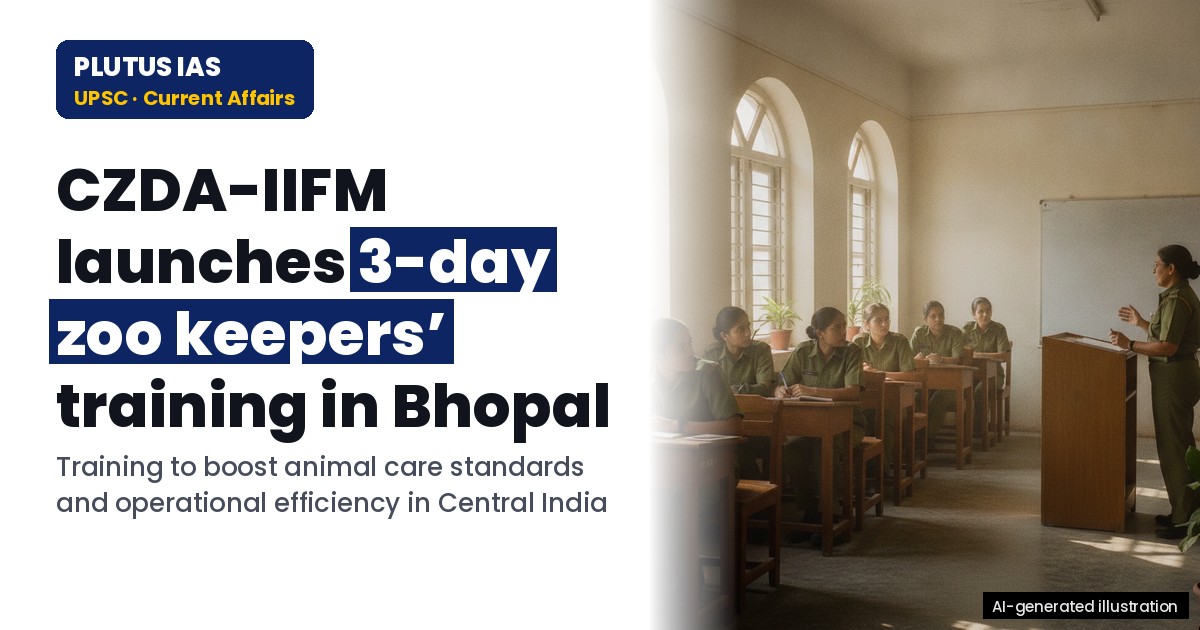
08 Oct CZDA-IIFM 3-Day Training Program for Zoo Keepers in Bhopal
✎ The Central Zoo Authority, established under the Wildlife (Protection) Act, 1972, mandates regular training for zoo personnel to ensure adherence to welfare standards and conservation best practices.
Subject Relevance — Where This Topic Fits
- GS Paper III — Environment, Conservation and Disaster Management
- Prelims: Central Zoo Authority (CZA), Wildlife (Protection) Act, 1972, Indian Institute of Forest Management (IIFM), Bhopal, Zoo keepers, Wildlife conservation, Animal welfare standards, Professional capacity building, Field training
- Essay: The role of institutional collaboration in wildlife conservation, Capacity building as a cornerstone of sustainable governance in conservation sectors
Quick Revision: The Central Zoo Authority, established under the Wildlife (Protection) Act, 1972, mandates regular training for zoo personnel to ensure adherence to welfare standards and conservation best practices.
Why is this in the news?
The Central Zoo Authority (CZA), in collaboration with the Indian Institute of Forest Management (IIFM), Bhopal, initiated a three-day regional training programme for zoo keepers from central India from 7 to 9 October 2026. The programme, held at IIFM, Bhopal, aims to standardise welfare protocols, enhance professional competencies in animal care, behaviour management, and conservation education, and strengthen coordination between zoo personnel and management. This initiative underscores the institutional mandate under the Wildlife (Protection) Act, 1972, to ensure systematic capacity building for those directly responsible for animal welfare in zoos.
Background
- The Wildlife (Protection) Act, 1972, is the primary legislation governing wildlife conservation and management in India, including the regulation of zoos.
- The Central Zoo Authority (CZA), established under Section 38A of the Act, is tasked with regulating zoos, ensuring adherence to welfare standards, and coordinating training for zoo personnel.
- Zoo keepers are the frontline staff responsible for daily animal care, health monitoring, and welfare, forming the operational backbone of zoo management.
- The Indian Institute of Forest Management (IIFM), Bhopal, is a premier national institute under the Ministry of Environment, Forest and Climate Change, specialising in forestry, wildlife, and environmental management education and research.
- Regional training programmes are designed to address specific regional challenges in zoo management, particularly in states with diverse wildlife and varying institutional capacities.
- The 2026 programme in Bhopal targets zoo personnel from central India, including Madhya Pradesh, Chhattisgarh, and adjoining regions.
What is the Central Zoo Authority (CZA) and its role in zoo regulation and personnel training?
- The CZA is a statutory body constituted under the Wildlife (Protection) Act, 1972, to oversee the functioning of zoos across India.
- Its primary functions include granting recognition to zoos, monitoring compliance with welfare standards, and promoting conservation education.
- Under Section 38A(1)(d) of the Act, the CZA is mandated to coordinate training programmes for zoo personnel, including keepers, veterinarians, and managers.
- The CZA sets minimum standards for zoo infrastructure, animal welfare, veterinary care, and record-keeping, ensuring uniformity across recognised zoos.
- The Authority conducts periodic inspections and audits to assess compliance and recommend corrective measures where necessary.
- The CZA collaborates with academic and research institutions like IIFM to design and deliver specialised training programmes for capacity building.
- Zoo keepers, as per the Act’s framework, are required to undergo regular training to stay updated on modern animal care practices, safety protocols, and conservation techniques.
- The training programmes emphasise the integration of field visits, classroom sessions, and practical demonstrations to reinforce learning outcomes.
Key Features
| Feature | Significance |
|---|---|
| Regional training programme for zoo keepers | Standardises welfare practices across middle India’s zoos by equipping frontline staff with uniform protocols. |
| Three-day duration (7–9 Oct 2026) | Provides intensive, immersive learning combining classroom sessions with field visits for practical reinforcement. |
| Joint conduct by CZA & IIFM, Bhopal | Leverages statutory authority (CZA) and academic expertise (IIFM) to ensure both legal compliance and technical rigour. |
| Classroom + field sessions | Balances theoretical knowledge (animal behaviour, veterinary protocols) with hands-on experience (direct animal care, facility operation). |
| Focus on welfare standards & inter-institutional coordination | Aligns zoo operations with the Wildlife (Protection) Act, 1972’s mandate for animal welfare and institutional synergy. |
Why it Matters
Institutional & Legal
- Strengthens the Central Zoo Authority’s statutory role under Section 38 of the Wildlife (Protection) Act, 1972, to coordinate zoo personnel training and enforce uniform welfare norms.
- Enhances the operational credibility of zoos by embedding standardised animal-care protocols, reducing variability in welfare outcomes across regions.
- Fosters institutional collaboration between a statutory body (CZA) and an academic institution (IIFM), demonstrating a model for public-sector capacity-building.
Professional & Human Resource
- Elevates the professional competence of zoo keepers—the backbone of daily animal welfare—through structured, evidence-based training in veterinary care, behavioural observation, and facility management.
- Reduces occupational hazards for keepers by institutionalising safety protocols and record-keeping standards, thereby improving workplace sustainability.
- Creates a cadre of trained personnel capable of cascading best practices to other zoos, ensuring long-term systemic improvement.
Conservation & Public Education
- Improves animal welfare outcomes, which are directly linked to conservation success in ex-situ breeding programmes for endangered species.
- Enhances the educational role of zoos by training keepers to interpret animal behaviour and conservation needs for visitors, aligning with Section 38(1)(c) of the Wildlife Act.
- Promotes public trust in zoos as institutions of conservation and welfare, rather than mere entertainment, by demonstrating adherence to professional standards.
Challenges
1. Variability in Zoo Standards
- Disparities in welfare practices across zoos in middle India due to differing resource levels, expertise, and enforcement of the Wildlife (Protection) Act, 1972.
- Risk of inconsistent implementation of training outcomes if post-programme monitoring and certification mechanisms are weak.
UPSC Link: Wildlife Protection Act, 1972: Sec 38
2. Resource Constraints
- Limited funding and infrastructure for sustained training programmes, especially for smaller or state-run zoos with constrained budgets.
- Need for continuous upskilling of keepers in emerging areas like behavioural enrichment and veterinary telemedicine, which require additional investment.
UPSC Link: Wildlife Protection Act, 1972: Sec 38
3. Regulatory Compliance & Enforcement
- Ensuring that all zoos, including private ones, adhere to the uniform standards set by the CZA, given the absence of a unified enforcement mechanism in the Act.
- Addressing gaps in periodic inspections and audits to verify compliance with welfare protocols post-training.
UPSC Link: Wildlife Protection Act, 1972: Sec 38
4. Human Resource Sustainability
- High attrition rates among zoo keepers due to physically demanding and low-compensation roles, undermining the long-term impact of training.
- Need for career progression pathways and incentives to retain trained personnel within the sector.
UPSC Link: Wildlife Protection Act, 1972: Sec 38
5. Public Perception & Ethical Concerns
- Balancing the dual roles of zoos as conservation centres and public attractions, which can lead to ethical dilemmas in animal housing and visitor engagement.
- Ensuring transparency in training outcomes and welfare audits to address public scepticism about zoo practices.
UPSC Link: Wildlife Protection Act, 1972: Sec 38(1)(c)
Challenges — UPSC Perspective
| Issue | Concern |
|---|---|
| Disparate welfare standards | Inconsistent animal care practices across zoos due to lack of uniform training and enforcement. |
| Resource allocation gaps | Smaller zoos struggle to implement training outcomes due to limited budgets for infrastructure and personnel. |
| Enforcement lacunae | Absence of a robust monitoring mechanism to ensure post-training compliance with welfare protocols. |
| Human resource attrition | High turnover of trained keepers reduces the sustainability of capacity-building efforts. |
| Ethical and public trust deficits | Risk of public perception issues if welfare outcomes are not visibly improved post-training. |
| Technological adoption barriers | Limited access to modern tools (e.g., telemedicine, behavioural tracking) in resource-constrained zoos. |
Way Forward
- Establish a **National Zoo Welfare Accreditation Framework** under the CZA to certify zoos annually based on trained keeper ratios and welfare outcomes.
- Create a **digital repository** of training modules, case studies, and compliance checklists for continuous learning and self-assessment by keepers.
- Institute **mandatory refresher courses** every two years for all zoo keepers, with certification tied to employment renewal or promotion.
- Develop **public-private partnerships** to fund upskilling programmes, leveraging CSR funds from conservation-aligned corporations.
- Strengthen **on-ground monitoring** by deploying CZA-appointed inspectors to conduct unannounced welfare audits post-training.
- Introduce **career ladders** for keepers, including specialised roles in veterinary support, behavioural enrichment, and conservation education.
- Launch a **public awareness campaign** highlighting the role of trained keepers in animal welfare, fostering societal support for zoo reforms.
- Integrate **behavioural science modules** into the curriculum to enhance keepers’ ability to interpret animal stress signals and adapt care protocols.
UPSC Value Addition
Keywords for Mains Answer-Writing
Central Zoo Authority (CZA) · Indian Institute of Forest Management (IIFM) · Zoo Managers · Zoo Animal Welfare Standards · Wildlife (Protection) Act, 1972 · Regional Training Programme · Animal Keeper Training · Zoo Management Protocols · Conservation Education · Field Visits in Training · Animal Behaviour Studies · Zoo Operational Safety · Professional Capacity Building · Inter-Institutional Collaboration · Madhya Pradesh Zoo Network
Concept Flow
Regional training programme for zoo keepers → Standardised welfare protocols → Enhanced animal care practices → Improved conservation outcomes → Public trust in zoos → Compliance with Wildlife (Protection) Act, 1972 → Institutional capacity-building → Sustainable zoo management.
Prelims Practice Questions
Q1. Consider the following statements regarding the Central Zoo Authority (CZA) established under the Wildlife (Protection) Act, 1972:
1. The CZA is a statutory body responsible for the regulation of zoos across India.
2. One of the functions of the CZA is to coordinate training programmes for zoo personnel.
3. The CZA has the power to derecognise zoos that fail to meet prescribed welfare standards.
4. The CZA is chaired by the Union Minister of Environment, Forest and Climate Change.
How many of the above statements are correct?
- Only one
- Only two
- Only three
- All
Answer: All — Statements 1, 2, and 3 are correct. The CZA is indeed a statutory body under the Wildlife (Protection) Act, 1972, with functions including zoo regulation, training coordination, and derecognition powers. Statement 4 is incorrect as the CZA is chaired by the Secretary, Ministry of Environment, Forest and Climate Change, not the Union Minister.
Q2. Assertion (A): The Wildlife (Protection) Act, 1972, mandates the Central Zoo Authority to ensure uniform welfare standards across all zoos in India.
Reason (R): The Act empowers the CZA to coordinate training programmes for zoo personnel and prescribe guidelines for zoo management.
In the context of the above two statements, which one of the following is correct?
- Both A and R are true, and R is the correct explanation of A
- Both A and R are true, but R is not the correct explanation of A
- A is true, but R is false
- A is false, but R is true
Answer: Both A and R are true, but R is not the correct explanation of A — Both Assertion (A) and Reason (R) are true. The Wildlife (Protection) Act, 1972, indeed mandates the CZA to ensure uniform welfare standards, and the Act empowers the CZA to coordinate training programmes and prescribe guidelines, making R the correct explanation of A.
Q3. Match the following pairs related to zoo management and conservation in India:
Column I (Institution/Act) Column II (Function/Role)
A. Central Zoo Authority (CZA) 1. Conducts research on forest management
B. Indian Institute of Forest Management (IIFM) 2. Regulates and monitors zoos nationwide
C. Wildlife (Protection) Act, 1972 3. Provides training to zoo personnel
D. Zoo Managers 4. Directly responsible for daily animal care
Select the correct match:
- A-2, B-1, C-3, D-4
- A-3, B-1, C-2, D-4
- A-2, B-3, C-1, D-4
- A-4, B-1, C-2, D-3
Answer: A-2, B-1, C-3, D-4 — The correct matches are: A-2 (CZA regulates and monitors zoos), B-1 (IIFM conducts research on forest management), C-3 (Wildlife (Protection) Act, 1972, provides the legal framework for zoo regulation and training coordination), D-4 (Zoo Managers are directly responsible for daily animal care).
Mains Practice Question
✍ The role of zoo managers in India is often understated despite their critical contribution to animal welfare and conservation. Critically examine the significance of professional training programmes for zoo managers in ensuring uniform welfare standards and operational efficiency in zoos. Also, analyse how such initiatives align with the provisions of the Wildlife (Protection) Act, 1972. (15 Marks)
Approach: MODEL-ANSWER SKELETON:
1. **Introduction (2 Marks)**
– Define the role of zoo managers as the backbone of zoo operations, directly responsible for daily animal care and welfare.
– Highlight the importance of uniform welfare standards in zoos under the Wildlife (Protection) Act, 1972.
2. **Significance of Professional Training for Zoo Managers (5 Marks)**
– **Animal Welfare and Health**: Training in modern animal care techniques, behavioural studies, and veterinary protocols to ensure optimal health and welfare.
– **Operational Efficiency**: Enhances understanding of zoo management protocols, safety measures, and record-keeping, reducing risks and improving overall functionality.
– **Conservation Education**: Equips managers to educate visitors and staff on conservation efforts, aligning with the Act’s emphasis on conservation.
– **Inter-Institutional Collaboration**: Programmes like the CZA-IIFM initiative foster knowledge exchange and standardisation across regions.
3. **Alignment with Wildlife (Protection) Act, 1972 (5 Marks)**
– **Statutory Mandate**: Section 38A of the Act empowers the Central Zoo Authority (CZA) to coordinate training for zoo personnel, ensuring adherence to welfare standards.
– **Uniform Standards**: Training programmes help implement CZA’s guidelines, such as the National Zoo Policy (2009), which mandates welfare standards.
– **Accountability and Derecognition**: Trained managers ensure compliance with welfare protocols, reducing the risk of derecognition of zoos failing to meet standards.
4. **Challenges and Way Forward (3 Marks)**
– **Regional Disparities**: Addressing uneven implementation across states, particularly in regions like Madhya Pradesh.
– **Continuous Learning**: Emphasising lifelong learning and adaptation to evolving conservation science.
– **Policy Integration**: Strengthening linkages between training initiatives and broader conservation policies to enhance their impact.
Source: PIB (Press Information Bureau)
Madhya Pradesh PCS (MPPSC) — State PCS Practice
Prelims: Under the Central Zoo Authority (CZA) and Indian Institute of Forest Management (IIFM), Bhopal, a 3-day regional training program was organized for which category of personnel in Madhya Pradesh?
- A. Zoo veterinarians
- B. Zoo curators and keepers
- C. Forest guards
- D. Wildlife researchers
Answer: B. Zoo curators and keepers — The training was specifically for zoo curators and keepers to enhance their skills in zoo management and animal care.
Mains: Discuss the significance of the collaboration between the Central Zoo Authority (CZA) and the Indian Institute of Forest Management (IIFM), Bhopal, in strengthening zoo management practices in Madhya Pradesh. Highlight the role of such initiatives in wildlife conservation and local biodiversity preservation.
Generated by AanyaAi for educational purpose.

- जयशंकर और टस्क की बैठक: मोदी-टस्क वार्ता से पहले भारत-पोलैंड संबंधों की दिशा तय - October 22, 2026
- UPSC Alert: 40-Day ‘Khet Bachao Abhiyan’ Launch by Union Minister - October 22, 2026
- भारत ने बताया UN रिपोर्ट में दाऊद इब्राहिम को ‘भारत-आधारित’ बताना ‘गलत’ - October 22, 2026

No Comments