


11 Aug DAVY-NRLM: 10.08 करोड़ महिलाओं को संगठित करने वाली केंद्र सरकार की प्रमुख योजना
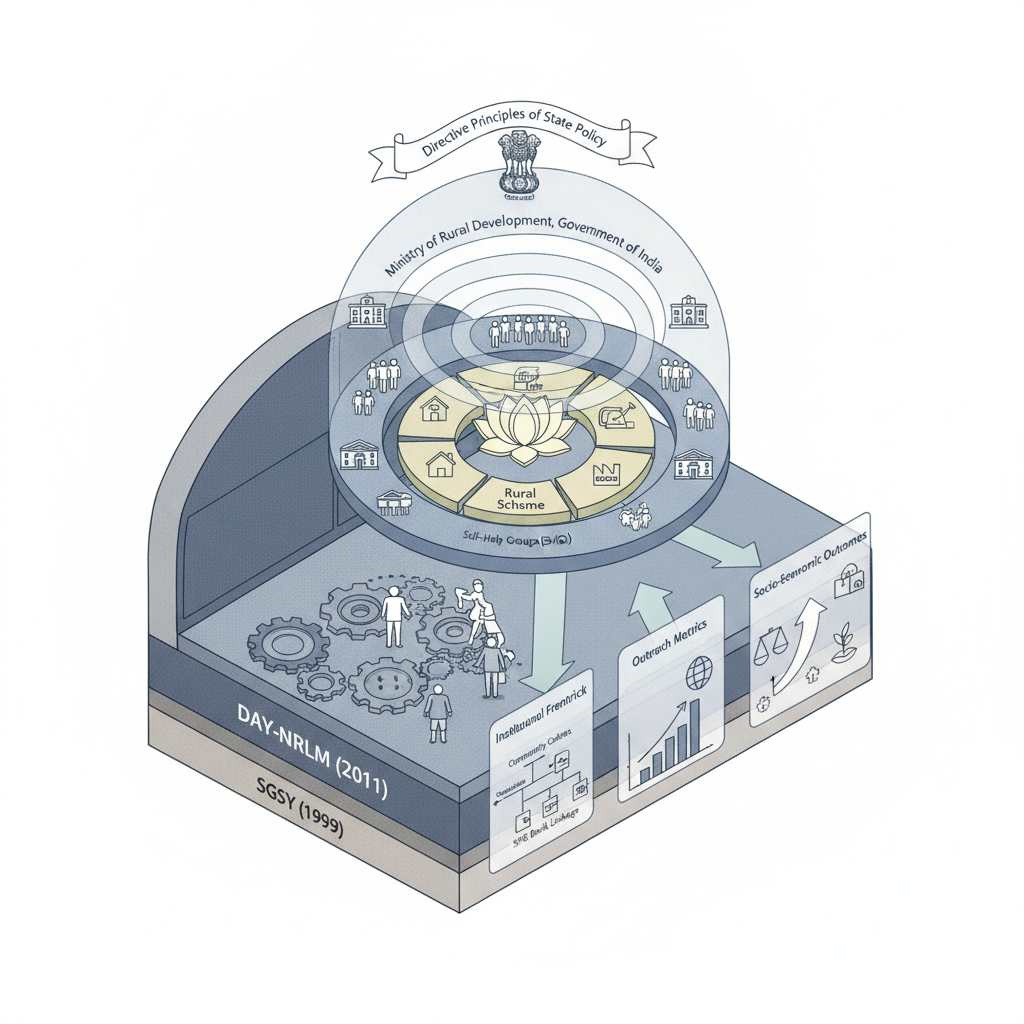
Self-Help GroupsDAY-NRLMMinistry of Rural DevelopmentSocio-economic outcomes✎ DAY-NRLM operationalises rural poverty reduction through SHGs by providing collateral-free credit, skill training via RSETIs, and institutional support via CMTCs, with documented outcomes of 9.5–33% income growth and 6–11% rise…
Subject Relevance — Where This Topic Fits
- GS Paper II — Governance, Administration and Challenges | GS Paper III — Agriculture, Rural Development and Allied Sectors
- Prelims: Self-Help Groups (SHGs), Deendayal Antyodaya Yojana–National Rural Livelihood Mission (DAY-NRLM), RBI guidelines on SHG-bank linkage, NABARD, Rural Self-Employment Training Institutes (RSETI), Community-Managed Training Centres (CMTC), Financial inclusion, Women empowerment, 3ie impact evaluation
- Essay: Role of women in rural transformation, Sustainable livelihoods as a pathway to inclusive growth
Quick Revision: DAY-NRLM operationalises rural poverty reduction through SHGs by providing collateral-free credit, skill training via RSETIs, and institutional support via CMTCs, with documented outcomes of 9.5–33% income growth and 6–11% rise in per capita consumption.
Why is this in the news?
The Ministry of Rural Development, Government of India, has issued a press release dated 11 August 2026 highlighting the implementation of rural schemes under Deendayal Antyodaya Yojana–National Rural Livelihood Mission (DAY-NRLM) for Self-Help Groups (SHGs), underscoring its institutional framework, outreach metrics, and documented socio-economic outcomes. This initiative is significant for UPSC aspirants as it integrates governance, rural development, and gender empowerment within the syllabus, particularly in the context of poverty alleviation and participatory development.
Background
- The DAY-NRLM was launched in 2011 as a restructured version of the Swarnajayanti Gram Swarozgar Yojana (SGSY) to address multidimensional poverty through community-driven institutions.
- It operates under the constitutional mandate of Directive Principles of State Policy (Article 46) to promote the educational and economic interests of weaker sections.
- The programme is aligned with the Sustainable Development Goals (SDGs), particularly SDG 1 (No Poverty), SDG 5 (Gender Equality), and SDG 8 (Decent Work and Economic Growth).
- SHGs are informal associations of 10–20 individuals, predominantly women, who pool resources, provide mutual support, and access credit through the bank-SHG linkage model.
- The Reserve Bank of India (RBI) and NABARD have issued guidelines to facilitate collateral-free credit to SHGs, ensuring financial inclusion for marginalised rural households.
- Independent impact assessments by 3ie (2025) and NITI Aayog (2025) have validated the programme’s effectiveness in enhancing household income, consumption, and women’s agency.
What is Deendayal Antyodaya Yojana–National Rural Livelihood Mission (DAY-NRLM)?
- DAY-NRLM is a centrally sponsored scheme implemented by the Ministry of Rural Development to organise rural poor households into SHGs, federations, and producer groups for sustainable livelihoods.
- It adopts a multi-pronged strategy comprising social mobilisation, financial inclusion, livelihood diversification, and social inclusion to empower marginalised rural women.
- The mission operates in 28 states and 6 Union Territories (excluding Delhi and Chandigarh), covering over 10.08 crore women across 92.30 lakh SHGs as of August 2026.
- SHGs under DAY-NRLM are entitled to collateral-free credit from scheduled commercial banks and cooperative banks, in accordance with RBI and NABARD guidelines.
- Rural Self-Employment Training Institutes (RSETIs) provide skill development, entrepreneurship training, and post-training handholding to SHG members, with a focus on women’s empowerment.
- Community-Managed Training Centres (CMTCs) are promoted as community-owned institutions for peer learning, capacity building, and knowledge dissemination among SHG members.
- The programme emphasises the convergence of livelihood initiatives with other welfare schemes, including MGNREGA and PM-KISAN, to enhance socio-economic outcomes.
- DAY-NRLM’s institutional architecture includes Cluster Level Federations (CLFs) and State Rural Livelihood Missions (SRLMs) to ensure grassroots governance and scalability.
Key Features
| Feature | Significance |
|---|---|
| Self-Help Groups (SHGs) | Formalizes grassroots-level women’s collectives for savings, credit, and livelihood activities, enhancing financial inclusion and social capital. |
| Deendayal Antyodaya Yojana-National Rural Livelihoods Mission (DAY-NRLM) | A centrally sponsored scheme under the Ministry of Rural Development, operational in 28 states and 6 UTs, aiming to reduce rural poverty through institutional and financial empowerment. |
| Financial Inclusion | Provides collateral-free credit linkages to SHGs through scheduled commercial banks and cooperative banks, as per RBI and NABARD guidelines, reducing dependency on informal credit. |
| Skill Development & Entrepreneurship Training | Implemented via Rural Self-Employment Training Institutes (RSETIs), focusing on livelihood diversification, entrepreneurship, and women’s empowerment. |
| Community-Managed Training Centres (CMTCs) | Promotes grassroots-led capacity-building hubs for peer learning, knowledge exchange, and sustainable livelihood support. |
| Impact Assessment Studies | Independent evaluations (e.g., 3ie, NITI Aayog) validate outcomes like income growth, consumption increase, and social empowerment. |
Why it Matters
Economic Empowerment
- Enhances household income through diversified livelihoods and financial inclusion, with documented income growth ranging from 9.5% to 33% in NRLM blocks.
- Reduces dependency on informal credit markets by facilitating access to formal banking systems for SHGs.
- Promotes entrepreneurship and self-employment, particularly among rural women, fostering local economic resilience.
Social Empowerment
- Strengthens women’s agency through collective bargaining, leadership roles in SHGs, and participation in decision-making processes.
- Improves social indicators such as literacy, health, and consumption patterns, as evidenced by impact studies.
- Facilitates convergence with other social sector schemes, amplifying benefits in education, health, and nutrition.
Institutional Strengthening
- Builds sustainable community institutions (SHGs, federations) that serve as platforms for collective action and resource mobilization.
- Encourages convergence with other rural development programs (e.g., MGNREGA, PM-KISAN) for integrated outcomes.
- Enhances local governance by integrating SHGs into planning and implementation of rural development initiatives.
Policy Relevance
- Aligns with the Sustainable Development Goals (SDG 1, 5, 8, 10) by addressing poverty, gender equality, decent work, and reduced inequalities.
- Serves as a model for scalable, community-driven poverty alleviation strategies in developing economies.
- Demonstrates the efficacy of multi-dimensional approaches (financial, social, institutional) in rural transformation.
Challenges
1. Gender-Based Barriers
- Persistent gender norms limit women’s participation in SHGs, especially in patriarchal societies.
- Unequal access to resources and decision-making within households constrains SHG effectiveness.
UPSC Link: GS-II: Social Justice
2. Geographical Disparities
- Limited reach in remote and tribal regions due to poor infrastructure and connectivity.
- Variations in state-wise implementation, with some states lagging in SHG formation and credit linkages.
UPSC Link: GS-II: Governance
3. Market Access & Technology Gaps
- Inadequate market linkages hinder the sale of SHG-produced goods, leading to low returns.
- Limited digital literacy and access to technology restrict e-commerce and financial digitalization.
UPSC Link: GS-III: Technology
4. Climate & Economic Vulnerabilities
- Climate change-induced disasters (droughts, floods) disrupt livelihoods and SHG operations.
- Economic downturns and inflation reduce purchasing power, impacting SHG savings and credit cycles.
UPSC Link: GS-III: Environment
5. Capacity & Sustainability Issues
- Inadequate training and handholding post-skilling affect long-term entrepreneurship sustainability.
- High dropout rates in SHGs due to lack of motivation or external pressures (e.g., migration, domestic responsibilities).
UPSC Link: GS-II: Skill Development
Challenges — UPSC Perspective
| Issue | Concern |
|---|---|
| Low Literacy Rates | Hinders SHG members’ ability to manage finances, access digital tools, and participate in decision-making. |
| Migration of Rural Youth | Leads to labor shortages in SHGs and disrupts continuity in group activities. |
| Limited Financial Literacy | Results in suboptimal savings habits and poor credit utilization among SHG members. |
| Inadequate Infrastructure | Poor road connectivity, electricity, and internet access impede market access and training delivery. |
| Social Stigma | Discourages women’s participation in SHGs, particularly in conservative communities. |
| Policy-Implementation Gaps | Delays in fund disbursement, bureaucratic hurdles, and lack of convergence with other schemes. |
Government Initiatives — Must-Memorise for Prelims
- Deendayal Antyodaya Yojana-National Rural Livelihoods Mission (DAY-NRLM)
- Rural Self-Employment Training Institutes (RSETIs)
- Mahatma Gandhi National Rural Employment Guarantee Scheme (MGNREGS) – for convergence
- Pradhan Mantri Kisan Samman Nidhi (PM-KISAN) – for income support convergence
Way Forward
- Strengthen convergence between DAY-NRLM and other rural development schemes (e.g., MGNREGS, PM-KISAN) to maximize impact on livelihoods and income.
- Expand digital literacy and financial inclusion programs to enhance SHG members’ access to e-commerce and banking services.
- Scale up community-managed training centers (CMTCs) in remote and tribal regions to address skill gaps and local needs.
- Implement gender-transformative approaches within SHGs to challenge patriarchal norms and improve women’s leadership.
- Enhance market linkages for SHG products through partnerships with e-commerce platforms, cooperatives, and government procurement schemes.
- Address climate resilience by integrating disaster risk reduction and sustainable agriculture practices into SHG livelihood programs.
- Improve monitoring and evaluation mechanisms to track progress and address implementation bottlenecks in real time.
- Promote public-private partnerships to provide mentorship, technology, and financial support to SHGs for scaling up enterprises.
UPSC Value Addition
Keywords for Mains Answer-Writing
Deendayal Antyodaya Yojana-National Rural Livelihood Mission (DAY-NRLM) · Self-Help Groups (SHGs) · Rural women empowerment · Financial inclusion of rural poor · Sustainable livelihoods · Social inclusion and development · Community-managed institutions · Skill development and entrepreneurship · Impact assessment studies · Rural development policy · Women’s self-help groups and credit linkage · Community Resource Persons (CRPs) · 3ie impact evaluation report · NITI Aayog assessment of DAY-NRLM
Concept Flow
Rural Poverty → Formation of SHGs → Financial Inclusion & Skill Development → Income Diversification → Social Empowerment → Sustainable Livelihoods → Reduced Inequality → Rural Transformation → State Intervention (DAY-NRLM) → Institutional Strengthening (SHGs, CMTCs) → Access to Credit & Markets → Entrepreneurship & Employment → Household Income Growth → Improved Consumption & Well-being → Impact Assessment → Evidence-Based Policy → Scaling Up Best Practices → Convergence with Other Schemes → Holistic Rural Development → Gender Inequality → Low SHG Participation → Limited Agency → Targeted Gender-Sensitive Interventions → Women’s Empowerment → Inclusive Growth → Climate Shocks → Livelihood Disruptions → SHG Vulnerability → Climate-Resilient Practices → Sustainable Livelihoods → Community Resilience
Prelims Practice Questions
Q1. Consider the following statements regarding the Deendayal Antyodaya Yojana-National Rural Livelihood Mission (DAY-NRLM):
1. It is implemented by the Ministry of Rural Development.
2. It provides collateral-free credit to women Self-Help Groups (SHGs) as per RBI and NABARD guidelines.
3. It operates in all Union Territories of India without exception.
4. Its primary objective is to enhance rural household incomes through sustainable livelihoods.
How many of the above statements are correct?
- Only one
- Only two
- Only three
- All four
Answer: Only three — Statements 1, 2, and 4 are correct. Statement 3 is incorrect as DAY-NRLM does not operate in Delhi and Chandigarh.
Q2. Assertion (A): The Deendayal Antyodaya Yojana-National Rural Livelihood Mission (DAY-NRLM) focuses on building community-managed institutions like Community Resource Persons (CRPs).
Reason (R): CRPs are trained to provide skill development and entrepreneurship training to rural youth, with special emphasis on women’s empowerment.
In the context of the above two statements, which one of the following is correct?
- Both A and R are true, and R is the correct explanation of A.
- Both A and R are true, but R is not the correct explanation of A.
- A is true, but R is false.
- A is false, but R is true.
Answer: Both A and R are true, and R is the correct explanation of A. — Both A and R are true, and R correctly explains A as CRPs are a key component of DAY-NRLM’s institutional framework for training and empowerment.
Q3. Which of the following institutions is primarily responsible for providing skill development and entrepreneurship training to rural youth under the DAY-NRLM framework?
- National Rural Livelihood Mission (NRLM) Training Centres
- Rural Self-Employment Training Institutes (RSETIs)
- National Skill Development Corporation (NSDC)
- Ministry of Skill Development and Entrepreneurship
Answer: Rural Self-Employment Training Institutes (RSETIs) — Rural Self-Employment Training Institutes (RSETIs) are specifically designated under DAY-NRLM to provide skill development and entrepreneurship training to rural youth.
Mains Practice Question
✍ The Deendayal Antyodaya Yojana-National Rural Livelihood Mission (DAY-NRLM) represents a paradigm shift in India’s rural development strategy by institutionalising Self-Help Groups (SHGs) to achieve women’s empowerment and sustainable livelihoods. Critically examine the institutional, financial, and social mechanisms employed by DAY-NRLM to realise these objectives. Also, analyse the empirical evidence from impact assessment studies to evaluate its effectiveness in improving household incomes and social indicators. (15 Marks)
Approach: MODEL-ANSWER SKELETON:
1. **Institutional Mechanisms** (4 Marks):
– Explain the four-pillar framework of DAY-NRLM: (i) social mobilisation and institution-building, (ii) financial inclusion, (iii) sustainable livelihoods, and (iv) social inclusion.
– Discuss the role of Community Resource Persons (CRPs) and Community-Managed Training Centres (CMTCs) in capacity-building and peer learning.
– Reference the social mobilisation process leading to the formation of 92.30 lakh SHGs covering 10.08 crore women across 28 states and 6 UTs.
2. **Financial Mechanisms** (4 Marks):
– Detail the collateral-free credit linkage framework for SHGs under RBI and NABARD guidelines, involving scheduled commercial banks and cooperative banks.
– Explain the role of NABARD in refinancing and capacity-building support.
– Highlight the significance of financial inclusion in reducing dependency on informal credit sources.
3. **Social and Livelihood Mechanisms** (3 Marks):
– Discuss the focus on skill development through RSETIs, entrepreneurship training, and handholding support.
– Explain the emphasis on women’s empowerment, gender equity, and social inclusion in programme design.
– Reference the challenges such as gender inequality, migration, low literacy, and climate vulnerability.
4. **Empirical Evidence and Impact** (4 Marks):
– Summarise findings from 3ie impact evaluation (2025): 9.5% income increase in NRLM blocks, 12–33% in mature SHG clusters; 6–11% rise in per capita household consumption.
– Reference NITI Aayog’s 2025 assessment highlighting DAY-NRLM’s relevance in income growth, livelihood diversification, financial inclusion, and social inclusion.
– Conclude with the overall 49% average household income increase reported by the Ministry.
Source: PIB (Press Information Bureau)
Generated by AanyaAi for educational purpose.

- दिल्ली हाई कोर्ट ने रेड बुल के ‘एनर्जी ड्रिंक’ टैग पर FSSAI के आदेश को किया निरस्त - September 29, 2026
- Sub-Sectoral Trial Index of Services Production (ISP) July 2026: Key Insights for UPSC & State PCS - September 29, 2026
- विशेष अभियान 6: कौशल मंत्रालय तैयार, जानें मुख्य लक्ष्य और तैयारियां - September 29, 2026

No Comments