


24 Sep DDU-GKY 2.0: UPSC Focused Guide on Rural Skill Scheme for 2026-27
 Skill trainingPlacement supportMonitoring mechanism
✎ DDU-GKY 2.0 is a centrally sponsored scheme under the Ministry of Rural Development, providing employment-linked skill training with mandatory post-placement support, industry-aligned modules, and targeted interventions for…
Subject Relevance — Where This Topic Fits
- GS Paper II — Governance, Welfare Schemes for Vulnerable Sections | GS Paper III — Employment, Skill Development, Rural Development
- Prelims: DDU-GKY, National Rural Livelihood Mission (NRLM), Aspirational Districts, Left-Wing Extremism (LWE), NE Region Allocation, Post-Placement Support, Skill India Mission, Skill India Digital Platform, Garib Kalyan Rozgar Abhiyaan, Placement Linked Skill Training, Entrepreneurship Development
- Essay: Role of Skill Development in Achieving Inclusive Growth, Bridging Rural-Urban Divide: The Case of Employment-Linked Skill Training
Quick Revision: DDU-GKY 2.0 is a centrally sponsored scheme under the Ministry of Rural Development, providing employment-linked skill training with mandatory post-placement support, industry-aligned modules, and targeted interventions for vulnerable regions.
Why is this in the news?
The Deen Dayal Upadhyaya Grameen Kaushalya Yojana (DDU-GKY) 2.0 has been highlighted in a recent Press Information Bureau (PIB) release to mark its 12th anniversary, underscoring its evolution into a more comprehensive framework for rural youth employment through skill training, placement, and post-placement support. The updated guidelines, notified in May 2025, introduce targeted measures for vulnerable regions, standardized training modules, and enhanced monitoring mechanisms, reflecting the scheme’s alignment with broader national priorities in employment and rural development.
Background
- Launched on 25 September 2014 under the National Rural Livelihood Mission (NRLM), DDU-GKY is a flagship scheme of the Ministry of Rural Development aimed at providing employment-linked skill training to rural youth aged 15–35 years from poor households.
- The scheme was conceptualized to leverage India’s demographic dividend, with the youth population expected to reach approximately 345 million by 2036, necessitating quality skill development and access to sustainable livelihood opportunities.
- DDU-GKY has evolved from a basic skill training initiative to a multi-dimensional programme emphasizing post-placement support, industry-aligned training, and social inclusion, with mandatory coverage for SC/ST (50%), women (33%), and persons with disabilities (5%).
- The Union Budget 2026-27 allocated ₹750 crore to DDU-GKY, reflecting its continued prioritization in national development planning.
What is Deen Dayal Upadhyaya Grameen Kaushalya Yojana (DDU-GKY) 2.0?
- DDU-GKY 2.0 is an upgraded version of the original DDU-GKY scheme, notified in May 2025, with a focus on enhancing the employability and sustainability of rural youth through structured skill training, placement, and post-placement support.
- Training is aligned with industry requirements across sectors such as aerospace and aviation, agriculture, beauty and wellness, green jobs, healthcare, textiles, and others, ensuring relevance to current and emerging job markets.
- A key feature of DDU-GKY 2.0 is the emphasis on post-placement support, including career progression assistance, to ensure long-term employment retention and upward mobility for trained candidates.
- The scheme mentions that the revised framework ‘increases the minimum placement period’, aiming to improve the quality and durability of employment outcomes for beneficiaries.
- DDU-GKY 2.0 incorporates technology-enabled monitoring and implementation mechanisms to enhance transparency, accountability, and real-time tracking of training and placement activities.
- The scheme includes targeted interventions for vulnerable regions, such as Left-Wing Extremism (LWE)-affected districts under the ‘Roshni’ initiative and Jammu & Kashmir and Ladakh under the ‘Himayat’ initiative, with dedicated funding and implementation support.
- For the Northeastern states, 10% of the total allocation is earmarked to address socio-cultural and geographical challenges, and special area allowances are provided for training in remote and inaccessible regions.
Key Features
| Feature | Significance |
|---|---|
| Target Demographic | Focuses on rural youth aged 15–35 from impoverished households, ensuring inclusive coverage with mandatory quotas for SC/ST (50%), women (33%), and persons with disabilities (5%). |
| Training Duration | Mandates a minimum of 576 hours of training, including 396 hours of domain-specific instruction and 180 hours of non-domain skills (English communication, employability, digital literacy, and entrepreneurship). |
| Sectoral Coverage | Expands training to high-growth sectors such as aerospace, healthcare, textiles, green jobs, and agriculture, aligning with industry demands and national priorities. |
| Post-Placement Support | Enhances post-placement assistance, including wage subsidies, career progression guidance, and retention support, to ensure sustainable employment outcomes. |
| Geographical Inclusivity | Reserves 10% of allocations for the Northeast and provides special area allowances for remote and aspirational districts to address accessibility challenges. |
Why it Matters
Demographic Dividend Utilisation
- Aligns with India’s youth bulge, projected to reach 345 million by 2036, by converting demographic potential into a skilled workforce to drive economic growth.
- Targets rural youth, a segment historically excluded from formal skill development, thereby reducing urban-rural skill disparities.
- Ensures equitable access to employment opportunities through affirmative action for marginalised groups (SC/ST, women, PwDs).
Economic Growth & Labour Market Integration
- Addresses the dual challenge of skill shortages in emerging sectors (e.g., green jobs, healthcare) while mitigating rural unemployment.
- Promotes formalisation of the rural workforce by linking training to industry-recognised certifications and wage employment.
- Enhances productivity in agriculture and allied sectors through targeted upskilling in high-value domains.
Social Inclusion & Empowerment
- Mandatory inclusion of women and persons with disabilities fosters gender parity and disability-inclusive growth.
- Special initiatives (e.g., *Roshni* for LWE-affected districts, *Himayat* for J&K) address socio-economic barriers in conflict-prone and geographically isolated regions.
- Life-skills training (e.g., financial literacy, digital navigation) empowers beneficiaries beyond mere employment.
Governance & Institutional Strengthening
- Leverages the institutional framework of the National Rural Livelihoods Mission (NRLM) to ensure decentralised, community-driven implementation.
- Adopts technology-enabled monitoring (e.g., digital attendance, outcome tracking) to enhance transparency and accountability.
- Integrates with central budgetary allocations (₹750 crore in 2026-27) to ensure fiscal sustainability and scalability.
Challenges
1. Quality Assurance & Standardisation
- Ensuring uniformity in training quality across diverse sectors and geographical regions, given the decentralised implementation model.
- Balancing the need for rapid upskilling with the requirement for industry-aligned, high-standard curricula.
- Addressing the risk of
- placements
- becoming mere data points without genuine skill retention or career progression.
UPSC Link: GS3: Skill Development & Employment
2. Geographical & Socio-Cultural Barriers
- Overcoming access constraints in remote, hilly, or conflict-affected regions (e.g., Northeast, LWE districts) where infrastructure and mobility are limited.
- Mitigating resistance to non-traditional skills (e.g., digital literacy, entrepreneurship) in communities with entrenched livelihood practices.
- Ensuring cultural sensitivity in training delivery, particularly for indigenous communities in the Northeast.
UPSC Link: GS1: Regional Disparities & Inclusion
3. Industry-Academia Collaboration
- Strengthening partnerships with private sector employers to ensure training modules meet evolving market demands.
- Addressing the mismatch between formal education (school/college dropouts) and industry expectations.
- Encouraging investment in apprenticeship programmes and on-the-job training as part of the skill ecosystem.
UPSC Link: GS3: Industrial Policy & Employment
4. Sustainability of Employment Outcomes
- Preventing high attrition rates post-placement due to wage disparities, lack of career growth, or poor working conditions.
- Ensuring that wage subsidies and post-placement support do not create dependency but foster long-term employability.
- Monitoring the transition from informal to formal employment, particularly in sectors like gig economy and self-employment.
UPSC Link: GS3: Labour Reforms & Formalisation
5. Monitoring & Evaluation Framework
- Developing robust MIS systems to track real-time outcomes (e.g., placements, wage growth, retention) across 36 states/UTs.
- Avoiding the pitfall of
- paper placements
- by validating employment data through third-party audits.
- Balancing quantitative targets (e.g., number of beneficiaries) with qualitative outcomes (e.g., skill retention, income growth).
UPSC Link: GS2: Governance & Accountability
Challenges — UPSC Perspective
| Issue | Concern |
|---|---|
| Curriculum Relevance | Risk of outdated or generic training modules failing to align with dynamic industry requirements. |
| Placement Integrity | Potential for inflated placement data without genuine skill utilisation or career progression. |
| Accessibility Gaps | Physical and digital barriers limiting participation in remote or conflict-affected regions. |
| Gender & Disability Inclusion | Cultural biases or infrastructural gaps hindering equitable participation of women and PwDs. |
| Funding Sustainability | Dependence on central allocations may limit scalability during fiscal constraints. |
| Stakeholder Coordination | Need for seamless collaboration between central ministries, state agencies, and private employers. |
Way Forward
- Strengthen industry partnerships through formal MoUs with sectoral councils (e.g., NSDC, Sector Skill Councils) to co-design curricula and apprenticeship programmes.
- Expand the scope of post-placement support to include mentorship, upskilling pathways, and micro-entrepreneurship grants for self-employed beneficiaries.
- Leverage digital public infrastructure (e.g., DigiLocker, Aadhaar-enabled services) for seamless certification, wage disbursement, and grievance redressal.
- Enhance geographical inclusivity by piloting mobile training units and satellite centres in aspirational districts and Northeast states.
- Institute a third-party evaluation mechanism to validate placement data and assess long-term employability outcomes annually.
- Integrate DDU-GKY 2.0 with other livelihood missions (e.g., DAY-NRLM, PMKVY) to create a unified skill-employment ecosystem.
- Promote convergence with state-level initiatives (e.g., Odisha’s Mo Upakarma, Kerala’s Kudumbashree) to replicate best practices.
- Develop a grievance redressal portal with AI-driven analytics to identify systemic bottlenecks in real time.
UPSC Value Addition
Keywords for Mains Answer-Writing
Deen Dayal Upadhyaya Grameen Kaushalya Yojana (DDU-GKY) 2.0 · National Rural Livelihood Mission (NRLM) · Rural youth skill development · Sustainable livelihoods · Post-placement support · Employment-linked skill training · Social inclusion in skill development · Left-Wing Extremism (LWE) affected districts · Himayat Scheme · Green jobs in rural India · Aspirational Districts Programme · Entrepreneurship and digital literacy in rural India · Gender and disability inclusion in skill training · Rural employment retention and career progression · Technology-enabled monitoring in skill development
Concept Flow
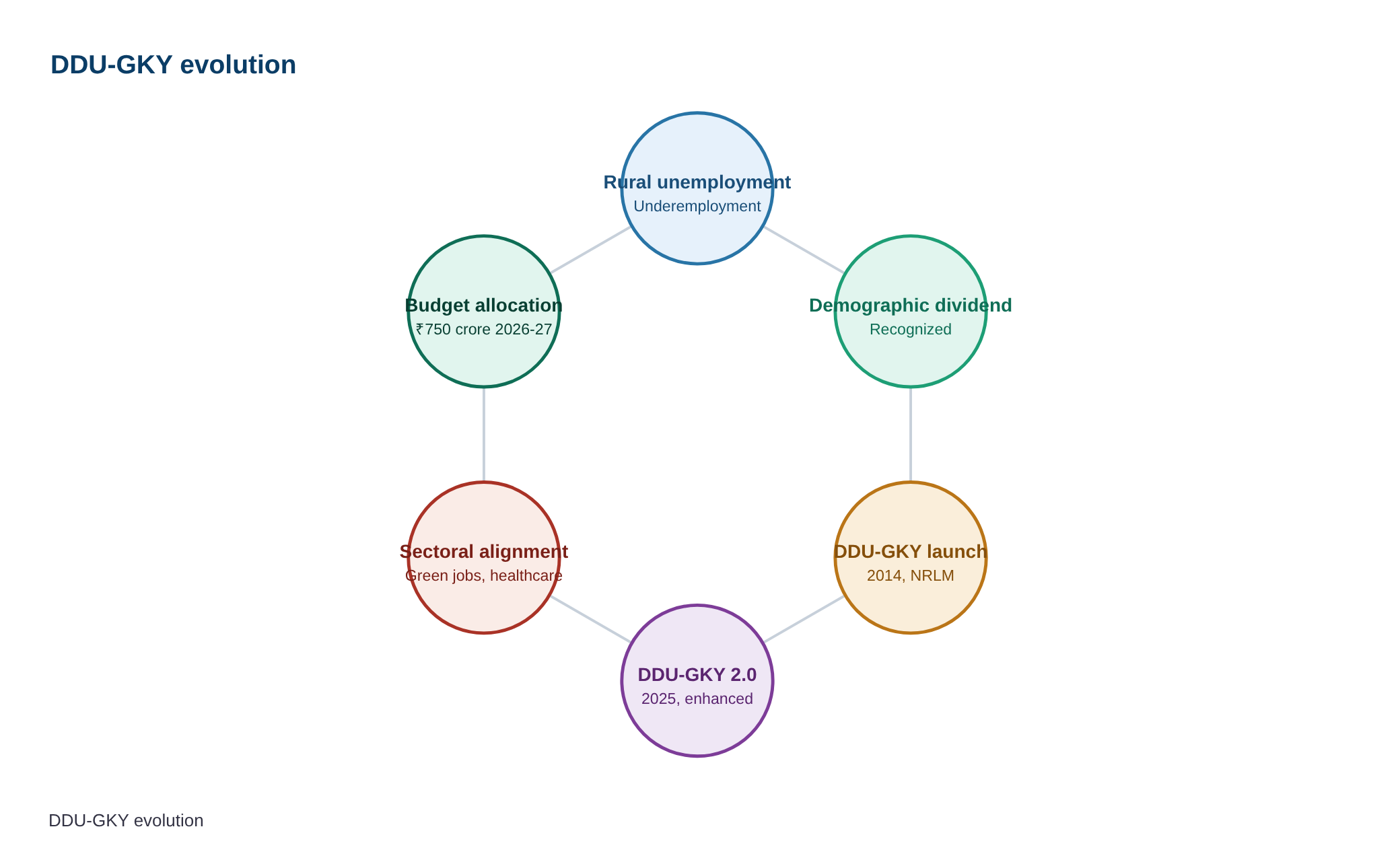
Rural youth unemployment and underemployment → Recognition of demographic dividend as an economic opportunity → Launch of DDU-GKY (2014) under NRLM to bridge skill gaps → Evolution to DDU-GKY 2.0 (2025) with enhanced post-placement support and sectoral alignment → Expansion to high-growth industries and marginalised groups → Integration with central budgetary allocations and technology-enabled monitoring → Sustainable employment outcomes and reduced rural-urban disparities.
Prelims Practice Questions
Q1. Consider the following statements regarding the Deen Dayal Upadhyaya Grameen Kaushalya Yojana (DDU-GKY) 2.0:
1. DDU-GKY 2.0 mandates a minimum of 576 hours of training duration for rural youth.
2. The scheme reserves 50% of its training slots for Scheduled Caste/Scheduled Tribe communities.
3. DDU-GKY 2.0 includes a 30-hour module on entrepreneurship as part of its non-domain training components.
4. The scheme provides a 10% additional project cost reimbursement for training in inaccessible areas.
How many of the above statements are correct?
- Only one
- Only two
- Only three
- All four
Answer: All four — Statements 1, 2, and 3 are correct as per the scheme guidelines. Statement 4 is incorrect; the additional reimbursement is 10% of the per-candidate training cost, not 10% of the total project cost.
Q2. Assertion (A): The Himayat Scheme under DDU-GKY 2.0 is exclusively for rural youth in Jammu & Kashmir and Ladakh.
Reason (R): The scheme is 100% centrally funded and implemented through dedicated Mission Management Units in the Union Territory.
Options:
A. Both A and R are true, and R is the correct explanation of A.
B. Both A and R are true, but R is not the correct explanation of A.
C. A is true but R is false.
D. A is false but R is true.
Answer: ? — Assertion (A) is false because the Himayat Scheme covers both rural and urban youth in Jammu & Kashmir and Ladakh. Reason (R) is true as the scheme is 100% centrally funded and implemented through dedicated Mission Management Units.
Q3. Match the following special initiatives under DDU-GKY 2.0 with their respective focus areas:
Column I (Initiative) | Column II (Focus Area)
———————————————–|——————————————–
1. Roshni | A. Aspirational Districts Programme
2. Himayat | B. Left-Wing Extremism (LWE) affected districts
3. Northeast allocation | C. Jammu & Kashmir and Ladakh
4. Special area allowance | D. Inaccessible and remote areas
- 1-B, 2-C, 3-A, 4-D; 1-A, 2-B, 3-C, 4-D; 1-C, 2-D, 3-A, 3-B; 1-D, 2-A, 3-C, 4-B
- answer_list_indexes_only_for_internal_use_but_output_as_full_text_here_instead_of_list_indexes_so_that_it_is_readable_by_humans
- answer_list_indexes_only_for_internal_use_but_output_as_full_text_here_instead_of_list_indexes_so_that_it_is_readable_by_humans
- answer_list_indexes_only_for_internal_use_but_output_as_full_text_here_so_that_it_is_readable_by_humans
Answer: ? — Roshni focuses on Left-Wing Extremism (LWE) affected districts (1-B). Himayat targets Jammu & Kashmir and Ladakh (2-C). The Northeast allocation is reserved for aspirational districts in the region (3-A). Special area allowance is provided for inaccessible and remote areas (4-D).
Mains Practice Question
✍ The Deen Dayal Upadhyaya Grameen Kaushalya Yojana (DDU-GKY) 2.0 represents a paradigm shift from mere skill training to a holistic approach encompassing employment, retention, and career progression for rural youth. Critically examine the key features of DDU-GKY 2.0 and analyse how it addresses the challenges of rural unemployment and underemployment in India. (15 Marks)
Approach: MODEL-ANSWER SKELETON:
1. **Introduction (2 marks)**
– Brief context: India’s demographic dividend and rural youth unemployment (reference to 345 million youth by 2036).
– Evolution of DDU-GKY: Launched in 2014 under NRLM, now in its 2.0 avatar (2025 guidelines).
– Objective: To transform rural youth into a skilled, employable workforce with sustainable livelihoods.
2. **Key Features of DDU-GKY 2.0 (5 marks)**
– **Structured Training Framework**: Minimum 576 hours (396 hours domain + 180 hours non-domain training).
– Non-domain components: English communication (60 hrs), employability & life skills (60 hrs), digital literacy (30 hrs), entrepreneurship (30 hrs).
– **Industry Alignment**: Training in sectors like aerospace, healthcare, green jobs, textiles, and agriculture.
– **Social Inclusion**: Mandatory coverage of SC/ST (50%), women (33%), and persons with disabilities (5%).
– **Post-Placement Support**: Enhanced focus on employment retention, career progression, and migration-linked challenges.
– **Special Initiatives**:
– *Roshni*: Targets LWE-affected districts with 40% women coverage.
– *Himayat*: Covers J&K and Ladakh, 100% centrally funded.
– *Northeast Allocation*: 10% of total funds reserved for NE states.
– *Special Area Allowance*: 10% additional reimbursement for inaccessible areas.
– **Technology-Enabled Monitoring**: Strengthened implementation through digital tools.
3. **Challenges Addressed (4 marks)**
– **Rural Unemployment**: Focus on industry-aligned skills reduces skill mismatches.
– **Underemployment**: Emphasis on career progression and entrepreneurship addresses low-productivity jobs.
– **Social Barriers**: Mandatory inclusion policies (women, SC/ST, PwDs) promote equitable access.
– **Geographical Disparities**: Special initiatives for LWE districts, NE states, and inaccessible areas.
– **Post-Placement Sustainability**: Robust post-placement support ensures long-term employment retention.
4. **Critique and Limitations (3 marks)**
– **Implementation Gaps**: Challenges in last-mile delivery, especially in remote areas.
– **Quality vs. Quantity**: Ensuring high-quality training across diverse sectors and geographies.
– **Monitoring and Evaluation**: Need for robust MIS systems to track outcomes beyond placements.
– **Funding Constraints**: While ₹750 crore allocated in Budget 2026-27, scalability remains a concern.
5. **Conclusion (1 mark)**
– DDU-GKY 2.0 is a significant step toward leveraging India’s demographic dividend through skill development.
– Its holistic approach—spanning training, placement, retention, and career growth—positions it as a model for rural employment schemes.
– However, sustained implementation, quality assurance, and adaptive policy measures are essential for long-term success.
Source: PIB (Press Information Bureau)
Generated by AanyaAi for educational purpose.
Related guides on our sites
- Best PSIR optional coaching for upsc
- Best PSIR optional teacher for upsc
- Best teacher of PSIR optional for upsc
- Best PSIR optional coaching in delhi for UPSC

- DDU-GKY 2.0: UPSC Focused Guide on Rural Skill Scheme for 2026-27 - September 24, 2026
- यूपीएससी/पीसीएस: 25 सितंबर 2026 को सरकारी प्रतिभूतियों की बोली प्रक्रिया, ₹34,000 करोड़ का पुनर्प्रस्ताव - September 24, 2026
- RBI to Auction ₹34,000 Crore Govt Securities on Sept 25, 2026: Key Details for UPSC & PCS - September 24, 2026

No Comments