


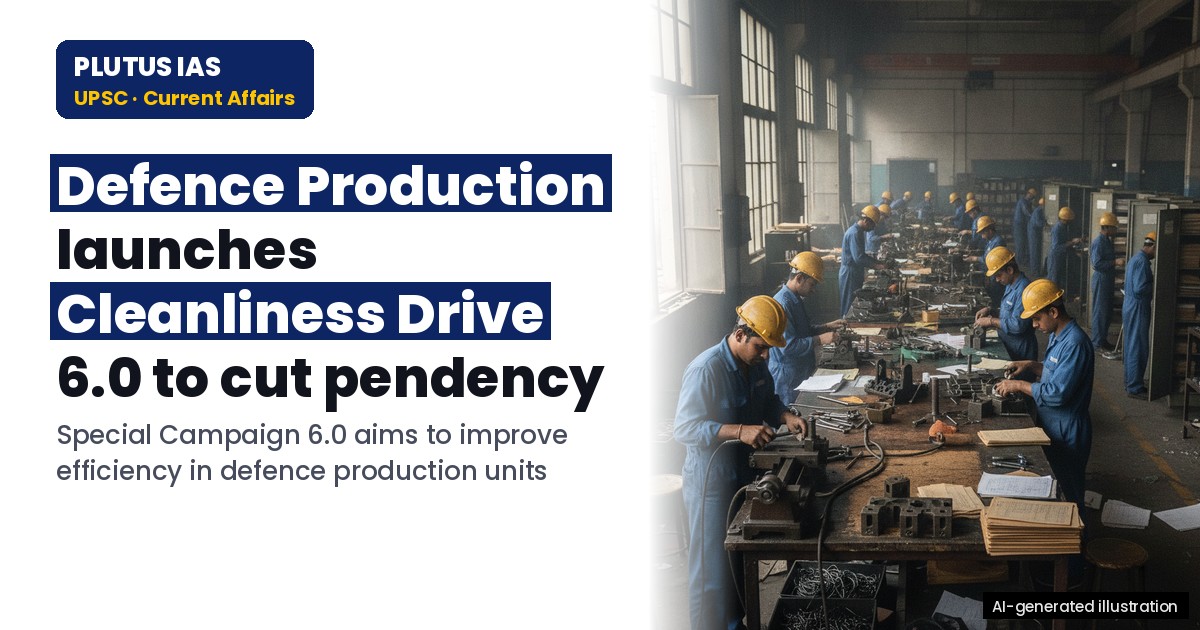
08 Oct Defence Production Launches Special Campaign 6.0 for Cleanliness & Efficiency
✎ Special Campaign 6.0 is a bi-annual, time-bound governance reform initiative aimed at reducing pendency and institutionalising cleanliness in government offices, with the Department of Defence Production leading its…
Subject Relevance — Where This Topic Fits
- GS Paper III — Economic Development — Industrial Policy and Public Sector Undertakings | GS Paper IV — Ethics, Integrity and Aptitude — Governance and Institutional Reforms
- Prelims: Special Campaign 2.0, Special Campaign 3.0, Special Campaign 4.0, Special Campaign 5.0, Department of Defence Production (DDP), Defence Public Sector Undertakings (DPSUs), Swachh Bharat Mission, pendency reduction, Ministry of Defence
- Essay: Governance reforms and institutional efficiency in India, Public sector enterprises as instruments of national development
Quick Revision: Special Campaign 6.0 is a bi-annual, time-bound governance reform initiative aimed at reducing pendency and institutionalising cleanliness in government offices, with the Department of Defence Production leading its implementation across Defence Public Sector Undertakings.
Why is this in the news?
The Department of Defence Production (DDP) has initiated Special Campaign 6.0, a time-bound governance reform initiative focused on cleanliness drives and reduction of pendency in Defence Public Sector Undertakings (DPSUs). This campaign aligns with the broader government-wide Special Campaign initiative, which seeks to institutionalise administrative efficiency, citizen-centric governance, and cleanliness as enduring practices rather than one-off events. The renewed emphasis on DPSUs underscores their pivotal role in India’s defence industrial ecosystem and the need for operational streamlining.
Background
- The Special Campaign initiative was launched by the Government of India in 2021 as a comprehensive reform measure to improve governance, reduce pendency, and enhance cleanliness across all ministries and departments.
- Special Campaign 6.0 builds on the outcomes of Special Campaign 5.0, which reportedly achieved significant reductions in pendency and improved cleanliness in public offices.
- Defence Public Sector Undertakings (DPSUs) such as HAL, BEL, BDL, and MDL are critical to India’s defence manufacturing, contributing to self-reliance (Atmanirbhar Bharat) and strategic autonomy.
- Swachhata Abhiyan has been a recurring theme in government campaigns, with the Swachh Bharat Mission (Urban and Rural) aiming for universal sanitation and cleanliness.
- Pendency reduction in government offices is a key performance indicator under the National e-Governance Plan (NeGP) and the Digital India initiative.
What is Special Campaign 6.0?
- Special Campaign 6.0 is a government-wide initiative launched under the aegis of the Department of Administrative Reforms and Public Grievances (DARPG), Ministry of Personnel, Public Grievances and Pensions, aimed at institutionalising cleanliness and reducing pendency in government offices.
- The campaign is structured as a 15-day intensive drive, typically conducted bi-annually (April and October), with a focus on field-level activities such as cleanliness drives, disposal of pending files, and digitisation of records.
- The Department of Defence Production (DDP) is leading the implementation of Special Campaign 6.0 within its jurisdiction, which includes Defence Public Sector Undertakings (DPSUs), Ordnance Factories, and DRDO laboratories.
- Key objectives include: (i) disposal of all pending files older than one year, (ii) reduction of physical files through digitisation, (iii) cleanliness drives in office premises, and (iv) improving service delivery through process re-engineering.
- The campaign is monitored through a centralised dashboard that tracks pendency reduction, file disposal, and cleanliness metrics across participating units.
- Special Campaign 6.0 emphasises sustainability by mandating that cleanliness and pendency reduction measures become part of the regular functioning of government offices, rather than ad-hoc efforts.
- The initiative aligns with the broader goals of the Swachh Bharat Mission and the Digital India programme, reinforcing the government’s commitment to cleanliness and e-governance.
- Participation is mandatory for all government offices, including DPSUs, with performance being reviewed by senior officials and reported to the Prime Minister’s Office (PMO).
Key Features
| Feature | Significance |
|---|---|
| Special Campaign 6.0 by Department of Defence Production (DDP) | A time-bound, mission-mode initiative under the Union Government’s Special Campaign for Swachhata and Reducing Pendency, aimed at enhancing operational efficiency in defence production units. |
| Focus on Swachhata (Cleanliness) | Institutionalises cleanliness drives, waste management, and environmental sustainability within defence production facilities, aligning with the broader national cleanliness mission. |
| Reduction of Pendency in Defence Procurement | Targets the backlog in procurement cases, contract finalisations, and grievance redressal to expedite defence acquisition processes. |
| Monitoring through Digital Dashboards | Leverages real-time tracking mechanisms to ensure accountability, transparency, and timely resolution of pending matters in defence production. |
| Inter-Ministerial Coordination | Facilitates synergy between the Department of Defence Production, Ministry of Defence, and other stakeholders to streamline administrative processes. |
Why it Matters
Governance and Administrative Efficiency
- Enhances the operational readiness of defence production units by reducing bureaucratic delays in procurement and contract finalisation.
- Promotes a culture of accountability and transparency in public sector undertakings under the Ministry of Defence.
- Aligns with the broader national agenda of ‘Minimum Government, Maximum Governance’ by optimising administrative processes.
- Strengthens institutional mechanisms for monitoring and reviewing pending cases in defence-related governance.
Economic and Industrial Impact
- Accelerates the delivery of defence equipment and platforms, thereby supporting the ‘Atmanirbhar Bharat’ initiative in defence manufacturing.
- Reduces financial costs associated with prolonged procurement delays, such as storage expenses and opportunity costs.
- Enhances the competitiveness of India’s defence industrial base by improving turnaround times for contracts.
Strategic and Security Implications
- Ensures timely availability of critical defence assets, thereby bolstering India’s military preparedness and strategic autonomy.
- Reduces vulnerabilities in the supply chain by expediting procurement processes for essential defence components.
- Supports the modernisation of the Indian Armed Forces through faster clearance of modernisation projects.
Environmental and Social Governance (ESG)
- Institutionalises sustainable practices within defence production units, contributing to national cleanliness and environmental goals.
- Promotes occupational health and safety standards in defence PSUs, aligning with global ESG frameworks.
Challenges
1. Bureaucratic Inertia in Defence Procurement
- Historical delays in defence procurement due to multi-layered approval processes and inter-ministerial coordination gaps.
- Resistance to change in legacy systems and reluctance to adopt digital monitoring tools in some defence PSUs.
UPSC Link: GS III: Infrastructure – Defence
2. Resource Constraints in Defence PSUs
- Limited financial and human resources in some defence production units to implement cleanliness drives and digital transformation initiatives.
- Dependence on government funding for modernisation, which may not always align with operational timelines.
UPSC Link: GS III: Industrial Policy
3. Data Security and Digital Governance Risks
- Ensuring cybersecurity and data integrity while transitioning to digital dashboards for monitoring defence procurement cases.
- Addressing concerns related to unauthorised access or manipulation of sensitive procurement data.
UPSC Link: GS III: Science & Tech
4. Inter-Service Coordination Gaps
- Coordination challenges between the Army, Navy, Air Force, and Coast Guard in aligning procurement priorities with production timelines.
- Divergent operational requirements across services that may lead to conflicting demands on defence PSUs.
UPSC Link: GS III: Security
5. Skill Gaps in Defence Production Workforce
- Shortage of skilled personnel in defence PSUs to manage cleanliness drives, digital tools, and procurement processes efficiently.
- Need for continuous upskilling to adapt to evolving technologies in defence manufacturing.
UPSC Link: GS III: Skill Development
Challenges — UPSC Perspective
| Issue | Concern |
|---|---|
| Multi-layered Approval Processes | Delays in procurement due to sequential clearances from multiple authorities (e.g., DAC, MoD, Finance Ministry). |
| Legacy Systems and Resistance to Digitalisation | Inadequate adoption of digital tools in some defence PSUs, leading to inefficiencies in monitoring and review. |
| Inter-Ministerial Coordination Gaps | Lack of synchronised efforts between the Department of Defence Production, Ministry of Defence, and other ministries. |
| Resource Allocation Bottlenecks | Insufficient funding or manpower in defence PSUs to execute cleanliness drives and procurement optimisation. |
| Data Privacy and Cybersecurity Risks | Potential vulnerabilities in digital dashboards used for monitoring procurement cases. |
| Skill Mismatch in Workforce | Shortage of trained personnel to manage emerging technologies and administrative reforms in defence PSUs. |
Way Forward
- Establish a centralised digital dashboard for real-time monitoring of procurement cases, with automated alerts for pending approvals.
- Conduct periodic inter-ministerial review meetings to address coordination gaps and expedite decision-making.
- Launch targeted capacity-building programmes for defence PSU employees to enhance digital literacy and procurement management skills.
- Incentivise defence PSUs that achieve measurable reductions in procurement pendency and cleanliness compliance.
- Strengthen public-private partnerships to augment resources for cleanliness drives and technological upgrades in defence PSUs.
- Implement a ‘Fast-Track Procurement Cell’ within the Department of Defence Production to resolve critical backlog cases.
- Promote the adoption of green procurement policies to align cleanliness drives with sustainable development goals.
- Enhance transparency by publishing quarterly progress reports on pendency reduction and cleanliness compliance.
UPSC Value Addition
Keywords for Mains Answer-Writing
Department of Defence Production · Special Campaign 6.0 · Swachhata Abhiyan · Pendency reduction · Government of India initiatives · Defence sector governance · Administrative reforms · E-government · Public service delivery · Government transparency · Institutional efficiency · Union Government ministries · Defence production policy · Bureaucratic reforms · Government accountability · Sarkar ka Samay · Mission Karmayogi · Government e-Marketplace (GeM) · Digital India · Government efficiency · Public sector undertakings (PSUs) · Good governance practices · Government audit and compliance · Union Budget allocation · Defence Public Sector Undertakings (DPSUs)
Concept Flow
Defence Procurement Delays → Institutional Response (Special Campaign 6.0) → Digital Monitoring & Cleanliness Drives → Reduction in Pendency → Enhanced Operational Readiness → Strategic Autonomy & Economic Efficiency
Prelims Practice Questions
Q1. Consider the following statements regarding the Department of Defence Production (DDP) in India:
1. The DDP operates under the Ministry of Defence.
2. The DDP is responsible for the implementation of the Special Campaign 6.0.
3. The Special Campaign 6.0 focuses exclusively on reducing pendency in government offices.
4. The DDP is mandated to oversee the Swachh Bharat Mission in defence establishments.
How many of the above statements are correct?
Options:
A. Only one
B. Only two
C. Only three
D. All four
- A
- B
- C
- D
Answer: C — Statement 1 is correct: The DDP functions under the Ministry of Defence. Statement 2 is correct: The DDP is leading Special Campaign 6.0. Statement 3 is incorrect: The campaign addresses both Swachhata (cleanliness) and pendency reduction. Statement 4 is incorrect: Swachh Bharat Mission is a separate initiative under the Ministry of Housing and Urban Affairs and Ministry of Jal Shakti.
Q2. Assertion (A): The Department of Defence Production is mandated to reduce pendency in government offices as part of Special Campaign 6.0.
Reason (R): The campaign is a government-wide initiative aimed at improving efficiency and governance through cleanliness drives and digitisation.
Options:
A. Both A and R are true, and R is the correct explanation of A.
B. Both A and R are true, but R is NOT the correct explanation of A.
C. A is true, but R is false.
D. A is false, but R is true.
Answer: ? — Assertion (A) is true: The DDP is tasked with reducing pendency under Special Campaign 6.0. Reason (R) is also true and correctly explains (A) as the campaign is a government-wide effort for efficiency and governance improvement.
Q3. Match the following government initiatives with their respective ministries/ departments:
Column I (Initiative)
1. Swachh Bharat Mission
2. Special Campaign 6.0
3. Mission Karmayogi
4. Government e-Marketplace (GeM)
Column II (Ministry/Department)
A. Ministry of Housing and Urban Affairs
B. Department of Defence Production
C. Department of Personnel and Training
D. Ministry of Commerce and Industry
Options:
1-A, 2-B, 3-C, 4-D
2-A, 2-C, 3-B, 4-D
3-B, 2-A, 3-C, 4-D
4-A, 2-B, 3-D, 4-C
- 1-A, 2-B, 3-C, 4-D
- 1-A, 2-C, 3-B, 4-D
- 1-B, 2-A, 3-C, 4-D
- 1-A, 2-B, 3-D, 4-C
Answer: 1-A, 2-B, 3-C, 4-D — The correct matching is: Swachh Bharat Mission (A) under Ministry of Housing and Urban Affairs, Special Campaign 6.0 (B) under Department of Defence Production, Mission Karmayogi (C) under Department of Personnel and Training, and Government e-Marketplace (D) under Ministry of Commerce and Industry.
Mains Practice Question
✍ The Department of Defence Production (DDP) has initiated Special Campaign 6.0 with twin objectives of promoting Swachhata and reducing pendency in governance. In this context, critically examine the significance of such campaigns for enhancing administrative efficiency and accountability in the defence sector. (15 Marks)
Approach: MODEL-ANSWER SKELETON:
1. **Introduction (2 marks)**: Define Special Campaign 6.0 and its twin objectives (Swachhata and pendency reduction) as part of the government’s broader administrative reform agenda under initiatives like Mission Karmayogi and Digital India.
2. **Administrative Efficiency in Defence Sector (4 marks)**:
– Discuss the role of DDP in overseeing Defence Public Sector Undertakings (DPSUs) and Ordnance Factories.
– Highlight challenges such as bureaucratic delays, procedural bottlenecks, and lack of digitisation in defence procurement and production.
– Reference the Defence Procurement Procedure (DPP) 2020 and its emphasis on e-governance and transparency.
3. **Accountability Mechanisms (4 marks)**:
– Explain how Swachhata drives (inspired by Swachh Bharat Mission) foster a culture of cleanliness, transparency, and citizen-centric governance in defence establishments.
– Discuss pendency reduction through digital tools (e.g., e-office, CPGRAMS, GeM) and their impact on decision-making timelines.
– Reference the Comptroller and Auditor General (CAG) reports on defence expenditure and audit findings to underscore the need for accountability.
4. **Challenges and Limitations (3 marks)**:
– Identify structural challenges: hierarchical bureaucracy, resistance to change, and legacy systems in defence PSUs.
– Discuss data privacy and cybersecurity concerns in digitising defence-related processes.
– Reference the need for capacity-building under Mission Karmayogi for defence sector officials.
5. **Conclusion (2 marks)**:
– Summarise the transformative potential of Special Campaign 6.0 in the defence sector.
– Emphasise the need for sustained political will, institutional reforms, and stakeholder collaboration to institutionalise these changes.
Key provisions to cite: Mission Karmayogi (2020), Digital India initiative, Defence Procurement Procedure (DPP) 2020, Right to Information Act, 2005, and CAG audit reports.
Source: PIB (Press Information Bureau)
Generated by AanyaAi for educational purpose.

- हौथी विद्रोही संगठन ने रियाद हवाईअड्डे पर किया बैलिस्टिक मिसाइल हमला - October 8, 2026
- Defence Production Launches Special Campaign 6.0 for Cleanliness & Efficiency - October 8, 2026
- भारत-ग्रीस रक्षा एवं सामरिक सहयोग पर चर्चा, समुद्री सुरक्षा बढ़ाने पर जोर - October 8, 2026

No Comments