


24 Sep Delhi Cabinet Approves DURGA Scheme for Women & Transgender E-Auto Drivers
✎ The DURGA e-Auto Scheme exemplifies a gender-responsive governance model that integrates clean transport, livelihood generation, and social inclusion within Delhi’s urban mobility ecosystem.
Subject Relevance — Where This Topic Fits
- GS Paper II — Governance, Welfare Schemes for Vulnerable Sections | GS Paper III — Environment and Sustainable Development, Urban Infrastructure
- Prelims: DURGA scheme, e-autos, gender-inclusive mobility, Public Service Vehicle (PSV) badge, electric vehicle (EV) policy, Delhi Metro Rail Corporation (DMRC), lock-in period, socio-economic impact assessment
- Essay: The intersection of gender equity and sustainable urban development, Inclusive governance as a catalyst for social transformation
Quick Revision: The DURGA e-Auto Scheme exemplifies a gender-responsive governance model that integrates clean transport, livelihood generation, and social inclusion within Delhi’s urban mobility ecosystem.
Why is this in the news?
The Delhi Cabinet’s approval of the ‘DURGA’ e-auto scheme introduces a targeted governance intervention to enhance mobility, economic empowerment, and environmental sustainability for women and transgender persons in the National Capital Territory. The scheme, with its phased allocation of 1,300 electric autos, underscores the state’s commitment to gender-responsive public policy while aligning with broader national objectives of clean energy transition and inclusive urban development.
Background
- Urban mobility in Delhi is characterised by high congestion, air pollution, and safety concerns, particularly for women and marginalised groups, necessitating gender-sensitive transport solutions.
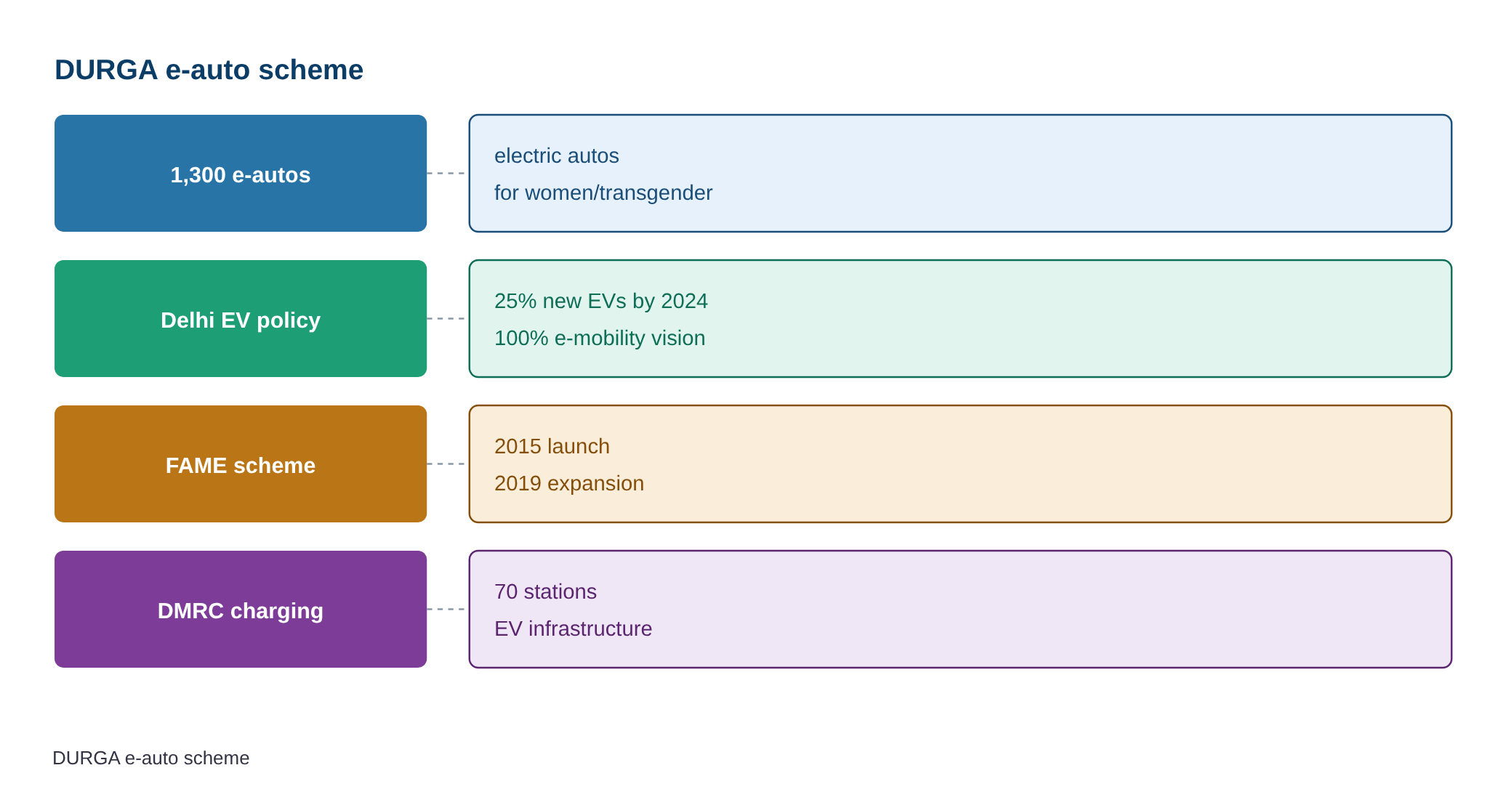
- The Government of India’s Faster Adoption and Manufacturing of (Hybrid &) Electric Vehicles (FAME) scheme, launched in 2015 and expanded in 2019, provides financial incentives for electric vehicles, creating a policy environment conducive to state-level EV adoption initiatives.
- Transgender persons in India face systemic barriers in employment and access to dignified livelihoods, as highlighted by the Transgender Persons (Protection of Rights) Act, 2019, which mandates affirmative action in education and employment.
- Delhi’s electric vehicle policy, notified in 2020, aims for 25% of all new vehicle registrations to be electric by 2024, with a long-term vision of 100% e-mobility, providing a regulatory framework for the DURGA scheme.
- The Delhi Metro Rail Corporation (DMRC) has operationalised 70 metro stations with EV charging infrastructure, demonstrating institutional preparedness for supporting e-mobility initiatives.
- Gender-disaggregated data on urban transport reveals that women in Delhi spend 20% more time on commutes due to safety concerns, underscoring the need for targeted interventions like DURGA.
What is the DURGA e-Auto Scheme?
- The DURGA e-Auto Scheme is a gender-inclusive livelihood and mobility initiative launched by the Government of the National Capital Territory of Delhi to provide ownership and driving opportunities for women and transgender persons in the e-auto (electric auto-rickshaw) sector.
- Under the scheme, 1,300 electric autos will be allocated in the first phase, with 1,170 e-autos reserved for women and 130 for transgender beneficiaries, distributed across Delhi’s revenue districts with a maximum of 90 women-allotted and 10 transgender-allotted autos per revenue district.
- The scheme mandates a three-year lock-in period for allocated e-autos, during which vehicles cannot be sold or transferred, ensuring long-term asset ownership and discouraging speculative practices.
- Eligible applicants must be Delhi residents aged 20–40, hold a valid voter ID, a Light Motor Vehicle (LMV) driving licence, and a Public Service Vehicle (PSV) badge, with additional criteria for transgender applicants, including a valid transgender certificate issued by the District Magistrate.
- Income eligibility for applicants is capped at ₹5 lakh for the financial year 2025–26, and neither the applicant nor their family can own a registered transport vehicle or three-wheeler, ensuring the scheme targets first-time owners.
- The e-autos will bear ‘DURGA’ branding and identification features, integrating the scheme into Delhi’s broader identity while promoting visibility and accountability in service delivery.
- The scheme is designed to generate ancillary employment in sectors such as repair, servicing, charging infrastructure, and battery recycling, creating a multiplier effect on local economies.
- A periodic socio-economic impact assessment is envisaged to evaluate the scheme’s effectiveness in achieving its objectives of economic empowerment, gender inclusion, and environmental sustainability.
Key Features
| Feature | Significance |
|---|---|
| Target beneficiaries | Exclusively women and transgender persons, ensuring targeted socio-economic inclusion and addressing mobility barriers for marginalised groups. |
| Eligibility criteria | Strict residency, age, income, and vehicle ownership restrictions to ensure equitable distribution and prevent misuse of subsidies. |
| Vehicle specifications | Pink-branded electric autos with mandatory three-year lock-in period to prevent resale and ensure sustained employment. |
| Application process | Online portal-based application to streamline access, reduce bureaucratic hurdles, and enhance transparency. |
| Employment generation | Multi-sectoral opportunities in repair, servicing, charging infrastructure, and battery recycling, fostering ancillary livelihoods. |
Why it Matters
Economic Empowerment
- Provides dignified self-employment opportunities for women and transgender persons, aligning with SDG 8 (Decent Work and Economic Growth).
- Reduces dependency on informal transport sectors, promoting formalisation of the gig economy in urban mobility.
- Leverages electric vehicle adoption to lower operational costs for drivers, enhancing long-term viability.
Social Inclusion
- Addresses mobility gaps for women and transgender persons, particularly in last-mile connectivity, enhancing safety and accessibility.
- Promotes gender and transgender-sensitive urban transport policies, contributing to SDG 5 (Gender Equality) and SDG 10 (Reduced Inequalities).
- Institutionalises affirmative action through targeted allocation, ensuring representation in public transport infrastructure.
Environmental Sustainability
- Promotes electric vehicle adoption in intra-city transport, reducing carbon emissions and aligning with India’s NDCs under the Paris Agreement.
- Supports Delhi’s Electric Vehicle Policy 2020 by expanding the e-mobility ecosystem and reducing fossil fuel dependence.
- Encourages battery recycling ecosystems, addressing e-waste management challenges.
Urban Governance
- Demonstrates municipal governance innovation in integrating social welfare with urban transport planning.
- Sets a precedent for state-led inclusionary policies in mobility, complementing central schemes like PM-eBus Sewa.
- Enhances last-mile connectivity in Delhi’s public transport network, reducing pressure on metro and bus systems.
Challenges
1. Financial Sustainability
- High upfront capital costs for electric autos and charging infrastructure may strain Delhi’s municipal budget.
- Dependence on subsidies risks creating a dependency culture; long-term viability requires revenue models beyond grants.
- Battery replacement costs post-lock-in period could deter beneficiaries, necessitating a recycling ecosystem.
UPSC Link: GS3: Infrastructure, Environment
2. Operational Challenges
- Limited charging infrastructure despite DMRC’s assurances; scalability may be constrained by land availability in dense urban areas.
- Driver training and safety protocols for women and transgender persons require robust implementation frameworks.
- Monitoring and enforcement of lock-in clauses may face administrative bottlenecks.
UPSC Link: GS2: Governance, GS3: Urbanisation
3. Social and Cultural Barriers
- Stigma and safety concerns may deter transgender persons from participating, requiring community sensitisation.
- Gender-based violence risks in public spaces necessitate integrated safety measures beyond vehicle allocation.
- Cultural resistance to women driving commercial vehicles in certain communities may hinder adoption.
UPSC Link: GS1: Social Issues, GS2: Governance
4. Regulatory and Legal Hurdles
- Compliance with Motor Vehicles Act, 1988, and Delhi Motor Vehicles Rules, 1993, for e-auto licensing and operations.
- Inter-state coordination for battery recycling and e-waste management under E-Waste (Management) Rules, 2022.
- Data privacy concerns in online application portals requiring compliance with DPDP Act, 2023.
UPSC Link: GS2: Constitution, GS3: Environment
Challenges — UPSC Perspective
| Issue | Concern |
|---|---|
| Charging Infrastructure | Insufficient public charging stations despite DMRC claims; scalability issues in high-density areas. |
| Beneficiary Participation | Low awareness among marginalised groups; digital literacy barriers in online application process. |
| Safety and Security | Lack of gender-sensitive urban design in auto routes; inadequate law enforcement for harassment cases. |
| Policy Coordination | Fragmented implementation across municipal, state, and central agencies; overlapping jurisdictions. |
| Economic Viability | High operational costs post-subsidy phase; dependency on volatile battery prices. |
Way Forward
- Establish a multi-stakeholder task force with DMRC, Delhi Transport Department, and beneficiary groups to monitor implementation.
- Expand charging infrastructure in partnership with private players under Delhi’s EV Policy 2020, leveraging viability gap funding.
- Conduct periodic socio-economic impact assessments to evaluate employment generation, income sustainability, and safety outcomes.
- Integrate gender and transgender sensitisation modules in driver training programs and urban mobility planning.
- Develop a transparent grievance redressal mechanism for beneficiaries, including helplines and localised support centres.
- Pilot a revenue-sharing model with e-auto owners to ensure long-term financial sustainability post-lock-in period.
- Collaborate with battery manufacturers and recyclers to establish a closed-loop recycling ecosystem for e-auto batteries.
UPSC Value Addition
Keywords for Mains Answer-Writing
DURGA scheme · electric three-wheelers · gender-inclusive mobility · Delhi government schemes · e-mobility policy · last-mile connectivity · self-employment schemes · urban transport governance · transgender welfare · sustainable urban mobility · Delhi Metro integration · electric vehicle subsidy · women empowerment · public service vehicle regulation
Constitutional & Policy Linkages
- [‘Article 14: Equality before law’, ‘Ensures non-discriminatory eligibility criteria for beneficiaries.’]
- [‘Article 15(3): Special provisions for women’, ‘Justifies targeted allocation for women in mobility infrastructure.’]
- [‘Article 16: Equality of opportunity’, ‘Promotes equitable access to self-employment in public transport.’]
- [‘Article 21: Right to livelihood’, ‘Supports dignified employment as part of the right to life.’]
Concept Flow
Identification of mobility gaps for women and transgender persons in urban transport systems. → Policy design: Targeted allocation of e-autos with eligibility criteria to ensure inclusivity. → Implementation: Online portal for applications, DMRC charging infrastructure, and beneficiary training. → Employment generation: Direct roles as drivers and indirect roles in allied sectors. → Socio-economic impact: Income generation, safety enhancement, and environmental benefits. → Monitoring and feedback: Periodic assessments to refine policy and address challenges.
Prelims Practice Questions
Q1. Consider the following statements regarding the ‘DURGA’ e-auto scheme launched by the Delhi Government:
1. The scheme allocates 1,300 e-autos exclusively to women beneficiaries.
2. Transgender applicants must possess a valid transgender certificate issued by a Delhi District Magistrate’s office.
3. The scheme mandates a three-year lock-in period during which the e-autos cannot be sold or transferred.
4. The scheme allows applicants with more than three children to avail benefits.
How many of the above statements are correct?
- Only one
- Only two
- Only three
- All four
Answer: Only three — Statements 2 and 3 are correct. Statement 1 is incorrect as the scheme allocates e-autos to both women and transgender persons. Statement 4 is incorrect as women with more than three children are ineligible.
Q2. Assertion (A): The ‘DURGA’ e-auto scheme is designed to promote clean transport and last-mile connectivity in Delhi.
Reason (R): The scheme provides charging infrastructure at Delhi Metro stations to support the operation of electric autos.
Options:
A. Both A and R are true, and R is the correct explanation of A.
B. Both A and R are true, but R is not the correct explanation of A.
C. A is true, but R is false.
D. A is false, but R is true.
Answer: ? — Both the Assertion (A) and Reason (R) are true. The scheme aims to promote clean transport and last-mile connectivity, and the provision of charging infrastructure at Delhi Metro stations supports this objective. Hence, R correctly explains A.
Q3. Match the following eligibility criteria with the corresponding beneficiary category under the ‘DURGA’ e-auto scheme:
Column I (Eligibility Criteria)
A. Valid transgender certificate issued by Delhi District Magistrate
B. Maximum of 90 e-autos per revenue district for women
C. Combined family income not exceeding ₹5 lakh for 2025-26
D. Valid voter ID, LMV driving licence, and Public Service Vehicle Badge
Column II (Beneficiary Category)
1. Women
2. Transgender persons
Select the correct match:
- A-1, B-1, C-1, D-2
- A-2, B-1, C-1, D-1
- A-2, B-2, C-1, D-1
- A-1, B-2, C-2, D-2
Answer: A-2, B-1, C-1, D-1 — A-2 (Transgender persons require a valid transgender certificate), B-1 (90 e-autos per revenue district for women), C-1 (Income criterion applies to women), D-1 (All documents apply to women).
Mains Practice Question
✍ The ‘DURGA’ e-auto scheme of the Delhi Government represents a multi-dimensional policy intervention to address gender-inclusive mobility, sustainable urban transport, and self-employment generation. Critically examine the scheme’s design, eligibility criteria, and potential socio-economic impact. Also, analyse how such schemes can contribute to India’s broader goals of climate-resilient urban development and gender mainstreaming in public policy. (15 Marks)
Approach: MODEL-ANSWER SKELETON:
1. **Introduction (2 marks)**: Define the ‘DURGA’ scheme—its objective to provide dignified self-employment to women and transgender persons through ownership of electric autos, promoting clean transport and last-mile connectivity.
2. **Scheme Design and Provisions (4 marks)**:
– Allocation: 1,300 e-autos (1,170 for women, 130 for transgender persons) with district-wise caps (90 women, 10 transgender per revenue district).
– Eligibility: Age (20–40), Delhi residency, valid voter ID, LMV licence, PSV badge; income cap (₹5 lakh), no ownership of transport vehicles/three-wheelers; transgender certificate requirement.
– Lock-in period: 3 years for e-autos to prevent premature sale/transfer.
– Branding and infrastructure: ‘DURGA’ branding, charging spaces at 70 Delhi Metro stations.
3. **Gender Inclusion and Empowerment (3 marks)**:
– Addresses underrepresentation of women and transgender persons in formal transport sectors.
– Provides dignified self-employment, aligning with SDG 5 (Gender Equality) and SDG 11 (Sustainable Cities and Communities).
– Potential to challenge gender stereotypes in urban mobility.
4. **Sustainable Urban Transport (3 marks)**:
– Promotes e-mobility, reducing carbon emissions and air pollution in Delhi (a non-attainment city under NAAQS).
– Supports Delhi’s Electric Vehicle Policy 2022 and climate action plans.
– Last-mile connectivity enhancement aligns with urban transport governance frameworks (e.g., National Urban Transport Policy 2014).
5. **Challenges and Critiques (2 marks)**:
– Scalability: 1,300 e-autos are a small fraction of Delhi’s transport demand; replicability in other cities.
– Financial viability: Sustainability of income generation for beneficiaries post-lock-in period.
– Inclusivity gaps: Exclusion of applicants over 40 or with more than three children; potential intersectional barriers for transgender persons.
6. **Broader Policy Implications (3 marks)**:
– Demonstrates how state-led schemes can integrate social justice, economic empowerment, and environmental sustainability.
– Aligns with India’s commitments under the Paris Agreement and the Sendai Framework for Disaster Risk Reduction.
– Serves as a model for gender-responsive climate adaptation in urban areas.
**Conclusion (2 marks)**: Summarise the scheme’s significance as a pioneering initiative in gender-inclusive, sustainable urban mobility, while acknowledging the need for continuous evaluation and scaling.
Source: The Indian Express
Generated by AanyaAi for educational purpose.
Related guides on our sites
- Best PSIR optional coaching in delhi for UPSC
- Best PSIR optional coaching for upsc
- Best PSIR optional teacher for upsc
- Best teacher of PSIR optional for upsc

- Ministry Launches Swachhata Abhiyan 6.0 for National Highways & Toll Plazas - September 29, 2026
- उत्तराखंड में 54 धारा-नौलों का पारंपरिक विधि से पुनरुद्धार, सीमेंट का न्यूनतम प्रयोग - September 29, 2026
- Kerala doubles compensation for wildlife attacks, crop loss amid rising conflicts - September 29, 2026

No Comments