


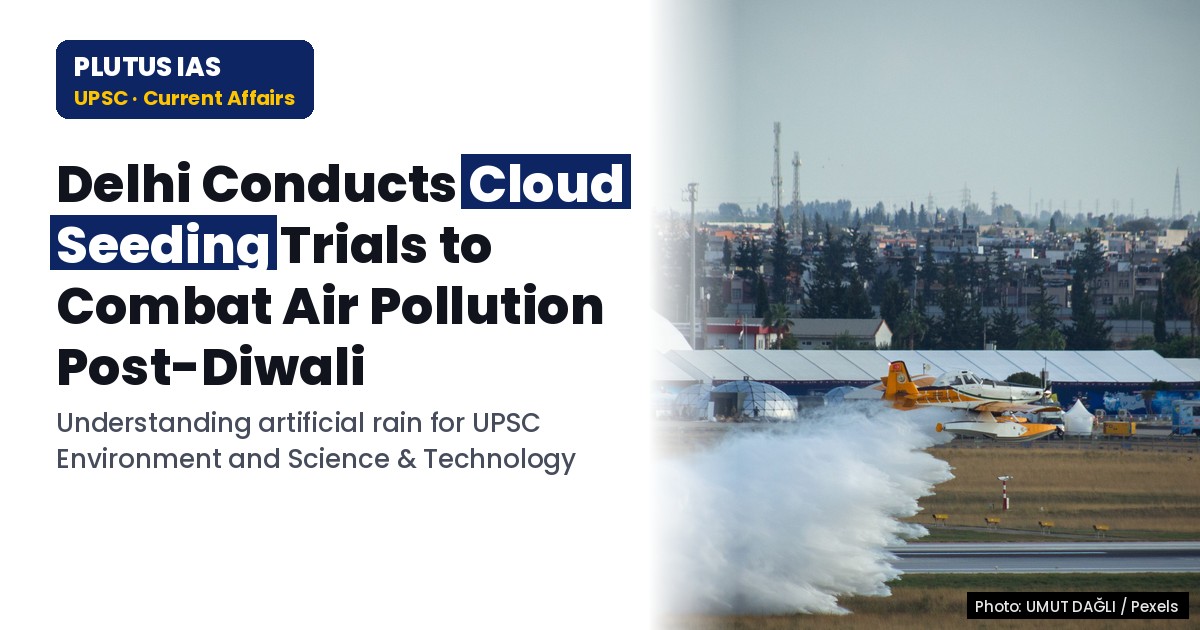
05 Nov Delhi’s Cloud Seeding Trials: Tackling Air Pollution
✎ Cloud seeding is a weather modification technique employing 'seed' particles like silver iodide to induce or enhance precipitation, primarily explored for air pollution mitigation in Delhi.
Subject Relevance — Where This Topic Fits
- GS Paper III — Environment and Ecology; Science and Technology
- Prelims: Cloud seeding, Artificial rain, Silver iodide, Potassium iodide, Sodium chloride, Cloud condensation nuclei (CCN), Ice nuclei particles, Air pollution mitigation
- Essay: Technological interventions for environmental challenges, The role of science and technology in sustainable urban development
Quick Revision: Cloud seeding is a weather modification technique employing ‘seed’ particles like silver iodide to induce or enhance precipitation, primarily explored for air pollution mitigation in Delhi.
Why is this in the news?
The Delhi government is actively exploring cloud seeding, also known as artificial rain, as a potential measure to combat escalating air pollution levels. Recent trial runs have been conducted near the airport, with further trials anticipated after the Diwali and Chhath festivals, in collaboration with institutions like the Indian Institute of Technology (IIT). This initiative follows previous trials in October-November of the preceding year, which did not yield significant on-ground impact.
Background
- Air pollution, particularly in urban centres like Delhi, poses a severe public health and environmental challenge, necessitating a multi-faceted approach to mitigation.
- Cloud seeding is a weather modification technique aimed at increasing precipitation from clouds, primarily rainfall or snowfall.
- The technique involves introducing ‘seed’ particles into suitable clouds to stimulate the formation of ice crystals or water droplets.
- Studies suggest that artificial rain can contribute to reducing dust pollution by facilitating the deposition of particulate matter and smoke onto the ground.
- The efficacy of cloud seeding, particularly in convective, low-level clouds, remains a subject of scientific debate, with experts highlighting the critical dependence on specific atmospheric conditions.
- The Indian Institute of Tropical Meteorology (IITM), Pune, has provided definitions and insights into cloud seeding methodologies.
What is Cloud Seeding?
- Cloud seeding is a deliberate weather modification technique designed to alter the development of clouds, typically to increase precipitation (rain or snow).
- The process involves dispersing substances into the air that serve as cloud condensation nuclei (CCN) or ice nuclei particles.
- Common seeding agents include silver iodide, potassium iodide, and sodium chloride, chosen for their crystalline structures that mimic ice or their hygroscopic properties.
- These agents are introduced into clouds either by aircraft, which disperse them directly into the cloud, or by ground-based generators that release them into updrafts.
- The ‘seed’ particles provide additional surfaces around which water vapour can condense or freeze, accelerating the formation of cloud droplets or ice crystals.
- In natural rainfall, water vapour condenses around existing atmospheric particles to form cloud droplets, which then collide and grow until they are heavy enough to fall.
- Cloud seeding aims to enhance this natural process by providing more efficient nuclei, thereby potentially increasing the rate or amount of precipitation.
- The effectiveness of cloud seeding is contingent upon the presence of suitable cloud types, adequate moisture content, and precise timing of the seeding operation.
Key Features
| Feature | Significance |
|---|---|
| Cloud Seeding | A weather modification technique aimed at increasing precipitation or altering cloud structure. |
| Artificial Rain Induction | Involves dispersing ‘seed’ particles (e.g., silver iodide, potassium iodide, sodium chloride) into suitable clouds. |
| Mechanism of Action | Seed particles act as cloud condensation nuclei (CCN) or ice nuclei, promoting the formation and growth of cloud droplets or ice crystals, leading to precipitation. |
| Application in Air Quality Management | Theoretically, induced rainfall can help reduce atmospheric particulate matter (dust, smoke) by washing it down to the ground. |
| Trial Runs in Delhi | Exploratory exercises to assess the feasibility and efficacy of cloud seeding as a measure to mitigate severe air pollution. |
Why it Matters
Environmental Significance
- Offers a potential, albeit experimental, method for mitigating severe air pollution episodes, particularly in densely populated urban areas.
- Aims to improve ambient air quality by facilitating the removal of airborne particulate matter and pollutants through precipitation.
- Represents an adaptive strategy to address the growing challenge of urban atmospheric degradation and its associated health impacts.
Technological and Scientific Significance
- Highlights ongoing research and development in weather modification technologies within India, involving institutions like IIT-Kanpur and IITM, Pune.
- Contributes to the scientific understanding of cloud microphysics and the practical application of cloud seeding techniques in diverse meteorological conditions.
- Provides empirical data for evaluating the effectiveness, limitations, and optimal conditions for cloud seeding operations in specific geographical contexts.
Governance and Policy Significance
- Demonstrates proactive governmental exploration of innovative solutions to complex environmental problems, such as persistent air pollution.
- Informs future policy decisions regarding the adoption and scaling of weather modification technologies for environmental management.
- Emphasizes the importance of inter-agency collaboration and scientific input in developing and implementing environmental mitigation strategies.
Challenges
1. Efficacy and Predictability
- Scientific evidence for significant rainfall enhancement, particularly from convective, low-level clouds, remains uncertain and highly dependent on specific meteorological conditions.
- The precise timing, cloud type, and moisture content must align almost perfectly for cloud seeding to be effective, conditions often not met over plains.
- Quantifying the exact contribution of seeding to observed precipitation versus natural rainfall is inherently difficult, making impact assessment challenging.
UPSC Link: Environmental Pollution & Degradation
2. Short-lived Air Quality Gains
- Any improvements in air quality resulting from induced rainfall are typically temporary, as pollution sources continue to emit, leading to rapid re-accumulation of pollutants.
- Cloud seeding does not address the root causes of air pollution, such as vehicular emissions, industrial discharges, and biomass burning, serving only as a palliative measure.
UPSC Link: Conservation, Environmental Pollution
3. Ecological and Climatic Concerns
- Potential long-term environmental impacts of dispersing chemical agents like silver iodide into the atmosphere and ecosystem are not fully understood.
- Concerns exist regarding the redistribution of rainfall, where inducing rain in one area might inadvertently reduce precipitation in downwind regions.
- The energy and resource intensity of large-scale cloud seeding operations could be substantial, raising questions about sustainability and cost-effectiveness.
UPSC Link: Environmental Impact Assessment
4. Operational and Logistical Hurdles
- Requires specialized aircraft or ground-based generators, specific seeding materials, and highly skilled personnel, leading to significant operational costs.
- Dependency on suitable cloud formations and atmospheric conditions limits the operational window and reliability of the technique.
- Coordination across multiple agencies and jurisdictions may be complex, especially in densely populated and politically sensitive regions.
UPSC Link: Science & Technology- Developments
Challenges — UPSC Perspective
| Issue | Concern |
|---|---|
| Uncertain Efficacy | Limited conclusive scientific evidence for consistent and significant rainfall enhancement, especially in specific cloud types and geographical settings. |
| Temporary Impact | Air quality improvements are often short-lived, as cloud seeding does not address the fundamental sources of pollution. |
| Environmental Risks | Potential unknown long-term ecological impacts of seeding agents and altered precipitation patterns. |
| High Costs | Significant financial investment required for equipment, materials, operations, and scientific monitoring. |
| Logistical Complexity | Requires precise meteorological conditions, specialized infrastructure, and expert coordination for successful implementation. |
| Ethical and Legal Aspects | Questions regarding ownership of clouds, transboundary impacts, and potential for unintended weather modification. |
Way Forward
- Prioritize comprehensive, long-term scientific research and rigorous impact assessments to establish the definitive efficacy and safety of cloud seeding under various meteorological conditions.
- Focus on source reduction strategies for air pollution, including transitioning to cleaner energy, improving public transport, and regulating industrial emissions, as primary mitigation measures.
- Develop robust monitoring and evaluation frameworks, utilizing advanced atmospheric sensors and computational models, to accurately measure the outcomes of cloud seeding trials.
- Explore integrated approaches that combine cloud seeding with other environmental management techniques, such as green infrastructure development and waste management, for holistic impact.
- Establish clear regulatory guidelines and ethical frameworks for weather modification activities, addressing potential transboundary effects and environmental concerns.
- Invest in public awareness campaigns to educate citizens about the complexities of air pollution and the range of solutions being explored, including their limitations.
- Foster international collaboration and knowledge sharing on weather modification technologies to leverage global best practices and research findings.
UPSC Value Addition
Keywords for Mains Answer-Writing
Cloud seeding · Artificial rain · Air pollution mitigation · Environmental technology · Weather modification · Silver iodide · Potassium iodide · Sodium chloride · Cloud condensation nuclei · Ice nuclei particles · Delhi air quality · Sustainable urban development
Constitutional & Policy Linkages
- {‘article’: ‘Article 48A’, ‘note’: ‘Protection and improvement of environment’}
- {‘article’: ‘Article 51A (g)’, ‘note’: ‘Duty to protect natural environment’}
Concept Flow
High air pollution levels observed → Cloud seeding trials initiated as mitigation → Chemical agents dispersed into clouds → Artificial condensation/freezing nuclei formed → Precipitation potentially induced → Pollutants washed down, air quality improved (temporary)
Prelims Practice Questions
Q1. Consider the following statements regarding cloud seeding:
1. Cloud seeding is a technique used to modify suitable clouds to increase rainfall.
2. Silver iodide, potassium iodide, and sodium chloride are commonly used as seeding agents.
3. The primary objective of cloud seeding is always to induce precipitation for agricultural purposes.
How many of the above statements are correct?
- Only one
- Only two
- Only three
- None
Answer: Only two — Statement 1 is correct: Cloud seeding is indeed a weather modification technique aimed at increasing precipitation. Statement 2 is correct: Silver iodide, potassium iodide, and sodium chloride are established seeding agents. Statement 3 is incorrect: While agricultural purposes are common, cloud seeding can also be employed for other objectives, such as mitigating air pollution by inducing rainfall, as seen in the Delhi trials.
Q2. Which of the following substances are commonly used as ‘seed’ particles in cloud seeding operations?
1. Silver Iodide
2. Carbon Dioxide
3. Potassium Iodide
4. Sodium Chloride
Select the correct answer using the code given below:
- 1 and 2 only
- 1, 3 and 4 only
- 2, 3 and 4 only
- 1, 2, 3 and 4
Answer: 1, 3 and 4 only — Silver iodide, potassium iodide, and sodium chloride are widely recognized and used as seeding agents in cloud seeding to provide additional nuclei for droplet formation. Carbon dioxide is not typically used as a seeding agent in this context.
Mains Practice Question
✍ Examine the scientific principles behind cloud seeding and its potential as a measure to mitigate urban air pollution. Discuss the associated challenges and limitations in its effective implementation, particularly in metropolitan areas. (15 Marks)
Approach: INTRODUCTION: Define cloud seeding as a weather modification technique. BODY PART 1 (Scientific Principles): Explain the mechanism of cloud formation (condensation nuclei, droplet growth). Detail how cloud seeding agents (e.g., silver iodide, potassium iodide, sodium chloride) act as cloud condensation nuclei (CCN) or ice nuclei particles (INP) to enhance precipitation. BODY PART 2 (Potential for Air Pollution Mitigation): Discuss how induced rainfall can ‘wash down’ particulate matter (dust, smoke) from the atmosphere, thereby temporarily improving air quality. Refer to studies suggesting this effect. BODY PART 3 (Challenges and Limitations): Address the scientific uncertainties (efficacy in low-level convective clouds, short-lived air quality gains), meteorological prerequisites (timing, cloud type, moisture alignment), logistical complexities (dispersion methods, cost), and environmental concerns (potential ecological impacts of seeding agents). Conclude with a balanced perspective on its role as one component in a broader air pollution control strategy, emphasizing the need for robust scientific validation and consideration of long-term solutions.
Source: The Indian Express
Generated by AanyaAi for educational purpose.
Related guides on our sites
- Best PSIR optional coaching in delhi for UPSC
- How to prepare for GS paper 1 for UPSC CSE mains exam
- Best UPSC coaching for IFOS exam
- Best geography optional coaching

- NAMASTE Scheme: Enhancing Sanitation Workers’ Livelihoods & Safety - November 14, 2026
- एमएसएमई का विशेष अभियान 6.0: स्वच्छता और लंबित मामलों का निपटारा - November 14, 2026
- Sea Vigil-26: Coastal Defence Drills Off Visakhapatnam - November 14, 2026

No Comments