


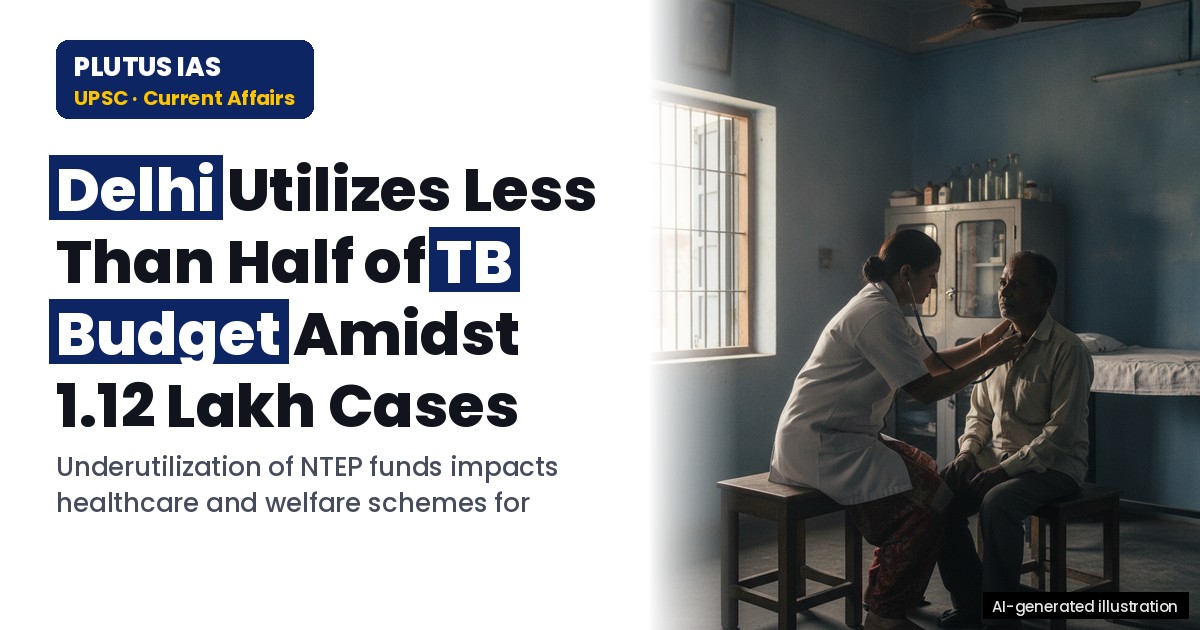
08 Nov Delhi’s TB Budget Underutilization: UPSC Economy Analysis
✎ The National Tuberculosis Elimination Programme (NTEP) is India's flagship initiative to achieve a TB-free nation by 2025, employing strategies such as universal drug susceptibility testing, early diagnosis, and nutritional…
Subject Relevance — Where This Topic Fits
- GS Paper II — Governance, Social Justice (Health) | GS Paper III — Indian Economy (Government Budgeting)
- Prelims: National Tuberculosis Elimination Programme (NTEP), Ni-kshay Poshan Yojana (NPY), Direct Benefit Transfer (DBT), TB Mukt Bharat Abhiyaan, Comptroller and Auditor General (CAG), Directorate General of Health Services (DGHS)
- Essay: Public Health and Governance Challenges in India, Effective Implementation of Social Welfare Schemes
Quick Revision: The National Tuberculosis Elimination Programme (NTEP) is India’s flagship initiative to achieve a TB-free nation by 2025, employing strategies such as universal drug susceptibility testing, early diagnosis, and nutritional support through the Ni-kshay Poshan Yojana, but faces persistent challenges in fund utilisation and implementation.
Why is this in the news?
Delhi has significantly underutilised its allocated budget for the National Tuberculosis Elimination Programme (NTEP), spending less than half of the approved funds in the past year. This underspending, amounting to approximately Rs 57 crore, occurred despite a substantial number of tuberculosis (TB) cases being notified in the capital, highlighting systemic issues in programme implementation and financial management.
Background
- The National Tuberculosis Elimination Programme (NTEP), formerly known as the Revised National Tuberculosis Control Programme (RNTCP), is India’s flagship public health initiative aimed at eradicating tuberculosis.
- India bears the highest burden of tuberculosis globally, accounting for a significant proportion of new cases and deaths worldwide, necessitating robust public health interventions.
- The Ni-kshay Poshan Yojana (NPY) provides nutritional support to TB patients through Direct Benefit Transfer (DBT), a critical component for improving treatment adherence and outcomes.
- The ‘TB Mukt Bharat Abhiyaan’ (Tuberculosis-Free India Campaign) aims to accelerate the country’s progress towards achieving the Sustainable Development Goal (SDG) target of ending the TB epidemic by 2030, with India setting an ambitious target of 2025.
- Reports from the Directorate General of Health Services (DGHS) and the Comptroller and Auditor General (CAG) have consistently flagged deficiencies in the implementation and fund utilisation of the NTEP at both national and state levels.
- Administrative bottlenecks, delays in procurement, gaps in digitisation, and challenges in beneficiary identification and Aadhaar-bank account linking have been identified as key contributors to the underutilisation of funds.
- Public awareness and education campaigns (IEC activities) are crucial for early detection and treatment adherence but have often been neglected, as highlighted by audit reports.
National Tuberculosis Elimination Programme (NTEP)
- The NTEP is a centrally sponsored scheme implemented by the Ministry of Health and Family Welfare, Government of India, in collaboration with state governments.
- Its primary objective is to achieve a TB-free India by 2025, five years ahead of the global SDG target.
- Key strategies include universal drug susceptibility testing, early diagnosis, prompt treatment with quality-assured drugs, and patient-centric care.
- The programme also focuses on active case finding, preventive treatment for contacts, and engagement of the private sector and community.
- The Ni-kshay portal serves as a national TB information system for patient management, monitoring, and reporting, facilitating data-driven decision-making.
- The Ni-kshay Poshan Yojana provides financial assistance of Rs 1,000 per month to all notified TB patients for the entire duration of their treatment, disbursed through DBT.
- ‘Ni-kshay Mitras’ (patient mentors) are community volunteers or organisations who provide nutritional, diagnostic, and vocational support to TB patients.
- The programme employs various diagnostic tools, including sputum smear microscopy, CBNAAT (Cartridge-Based Nucleic Acid Amplification Test), and TrueNat, for rapid and accurate diagnosis of TB and drug-resistant TB.
Key Features
| Feature | Significance |
|---|---|
| Underutilisation of Funds | Delhi utilised only 47.4% of its approved National Tuberculosis Elimination Programme (NTEP) funds in 2025, indicating a significant gap between allocation and expenditure. |
| Notified TB Cases | Despite the underutilisation of funds, 112,977 TB cases were notified in Delhi in 2025, highlighting the persistent burden of the disease. |
| Ni-kshay Poshan Yojana (NPY) | Provides nutritional support of Rs 1,000 per month to TB patients via Direct Benefit Transfer (DBT), crucial for treatment adherence and recovery. |
| TB Mukt Bharat Abhiyaan 2.0 | Focused on active case finding in high-risk populations, screening 3.45 lakh individuals and identifying 29,361 positive cases in vulnerable settings. |
| National Trend of Underspending | The underutilisation of TB funds in Delhi mirrors a broader national pattern, with the Union Health Ministry reporting similar trends in NTEP expenditure. |
Why it Matters
Public Health
- Underutilisation of funds directly impedes the efficacy of tuberculosis elimination efforts, potentially leading to higher disease prevalence and mortality rates.
- Delayed or insufficient nutritional support through schemes like Ni-kshay Poshan Yojana can compromise patient recovery and increase treatment dropout rates, fostering drug resistance.
- Ineffective implementation of screening and preventive treatment initiatives in high-risk areas allows for continued transmission and a sustained public health burden.
Governance and Administration
- Persistent administrative bottlenecks, procurement delays, and issues in fund disbursement highlight systemic inefficiencies within the healthcare delivery mechanism.
- The Comptroller and Auditor General (CAG) report’s findings on neglected public awareness campaigns indicate a failure in strategic communication and community engagement, critical for disease control.
- Challenges in digitisation and beneficiary identification for Direct Benefit Transfers (DBT) underscore the need for robust data management and interoperability across government systems.
Socio-Economic Impact
- Inadequate financial and nutritional support for TB patients exacerbates their socio-economic vulnerability, particularly for those in high-risk settings like slums and shelters.
- The failure to fully implement allocated programmes can perpetuate health inequalities, disproportionately affecting marginalised communities with limited access to healthcare.
- Unspent funds represent a missed opportunity to invest in healthcare infrastructure, research, and human resources, which are vital for long-term disease elimination goals.
Challenges
1. Administrative Bottlenecks and Fund Utilisation
- Significant underutilisation of allocated funds under the National Tuberculosis Elimination Programme (NTEP) due to administrative delays and inefficiencies.
- Delayed releases of funds to implementing agencies and lower expenditure by various TB centres and research institutions.
UPSC Link: Governance: mechanisms, laws, institutions and bodies constituted for the protection and betterment of vulnerable sections.
2. Direct Benefit Transfer (DBT) Implementation Issues
- Challenges in timely transfer of benefits under Ni-kshay Poshan Yojana due to beneficiaries lacking Aadhaar-bank account linkages.
- Gaps in digitisation and accurate beneficiary identification contributing to the shortfall in fund utilisation for nutritional support.
UPSC Link: Government policies and interventions for development in various sectors and issues arising out of their design and implementation.
3. Infrastructure and Procurement Delays
- Lower expenditure recorded by some TB centres and research institutions attributed to delays in procurement of essential equipment and infrastructure development.
- Poor equipping of many DOT centres and TB hospitals, impacting service delivery and patient care.
UPSC Link: Social Sector/Services: Health.
4. Public Awareness and Education Deficiencies
- Failure to conduct adequate public awareness and education campaigns (IEC) despite allocated funds, as highlighted by the CAG report.
- Minimal expenditure on IEC activities over a five-year period, indicating a lack of strategic communication for disease prevention and control.
UPSC Link: Role of NGOs, SHGs, various groups and associations, donors, charities, institutional and other stakeholders.
5. National Trend of Underspending
- The issue of unspent funds in Delhi reflects a broader national trend of underspending in the NTEP, indicating systemic challenges beyond a single administrative unit.
- Consistent underutilisation of approved budgets at the national level suggests a need for comprehensive review of programme implementation strategies.
UPSC Link: Issues relating to development and management of Social Sector/Services relating to Health.
Challenges — UPSC Perspective
| Issue | Concern |
|---|---|
| Underutilisation of NTEP Funds | Hinders the achievement of tuberculosis elimination targets and compromises public health outcomes. |
| DBT Implementation Gaps | Deprives vulnerable TB patients of crucial nutritional support, impacting treatment adherence and recovery. |
| Administrative Bottlenecks | Causes delays in programme execution, procurement, and infrastructure development, reducing operational efficiency. |
| Lack of Public Awareness Campaigns | Limits community engagement and knowledge about TB prevention, symptoms, and treatment, hindering early detection. |
| Poorly Equipped Health Facilities | Compromises the quality of diagnosis, treatment, and care provided at DOT centres and TB hospitals. |
Government Initiatives — Must-Memorise for Prelims
- National Tuberculosis Elimination Programme (NTEP)
- Ni-kshay Poshan Yojana (NPY)
- TB Mukt Bharat Abhiyaan 2.0
Way Forward
- Streamline fund release mechanisms and enhance financial management systems to ensure timely and efficient utilisation of allocated budgets.
- Strengthen digitisation efforts and Aadhaar-bank account linkage drives to ensure seamless and timely Direct Benefit Transfers (DBT) to beneficiaries.
- Address administrative bottlenecks by simplifying procurement procedures and expediting infrastructure development for TB centres and research institutions.
- Launch robust and sustained Information, Education, and Communication (IEC) campaigns to raise public awareness about TB, its prevention, and available support services.
- Enhance inter-departmental coordination between health, finance, and social welfare departments for integrated programme implementation.
- Conduct regular audits and performance reviews to identify specific implementation gaps and ensure accountability at all levels of programme delivery.
- Invest in capacity building for healthcare workers and community volunteers to improve active case finding, patient support, and treatment adherence.
UPSC Value Addition
Keywords for Mains Answer-Writing
National Tuberculosis Elimination Programme (NTEP) · Ni-kshay Poshan Yojana (NPY) · Direct Benefit Transfer (DBT) · Public Health Expenditure · Fund Utilisation Challenges · Administrative Bottlenecks · TB Mukt Bharat Abhiyaan · Disease Elimination Targets · Health Infrastructure Development · Comptroller and Auditor General (CAG) Report · Information, Education and Communication (IEC) · Healthcare Access
Constitutional & Policy Linkages
- Article 21: Right to life and personal liberty, encompassing the right to health.
- Article 47: Duty of the State to raise the level of nutrition and public health.
Concept Flow
Funds allocated for NTEP → Administrative bottlenecks and digitisation gaps → Underutilisation of funds → Delayed patient benefits and infrastructure development → Impeded TB elimination efforts
Prelims Practice Questions
Q1. Consider the following statements regarding the National Tuberculosis Elimination Programme (NTEP) and related initiatives:
1. The Ni-kshay Poshan Yojana (NPY) provides nutritional support to TB patients through Direct Benefit Transfer (DBT).
2. The amount provided under NPY was doubled from Rs. 500 to Rs. 1,000 per month in November 2024.
3. The TB Mukt Bharat Abhiyaan 2.0 focuses on active case finding in high-risk populations.
How many of the above statements are correct?
- Only one
- Only two
- Only three
- None
Answer: Only three — Statement 1 is correct: NPY provides nutritional support via DBT. Statement 2 is correct: The amount was indeed doubled to Rs. 1,000 per month in November 2024. Statement 3 is correct: TB Mukt Bharat Abhiyaan 2.0 includes active case finding in vulnerable settings.
Q2. Which of the following are identified as reasons for underutilisation of funds in public health programmes like the NTEP?
1. Delays in procurement and infrastructure development.
2. Gaps in digitisation and beneficiary identification.
3. Lack of public awareness and education campaigns.
Select the correct answer using the code given below:
- 1 and 2 only
- 2 and 3 only
- 1 and 3 only
- 1, 2 and 3
Answer: 1, 2 and 3 — All three statements are identified reasons for fund underutilisation in the context of the NTEP. Delays in procurement and infrastructure, gaps in digitisation and beneficiary identification (especially Aadhaar linkage for DBT), and inadequate public awareness campaigns (as flagged by CAG) all contribute to this issue.
Mains Practice Question
✍ Critically examine the factors contributing to the underutilisation of allocated funds in public health programmes in India, with specific reference to the National Tuberculosis Elimination Programme (NTEP). Suggest measures to enhance financial absorption and programme efficacy. (15 Marks)
Approach: MODEL-ANSWER SKELETON:
1. **Introduction:** Briefly define public health programmes and the significance of adequate fund utilisation for their success. Mention the context of NTEP’s fund underutilisation.
2. **Factors Contributing to Underutilisation (Critically Examine):**
* **Administrative Bottlenecks:** Delayed fund releases, complex bureaucratic procedures, lack of empowered implementing agencies.
* **Procurement Delays:** Challenges in acquiring equipment, medicines, and infrastructure development.
* **Beneficiary Identification and DBT Issues:** Gaps in digitisation, Aadhaar-bank account linkage problems, leading to non-disbursement of benefits (e.g., Ni-kshay Poshan Yojana).
* **Human Resource Shortages:** Insufficient trained personnel for programme implementation, monitoring, and reporting.
* **Planning and Implementation Gaps:** Inaccurate needs assessment, lack of capacity at grassroots level, poor coordination between central and state agencies.
* **Monitoring and Evaluation Deficiencies:** Weak oversight mechanisms, leading to undetected inefficiencies.
* **Information, Education, and Communication (IEC) Deficiencies:** Lack of effective public awareness campaigns, as highlighted by CAG reports, leading to lower demand for services or awareness of benefits.
3. **Impact of Underutilisation:** Delayed achievement of health targets (e.g., TB elimination by 2025), compromised patient care, erosion of public trust, economic burden due to prolonged illness.
4. **Measures to Enhance Financial Absorption and Programme Efficacy (Suggest Measures):**
* **Streamlining Financial Processes:** Timely fund release, simplified accounting and reporting mechanisms.
* **Strengthening DBT Framework:** Ensuring universal Aadhaar-bank linkage, robust grievance redressal for beneficiaries.
* **Capacity Building:** Training for programme managers, healthcare workers, and community volunteers.
* **Decentralised Planning and Implementation:** Empowering local bodies and health institutions.
* **Robust Monitoring and Evaluation:** Real-time data collection, regular audits (e.g., CAG recommendations), performance-linked funding.
* **Enhanced IEC Strategies:** Targeted campaigns to improve public awareness and engagement.
* **Inter-sectoral Convergence:** Collaboration with other departments for holistic patient support (e.g., nutrition, housing).
5. **Conclusion:** Reiterate the importance of efficient fund utilisation for achieving national health goals and ensuring equitable access to healthcare. Emphasise a multi-pronged approach combining administrative reforms, technological integration, and community engagement.
Source: The Indian Express
Generated by AanyaAi for educational purpose.
Related guides on our sites
- Best economics optional coaching for upsc
- Best economics optional teacher for upsc
- Best mentorship programme for upsc
- Best PSIR optional coaching in delhi for UPSC

- NAMASTE Scheme: Enhancing Sanitation Workers’ Livelihoods & Safety - November 14, 2026
- एमएसएमई का विशेष अभियान 6.0: स्वच्छता और लंबित मामलों का निपटारा - November 14, 2026
- Sea Vigil-26: Coastal Defence Drills Off Visakhapatnam - November 14, 2026

No Comments