


12 Nov Dewas Achieves Top Rank in Swachhata: Key Takeaways
✎ Swachh Survekshan is an annual cleanliness survey by MoHUA, evaluating urban areas on sanitation and waste management, with Dewas achieving top rank in its population category, underscoring the critical role of sanitation workers.
Subject Relevance — Where This Topic Fits
- GS Paper II — Governance, Social Justice, Welfare Schemes | GS Paper III — Environment, Disaster Management, Urban Planning
- Prelims: Swachh Survekshan, Urban Local Bodies (ULBs), Sanitation workers, Waste management, Sustainable Development Goals (SDGs), Swachh Bharat Abhiyan (Urban)
- Essay: The role of local governance and community participation in achieving national development goals., Sustainable urban development: Challenges and opportunities in India.
Quick Revision: Swachh Survekshan is an annual cleanliness survey by MoHUA, evaluating urban areas on sanitation and waste management, with Dewas achieving top rank in its population category, underscoring the critical role of sanitation workers.
Why is this in the news?
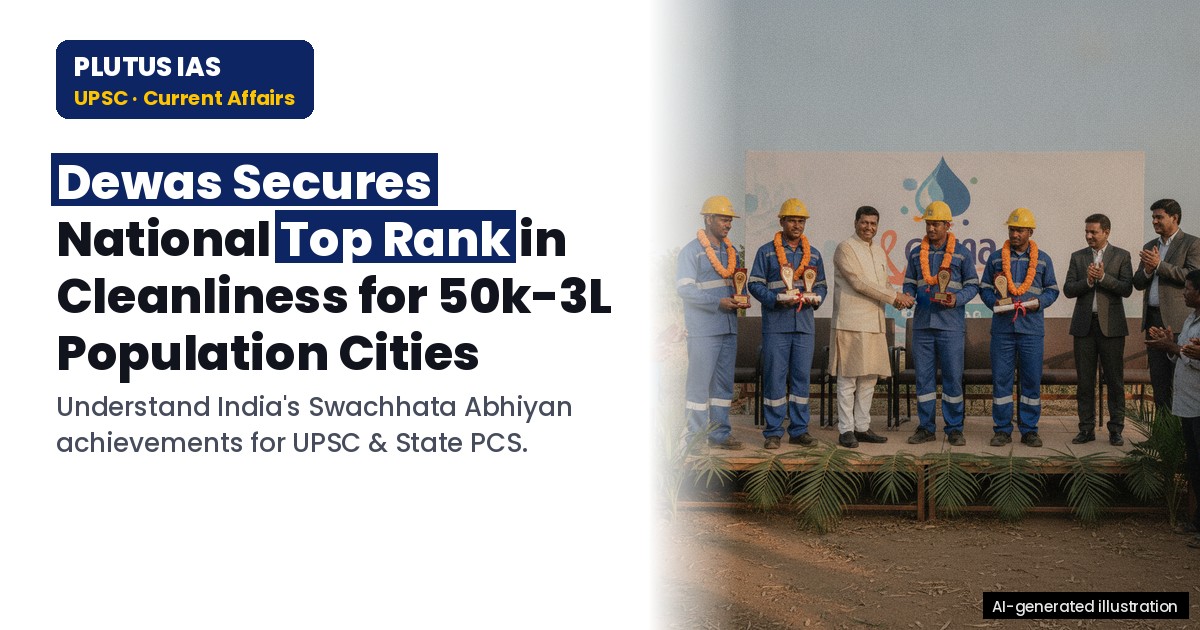
Dewas, a city in Madhya Pradesh, has achieved the first position nationally in the ‘50,000 to 3 lakh population’ category under the Swachh Survekshan awards. This recognition, presented by the President, underscores the city’s exemplary performance in urban sanitation and waste management. The achievement was celebrated with a felicitation ceremony for sanitation workers, acknowledging their pivotal role in this success, further highlighted by the Collector’s gesture of dining with them.
Background
- Swachh Bharat Abhiyan (SBA), launched on October 2, 2014, by the Government of India, aims to achieve universal sanitation coverage and eliminate open defecation.
- The mission is bifurcated into Swachh Bharat Abhiyan (Gramin) and Swachh Bharat Abhiyan (Urban), catering to rural and urban areas respectively.
- Swachh Survekshan is an annual survey conducted by the Ministry of Housing and Urban Affairs (MoHUA) under the Swachh Bharat Abhiyan (Urban) to assess the cleanliness, hygiene, and sanitation status of cities and towns in India.
- The survey encourages cities to improve urban sanitation, promotes citizen participation, and creates awareness among all sections of society about the importance of cleanliness.
- Performance in Swachh Survekshan is evaluated based on various parameters, including solid waste management, wastewater management, citizen feedback, and sustainable sanitation practices.
- The recognition of sanitation workers (Safai Mitras) is crucial, as they form the backbone of urban sanitation efforts, often working in challenging conditions.
What is Swachh Survekshan?
- Swachh Survekshan is an annual cleanliness survey conducted across urban India by the Ministry of Housing and Urban Affairs (MoHUA).
- It was first introduced in 2016 as a competitive framework to encourage cities to improve their sanitation and waste management services.
- The survey ranks cities based on various sanitation and cleanliness parameters, including waste collection, segregation, processing, and disposal.
- Key objectives include fostering a spirit of competition among cities, creating awareness among citizens, and validating the progress of the Swachh Bharat Abhiyan (Urban).
- The evaluation methodology includes direct observation, citizen feedback, and service level progress, which assesses the infrastructure and processes implemented by Urban Local Bodies (ULBs).
- It categorizes cities based on population size to ensure fair comparison and recognition of efforts across different scales of urban agglomerations.
- The survey has evolved over the years, incorporating new parameters like ‘Safai Mitra Suraksha’ to ensure the safety and dignity of sanitation workers.
- The ultimate goal is to move towards a ‘Garbage-Free’ and ‘Open Defecation Free (ODF)’ India, aligning with Sustainable Development Goal 6 (Clean Water and Sanitation).
Key Features
| Feature | Significance |
|---|---|
| National Recognition for Cleanliness | Deemed first in the 50,000 to 3 lakh population category, indicating effective urban sanitation management and community participation. |
| Acknowledgement of Sanitation Workers | Formal felicitation and public recognition of sanitation workers (safai karamcharis) by local administration and elected representatives, highlighting their pivotal role in urban cleanliness. |
| Civic Leadership Engagement | Participation of the District Collector, Mayor, and other officials in the felicitation ceremony, including the Collector sharing a meal with sanitation workers, symbolising administrative solidarity and appreciation. |
| Community and Collective Effort | Emphasis on the collective efforts of the municipal corporation, officials, and citizens, alongside sanitation workers, as crucial for achieving high cleanliness standards. |
| Implementation of National Directives | The achievement is attributed to the successful ground-level implementation of national cleanliness initiatives, aligning with broader governmental objectives. |
Why it Matters
Social Significance
- Elevates the social status and dignity of sanitation workers, who are often marginalised, by publicly acknowledging their indispensable contribution to urban well-being.
- Fosters a sense of community pride and collective responsibility towards maintaining public hygiene and cleanliness, essential for sustainable urban development.
- Promotes inclusive governance by demonstrating administrative recognition and engagement with all sections of the workforce contributing to public services.
Governance and Administrative Significance
- Showcases effective municipal governance and inter-departmental coordination in implementing sanitation programmes and achieving measurable outcomes.
- Provides a model for other urban local bodies (ULBs) on best practices in waste management, public engagement, and worker welfare, contributing to peer learning.
- Reinforces the importance of robust urban planning and resource allocation for sanitation infrastructure and services, crucial for improving quality of life.
Public Health Significance
- Improved sanitation directly contributes to better public health outcomes by reducing the incidence of communicable diseases and creating healthier living environments.
- Highlights the foundational role of basic urban services in disease prevention and overall community health, aligning with Sustainable Development Goal 3 (Good Health and Well-being).
- Encourages sustained efforts in waste segregation, collection, and disposal, which are critical components of a comprehensive public health strategy.
Challenges
1. Sustaining Cleanliness Standards
- Maintaining high cleanliness standards consistently over time requires continuous public participation, robust enforcement, and sustained political will.
- The challenge lies in preventing complacency and ensuring that initial successes translate into long-term behavioural changes and institutionalised practices.
UPSC Link: Urban Governance; Public Administration
2. Worker Welfare and Mechanisation
- Ensuring adequate safety equipment, fair wages, social security benefits, and opportunities for skill development for sanitation workers remains a persistent challenge.
- Transitioning from manual scavenging and hazardous work to mechanised cleaning processes requires significant investment in technology and retraining of the workforce.
UPSC Link: Social Justice; Labour Laws; Urban Development
3. Waste Management Infrastructure
- Developing and upgrading infrastructure for waste collection, segregation, processing, and disposal, including scientific landfills and waste-to-energy plants, is capital-intensive and complex.
- Managing increasing volumes of diverse waste streams, including plastic and electronic waste, poses significant logistical and environmental challenges.
UPSC Link: Urban Planning; Environmental Management; Infrastructure
4. Public Awareness and Behavioural Change
- Overcoming ingrained habits of littering and improper waste disposal requires continuous public awareness campaigns and community engagement initiatives.
- Ensuring active citizen participation in waste segregation at source and responsible waste management practices is crucial for the success of any cleanliness drive.
UPSC Link: Social Psychology; Public Policy; Citizen Participation
Challenges — UPSC Perspective
| Issue | Concern |
|---|---|
| Financial Sustainability of ULBs | Urban Local Bodies often face resource constraints in funding comprehensive sanitation programmes, including infrastructure development and operational costs. |
| Informal Waste Sector Integration | Integrating the informal waste pickers into the formal waste management system, ensuring their livelihoods and safety, is a complex socio-economic challenge. |
| Technological Adoption Gaps | Lack of access to modern waste management technologies and skilled personnel to operate them can hinder efficient and scientific waste processing. |
| Inter-Agency Coordination | Effective sanitation requires seamless coordination among various government departments, private entities, and community organisations, which can be challenging. |
| Land Availability for Waste Disposal | Securing suitable land for waste processing facilities and scientific landfills is increasingly difficult due to urbanisation and environmental concerns. |
Way Forward
- Implement robust monitoring and evaluation frameworks to track cleanliness standards and identify areas for continuous improvement.
- Invest in modern waste management technologies, including waste-to-energy plants and advanced recycling facilities, to enhance efficiency and sustainability.
- Strengthen the capacity of Urban Local Bodies through financial devolution, technical assistance, and training programmes for municipal staff.
- Launch sustained public awareness campaigns and educational programmes to foster a culture of cleanliness and responsible waste disposal among citizens.
- Ensure the welfare, safety, and dignity of sanitation workers by providing adequate protective gear, fair wages, social security, and opportunities for skill upgradation.
- Promote public-private partnerships (PPPs) in waste management to leverage private sector expertise, technology, and financial resources.
- Encourage citizen participation through community-led initiatives, resident welfare associations, and local self-help groups in maintaining urban hygiene.
- Develop comprehensive urban sanitation plans that integrate solid waste management, wastewater treatment, and public toilet facilities.
UPSC Value Addition
Keywords for Mains Answer-Writing
Swachh Bharat Abhiyan · Urban Local Bodies · Waste Management · Sanitation Workers · Public Participation · Sustainable Development Goals · Decentralised Governance · Civic Engagement
Constitutional & Policy Linkages
- {‘Article 243W’: ‘Powers of Municipalities’}
- {‘Article 243G’: ‘Powers of Panchayats’}
- {‘Twelfth Schedule’: ‘Public health, sanitation, conservancy’}
Concept Flow
National Cleanliness Initiative launched → Urban Local Bodies implement programmes → Sanitation workers perform essential duties → Community and administration collaborate → City achieves high cleanliness ranking → National recognition and awards received → Enhanced civic pride and public health
Prelims Practice Questions
Q1. Consider the following statements regarding the Swachh Bharat Abhiyan (SBA):
1. The Swachh Bharat Abhiyan was launched with the objective of achieving universal sanitation coverage.
2. The mission aims to make India Open Defecation Free (ODF) by 2nd October 2019.
3. The Swachh Bharat Abhiyan (Urban) is implemented by the Ministry of Housing and Urban Affairs.
How many of the above statements are correct?
- Only one
- Only two
- All three
- None
Answer: All three — Statement 1 is correct: SBA’s primary objective was indeed to achieve universal sanitation coverage. Statement 2 is correct: A key target of SBA was to achieve ODF status by Mahatma Gandhi’s 150th birth anniversary in 2019. Statement 3 is correct: The Swachh Bharat Abhiyan (Urban) is overseen by the Ministry of Housing and Urban Affairs, while the rural component is under the Ministry of Jal Shakti.
Q2. Which of the following initiatives is directly related to promoting cleanliness and sanitation in urban areas of India?
- Pradhan Mantri Gram Sadak Yojana
- National Health Mission
- Swachh Survekshan
- Jal Jeevan Mission
Answer: Swachh Survekshan — Swachh Survekshan is an annual survey conducted by the Ministry of Housing and Urban Affairs to assess and rank cities and towns across India based on sanitation and cleanliness. The other options are related to rural roads, health, and rural water supply, respectively.
Mains Practice Question
✍ Critically examine the role of Swachh Survekshan in fostering competitive federalism and improving urban sanitation outcomes in India. Discuss the challenges encountered in achieving sustainable cleanliness. (15 Marks)
Approach: MODEL-ANSWER SKELETON: Introduction: Briefly introduce Swachh Survekshan as a tool under Swachh Bharat Abhiyan (Urban). Role in Competitive Federalism: Discuss how the ranking system incentivises states and Urban Local Bodies (ULBs) to compete for better sanitation outcomes, leading to policy innovations and improved service delivery. Cite examples of cities like Devas (as per news) achieving high ranks. Role in Urban Sanitation Outcomes: Detail how the survey parameters (e.g., waste collection, processing, ODF status, citizen feedback) drive improvements in municipal solid waste management, infrastructure, and public behaviour. Challenges: Address issues such as data manipulation, sustainability of efforts beyond the survey period, capacity building for ULBs, financial constraints, behavioural change resistance, and ensuring equitable service delivery across all socio-economic strata. Conclusion: Summarise the dual impact of Swachh Survekshan as a catalyst for both competitive governance and tangible sanitation improvements, while acknowledging the need for sustained efforts and addressing systemic challenges for long-term impact.
Source: amarujala.com
Generated by AanyaAi for educational purpose.
Related guides on our sites
- Best sociology optional coaching
- Best coaching for sociology optional
- Best sociology optional coaching online
- is sociology good optional

- NAMASTE Scheme: Enhancing Sanitation Workers’ Livelihoods & Safety - November 14, 2026
- एमएसएमई का विशेष अभियान 6.0: स्वच्छता और लंबित मामलों का निपटारा - November 14, 2026
- Sea Vigil-26: Coastal Defence Drills Off Visakhapatnam - November 14, 2026

No Comments