


15 Sep Disha 2.0: Tele-Law Workshop in Nuh, Haryana for UPSC & State PCS
✎ Tele-Law under DISHA 2.0 is a digital legal aid initiative that leverages Common Service Centres and AI tools to provide free, timely, and accessible legal services to marginalised communities in rural India, thereby…
Subject Relevance — Where This Topic Fits
- GS Paper II — Governance, Constitution, Polity, Social Justice and International Relations | GS Paper III — Science and Technology (Digital Governance) | GS Paper IV — Ethics, Integrity and Aptitude (Public Service Delivery)
- Prelims: Tele-Law, DISHA 2.0, Common Service Centres (CSCs), Legal Services Authorities Act, 1987, Nyaya Bandhu, Village Level Entrepreneurs (VLEs), Tele-Law Portal, Nyaya Setu AI Chatbot
- Essay: Digital Public Infrastructure and Social Justice: Bridging the Legal Divide in Rural India, Technology as an Enabler of Constitutional Rights: The Case of Legal Empowerment
Quick Revision: Tele-Law under DISHA 2.0 is a digital legal aid initiative that leverages Common Service Centres and AI tools to provide free, timely, and accessible legal services to marginalised communities in rural India, thereby operationalising the constitutional mandate of equal justice under Article 39A.
Why is this in the news?
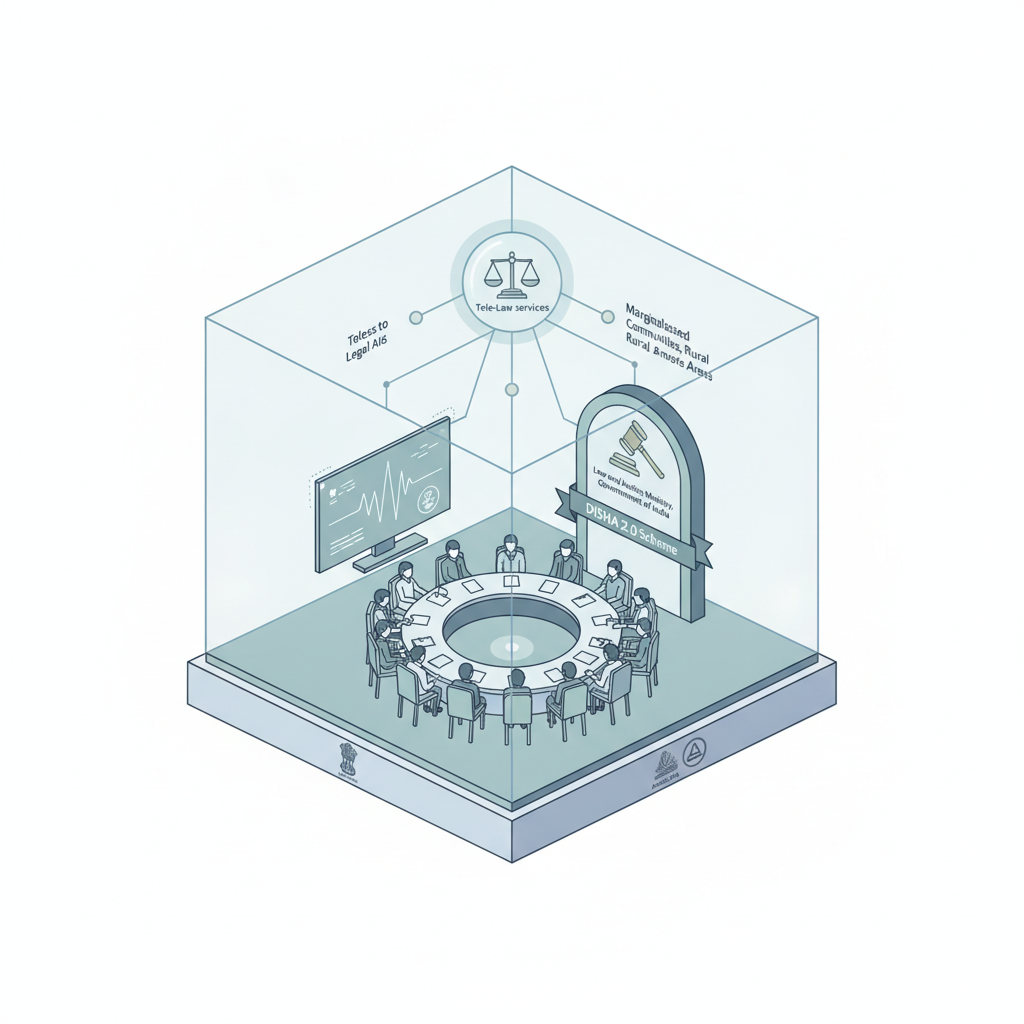
The Law and Justice Ministry, Government of India, organised an officer-level awareness workshop on 15 September 2026 in Nuh, Haryana, under the Tele-Law initiative of the DISHA 2.0 (Designing Innovative Solutions for Holistic Access to Justice) scheme. The workshop aimed to sensitise stakeholders—including district officials, CSC representatives, Village Level Entrepreneurs (VLEs), panel lawyers, and legal assistants—on the operationalisation of Tele-Law services to enhance access to legal aid, particularly for marginalised communities in rural and remote areas. This initiative underscores the government’s commitment to leveraging digital governance to realise the constitutional mandate of equal justice under Article 39A of the Constitution of India.
Background
- The Constitution of India, through Article 39A, enshrines the directive principle of equal justice and free legal aid, mandating the State to ensure that the legal system promotes justice on the basis of equal opportunity.
- The Legal Services Authorities Act, 1987, established the National Legal Services Authority (NALSA) and State Legal Services Authorities (SLSA) to provide free and competent legal services to the weaker sections of society.
- The Tele-Law programme, launched in 2017, is a flagship initiative of the Department of Justice, Ministry of Law and Justice, to connect marginalised communities with legal aid through Common Service Centres (CSCs) and panel lawyers via video conferencing and telecommunication.
- DISHA 2.0, an evolution of the DISHA scheme (2021), is a comprehensive framework under the Department of Justice to integrate digital and technological solutions for holistic access to justice, including Tele-Law, Nyaya Bandhu, Legal Literacy and Legal Awareness Programmes (LLLAP).
- The Common Service Centres (CSCs) scheme, implemented under the Digital India programme, serves as the last-mile delivery mechanism for various government services, including Tele-Law, in rural and remote areas.
- The Government of India has been progressively expanding the reach of Tele-Law services, with over 100,000 CSCs across the country providing legal aid to citizens, particularly in districts with low lawyer-to-population ratios.
What is Tele-Law under DISHA 2.0?
- Tele-Law is a digital legal aid service that connects citizens in rural and remote areas with panel lawyers through video conferencing at Common Service Centres (CSCs), enabling timely and affordable legal advice and assistance.
- The initiative operates under the aegis of the Department of Justice, Ministry of Law and Justice, and is implemented in collaboration with NALSA, State Legal Services Authorities, and CSC e-Governance Services India Limited.
- Tele-Law services are provided free of cost to eligible beneficiaries, including women, Scheduled Castes, Scheduled Tribes, senior citizens, persons with disabilities, and other marginalised groups, as per the Legal Services Authorities Act, 1987.
- The programme utilises a robust digital infrastructure, including the Tele-Law portal and the Nyaya Setu AI-powered chatbot, to facilitate seamless communication between citizens and legal service providers, thereby reducing the digital divide in legal access.
- DISHA 2.0 integrates Tele-Law with other justice-delivery mechanisms such as Nyaya Bandhu (pro bono legal services) and Legal Literacy and Legal Awareness Programmes (LLLAP), creating a multi-dimensional approach to access to justice.
- The role of Village Level Entrepreneurs (VLEs) is pivotal in the Tele-Law ecosystem, as they serve as the first point of contact for citizens seeking legal aid, assisting in registration, scheduling appointments, and providing guidance on the use of digital platforms.
- The programme also includes capacity-building initiatives for stakeholders, such as training sessions for VLEs, panel lawyers, and government officials, to ensure effective utilisation of digital tools and adherence to legal service standards.
- Tele-Law has been particularly impactful in districts with low lawyer density, such as Nuh in Haryana, where the scheme has enabled citizens to access legal advice without the need for physical travel to distant courts or legal aid centres.
Key Features
| Feature | Significance |
|---|---|
| Tele-Law Programme | Provides pre-litigation legal advice to marginalised communities through digital platforms, reducing barriers to justice. |
| DISHA 2.0 Scheme | Integrates Tele-Law, Nyaya Bandhu, and Legal Literacy programmes under a unified framework for holistic access to justice. |
| Common Service Centres (CSCs) | Serve as last-mile delivery points for legal services, leveraging Village Level Entrepreneurs (VLEs) to bridge digital and geographical divides. |
| Nyaya Setu AI Chatbot | Facilitates real-time legal guidance by providing automated responses to citizen queries on legal rights and procedures. |
| Legal Awareness Programmes (LLLAP) | Empowers citizens with foundational legal knowledge to navigate the justice system effectively. |
Why it Matters
Judicial Governance
- Enhances equitable access to legal services by leveraging technology to overcome physical and administrative barriers.
- Strengthens the principle of ‘Access to Justice’ as enshrined in Article 39A of the Constitution of India.
- Reduces pendency in lower courts by enabling pre-litigation legal guidance and dispute resolution.
Digital Public Infrastructure
- Demonstrates the role of digital governance in delivering citizen-centric services, aligning with the vision of ‘Digital India’.
- Showcases the integration of AI (Nyaya Setu Chatbot) and telecommunication networks to deliver scalable legal solutions.
- Highlights the importance of last-mile connectivity through CSCs and VLEs in rural and remote regions.
Social Justice
- Addresses the legal needs of socio-economically disadvantaged groups, including women, Scheduled Castes, Scheduled Tribes, and marginalised communities.
- Promotes legal empowerment by providing awareness and advisory services at the grassroots level.
- Supports the Sustainable Development Goal 16 (Peace, Justice, and Strong Institutions) by improving access to legal remedies.
Challenges
1. Digital Divide and Infrastructure Gaps
- Limited internet penetration and digital literacy in rural areas hinder the effective utilisation of Tele-Law services.
- Dependence on CSCs and VLEs may exclude communities lacking nearby service centres or with low digital literacy.
UPSC Link: GS-II: Governance, e-governance
2. Awareness and Trust Deficits
- Low awareness among potential beneficiaries about the availability and benefits of Tele-Law services.
- Skepticism towards digital legal services due to lack of familiarity or perceived complexity.
UPSC Link: GS-II: Social Justice
3. Resource Constraints
- Insufficient number of panel lawyers and legal aid providers to meet the demand in remote areas.
- Limited funding and capacity for scaling up digital infrastructure and training programmes.
UPSC Link: GS-II: Government Policies
4. Data Privacy and Security
- Risks associated with handling sensitive legal data through digital platforms, necessitating robust cybersecurity measures.
- Ensuring compliance with data protection laws such as the Digital Personal Data Protection Act, 2023.
UPSC Link: GS-II: Governance
5. Inter-departmental Coordination
- Need for seamless coordination between the Ministry of Law and Justice, state governments, and grassroots stakeholders for effective implementation.
- Challenges in aligning Tele-Law with other legal aid programmes like Nyaya Bandhu and Legal Services Authorities.
UPSC Link: GS-II: Centre-State Relations
Challenges — UPSC Perspective
| Issue | Concern |
|---|---|
| Digital Literacy | Low awareness and skills among rural populations to utilise digital legal services. |
| Infrastructure Deficit | Inadequate internet connectivity and device availability in remote areas. |
| Human Resource Shortage | Limited number of legal aid providers and trained VLEs for service delivery. |
| Trust and Perception | Lack of confidence in digital legal services due to unfamiliarity or misinformation. |
| Regulatory Compliance | Ensuring adherence to data privacy laws while delivering digital legal services. |
Government Initiatives — Must-Memorise for Prelims
- Tele-Law Programme
- DISHA 2.0 Scheme
- Nyaya Bandhu
- Legal Literacy and Legal Awareness Programmes (LLLAP)
Way Forward
- Strengthen digital infrastructure in rural and remote areas through targeted investments in connectivity and device accessibility.
- Expand awareness campaigns using local languages and community leaders to build trust in digital legal services.
- Enhance the capacity of CSCs and VLEs through regular training programmes on legal service delivery and digital tools.
- Increase the number of panel lawyers and legal aid providers in underserved regions to meet demand.
- Develop a robust grievance redressal mechanism for addressing issues related to service delivery and data security.
- Integrate Tele-Law with other welfare schemes to create a unified platform for citizen-centric legal services.
- Leverage AI and data analytics to identify gaps in service delivery and improve programme efficiency.
- Promote public-private partnerships to scale up digital legal services and ensure sustainability.
UPSC Value Addition
Keywords for Mains Answer-Writing
Tele-Law initiative · DISHA 2.0 scheme · Access to Justice · Digital Legal Services · Common Service Centres (CSCs) · Village Level Entrepreneurs (VLEs) · Legal Aid and Awareness · Justice Department initiatives · Justice Sanjeevini · Nyaya Bandhu · Legal Literacy and Legal Awareness Programmes (LLLAP) · Digital Platforms for Legal Services · Holistic Access to Justice · Ministry of Law and Justice · Justice Delivery System · Gram Nyayalayas and Alternate Dispute Resolution
Constitutional & Policy Linkages
- Article 39A: Directive Principle of State Policy on equal justice and free legal aid.
Concept Flow
Marginalised communities face barriers to legal services due to geographical and socio-economic constraints. → Government launches Tele-Law under DISHA 2.0 to provide pre-litigation legal advice via digital platforms. → CSCs and VLEs act as last-mile delivery points, leveraging technology to bridge access gaps. → Nyaya Setu AI Chatbot and Tele-Law portal enable real-time legal guidance and dispute resolution. → Legal awareness programmes (LLLAP) empower citizens with foundational knowledge of their rights. → Implementation challenges such as digital divide, awareness deficits, and resource constraints are addressed through targeted interventions. → Outcome: Enhanced access to justice, reduced pendency, and improved legal empowerment for marginalised groups.
Prelims Practice Questions
Q1. Consider the following statements regarding the Tele-Law initiative under the DISHA 2.0 scheme:
1. Tele-Law services are provided through Common Service Centres (CSCs) to enhance access to legal services in rural and remote areas.
2. The initiative is implemented by the Ministry of Law and Justice, Government of India.
3. Tele-Law services are exclusively available to citizens residing in urban areas.
4. The scheme includes the use of AI-powered tools like the Nyaya Setu chatbot to facilitate legal assistance.
How many of the above statements are correct?
- Only one
- Only two
- Only three
- All four
Answer: Only three — Statements 1, 2, and 4 are correct. Statement 3 is incorrect as Tele-Law services are specifically designed to cater to rural and remote areas. The initiative leverages CSCs and technology to bridge the urban-rural divide in legal service delivery.
Q2. Assertion (A): The DISHA 2.0 scheme aims to provide holistic access to justice through integrated implementation of initiatives like Tele-Law, Nyaya Bandhu, and Legal Literacy and Legal Awareness Programmes (LLLAP).
Reason (R): The scheme is designed to address the challenges of legal service delivery in rural and remote areas by leveraging digital platforms and community-based institutions.
In the context of the above two statements, which one of the following is correct?
- Both A and R are true, and R is the correct explanation of A.
- Both A and R are true, but R is not the correct explanation of A.
- A is true, but R is false.
- A is false, but R is true.
Answer: Both A and R are true, and R is the correct explanation of A. — Both the Assertion (A) and Reason (R) are true, and the Reason (R) correctly explains the Assertion (A). The DISHA 2.0 scheme integrates multiple initiatives to ensure holistic access to justice, particularly in underserved regions, by using digital tools and community networks.
Q3. Match the following initiatives under the DISHA 2.0 scheme with their respective objectives:
Column I (Initiative) Column II (Objective)
A. Tele-Law 1. Providing free legal aid to marginalized sections
B. Nyaya Bandhu 2. Enhancing legal literacy and awareness
C. Legal Literacy and Legal Awareness Programmes (LLLAP) 3. Facilitating virtual legal consultation
D. Justice Sanjeevini 4. Streamlining access to legal information and services through digital platforms
Select the correct match:
- A-3, B-1, C-2, D-4
- A-1, B-2, C-3, D-4
- A-4, B-3, C-2, D-1
- A-2, B-4, C-1, D-3
Answer: A-3, B-1, C-2, D-4 — The correct matches are: A. Tele-Law (3. Facilitating virtual legal consultation), B. Nyaya Bandhu (1. Providing free legal aid to marginalized sections), C. Legal Literacy and Legal Awareness Programmes (LLLAP) (2. Enhancing legal literacy and awareness), and D. Justice Sanjeevini (4. Streamlining access to legal information and services through digital platforms).
Mains Practice Question
✍ The DISHA 2.0 scheme represents a transformative approach to enhancing access to justice in India by integrating digital platforms, community-based institutions, and legal awareness programmes. Critically examine the role of the Tele-Law initiative in bridging the urban-rural divide in legal service delivery. Also, assess the challenges in its implementation and suggest measures to strengthen its outreach. (15 Marks)
Approach: MODEL-ANSWER SKELETON:
1. **Introduction (2 Marks)**
– Briefly define the DISHA 2.0 scheme and its objectives under the Ministry of Law and Justice.
– Highlight the significance of the Tele-Law initiative in the context of India’s justice delivery system, particularly for rural and remote areas.
2. **Role of Tele-Law in Bridging the Urban-Rural Divide (5 Marks)**
– Explain the mechanism of Tele-Law: virtual legal consultation via Common Service Centres (CSCs) and Village Level Entrepreneurs (VLEs).
– Discuss how Tele-Law leverages digital platforms (e.g., Tele-Law portal, Nyaya Setu chatbot) to provide timely and affordable legal services.
– Cite the role of CSCs and VLEs as grassroots-level facilitators in enhancing legal literacy and awareness.
– Reference the recent officer-level awareness workshop in Nuh, Haryana, as a case study of stakeholder engagement.
3. **Challenges in Implementation (5 Marks)**
– **Digital Divide**: Limited internet connectivity and digital literacy in rural areas.
– **Awareness Gaps**: Inadequate outreach and sensitization among rural populations about available legal services.
– **Resource Constraints**: Shortage of panel lawyers and legal aid providers in remote regions.
– **Infrastructure Deficits**: Insufficient CSCs and VLEs in certain areas.
– **Legal Literacy**: Low awareness of legal rights and entitlements among marginalized communities.
4. **Measures to Strengthen Outreach (3 Marks)**
– **Capacity Building**: Training and incentivizing VLEs and CSCs to act as legal literacy champions.
– **Community Engagement**: Collaborating with local self-government institutions (e.g., Panchayati Raj) for grassroots mobilization.
– **Technology Integration**: Expanding offline-capable digital tools (e.g., mobile applications) to address connectivity issues.
– **Partnerships**: Leveraging NGOs, civil society organizations, and educational institutions for awareness campaigns.
– **Monitoring and Evaluation**: Establishing a robust feedback mechanism to assess service delivery and address bottlenecks.
5. **Conclusion (2 Marks)**
– Summarize the transformative potential of Tele-Law in democratizing access to justice.
– Emphasize the need for a multi-stakeholder approach to ensure sustainable and inclusive implementation.
Source: PIB (Press Information Bureau)
Haryana PCS (HPSC / HCS) — State PCS Practice
Prelims: Under the ‘Disha 2.0’ scheme, the Ministry of Law and Justice organized an officer-level awareness workshop on Tele-Law services in which district of Haryana?
- A. Gurugram
- B. Nuh
- C. Karnal
- D. Hisar
Answer: B. Nuh — The workshop was specifically held in Nuh district, Haryana, under the Disha 2.0 scheme to promote Tele-Law services.
Mains: Discuss the significance of the ‘Disha 2.0’ scheme in enhancing access to legal services in Haryana, particularly through initiatives like Tele-Law. Highlight its potential impact on rural and underserved communities in the state.
Generated by AanyaAi for educational purpose.
Related guides on our sites
- Best PSIR optional coaching for upsc
- Best Law optional coaching for upsc
- Best PSIR optional teacher for upsc
- Best teacher of PSIR optional for upsc

- दिशा 2.0 योजना: नूंह में टेली-लॉ सेवाओं पर अधिकारियों को प्रशिक्षित किया गया - September 15, 2026
- Disha 2.0: Tele-Law Workshop in Nuh, Haryana for UPSC & State PCS - September 15, 2026
- एनएसटीएफडीसी-एचपीसीएल समझौते से राजस्थान के आदिवासी बच्चों को मिलेगी स्मार्ट शिक्षा - September 15, 2026

No Comments