


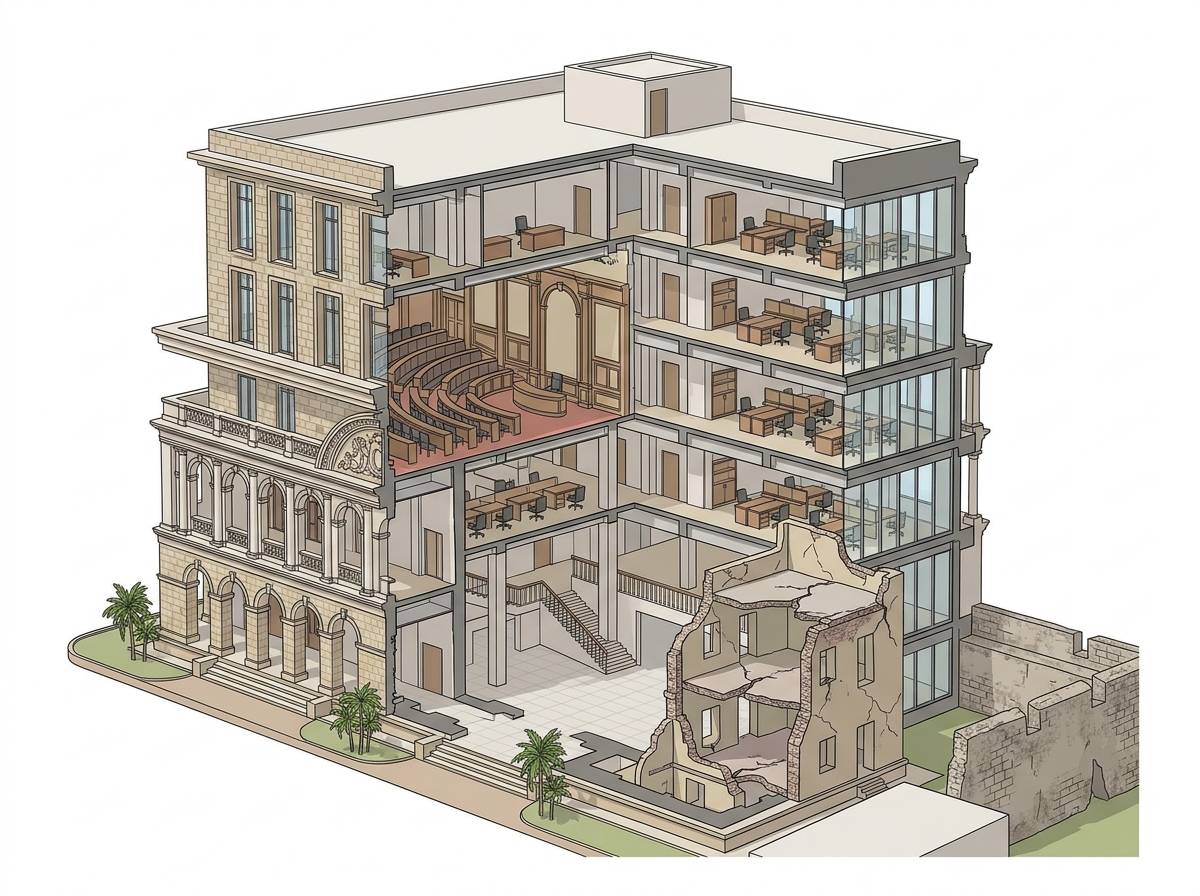
17 Sep DMK Proposes Heritage Structure at Fort St. George’s King’s Barracks
✎ The proposal for modifications or construction at the King's Barracks did not receive the approval of the defence authorities.
Subject Relevance — Where This Topic Fits
- GS Paper I — Indian Heritage and Culture | GS Paper II — Government Policies and Interventions | GS Paper III — Conservation and Environmental Issues
- Prelims: Fort St. George, Archaeological Survey of India (ASI), National Monuments Authority (NMA), Protected Monuments, 300-metre prohibited construction zone, King’s Barracks, Namakkal Kavignar Maaligai
- Essay: The paradox of development and conservation in India, Cultural heritage as a non-renewable resource
Quick Revision: The proposal for modifications or construction at the King’s Barracks did not receive the approval of the defence authorities.
Why is this in the news?
The Tamil Nadu government, led by the DMK, has proposed the construction of a heritage-compliant multi-storeyed structure at Fort St. George to address space constraints, replacing the dilapidated King’s Barracks. However, the proposal did not receive approval from the defence authorities. This highlights the broader challenge of reconciling heritage conservation with developmental needs in India’s urban and historical landscapes.
Background
- Fort St. George, established in 1644 by the British East India Company, is a historic fortress in Chennai and serves as the official seat of the Tamil Nadu government.
- The King’s Barracks, built in 1756 and extended in 1762, is a significant colonial-era structure within the fort, originally housing a royal regiment and later serving British battalions for over two centuries.
- The barracks are located behind the Namakkal Kavignar Maaligai, a 10-storeyed building within the fort complex, which itself faces space constraints.
- The Archaeological Survey of India (ASI) is the nodal agency responsible for the protection and conservation of the fort, classified as a protected monument under the AMASR Act, 1958.
- The National Monuments Authority (NMA) regulates construction activities within a 300-metre radius of protected monuments, imposing restrictions to prevent damage to heritage structures.
What is the King’s Barracks and the Fort St. George Complex?
- King’s Barracks is a colonial-era structure within Fort St. George, constructed in 1756 and extended in 1762, originally designed to house a royal regiment and later used by British battalions.
- The barracks are part of the larger Fort St. George complex, which includes administrative buildings, residential quarters, and heritage structures dating back to the 17th century.
- The Namakkal Kavignar Maaligai, a 10-storeyed building within the fort, was constructed to address space constraints but has itself become a subject of conservation concerns due to its proximity to heritage structures.
- The Archaeological Survey of India (ASI) is the custodian of the fort and is mandated to undertake conservation, preservation, and restoration of the monument and its surroundings.
- The defence authorities retain a hold over the building.
- The dilapidated condition of the King’s Barracks has raised concerns about structural safety, necessitating urgent conservation measures while balancing the need for functional space within the fort.
Key Features
| Feature | Significance |
|---|---|
| King’s Barracks, Fort St. George | Built in 1756 and extended in 1762, it is a historical military structure that housed British battalions for two centuries, reflecting colonial architectural heritage. |
| Protected Monument Status | Fort St. George is a protected monument under the Ancient Monuments and Archaeological Sites and Remains Act, 1958, placing it under the jurisdiction of the Archaeological Survey of India (ASI). |
| National Monuments Authority (NMA) Regulations | The NMA mandates a 300-meter no-construction zone around archaeological structures, restricting modifications to heritage sites. |
| Defence Authorities’ Jurisdiction | The Indian Army retains control over certain portions of the fort, necessitating dual approvals from both the Army and ASI for structural interventions. |
| Namakkal Kavignar Maaligai | A 10-storeyed administrative building within the fort, facing space constraints and structural challenges due to prolonged occupancy and limited maintenance. |
Why it Matters
Historical and Cultural
- Fort St. George is a symbol of India’s colonial past, with King’s Barracks representing the British military presence and administrative legacy in Madras Presidency.
- The fort’s heritage value is protected under national laws, necessitating preservation while balancing modern administrative needs.
- The proposed heritage structure could have integrated historical elements with contemporary functionality, enhancing the site’s cultural significance.
Administrative and Urban Planning
- The lack of space in the Secretariat and Assembly complex at Fort St. George has prompted discussions on relocating administrative functions to alternative sites like Omandurar Government Estate.
- The Marina-based Ezhilagam building has been considered for demolition to address space constraints, reflecting broader urban planning challenges in Chennai.
- The State government’s attempt to construct a horizontal heritage structure underscores the need for innovative space management in heritage zones.
Legal and Institutional
- The conflict between the ASI’s preservation mandate and the Army’s operational control highlights the challenges in managing multi-stakeholder heritage sites.
- The National Monuments Authority’s 300-meter no-construction zone imposes strict regulatory constraints, requiring careful planning for any structural interventions.
Challenges
1. Regulatory Constraints on Heritage Conservation
- The 300-meter no-construction zone around protected monuments restricts modern infrastructure development, complicating administrative and operational needs.
- Dual approval requirements from the ASI and defence authorities create bureaucratic delays and hinder timely conservation efforts.
UPSC Link: GS Paper 1: Indian Heritage and Culture
2. Structural Deterioration and Maintenance Gaps
- King’s Barracks is on the verge of collapse due to prolonged neglect and structural fatigue, necessitating urgent conservation measures.
- The ASI’s delayed renovation plans for the barracks highlight gaps in institutional coordination and resource allocation for heritage preservation.
UPSC Link: GS Paper 1: Indian Heritage and Culture
3. Space Constraints in Administrative Complexes
- The Secretariat and Assembly complex at Fort St. George faces acute space shortages, affecting operational efficiency and administrative workflows.
- The lack of consensus on relocating administrative functions to alternative sites like Omandurar Government Estate has stalled progress.
UPSC Link: GS Paper 2: Functions and Responsibilities of the Union and the States
4. Multi-Stakeholder Jurisdictional Conflicts
- The ASI’s assertion of full control over the fort premises as a protected monument conflicts with the Army’s operational jurisdiction, leading to administrative disputes.
- Differences in priorities between heritage conservation and operational needs of the Army exacerbate delays in structural interventions.
UPSC Link: GS Paper 2: Government Policies and Interventions
5. Public-Private Partnership Challenges
- The failure of past proposals to secure necessary approvals underscores the difficulties in implementing public-private partnerships for heritage conservation.
- The need for innovative funding models to address structural decay while adhering to regulatory constraints remains unmet.
UPSC Link: GS Paper 3: Conservation, Environmental Pollution and Degradation
Challenges — UPSC Perspective
| Issue | Concern |
|---|---|
| Regulatory Restrictions | 300-meter no-construction zone limits modern infrastructure development. |
| Institutional Coordination | Delays due to dual approvals from ASI and defence authorities. |
| Structural Decay | King’s Barracks on the verge of collapse due to prolonged neglect. |
| Space Management | Acute shortage of space in Secretariat and Assembly complex. |
| Jurisdictional Conflicts | ASI’s preservation mandate vs. Army’s operational control. |
| Funding Gaps | Lack of innovative models for heritage conservation projects. |
Way Forward
- Constitute a multi-stakeholder committee comprising ASI, Army, State government, and heritage conservation experts to streamline approval processes for structural interventions.
- Undertake immediate structural assessments of King’s Barracks and prioritise emergency conservation measures to prevent further deterioration.
- Explore the feasibility of relocating administrative functions to alternative sites like Omandurar Government Estate, with clear timelines and consensus-building mechanisms.
- Develop a heritage-compatible design framework for Fort St. George that integrates modern administrative needs with historical preservation.
- Engage with the National Monuments Authority to explore zonal relaxation for heritage structures, while ensuring compliance with conservation standards.
- Leverage corporate social responsibility (CSR) funds and public-private partnerships for heritage conservation, with transparent governance mechanisms.
- Conduct a comprehensive urban planning study for Chennai’s heritage zones to address space constraints and propose sustainable solutions.
- Enhance public awareness campaigns to highlight the cultural significance of Fort St. George and garner support for conservation efforts.
UPSC Value Addition
Keywords for Mains Answer-Writing
Fort St. George · King’s Barracks · heritage conservation · National Monuments Authority · Archaeological Survey of India · protected monuments · 300-metre prohibited construction zone · Fort St. George conservation · heritage structures in India · governance of archaeological sites · heritage legislation in India · protected area restrictions under the AMASR Act · Fort St. George history · heritage management in Tamil Nadu · heritage governance conflicts
Constitutional & Policy Linkages
- Article 49: Protection of monuments and places and objects of national importance.
Concept Flow
Colonial-era military structure (King’s Barracks) → Designation as protected monument under Ancient Monuments and Archaeological Sites and Remains Act, 1958 → Jurisdictional control by ASI and defence authorities → Structural deterioration due to neglect → State government’s proposal for heritage-compatible structure → Regulatory constraints (300-meter no-construction zone) → Approval delays and conflicts → Urgent need for conservation and space management solutions.
Prelims Practice Questions
Q1. Consider the following statements regarding the conservation of Fort St. George, Chennai:
1. Fort St. George is a protected monument under the Ancient Monuments and Archaeological Sites and Remains (AMASR) Act, 1958.
2. The Archaeological Survey of India (ASI) has jurisdiction over the entire premises of Fort St. George as per the AMASR Act.
3. Construction activities within a 300-metre radius of a protected monument are prohibited under the AMASR Act.
4. The National Monuments Authority (NMA) is responsible for granting permission for repairs within the prohibited zone.
How many of the above statements are correct?
- Only one
- Only two
- Only three
- All four
Answer: All four — Statements 1, 3, and 4 are correct. Statement 2 is incorrect because the ASI’s jurisdiction is limited to the protected monument itself, while the State government and the Army are occupants of the surrounding areas.
Q2. Assertion (A): The King’s Barracks at Fort St. George cannot be demolished or replaced without the approval of the Archaeological Survey of India (ASI).
Reason (R): Fort St. George is a protected monument under the Ancient Monuments and Archaeological Sites and Remains (AMASR) Act, 1958, and any structural intervention requires ASI’s permission.
Options:
A. Both A and R are true, and R is the correct explanation of A.
B. Both A and R are true, but R is not the correct explanation of A.
C. A is true, but R is false.
D. A is false, but R is true.
Answer: ? — Both the assertion and reason are true, and the reason correctly explains the assertion. The ASI’s approval is mandatory for any structural intervention in a protected monument under the AMASR Act.
Q3. Match the following columns related to heritage conservation in India:
Column I
1. Fort St. George, Chennai
2. Taj Mahal, Agra
3. Konark Sun Temple, Odisha
4. Hampi, Karnataka
Column II
A. Protected under the AMASR Act, 1958
B. Declared a UNESCO World Heritage Site
C. Managed by the State Archaeology Department
D. Part of the ‘Adarsh Smarak’ scheme
Select the correct match:
- 1-A, 2-B, 3-D, 4-C
- 1-B, 2-A, 3-D, 4-C
- 1-A, 2-B, 3-C, 4-D
- 1-D, 2-B, 3-A, 4-C
Answer: 1-A, 2-B, 3-D, 4-C — 1-A (Fort St. George is protected under the AMASR Act), 2-B (Taj Mahal is a UNESCO World Heritage Site), 3-D (Konark Sun Temple is part of the Adarsh Smarak scheme), 4-C (Hampi is managed by the State Archaeology Department).
Mains Practice Question
✍ The conservation of heritage structures within protected archaeological sites in India is governed by a complex interplay of statutory provisions, institutional jurisdictions, and governance challenges. Critically examine this proposition with reference to the ongoing conservation efforts at Fort St. George, Chennai, including the constraints imposed by the Ancient Monuments and Archaeological Sites and Remains (AMASR) Act, 1958, and the roles of the Archaeological Survey of India (ASI), the National Monuments Authority (NMA), and the State government. (15 Marks)
Approach: [{‘heading’: ‘Introduction (2 marks)’, ‘content’: [‘Define heritage conservation in the context of protected monuments under the AMASR Act, 1958. State the significance of Fort St. George as a protected monument and its historical importance (built in 1756, extended in 1762). Mention the recent proposal to replace King’s Barracks with a heritage structure and the reasons behind it (space constraints, structural instability).’], ‘weight’: 2}, {‘heading’: ‘Legal and Institutional Framework (5 marks)’, ‘content’: [‘1. AMASR Act, 1958: Provisions for protection of monuments older than 100 years, prohibition of construction within 300 metres of a protected monument, and penalties for violations (Sections 20-22).\n2. Role of ASI: Jurisdiction over protected monuments, powers to regulate repairs and conservation (Section 14).\n3. Role of NMA: Granting permissions for repairs within the prohibited zone (Section 16).\n4. Role of State Government: Occupant of the premises but subject to ASI/NMA regulations.\n5. Conflicts: Differences between ASI and State government over jurisdiction and conservation priorities (e.g., ASI’s refusal to allow multi-storeyed structures).’], ‘weight’: 5}, {‘heading’: ‘Governance Challenges (4 marks)’, ‘content’: [‘1. Jurisdictional conflicts: ASI vs. State government vs. Defence authorities over control and conservation priorities.\n2. Structural instability: King’s Barracks on the verge of collapse, necessitating urgent conservation but constrained by legal restrictions.\n3. Space constraints: Limited space in Namakkal Kavignar Maaligai and the main fort block, leading to proposals for horizontal expansion.\n4. Public-private partnerships: Limited scope due to legal restrictions on commercial activities within prohibited zones.\n5. Lack of consensus: Political and bureaucratic disagreements over conservation vs. development priorities.’], ‘weight’: 4}, {‘heading’: ‘Way Forward and Conclusion (4 marks)’, ‘content’: [‘1. Strengthening inter-institutional coordination: ASI, NMA, State government, and local bodies must collaborate on conservation plans.\n2. Innovative conservation models: Explore heritage-sensitive urban planning within the 300-metre zone, such as adaptive reuse of existing structures.\n3. Public awareness and stakeholder engagement: Involve local communities, historians, and conservationists in decision-making.\n4. Legal reforms: Revisit the AMASR Act to balance conservation with developmental needs, possibly through zone-specific regulations.\n5. Case studies: Compare with successful heritage conservation projects in India (e.g., Chandni Chowk in Delhi, Bhubaneswar’s heritage city project). Conclude with the need for a balanced approach that respects both heritage conservation and modern governance imperatives.’], ‘weight’: 4}] [‘Ancient Monuments and Archaeological Sites and Remains (AMASR) Act, 1958’, ‘Sections 14, 16, 20-22’] [{‘view’: ‘Strict conservationist approach’, ‘content’: ‘Advocates for minimal intervention, prioritising structural stability and historical authenticity over modern development. Argues that the AMASR Act’s restrictions are necessary to prevent commercialisation and encroachment of heritage sites.’}, {‘view’: ‘Balanced development approach’, ‘content’: ‘Argues for a pragmatic balance between conservation and development, suggesting that adaptive reuse and innovative conservation models can address space constraints while preserving heritage. Cites examples like Chandni Chowk’s redevelopment.’}] [‘Legal consequences: Violations of the AMASR Act can lead to penalties, demolition orders, and criminal prosecution under Sections 20-22.’, ‘Governance consequences: Prolonged conflicts between institutions can delay conservation efforts and exacerbate structural decay.’, ‘Economic consequences: Restrictions on construction may limit tourism revenue and urban development opportunities.’]
Source: The Hindu
Generated by AanyaAi for educational purpose.
Related guides on our sites
- UPSC History optional
- Is history a good optional for upsc exam
- Best history optional teacher for UPSC
- How to prepare for GS paper 1 for UPSC CSE mains exam

- अल्लाहाबाद हाईकोर्ट का बड़ा फैसला: धर्म और जीवनसाथी चुनने का अधिकार - September 17, 2026
- Allahabad HC Upholds Adult’s Right to Choose Religion & Partner in UP Case - September 17, 2026
- खान मंत्रालय का विशेष अभियान 6.0: ई-कचरा प्रबंधन में बड़ा कदम - September 17, 2026

No Comments