


07 Aug DMK’s 3 Key Conditions for Supporting Delimitation Bill in Lok Sabha
✎ The 1976 freeze on delimitation, introduced via the 42nd Amendment, is set to expire post-2027 Census, necessitating legislative action to extend or modify it; the Constitution (131st Amendment) Bill 2026 seeks to do so.
Subject Relevance — Where This Topic Fits
- GS Paper II — Polity and Governance (Constitutional Amendments, Federalism) | GS Paper II — Indian Constitution (Delimitation Commission, Representation of People’s Act)
- Prelims: Delimitation Commission, Constitution (131st Amendment) Bill 2026, 1976 Constitutional freeze on seat allocation, Lok Sabha seat increase, Federalism and Centre-State relations, Parliamentary procedures for constitutional amendments
- Essay: Federalism in India: Balancing Centre-State Relations in Constitutional Reforms, Demographic Representation vs. Political Stability: The Case of Delimitation
Quick Revision: The 1976 freeze on delimitation, introduced via the 42nd Amendment, is set to expire post-2027 Census, necessitating legislative action to extend or modify it; the Constitution (131st Amendment) Bill 2026 seeks to do so.
Why is this in the news?
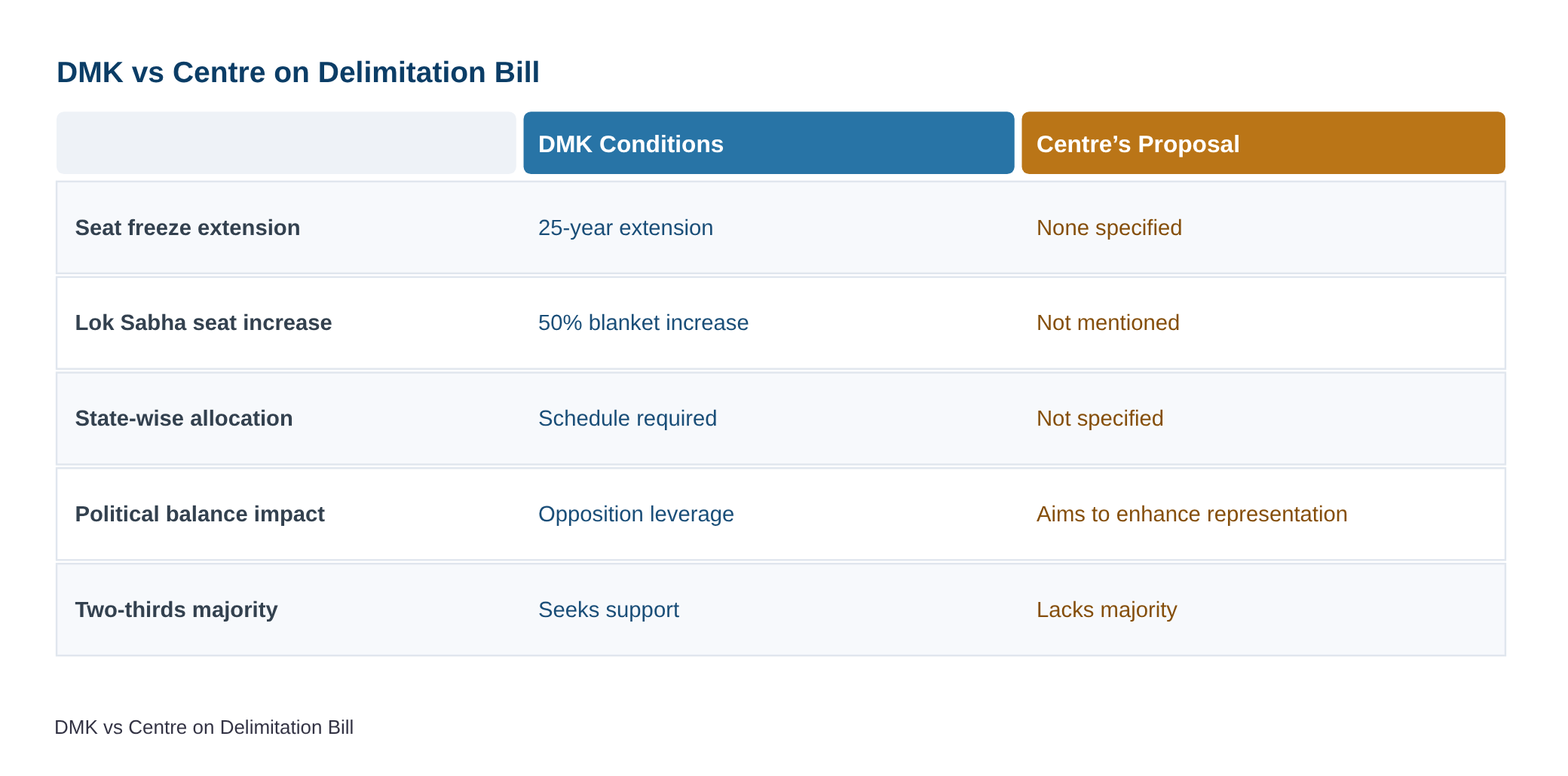
The Dravida Munnetra Kazhagam (DMK) has publicly articulated conditional support for the Centre’s proposed Delimitation Bill (Constitution (131st Amendment) Bill 2026), pending three critical revisions: a 25-year extension of the 1976 freeze on seat allocation, a 50% blanket increase in Lok Sabha seats across all states, and a schedule delineating state-wise seat allocations. This development is significant as it reflects the Opposition’s strategic engagement with a Bill that seeks to redraw electoral constituencies, potentially altering the political balance in Parliament. The Centre’s renewed outreach to Opposition parties, including the Congress, underscores the Bill’s contested nature and the numerical challenges in securing a two-thirds majority for constitutional amendments.
Background
- The Constitution (131st Amendment) Bill 2026 seeks to amend the Constitution to enable a fresh delimitation exercise, which has been frozen since 1976 based on the 1971 Census.
- The 1976 freeze was introduced via the 42nd Amendment Act to prevent demographic shifts from altering political representation disproportionately, particularly in southern states where population growth has slowed relative to northern states.
- The current Lok Sabha has 543 seats, with a two-thirds majority threshold set at 360 votes. The government lacks this majority, necessitating Opposition support or abstentions to pass the Bill.
- The INDIA bloc, an Opposition coalition, has grown numerically since the Bill’s initial defeat in April 2026, altering the political calculus for the Centre.
- Delimitation is constitutionally mandated to be based on the latest Census, which is expected to be completed in 2027. The freeze on seat allocation is set to expire post-Census, necessitating legislative action to extend or modify it.
- The Bill’s introduction follows the Centre’s stated objective of enhancing demographic representation, though critics argue it risks exacerbating regional imbalances in political power.
What is Delimitation and the Constitution (131st Amendment) Bill 2026?
- Delimitation refers to the process of redrawing the boundaries of parliamentary and assembly constituencies to reflect changes in population distribution, as mandated by the Constitution and the Representation of the People Act, 1950.
- The Constitution (131st Amendment) Bill 2026 proposes to amend Articles 81 and 82 of the Constitution to enable a fresh delimitation exercise, which has been frozen since the 42nd Amendment Act (1976) based on the 1971 Census.
- The DMK’s demand for a 25-year extension of the 1976 freeze aims to prevent the immediate redrawing of constituencies, which could disproportionately benefit states with higher population growth rates.
- Constitutional amendments under Article 368 require a two-thirds majority in both Houses of Parliament, making Opposition support critical for the Bill’s passage.
- The freeze on seat allocation was originally introduced to balance political representation between states with varying population growth rates, particularly to protect the interests of southern states where population growth has stabilised.
Key Features
| Feature | Significance |
|---|---|
| Proposed 50% blanket increase in Lok Sabha seats | Ensures proportional representation while addressing demographic changes and regional balance in Parliament. |
| Extension of 1976 freeze on seat delimitation for 25 years | Prevents frequent reallocation of seats, providing political stability and reducing administrative burden. |
| Demand for a Schedule of seats per State in the Bill | Clarifies distribution of seats, enabling informed debate and reducing ambiguity in the delimitation process. |
| DMK’s conditional support to the Bill | Demonstrates strategic bargaining by regional parties in coalition politics, influencing policy outcomes. |
| Government’s outreach to Opposition parties | Highlights the necessity of consensus in constitutional amendments, reflecting democratic negotiation. |
Why it Matters
Political Implications
- The DMK’s conditions underscore the influence of regional parties in shaping national legislative outcomes, particularly in constitutional amendments requiring supermajorities.
- A successful delimitation exercise could redefine political representation, benefiting states with higher population growth while potentially marginalising others.
- The government’s outreach to Opposition parties reflects the need for cross-party consensus in constitutional amendments, a hallmark of India’s federal democracy.
- The DMK’s demand for a seat schedule aligns with its long-standing advocacy for federal principles and equitable representation.
Constitutional and Electoral Reforms
- Delimitation is a critical electoral reform that redistributes seats based on population changes, ensuring fair representation in the Lok Sabha.
- The proposed 50% increase in seats addresses the growing electorate and prevents overcrowding in Parliament, enhancing democratic efficiency.
- Extending the 1976 freeze for 25 years introduces a long-term perspective to seat allocation, balancing immediate demographic shifts with stability.
- The demand for a seat schedule per State aligns with the principles of federalism, ensuring transparency and predictability in electoral reforms.
Federalism and Regional Dynamics
- The DMK’s stance highlights the tension between national-level reforms and regional aspirations, a recurring theme in India’s federal structure.
- Delimitation can alter the balance of power among states, with southern states potentially gaining seats due to higher population growth, while northern states may see relative decline.
- Regional parties like the DMK play a pivotal role in shaping national policies, reflecting the diversity of India’s political landscape.
Challenges
1. Lack of Consensus on Delimitation
- The Bill lacks two-thirds majority support in the Lok Sabha, necessitating negotiations with Opposition parties like the DMK and Congress.
- Opposition to constitutional amendments on delimitation stems from concerns over political representation and potential loss of influence for certain states.
- The government’s inability to secure early support underscores the challenges of coalition politics in passing critical reforms.
UPSC Link: GS II: Parliament and State Legislatures
2. Demographic and Regional Disparities
- Delimitation must balance population growth with fair representation, avoiding over-representation of states with slower population growth.
- Southern states, with lower fertility rates, may resist changes that reduce their relative political influence, while northern states with higher growth may demand greater representation.
- The DMK’s demand for a seat schedule reflects concerns over equitable distribution and transparency in seat allocation.
UPSC Link: GS I: Population and Associated Issues
3. Administrative and Logistical Hurdles
- Conducting a fresh delimitation exercise requires significant administrative resources, including Census data and boundary delineation.
- The proposed freeze extension adds complexity, requiring constitutional amendments and prolonged legislative debate.
- The government’s delay in formal outreach to the DMK highlights potential coordination challenges in policy implementation.
UPSC Link: GS II: Constitutional Framework
4. Legal and Constitutional Challenges
- Constitutional amendments on delimitation require a two-thirds majority in Parliament and ratification by state legislatures, posing a high bar for passage.
- The DMK’s demand for a seat schedule introduces legal questions on the scope of the amendment and its implications for federalism.
- Any delay in Census completion (expected 2027) could further complicate the delimitation timeline and political negotiations.
UPSC Link: GS II: Constitutional Amendments
Challenges — UPSC Perspective
| Issue | Concern |
|---|---|
| Two-thirds majority requirement | Government lacks sufficient support in Lok Sabha, necessitating Opposition backing for passage. |
| Regional disparities in seat allocation | Southern states may lose relative influence, while northern states gain seats, sparking political tensions. |
| DMK’s conditional support | Party’s demands (freeze extension, seat schedule) introduce additional hurdles for the government. |
| Congress’s opposition to constitutional amendments | Congress’s stance complicates consensus-building, reflecting broader Opposition resistance. |
| Administrative delays in Census completion | Delimitation timeline hinges on Census data, which may be delayed beyond 2027. |
| Federalism and state autonomy concerns | Delimitation raises questions about the Centre’s role in redistributing seats across states. |
Way Forward
- The government must initiate formal consultations with the DMK and other Opposition parties to address their demands on seat allocation and freeze extension.
- A detailed seat schedule per State should be prepared and shared with Parliament to facilitate informed debate and reduce ambiguity.
- The government should explore alternative strategies to secure a two-thirds majority, such as building consensus with regional parties beyond the DMK.
- Constitutional experts should review the proposed amendments to ensure compliance with federal principles and avoid legal challenges.
- The Census should be expedited to ensure timely availability of demographic data for delimitation purposes.
- Parliamentary debates on the Bill should include representations from state governments to reflect federal concerns.
- The government should consider phased implementation of delimitation to mitigate political resistance and administrative challenges.
- Civil society and think tanks should be engaged to assess the long-term implications of delimitation on political representation and democracy.
UPSC Value Addition
Keywords for Mains Answer-Writing
Delimitation Commission of India · Constitution (131st Amendment) Bill 2026 · Freeze on Lok Sabha seats · 1971 Census · Dravida Munnetra Kazhagam (DMK) political stance · Lok Sabha seat increase · Parliamentary form of government · Constitutional amendment process · Opposition unity and INDIA bloc · Federalism and State representation
Constitutional & Policy Linkages
- Article 82: Readjustment of seats in the Lok Sabha after each Census.
- Article 170: Composition of State Legislative Assemblies and delimitation of constituencies.
- Article 324: Role of the Election Commission in delimitation and electoral reforms.
Concept Flow
Initiation of delimitation process → Census data collection (2027) → Constitutional amendment proposal (131st Amendment) → Opposition demands (DMK conditions) → Government outreach to Opposition → Parliamentary debate and voting → Potential ratification by state legislatures → Implementation of new seat allocation
Prelims Practice Questions
Q1. Consider the following statements regarding the Delimitation Commission of India: 1. It is a statutory body constituted under the Delimitation Act, 2002. 2. The primary function of the Delimitation Commission is to readjust the division of territorial constituencies in India. 3. The Delimitation Commission operates under the supervision of the Election Commission of India. How many of the above statements are correct?
- Only one
- Only two
- All three
- None
Answer: Only two — Statement 1 is correct as the Delimitation Commission is indeed a statutory body under the Delimitation Act, 2002. Statement 2 is correct as its primary role is to readjust territorial constituencies. Statement 3 is incorrect because the Delimitation Commission does not operate under the Election Commission of India; it functions independently as per the Act.
Q2. Assertion (A): The freeze on the number of Lok Sabha seats based on the 1971 Census was introduced to prevent frequent changes in electoral boundaries. Reason (R): The freeze was implemented to ensure stability in political representation and avoid frequent revisions due to population shifts.
- Both A and R are true, and R is the correct explanation of A
- Both A and R are true, but R is not the correct explanation of A
- A is true, but R is false
- A is false, but R is true
Answer: Both A and R are true, and R is the correct explanation of A — Both the Assertion (A) and Reason (R) are true, and the Reason (R) correctly explains the Assertion (A). The freeze on Lok Sabha seats based on the 1971 Census was indeed introduced to prevent frequent changes in electoral boundaries and ensure stability in political representation.
Q3. Match the following pairs regarding the constitutional provisions related to delimitation:
Column I
A. Article 82
B. Article 170
C. Article 330
D. Article 332
Column II
1. Reservation of seats for Scheduled Castes and Scheduled Tribes in the Lok Sabha
2. Allocation of seats in the Legislative Assemblies of States
3. Readjustment of seats in the Lok Sabha after each Census
4. Reservation of seats for Scheduled Castes and Scheduled Tribes in the Legislative Assemblies of States
- A-3, B-2, C-1, D-4
- A-1, B-3, C-2, D-4
- A-2, B-1, C-4, D-3
- A-4, B-2, C-3, D-1
Answer: A-3, B-2, C-1, D-4 — The correct match is: A-3 (Article 82 pertains to the readjustment of seats in the Lok Sabha after each Census), B-2 (Article 170 pertains to the allocation of seats in the Legislative Assemblies of States), C-1 (Article 330 pertains to the reservation of seats for Scheduled Castes and Scheduled Tribes in the Lok Sabha), and D-4 (Article 332 pertains to the reservation of seats for Scheduled Castes and Scheduled Tribes in the Legislative Assemblies of States).
Mains Practice Question
✍ The proposed Constitution (131st Amendment) Bill, 2026 seeks to extend the freeze on the number of Lok Sabha seats based on the 1971 Census and introduce a blanket 50% increase in seats. Critically examine the constitutional, political, and federal implications of such an amendment in the context of contemporary Indian democracy. (15 Marks)
Approach: MODEL-ANSWER SKELETON:
1. **Constitutional Implications**:
– Article 82 and the 42nd Amendment (1976) froze the number of Lok Sabha seats based on the 1971 Census, with the freeze set to end post-2026 Census.
– The proposed amendment aims to extend this freeze for another 25 years, which would require a constitutional amendment (Article 368).
– The blanket 50% increase in seats is not constitutionally mandated but is a policy choice that must align with Articles 81 and 82.
– **Judicial Scrutiny**: The Supreme Court, in *S. R. Bommai v. Union of India* (1994), has held that constitutional amendments must not violate the basic structure of the Constitution. A prolonged freeze could be argued to dilute the principle of proportional representation.
2. **Political Implications**:
– **Executive-Legislative Balance**: The amendment centralises power in the Union government, as delimitation is a Union subject (List I, Seventh Schedule). This could further tilt the balance towards the Centre, raising concerns about federalism.
– **Opposition Dynamics**: The DMK’s conditions (freeze extension + seat increase) reflect regional parties’ concerns about under-representation. The INDIA bloc’s opposition to the Bill underscores the political fragmentation.
– **Electoral Strategy**: A seat increase could benefit parties with strong regional bases (e.g., DMK, TMC) while potentially diluting the BJP’s national dominance in the short term.
3. **Federal Implications**:
– **State Representation**: The freeze disproportionately benefits northern states (e.g., Uttar Pradesh, Bihar) with higher population growth, while southern states (e.g., Tamil Nadu, Kerala) argue for equitable representation.
– **Demographic Justice**: The 1971 Census freeze is criticised for ignoring subsequent demographic shifts, particularly the faster growth in northern states. A blanket 50% increase may not address this imbalance.
– **Regional Parties’ Concerns**: Parties like the DMK argue that the freeze and seat increase are attempts to consolidate power in the Centre, undermining state-level representation.
4. **Alternatives and Critiques**:
– **Gradual Increase**: Some scholars (e.g., Subhash Kashyap) advocate for a phased increase in seats to reflect demographic changes without disrupting federal balance.
– **Delimitation Commission Autonomy**: The current system, where the Delimitation Commission operates independently, could be strengthened to ensure fairness.
– **Constitutional Safeguards**: The amendment must include provisions to prevent arbitrary seat increases and ensure periodic review.
5. **Conclusion**:
– The amendment raises critical questions about federalism, proportional representation, and the balance of power between the Centre and States.
– While the freeze extension may provide stability, the blanket seat increase risks exacerbating regional imbalances and political tensions.
– A more nuanced approach, incorporating demographic data and federal consultations, is essential to uphold the spirit of the Constitution.
Source: The Hindu
Generated by AanyaAi for educational purpose.

- केरल लोक सेवा आयोग ने उच्च न्यायालय में दायर किया मामला, सदस्यों के खिलाफ मामला रद्द करने की मांग - September 23, 2026
- KPSC Challenges Prosecution Sanction in Kerala High Court: Key UPSC Polity Insight - September 23, 2026
- केरल में एंटीमाइक्रोबियल रेजिस्टेंस: सरकारी रिपोर्ट में चौंकाने वाले आँकड़े सामने - September 23, 2026

No Comments