


07 Aug DMK’s Conditions for Backing Delimitation Bill: Key Demands Explained
✎ The constitutional freeze on seat allocation, based on the 1971 Census, is a critical constraint in any delimitation exercise, and its extension or lifting requires a constitutional amendment, necessitating a two-thirds majority…
Subject Relevance — Where This Topic Fits
- GS Paper II — Polity and Governance (Constitutional Amendments, Federalism, Electoral Reforms) | GS Paper II — Parliament and State Legislatures (Delimitation, Representation) | GS Paper II — Federalism and Centre-State Relations
- Prelims: Delimitation Commission, 1976 Constitutional Amendment (42nd Amendment), Freeze on seat allocation (1971 Census), Lok Sabha seat increase (50% blanket increase), Constitution (131st Amendment) Bill, INDIA bloc, Parliamentary Affairs Minister, Two-thirds majority in Parliament
- Essay: Federalism in India: Balancing Unity and Diversity, Electoral Reforms and Democratic Representation: Challenges and Solutions
Quick Revision: The constitutional freeze on seat allocation, based on the 1971 Census, is a critical constraint in any delimitation exercise, and its extension or lifting requires a constitutional amendment, necessitating a two-thirds majority in Parliament.
Why is this in the news?
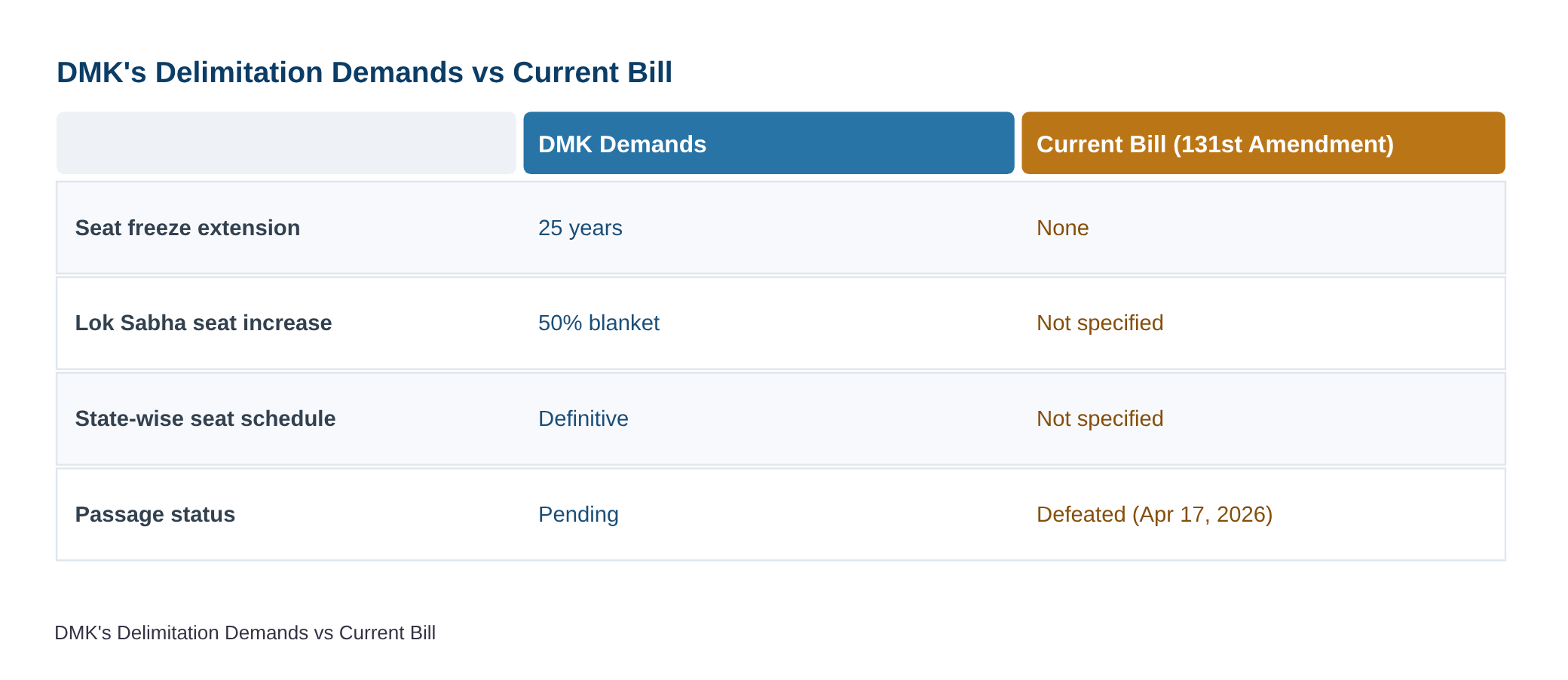
The Dravida Munnetra Kazhagam (DMK) has publicly articulated conditional support for the Centre’s proposed delimitation Bill, introducing three critical demands: extending the constitutional freeze on seat allocation by 25 years, ensuring a 50% blanket increase in Lok Sabha seats for all states, and providing a definitive schedule of seat allocation per state. These conditions underscore the DMK’s strategic calculus in balancing regional representation with national political dynamics, particularly as the government seeks to secure Opposition support amid shifting parliamentary arithmetic. The development also highlights the procedural and substantive challenges inherent in constitutional amendments, especially those requiring two-thirds majority approval in Parliament.
Background
- Delimitation exercises in India are conducted to redraw the boundaries of parliamentary and assembly constituencies based on the latest Census data, ensuring equitable representation.
- The 2024 general elections and subsequent political realignments have altered the numerical strength of the Opposition, particularly within the INDIA bloc, necessitating renewed negotiations for constitutional amendments.
- The Constitution (131st Amendment) Bill seeks to amend the Constitution to facilitate a fresh delimitation exercise, but it was defeated in the Lok Sabha on April 17, 2026.
- The DMK’s demands reflect broader concerns about regional representation, particularly in southern states, where population growth has been slower compared to northern states.
- The government’s outreach to Opposition parties, including the Congress and DMK, indicates a strategic attempt to build consensus for the Bill, despite lacking a two-thirds majority in the current Lok Sabha.
What is Delimitation and Why is it Significant?
- Delimitation is the process of redrawing the boundaries of parliamentary and assembly constituencies to reflect changes in population distribution, as mandated by the Constitution.
- The process is conducted by a Delimitation Commission, a statutory body established under the Delimitation Act, 2002, comprising a retired Supreme Court judge, the Chief Election Commissioner, and the respective state Election Commissioners.
- The constitutional freeze on seat allocation, imposed by the 42nd Amendment Act of 1976, prevents the reallocation of Lok Sabha seats based on subsequent Census data, thereby maintaining the seat distribution as per the 1971 Census until the freeze is lifted or extended.
- A fresh delimitation exercise would require the lifting of the freeze, which is contingent upon a constitutional amendment, as the freeze is embedded in the Constitution itself.
- The proposed 50% blanket increase in Lok Sabha seats aims to accommodate population growth while ensuring proportional representation, though critics argue it may disproportionately benefit states with higher population growth rates.
- The DMK’s demand for a 25-year extension of the freeze is rooted in concerns about the potential loss of representation for southern states, where population growth has been relatively slower, leading to a perceived dilution of their political voice.
- The Constitution (131st Amendment) Bill, if passed, would enable a new delimitation exercise, but it requires a two-thirds majority in both Houses of Parliament and ratification by at least half of the state legislatures, as per Article 368 of the Constitution.
- The political feasibility of the Bill is further complicated by the Opposition’s opposition to constitutional amendments that may alter the balance of power between states, particularly in the context of the INDIA bloc’s electoral strategy.
UPSC Value Addition
Keywords for Mains Answer-Writing
Delimitation Commission · Constitution (131st Amendment) Bill · Lok Sabha seat allocation · 1971 Census freeze · DMK political stance · Parliamentary procedures for constitutional amendments · Opposition unity in Parliament · Federalism and State representation · Constitutional amendments and political consensus · Role of the Speaker and Leader of Opposition in legislative processes
Prelims Practice Questions
Q1. Consider the following statements regarding the constitutional freeze on Lok Sabha seat allocation in India: 1. The freeze is based on the 1971 Census and is set to expire after the 2027 Census. 2. The freeze was introduced to prevent frequent changes in electoral boundaries. 3. The DMK has demanded an extension of this freeze for another 25 years. 4. The freeze applies only to the delimitation of Assembly seats, not Lok Sabha seats. How many of the above statements are correct?
- Only one
- Only two
- Only three
- All four
Answer: Only three — Statements 1, 2, and 3 are correct. Statement 4 is incorrect because the freeze applies to both Lok Sabha and Assembly seats.
Q2. Assertion (A): The Constitution (131st Amendment) Bill aims to amend the constitutional freeze on seat allocation based on the 1971 Census. Reason (R): The Bill seeks to introduce a 50% blanket increase in the number of Lok Sabha seats for all States.
- Both A and R are true, and R is the correct explanation of A.
- Both A and R are true, but R is not the correct explanation of A.
- A is true, but R is false.
- A is false, but R is true.
Answer: A is true, but R is false. — Assertion (A) is true as the Bill seeks to amend the freeze. Reason (R) is also true but does not directly explain the assertion, as the Bill’s primary focus is on the freeze, not solely on increasing seats.
Q3. Match the following political parties with their stance on the Constitution (131st Amendment) Bill: Column I (Party) — Column II (Stance) 1. DMK — A. Opposes any constitutional amendment for delimitation 2. Congress — B. Demands extension of the 1971 Census freeze for 25 years and a 50% increase in Lok Sabha seats 3. BJP — C. Supports the Bill without conditions 4. Left Parties — D. Demands a schedule of seats for each State in the Bill
- 1-B, 2-A, 3-C, 4-D
- 1-D, 2-B, 3-A, 4-C
- 1-B, 2-D, 3-C, 4-A
- 1-A, 2-B, 3-D, 4-C
Answer: 1-B, 2-A, 3-C, 4-D — The correct match is: 1-B (DMK demands extension of freeze and seat increase), 2-A (Congress opposes constitutional amendment), 3-C (BJP supports the Bill), 4-D (Left Parties demand a schedule of seats).
Mains Practice Question
✍ The Constitution (131st Amendment) Bill, 2026, seeks to amend the constitutional freeze on Lok Sabha seat allocation based on the 1971 Census. Critically examine the political and constitutional implications of this Bill, with particular reference to federalism, State representation, and the role of Opposition parties in Parliament. (15 Marks)
Approach: MODEL-ANSWER SKELETON:
1. **Introduction (2 Marks)**
– Define delimitation and the constitutional freeze under Article 82 (as amended in 1976).
– Context: The freeze, based on the 1971 Census, is set to expire post-2027 Census. The Bill aims to extend this freeze and introduce a 50% increase in Lok Sabha seats.
2. **Constitutional and Legal Framework (3 Marks)**
– Article 82: Provision for readjustment of seats after each Census.
– Article 334: Special provision for reservation of seats for SCs/STs.
– The 42nd Amendment, 1976: Introduced the freeze on seat allocation.
– Role of the Delimitation Commission: Composition, functions, and limitations.
3. **Federalism and State Representation (4 Marks)**
– Impact on federal balance: Northern vs. Southern States’ representation.
– Arguments for extension: Prevents frequent changes, maintains stability.
– Arguments against: May lead to under-representation of growing States (e.g., Bihar, Uttar Pradesh).
– DMK’s demand for a 50% blanket increase: Analyze equity vs. proportionality.
4. **Political Dynamics and Opposition Role (3 Marks)**
– Opposition unity: Congress and Left Parties’ stance against constitutional amendments.
– DMK’s conditional support: Extension of freeze, seat schedule, and seat increase.
– Government’s strategy: Outreach to Opposition, numerical thresholds in Lok Sabha and Rajya Sabha.
– Role of the Speaker and Leader of Opposition in legislative processes.
5. **Conclusion (3 Marks)**
– Weigh the merits of the Bill against federal principles and democratic representation.
– Suggest a middle path: Gradual increase in seats with safeguards for smaller States.
– Highlight the need for consensus-building in Parliament to uphold constitutional morality.
Source: The Hindu
Generated by AanyaAi for educational purpose.

- मुख्यमंत्री माझी बोले, शिक्षकों की समस्याओं पर त्रिपाठी पैनल की रिपोर्ट के बाद होगी निर्णय - September 21, 2026
- Odisha CM Majhi to Decide on Teachers’ Issues via Tripathy Panel Report - September 21, 2026
- एनएससी ने हरियाणा में कुरुक्षेत्र आईटीआई क्लस्टर के लिए ₹320 करोड़ मंजूर किए, जिंदल नवीन साझेदार - September 21, 2026

No Comments