


07 Aug DMK’s Conditions for Supporting Delimitation Bill: Key Demands Explained
✎ Delimitation in India is currently frozen based on the 1971 Census, and any amendment to conduct a fresh exercise requires a constitutional amendment with a two-thirds majority in Parliament and ratification by state legislatures.
Subject Relevance — Where This Topic Fits
- GS Paper II — Functions and Responsibilities of the Union and the States, Issues and Challenges Pertaining to the Federal Structure, Devolution of Powers and Finances up to Local Levels and Challenges Therein | GS Paper II — Parliament and State Legislatures—Structure, Functioning, Conduct of Business, Powers & Privileges and Issues Arising out of these
- Prelims: Delimitation Commission, Constitution (131st Amendment) Bill, 1976 Constitutional Amendment freezing seat allocation, Lok Sabha strength and two-thirds majority, Federalism and State representation, Census 2027 and its implications, INDIA bloc and Opposition dynamics, Parliamentary Affairs Minister, Rajya Sabha and legislative procedures
- Essay: Federalism in India: Balancing Unity and Diversity, Representation and Democracy: The Role of Delimitation in Ensuring Equitable Political Participation
Quick Revision: Delimitation in India is currently frozen based on the 1971 Census, and any amendment to conduct a fresh exercise requires a constitutional amendment with a two-thirds majority in Parliament and ratification by state legislatures.
Why is this in the news?
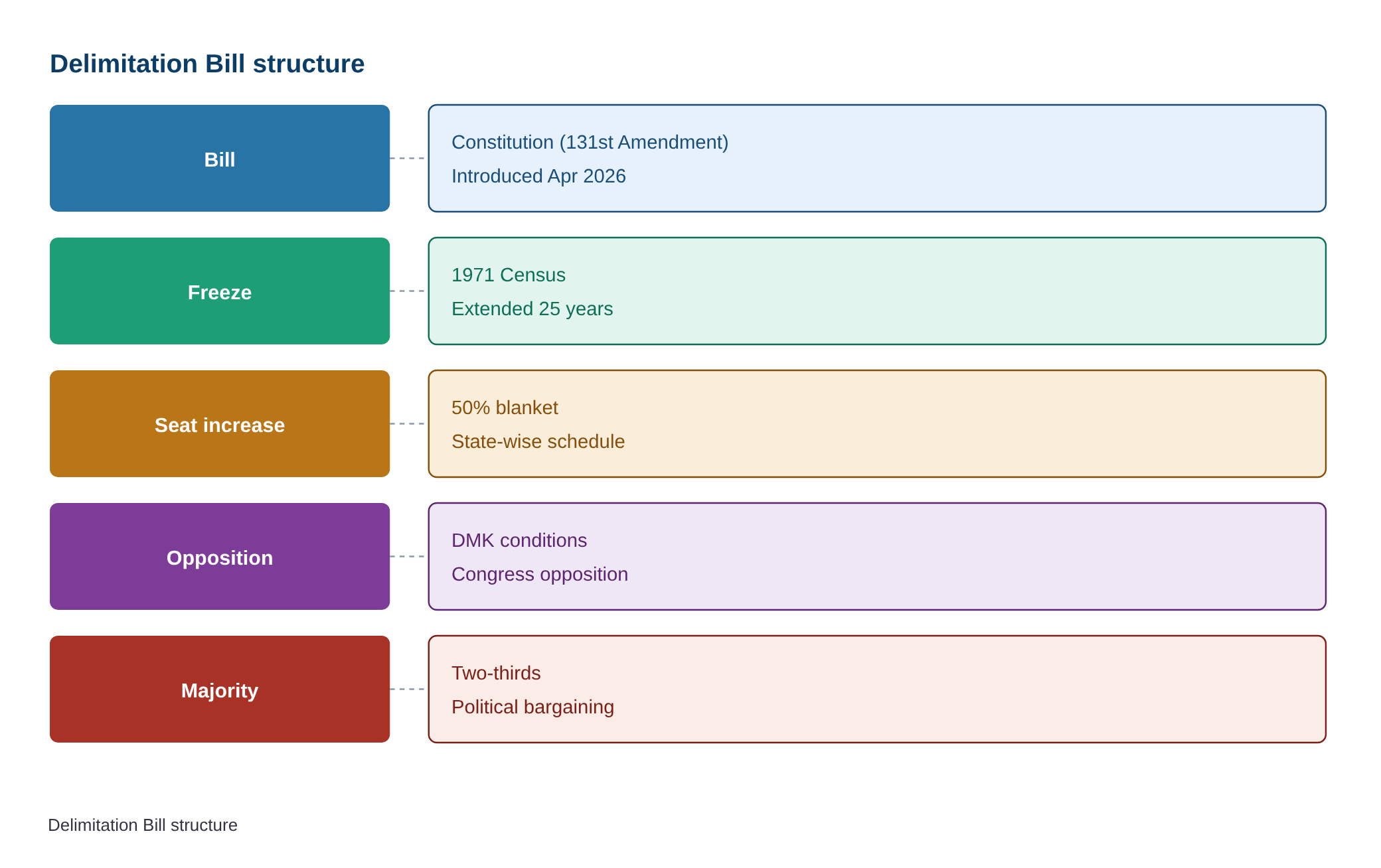
The Government of India’s renewed push for the Constitution (131st Amendment) Bill to conduct a fresh delimitation exercise has encountered conditional support from the DMK, which has articulated three key demands: extending the existing freeze on seat allocation based on the 1971 Census for another 25 years, ensuring a 50% blanket increase in Lok Sabha seats for all states, and providing a schedule of seat allocations for each state. These conditions underscore the intersection of constitutional provisions, federalism, and political bargaining, making the issue a critical subject for UPSC Civil Services aspirants, particularly in the context of parliamentary procedures, federal dynamics, and demographic representation.
Background
- The existing delimitation freeze, introduced by the 42nd Constitutional Amendment Act, 1976, was based on the 1971 Census and has been extended multiple times.
- The DMK, a key regional party from Tamil Nadu, has historically opposed any dilution of its representation, citing concerns over demographic shifts and federal principles.
- The government’s efforts to secure Opposition support for the Bill come amid shifting political alliances, including the INDIA bloc’s consolidation against the ruling dispensation.
- The Bill was introduced in the Lok Sabha in April 2026 but faced opposition, including from the Congress, which has reiterated its stance against any constitutional amendment for delimitation.
What is Delimitation and Why Does It Matter?
- Delimitation is the process of redrawing the boundaries of parliamentary and assembly constituencies based on the latest census data to ensure equitable representation. It is conducted by a Delimitation Commission, a statutory body established under the Delimitation Act, 2002.
- The primary objective of delimitation is to reflect population changes and ensure that each constituency has roughly equal numbers of voters, thereby upholding the principle of ‘one person, one vote’.
- In India, delimitation has been frozen since 1976 due to the 42nd Constitutional Amendment, which extended the freeze based on the 1971 Census. This freeze was further extended by the 84th Constitutional Amendment Act, 2001, until 2026.
- The freeze has led to significant demographic imbalances, with states like Uttar Pradesh and Bihar gaining disproportionately in terms of population but not in political representation, while southern states like Tamil Nadu and Kerala have seen their share of seats decline relative to their population growth.
- The DMK’s demands—extending the freeze for 25 years, a 50% blanket increase in Lok Sabha seats, and a schedule of seat allocations—reflect its concerns over potential loss of representation due to demographic shifts and the need to balance federal principles with equitable representation.
- The Bill’s passage requires a two-thirds majority in both Houses of Parliament and ratification by at least half of the state legislatures, making Opposition support critical for its success.
- The political dynamics surrounding the Bill highlight the tension between national integration and federal autonomy, as regional parties seek to safeguard their representation while the Centre aims to address demographic disparities.
Key Features
| Feature | Significance |
|---|---|
| Constitutional freeze on seat allocation (1976 amendment) | Prevents reallocation of seats based on population changes, ensuring demographic stability in representation. |
| 50% blanket increase in Lok Sabha seats | Proposed uniform expansion of Parliament seats across all States, potentially altering the balance of federal representation. |
| Schedule of State-wise seat allocation | Provides transparency and predictability in seat distribution, reducing ambiguity in delimitation outcomes. |
| Opposition outreach by the Centre | Demonstrates the government’s attempts to secure consensus for constitutional amendments, highlighting political bargaining. |
| Numerical threshold for constitutional amendment (two-thirds majority) | Determines the feasibility of passing the Bill, with current numbers requiring additional support from Opposition parties. |
Why it Matters
Federalism and Representation
- Delimitation directly impacts the federal structure by altering seat distribution among States, potentially favoring certain regions over others.
Political Strategy and Consensus-Building
- The DMK’s conditional support reflects the necessity of Opposition cooperation for constitutional amendments, underscoring the role of consensus in governance.
Demographic and Electoral Implications
- A freeze extension or seat increase could influence electoral outcomes by maintaining or altering the voting power of States with varying population growth rates.
Constitutional Amendments and Governance
- The requirement for a two-thirds majority highlights the checks and balances in the Indian Constitution, ensuring broad-based support for structural reforms.
Challenges
1. Achieving Two-Thirds Majority
- The government lacks the required two-thirds majority, necessitating negotiations with Opposition parties like the DMK and Congress.
- Abstentions or cross-voting could further complicate the passage of the Bill.
UPSC Link: Parliamentary procedures and constitutional amendments
2. Balancing State Interests
- Delimitation risks disproportionate representation if not carefully calibrated, potentially leading to political discontent among States.
- Southern States, including Tamil Nadu, may resist changes perceived to dilute their representation.
UPSC Link: Federalism and cooperative federalism
3. Ensuring Transparency and Fairness
- The absence of a published schedule for seat allocation raises concerns about arbitrary decision-making.
- Lack of formal outreach to the DMK by the Centre may erode trust in the legislative process.
UPSC Link: Constitutional morality and transparency
4. Political Polarisation and Opposition Unity
- The INDIA bloc’s opposition to the Bill, including the Congress, complicates consensus-building.
- Internal divisions within the ruling coalition could hinder cohesive decision-making.
UPSC Link: Role of Opposition in Parliament
5. Demographic Data Reliability
- The 2027 Census, delayed due to logistical and political factors, may not be available in time for accurate delimitation.
- Discrepancies in census data could lead to disputes over seat allocation.
UPSC Link: Census and its constitutional implications
Challenges — UPSC Perspective
| Issue | Concern |
|---|---|
| Lack of formal outreach to DMK | Erosion of trust in the legislative process and potential loss of crucial support. |
| Opposition unity against the Bill | Increased difficulty in securing the required majority for constitutional amendments. |
| Uncertainty over seat allocation schedule | Potential for arbitrary or politically motivated seat distribution. |
| Delayed 2027 Census | Inability to base delimitation on accurate demographic data, leading to disputes. |
| Risk of disproportionate representation | Perceived injustice among States, particularly those with slower population growth. |
| Political bargaining and conditional support | Delay in legislative progress due to protracted negotiations with Opposition parties. |
Way Forward
- Conduct formal and structured negotiations with the DMK and other Opposition parties to address their concerns regarding seat allocation and freeze extension.
- Publish a detailed schedule of proposed seat allocations for each State to enhance transparency and reduce ambiguity.
- Engage constitutional experts to review the Bill’s provisions, ensuring alignment with federal principles and demographic fairness.
- Accelerate the 2027 Census process to provide a reliable demographic baseline for delimitation, avoiding disputes.
- Explore alternative mechanisms for consensus-building, such as a joint parliamentary committee, to facilitate broader support.
- Assess the feasibility of incremental seat increases rather than a blanket 50% expansion to mitigate political resistance.
- Strengthen outreach efforts to the INDIA bloc, particularly the Congress, to address their objections and explore compromises.
- Monitor political developments closely, as shifts in Opposition alliances or internal party dynamics could alter the legislative landscape.
UPSC Value Addition
Keywords for Mains Answer-Writing
Delimitation Commission · Constitution (131st Amendment) Bill · Lok Sabha seat allocation · 1976 freeze on seat allocation · Dravida Munnetra Kazhagam (DMK) demands · Federalism and Centre-State relations · Parliamentary procedures for constitutional amendments · Opposition consensus in Parliament · Lok Sabha numerical thresholds for amendments · Role of Census in delimitation
Constitutional & Policy Linkages
- {‘Article 82’: ‘Readjustment of seats after each Census.’}
- {‘Article 170’: ‘Composition of State Legislative Assemblies.’}
- {‘Article 324’: ‘Role of the Election Commission in delimitation.’}
- {‘Seventh Schedule’: ‘Division of powers between Union and States.’}
- {‘Article 368’: ‘Procedure for constitutional amendments.’}
Concept Flow
Centre proposes delimitation Bill to reallocate Lok Sabha seats based on updated demographic data. → DMK and other Opposition parties oppose the Bill due to perceived threats to federal balance and lack of transparency. → DMK conditions support on extending the 1976 freeze, increasing seats by 50%, and publishing a State-wise schedule. → Centre engages in political outreach to Opposition parties to secure the required two-thirds majority for the constitutional amendment. → Opposition unity and numerical thresholds create challenges, necessitating negotiations and potential compromises. → Delimitation’s impact on federalism, representation, and electoral outcomes becomes a subject of national debate. → Final passage of the Bill depends on consensus-building, demographic accuracy, and constitutional compliance.
Prelims Practice Questions
Q1. Consider the following statements regarding the delimitation process in India:
1. The current freeze on Lok Sabha seat allocation is based on the 1971 Census.
2. The 1976 amendment to the Constitution imposed a freeze on seat allocation that is set to expire after the 2027 Census.
3. The Constitution (131st Amendment) Bill, 2026 seeks to increase the total number of Lok Sabha seats by 50% uniformly across all States.
4. The delimitation process is conducted by the Election Commission of India without any parliamentary oversight.
How many of the above statements are correct?
- Only one
- Only two
- Only three
- All
Answer: Only three — Statements 1 and 2 are correct as the freeze is based on the 1971 Census and the 1976 amendment imposed it. Statement 3 is correct as the DMK has demanded a 50% blanket increase in seats. Statement 4 is incorrect as delimitation is conducted by a Delimitation Commission, not the Election Commission, and involves parliamentary procedures.
Q2. Assertion (A): The Constitution (131st Amendment) Bill, 2026, if passed, would require a two-thirds majority in both Houses of Parliament.
Reason (R): Constitutional amendments related to the delimitation of constituencies fall under Article 368 of the Constitution, which mandates a special majority in Parliament.
Options:
A. Both A and R are true, and R is the correct explanation of A.
B. Both A and R are true, but R is not the correct explanation of A.
C. A is true, but R is false.
D. A is false, but R is true.
Answer: ? — Both the assertion and reason are true. The Constitution (131st Amendment) Bill pertains to a constitutional amendment under Article 368, which requires a two-thirds majority in both Houses of Parliament. The reason correctly explains the assertion.
Q3. Match the following provisions related to delimitation with their respective constitutional or statutory sources:
Column I
1. Freeze on seat allocation based on 1971 Census
2. Power to delimit constituencies
3. Requirement of two-thirds majority for constitutional amendments
4. Role of the Delimitation Commission
Column II
A. Article 368
B. 42nd Amendment Act, 1976
C. Delimitation Act, 2002
D. Article 82
Options:
A. 1-B, 2-D, 3-A, 4-C
B. 1-A, 2-B, 3-C, 4-D
C. 1-C, 2-A, 3-B, 4-D
D. 1-D, 2-C, 3-A, 4-B
- A
- B
- C
- D
Answer: A — 1-B: The 42nd Amendment Act, 1976 imposed a freeze on seat allocation based on the 1971 Census. 2-D: Article 82 empowers Parliament to delimit constituencies. 3-A: Article 368 mandates a two-thirds majority for constitutional amendments. 4-C: The Delimitation Act, 2002 governs the role of the Delimitation Commission.
Mains Practice Question
✍ The Centre’s proposal to amend the Constitution for a fresh delimitation exercise has drawn opposition from political parties, including the DMK, which has laid down specific conditions for its support. Critically examine the constitutional and political implications of the delimitation process in India, with reference to federalism, parliamentary procedures, and the balance of power between the Centre and States. (15 Marks)
Approach: MODEL-ANSWER SKELETON:
1. **Introduction** (2 marks): Define delimitation and its constitutional basis (Article 82, 327, 329; Delimitation Acts). State the current freeze on seat allocation (42nd Amendment, 1976) and its expiry post-2027 Census.
2. **Constitutional and Procedural Dimensions** (4 marks):
– Article 368: Requirement of two-thirds majority in Parliament for constitutional amendments.
– Role of the Delimitation Commission (Delimitation Act, 2002) and its independence.
– Parliamentary procedures: Need for Opposition consensus (DMK’s conditions: 25-year freeze extension, 50% seat increase, State-wise seat schedule).
3. **Federalism and Centre-State Relations** (4 marks):
– Impact on State representation: Potential dilution of southern States’ share if seats are not increased proportionally.
– Federal principles: Need for consensus among States (e.g., southern States vs. northern States with higher population growth).
– Political bargaining: DMK’s demands as a reflection of regional aspirations and federal tensions.
4. **Political and Institutional Implications** (3 marks):
– Opposition unity: INDIA bloc’s stance and Congress’s opposition to constitutional amendments.
– Executive-Legislature balance: Role of the PMO and Home Ministry in steering the Bill.
– Consequences of failure: Impact on electoral reforms, representation, and trust in federal institutions.
5. **Conclusion** (2 marks): Weigh the necessity of delimitation for equitable representation against the risks of political disunity and federal strain. Suggest a consensus-driven approach involving all stakeholders.
Source: The Hindu
Generated by AanyaAi for educational purpose.

- किशाऊ परियोजना विवाद: पंजाब सुप्रीम कोर्ट पहुंचेगा, जानें पूरा मामला - September 22, 2026
- Punjab to Challenge Kishau Project in Supreme Court: Key Polity & Governance Issue for UPSC - September 22, 2026
- दिल्ली हाईकोर्ट ने बदले ‘वरिष्ठ अधिवक्ता’ के नियम, 100-प्वाइंट प्रणाली हुई खत्म - September 22, 2026

No Comments