


07 Aug DMK’s Conditions for Supporting Delimitation Bill: Key Demands Explained
✎ The Delimitation Bill seeks to extend the 1971 Census-based seat freeze for 25 years and introduce a 50% blanket increase in Lok Sabha seats, but its passage hinges on Opposition consensus, particularly the DMK’s conditional…
Subject Relevance — Where This Topic Fits
- GS Paper II — Polity and Governance: Constitutional Amendments, Federalism, and Parliamentary Procedures | GS Paper II — Governance, Constitution and Polity: Role of Opposition Parties in Legislative Processes
- Prelims: Delimitation Commission, Constitutional Amendment Bill, 1971 Census freeze, Lok Sabha seat allocation, Two-thirds majority in Parliament, INDIA bloc, Rajya Sabha dynamics
- Essay: Federalism and Centre-State Relations in India: Challenges and Compromises, The Role of Opposition in Democratic Governance: Balancing Dissent and Constructive Engagement
Quick Revision: The Delimitation Bill seeks to extend the 1971 Census-based seat freeze for 25 years and introduce a 50% blanket increase in Lok Sabha seats, but its passage hinges on Opposition consensus, particularly the DMK’s conditional support.
Why is this in the news?
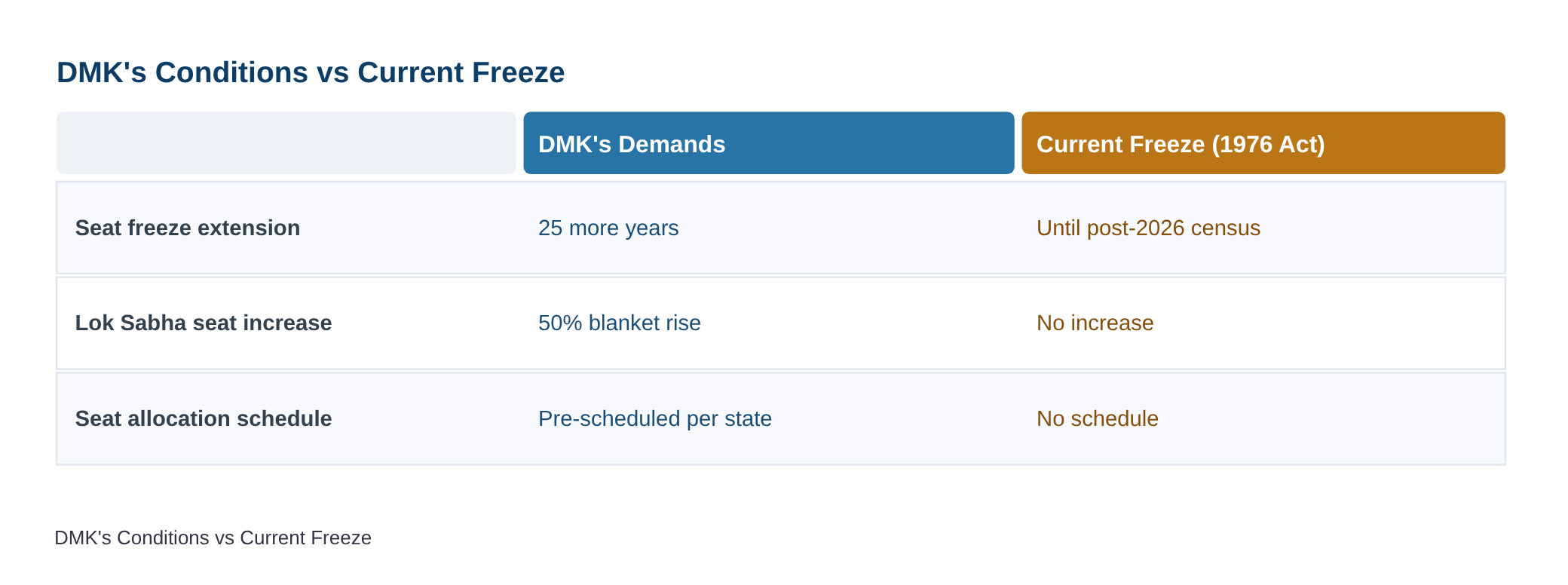
The Dravida Munnetra Kazhagam (DMK) has articulated conditional support for the Centre’s proposed Delimitation Bill, introducing three critical demands: extending the constitutional freeze on seat allocation based on the 1971 Census for another 25 years, ensuring a 50% blanket increase in Lok Sabha seats for all states, and a pre-scheduled allocation of seats per state. These conditions, emerging amid renewed Centre-Opposition outreach efforts, underscore the Bill’s political sensitivities and the DMK’s strategic leverage in shaping the legislative outcome.
Background
- The current Lok Sabha seat allocation is frozen as per the 1976 Constitution (42nd Amendment) Act, which extended the 1971 Census-based delimitation freeze until the first census after 2026. The 2021 Census was delayed and is now expected to conclude by 2027, necessitating a decision on the freeze’s extension.
- The Constitution (131st Amendment) Bill, introduced in April 2026, seeks to amend Article 82 to enable a fresh delimitation exercise. However, it was defeated in the Lok Sabha on April 17, 2026, due to lack of consensus, reflecting Opposition apprehensions.
- The freeze on seat allocation has historically skewed representation, benefiting certain states while under-representing others, particularly southern states like Tamil Nadu, which have seen slower population growth compared to northern states.
- The DMK’s demands align with its long-standing advocacy for federal equity, including proportional representation based on population growth and demographic shifts.
- The political landscape has evolved since April 2026, with the numerical strength of the INDIA bloc increasing, though the government still lacks a two-thirds majority to pass the Bill unilaterally.
- The Rajya Sabha, where the government holds a stronger position, may provide a more conducive environment for passing the Bill, though Opposition consensus remains pivotal.
What is the Delimitation Bill and Why is it Contentious?
- The Delimitation Bill is a proposed constitutional amendment aimed at redrawing the boundaries of parliamentary and assembly constituencies to reflect population changes, as mandated by the Constitution.
- The Bill seeks to amend Article 82 of the Constitution to enable a fresh delimitation exercise, which has been frozen since the 1971 Census to prevent frequent changes that could destabilise political representation.
- The freeze, originally imposed by the 42nd Amendment (1976), was extended to the first census after 2026, now expected to conclude in 2027. The Bill proposes to extend this freeze for another 25 years, delaying delimitation until 2052.
- The DMK’s primary demand is to maintain the 1971 Census-based freeze for another 25 years, ensuring no immediate redistribution of seats that could disadvantage states with slower population growth, such as Tamil Nadu.
- The party also seeks a blanket 50% increase in Lok Sabha seats for all states, a promise reportedly made by the Home Minister in April 2026, to accommodate future population growth without altering existing seat ratios.
- Additionally, the DMK demands a pre-scheduled allocation of seats per state in the legislative package, providing transparency and predictability in representation.
- Opposition parties, including the Congress, have opposed the Bill on grounds that it could disrupt federal balance, disproportionately benefit certain states, and lack adequate consultation with state governments.
- The Bill’s passage requires a two-thirds majority in both Houses of Parliament, making Opposition support or abstention critical for its success.
Key Features
| Feature | Significance |
|---|---|
| Proposed 50% blanket increase in Lok Sabha seats | Aims to expand representation while maintaining proportionality among states, addressing demographic shifts since the last delimitation. |
| Extension of 1976 freeze on seat allocation | Prevents immediate reduction in southern states’ representation, ensuring stability in political arithmetic during transitional phase. |
| DMK’s demand for a published State-wise seat schedule | Provides transparency and predictability in the delimitation process, reducing ambiguity for political stakeholders. |
| Government’s outreach to Opposition parties | Demonstrates attempt to build consensus, though formal engagement with DMK remains pending as of report. |
| Numerical threshold for constitutional amendment | Requires two-thirds majority in both Houses; current Lok Sabha strength necessitates cross-party support for passage. |
Why it Matters
Constitutional and Legal
- Delimitation is constitutionally mandated under Article 82 and governed by the Delimitation Commission Act, 2002, ensuring adherence to democratic principles of representation.
- The 1976 freeze on seat allocation, extended via the 42nd Amendment, was a temporary measure to stabilise political representation during Emergency-era redistributions.
- A 50% blanket increase in seats would require a constitutional amendment, altering the fundamental structure of parliamentary representation.
Political
- DMK’s conditional support signals shifting alliances in the INDIA bloc, potentially influencing the government’s ability to secure the required majority.
- The opposition’s unified stance against constitutional amendments for delimitation reflects concerns over federalism and regional equity.
- Tamil Nadu’s political stance could set a precedent for other southern states, given its historical emphasis on linguistic and regional identity.
Representational Equity
- Delimitation aims to correct population-based disparities in representation, ensuring that demographic changes are reflected in parliamentary composition.
- Southern states, with lower population growth rates, risk losing seats if delimitation is based solely on the 2027 Census, necessitating safeguards like the DMK’s proposed freeze.
Institutional
- The Delimitation Commission, a statutory body, plays a pivotal role in ensuring impartiality and fairness in seat allocation, though its recommendations are subject to parliamentary approval.
- Parliamentary Affairs Minister’s outreach to Opposition leaders highlights the institutional need for consensus-building in constitutional amendments.
Challenges
1. Constitutional Majority Requirement
- A two-thirds majority in both Houses is essential for amending the Constitution, which the current government lacks without Opposition support.
- Even with DMK’s conditional support, the government may fall short of the required 360 votes in the Lok Sabha, necessitating further negotiations or abstentions.
- The Rajya Sabha, where the government has a stronger numerical position, may still require cross-party consensus for smooth passage.
UPSC Link: Constitution of India – Amendment Procedure (Article 368)
2. Federalism and Regional Equity
- Southern states, with lower population growth, face the risk of reduced representation if delimitation is based solely on the 2027 Census, undermining federal principles.
- The DMK’s demand for a 25-year freeze on the 1976 amendment reflects concerns over disproportionate impact on states with slower demographic growth.
- Balancing national demographic shifts with regional equity remains a critical challenge in delimitation exercises.
UPSC Link: Federalism in India – Constitutional Provisions
3. Political Consensus and Opposition Resistance
- The INDIA bloc’s unified opposition to constitutional amendments for delimitation complicates the government’s efforts to secure the required majority.
- Lack of formal engagement with DMK despite informal outreach indicates potential gaps in trust-building between the Centre and Opposition parties.
- Regional parties like DMK play a decisive role in shaping the outcome, given their numerical strength and ideological stance.
UPSC Link: Role of Regional Parties in Indian Politics
4. Transparency and Predictability in Delimitation
- Absence of a published State-wise seat schedule creates ambiguity and fuels speculation among political stakeholders.
- Ensuring transparency in the delimitation process is essential to prevent allegations of political manipulation or bias.
- The demand for a pre-legislative schedule aligns with principles of participatory democracy and informed decision-making.
UPSC Link: Delimitation Commission – Transparency and Accountability
5. Demographic Data and Methodological Challenges
- The 2027 Census, which will inform the next delimitation, faces logistical and political challenges, including delays and potential discrepancies in data collection.
- Methodological issues, such as the use of population data versus voter rolls, could lead to disputes over seat allocations.
- Ensuring the accuracy and timeliness of Census data is critical for a fair and equitable delimitation process.
UPSC Link: Census in India – Constitutional and Legal Framework
Challenges — UPSC Perspective
| Issue | Concern |
|---|---|
| Two-thirds majority requirement | Government lacks sufficient votes to pass the constitutional amendment without Opposition support. |
| Federalism and regional equity | Risk of disproportionate impact on southern states with lower population growth. |
| Opposition resistance | INDIA bloc’s unified stance against constitutional amendments complicates consensus-building. |
| Transparency in seat allocation | Lack of a published State-wise schedule fuels ambiguity and mistrust. |
| Demographic data accuracy | Potential delays or discrepancies in the 2027 Census could undermine delimitation. |
| Political trust deficit | Lack of formal engagement with DMK despite informal outreach indicates gaps in consensus-building. |
Way Forward
- Conduct formal and structured negotiations with the DMK and other Opposition parties to address their concerns and secure conditional support for the Bill.
- Publish a detailed State-wise seat allocation schedule in the legislative package to enhance transparency and build trust among stakeholders.
- Engage the Delimitation Commission proactively to ensure methodological clarity and address potential disputes over data interpretation.
- Explore the possibility of phased implementation of delimitation to mitigate immediate political and representational risks.
- Strengthen outreach to regional parties beyond the DMK, including consultations with southern states to address federalism concerns.
- Leverage the Rajya Sabha’s stronger numerical position to build consensus, while ensuring synchronised passage in both Houses.
- Establish a multi-stakeholder committee to oversee the delimitation process, ensuring representation from political parties, civil society, and experts.
- Prioritise the timely completion of the 2027 Census to avoid delays and ensure the availability of accurate demographic data for delimitation.
UPSC Value Addition
Keywords for Mains Answer-Writing
Delimitation Commission · Constitution (131st Amendment) Bill · Lok Sabha seat increase · Constitutional freeze on seats · Dravida Munnetra Kazhagam (DMK) · Federalism and Centre-State relations · Parliamentary procedures for constitutional amendments · 1976 freeze on delimitation · Lok Sabha numerical strength · Opposition consensus in Parliament · Constitutional amendment thresholds · Federal distribution of seats
Constitutional & Policy Linkages
- Article 82 – Readjustment after each census
- Article 170 – Composition of the Legislative Assemblies
- Article 324 – Superintendence, direction and control of elections
- Seventh Schedule – State List (Entry 50: Delimitation)
Concept Flow
Government introduces Constitution (131st Amendment) Bill for delimitation → DMK lays down conditional support requirements → Opposition resistance and federalism concerns arise → Government seeks to build consensus through outreach → Numerical threshold for amendment remains unmet → Delimitation Commission awaits Census data (2027) → Final seat allocation depends on political negotiations and constitutional amendments
Prelims Practice Questions
Q1. Consider the following statements regarding the delimitation of Lok Sabha seats in India: 1. The current freeze on the number of seats in the Lok Sabha is based on the 1971 Census. 2. The Constitution (131st Amendment) Bill proposes a 50% blanket increase in the Lok Sabha seats for all States. 3. A constitutional amendment to alter the number of seats requires a two-thirds majority in both Houses of Parliament. 4. The delimitation process is conducted by the Election Commission of India. How many of the above statements are correct?
- Only one
- Only two
- Only three
- All
Answer: Only three — Statements 1 and 3 are correct. Statement 2 is incorrect as the DMK’s demand for a 50% increase is not part of the Bill introduced in April 2026. Statement 4 is incorrect as delimitation is conducted by the Delimitation Commission, not the Election Commission.
Q2. Assertion (A): The Constitution (131st Amendment) Bill aims to increase the number of Lok Sabha seats by 50% across all States. Reason (R): The Bill seeks to amend the constitutional freeze on seats based on the 1971 Census, which currently limits the Lok Sabha strength.
- Both A and R are true, and R is the correct explanation of A
- Both A and R are true, but R is not the correct explanation of A
- A is true but R is false
- A is false but R is true
Answer: ? — Assertion (A) is false: the Bill does not propose a blanket 50% increase in seats; the DMK’s demand for such an increase is not part of the Bill. Reason (R) is true: the Bill seeks to amend the constitutional freeze on seats based on the 1971 Census.
Q3. Match the following provisions with their respective constitutional/legislative contexts: 1. Constitutional freeze on Lok Sabha seats 2. Delimitation Commission 3. Two-thirds majority requirement for constitutional amendments 4. Federal distribution of seats A. Article 82 B. Article 324(4) C. Article 368 D. Article 330
- 1-A, 2-B, 3-C, 4-D; 1-B, 2-A, 3-C, 4-D; 1-D, 2-A, 3-C, 4-B; 1-C, 2-B, 3-A, 4-D
- answer_letter_indexed_ordered_list_only_please_yes_1_2_3_4_5_6_7_8_9_10_11_12_13_14_15_16_17_18_19_20_21_22_23_24_25_26_27_28_29_30_31_32_33_34_35_36_37_38_39_40_41_42_43_44_44_45_46_47_48_49_50_51_52_53_54_55_56_57_58_59_60_61_62_63_64_65_66_67_68_69_70_71_72_73_74_75_76_77_78_79_80
- answer_letter_indexed_ordered_list_only_please_yes_1_2_3_4_5_6_7_8_9_10_11_12_13_14_15_16_17_18_19_20_21_22_23_24_25_26_27_28_29_30_31_32_33_34_35_36_37_38_39_40_41_42_43_44_44_45_46_47_48_49_50_51_52_53_54_55_56_57_58_59_60_61_62_63_64_65_66_67_68_69_70
- answer_letter_indexed_ordered_list_only_please_yes_1_A_2_B_3_C_4_D
Answer: ? — 1. Constitutional freeze on Lok Sabha seats: Article 82 (Constitution of India). 2. Delimitation Commission: Article 324(4) (Constitution of India). 3. Two-thirds majority requirement for constitutional amendments: Article 368. 4. Federal distribution of seats: Article 330 (reservation of seats for SCs/STs).
Mains Practice Question
✍ The proposed Constitution (131st Amendment) Bill, 2026, seeks to amend the constitutional freeze on Lok Sabha seats based on the 1971 Census while introducing a 50% blanket increase in the Lok Sabha’s numerical strength. Critically examine the constitutional, federal, and political implications of such an amendment in the context of India’s parliamentary democracy. Also, analyse the procedural challenges in securing the required legislative majority for its passage. (15 Marks)
Approach: MODEL-ANSWER SKELETON:
1. **Constitutional Implications**
– Article 82 and the 42nd Amendment (1976) freezing delimitation based on the 1971 Census.
– Provisions for constitutional amendments under Article 368: special majority (two-thirds of members present and voting + absolute majority of total membership) and, in some cases, ratification by state legislatures.
– The Bill’s aim to increase Lok Sabha seats by 50%: examine whether this constitutes a ‘major change’ requiring state ratification (Article 368(2)(b)).
– Contrast with the Sarkaria Commission’s recommendations on federal balance and seat distribution.
2. **Federal Implications**
– Impact on federalism: potential dilution of southern States’ representation due to population-based seat allocation vs. the DMK’s demand for a 50% blanket increase.
– Historical context: the 1976 freeze was introduced to protect southern States from losing seats post-1971 Census data.
– The proposed 50% increase: assess whether it aligns with the principle of ‘one person, one value’ or exacerbates regional imbalances.
– Role of the Delimitation Commission (Article 324(4)): independence and transparency concerns.
3. **Political Implications**
– Opposition consensus: DMK’s conditions (freeze extension, seat increase, and schedule of seats) and the INDIA bloc’s opposition to constitutional amendments.
– Numerical thresholds: two-thirds majority in Lok Sabha (360 seats) and Rajya Sabha; role of abstentions and regional parties.
– Centre-State relations: Tamil Nadu’s stance vs. Centre’s push for delimitation; federal trust deficit.
4. **Procedural Challenges**
– Legislative hurdles: securing two-thirds majority in Lok Sabha (current strength: 540 seats) and Rajya Sabha.
– State ratification: whether the Bill qualifies for Article 368(2)(b) ratification by state legislatures.
– Parliamentary procedures: time-bound debates, whip enforcement, and consensus-building with Opposition parties.
5. **Conclusion**
– Weigh the constitutional validity, federal equity, and political feasibility of the amendment.
– Suggest alternatives: phased seat increase, independent expert committee, or state consultations to address federal concerns.
Source: The Hindu
Generated by AanyaAi for educational purpose.

- यूपीएससी/पीसीएस: उत्तराखंड में एसटी/एससी अत्याचार मामलों पर सीएम धामी के निर्देश, त्वरित न्याय पर जोर - September 22, 2026
- UPSC Alert: CM Dhami’s Strict Action Plan for SC/ST Atrocity Cases in Uttarakhand - September 22, 2026
- हिमाचल में उड़ान योजना का विस्तार: 10 साल के लिए त्रिपक्षीय करार, जानिए पूरी डिटेल्स - September 22, 2026

No Comments