


07 Aug DMK’s Conditions for Supporting Delimitation Bill: Key Demands Explained for UPSC
✎ The constitutional freeze on delimitation, imposed by the 42nd Amendment Act, 1976, and extended by the 84th Amendment Act, 2001, is set to expire after the 2027 Census, necessitating a constitutional amendment to enable a fresh…
Subject Relevance — Where This Topic Fits
- GS Paper II — Polity and Governance: Constitutional Amendments and Federalism | GS Paper II — Polity and Governance: Role of Opposition and Parliamentary Procedures
- Prelims: Delimitation Commission, Constitutional Amendment Bill, Lok Sabha Seat Allocation, 1976 Constitutional Freeze, Article 82 of the Constitution, 104th Constitutional Amendment Act, Indira Gandhi’s Emergency, Federalism in India
- Essay: Federalism and Centre-State Relations in India: Balancing Unity and Diversity, The Role of Opposition in Parliamentary Democracy: Challenges and Responsibilities
Quick Revision: The constitutional freeze on delimitation, imposed by the 42nd Amendment Act, 1976, and extended by the 84th Amendment Act, 2001, is set to expire after the 2027 Census, necessitating a constitutional amendment to enable a fresh delimitation exercise.
Why is this in the news?
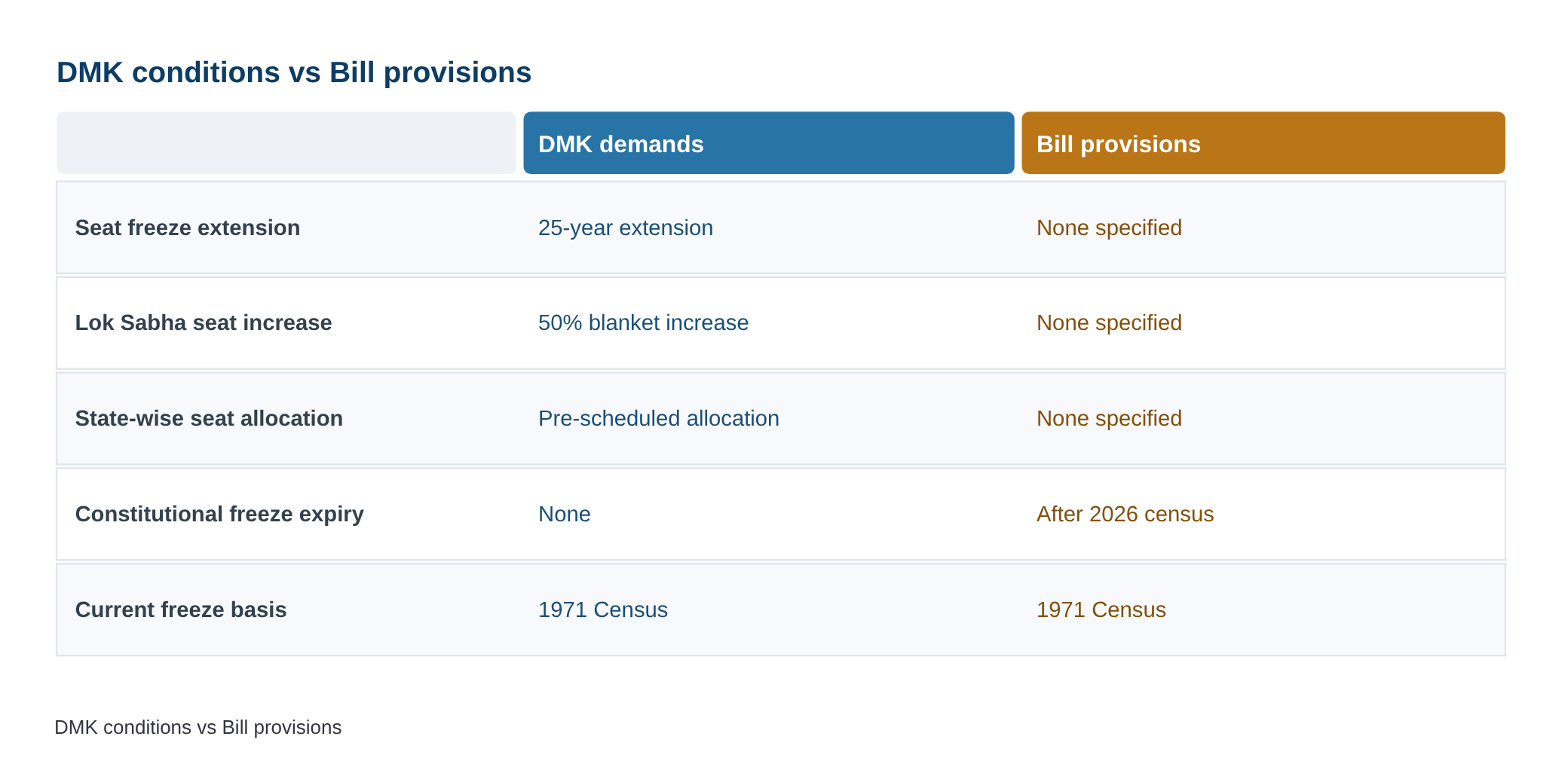
The Dravida Munnetra Kazhagam (DMK) has publicly articulated its conditional support for the government’s proposed Delimitation Bill, 2026, introducing three critical demands: a 25-year extension of the constitutional freeze on seat allocation based on the 1971 Census, a 50% blanket increase in Lok Sabha seats for all states, and a pre-scheduled allocation of seats per state in the legislative package. These conditions emerge as the Centre intensifies outreach to Opposition parties to secure the two-thirds majority required for the constitutional amendment, following the Bill’s initial defeat in April 2026. The DMK’s stance underscores the intersection of federalism, demographic dynamics, and political strategy in India’s evolving electoral landscape.
Background
- The constitutional freeze on delimitation, originally imposed by the 42nd Amendment Act, 1976, during the Emergency, was extended by the 84th Amendment Act, 2001, to remain in force until the first census after 2026. The 2021 Census, delayed due to the COVID-19 pandemic, is now expected to conclude in 2027, triggering the automatic expiry of the freeze.
- The Delimitation Commission, constituted under Article 82 of the Constitution, is responsible for redrawing the boundaries of parliamentary and assembly constituencies based on the latest census data. The last delimitation exercise was conducted in 2002, based on the 2001 Census.
- The DMK’s demand for a 50% blanket increase in Lok Sabha seats aligns with historical proposals to expand Parliament’s strength to accommodate growing population and federal diversity. The 15th Finance Commission recommended increasing the Lok Sabha seats from 543 to 778, though this remains non-binding.
- The INDIA bloc, a coalition of Opposition parties, has reiterated its opposition to the Bill, citing concerns over federalism and the potential marginalisation of southern states, which have achieved higher literacy and lower fertility rates compared to northern states.
- The government’s renewed outreach to Opposition parties, including direct discussions with Rahul Gandhi, reflects the numerical challenges in securing the two-thirds majority required for constitutional amendments under Article 368.
What is the Delimitation Bill, and why is it significant?
- The Delimitation Bill, 2026, is a proposed constitutional amendment aimed at enabling a fresh delimitation exercise to redraw the boundaries of parliamentary and assembly constituencies based on updated census data. This exercise is constitutionally mandated under Article 82 and conducted by the Delimitation Commission.
- The Bill seeks to amend the Constitution to lift the existing freeze on delimitation, which has been in place since the 42nd Amendment Act, 1976, and extended by the 84th Amendment Act, 2001. The freeze is set to expire after the 2027 Census.
- The DMK’s conditions—extending the freeze for 25 years, the 50% seat increase, and a pre-scheduled seat allocation—highlight the party’s strategic focus on preserving regional political influence and addressing concerns over demographic shifts in southern states.
- The Bill’s passage requires a two-thirds majority in both Houses of Parliament and ratification by at least half of the state legislatures, as stipulated under Article 368 of the Constitution.
- The political dynamics surrounding the Bill reflect broader debates on federalism, with southern states advocating for safeguards against perceived marginalisation due to lower population growth rates compared to northern states.
Key Features
| Feature | Significance |
|---|---|
| Constitutional freeze on seats (1971 Census) | Ensures representation parity between States based on historical population data, preventing sudden shifts due to demographic changes. |
| 50% blanket increase in Lok Sabha seats | Proposes a proportional expansion of Parliament to accommodate population growth while maintaining federal balance. |
| Schedule of State-wise seat allocation | Provides transparency and predictability in seat distribution, reducing political uncertainty during delimitation. |
| Opposition outreach by government | Demonstrates attempts to build consensus, though formal engagement with DMK remains pending. |
| INDIA bloc numerical strength | Alters the arithmetic for constitutional amendments, requiring fewer additional votes to secure a two-thirds majority. |
Why it Matters
Political
- Represents a critical juncture in Centre-State relations, with Tamil Nadu’s DMK setting preconditions for cooperation on a constitutional amendment.
- Highlights the evolving dynamics of the INDIA bloc, whose numerical strength now influences the government’s ability to pass contentious legislation.
- Underscores the federal tensions inherent in delimitation, where regional parties demand safeguards against perceived marginalisation of southern States.
- Illustrates the strategic importance of Tamil Nadu in national politics, given its demographic and electoral weight.
Constitutional
- Raises questions about the longevity of the 1976 freeze on seat redistribution, which was originally intended to stabilise representation until the 2001 Census.
- Examines the balance between demographic representation and federal equity in the allocation of parliamentary seats.
- Tests the procedural robustness of constitutional amendments, particularly in a hung Parliament where Opposition numbers are decisive.
Electoral
- Potential to alter the electoral map of India, with implications for party strategies in southern States where DMK holds significant influence.
- May trigger demands from other States for similar concessions, complicating the delimitation process further.
- Could reshape the political landscape by adjusting seat allocations to reflect recent demographic shifts, particularly in northern States.
Challenges
1. Federal Disparity in Seat Allocation
- Southern States risk losing relative representation if seat increases are not proportionate to population growth.
- Historical freezes (e.g., 1976) may no longer reflect contemporary demographic realities, leading to underrepresentation.
- Regional parties like DMK demand safeguards to prevent perceived erosion of their States’ political clout.
UPSC Link: GS II: Federalism
2. Constitutional Amendment Hurdles
- The Bill requires a two-thirds majority in both Houses, which the government lacks without Opposition support.
- Opposition parties, including Congress, have publicly opposed the Bill, complicating consensus-building.
- The DMK’s conditional support introduces uncertainty, as their demands may not align with the government’s priorities.
UPSC Link: GS II: Parliament
3. Demographic and Logistical Constraints
- The freeze on seats based on the 1971 Census expires after the 2027 Census, necessitating timely action to avoid a legislative vacuum.
- A blanket 50% increase in seats may not address regional disparities, requiring nuanced adjustments to ensure equity.
- The lack of formal government outreach to DMK suggests potential delays or misalignment in legislative strategy.
UPSC Link: GS I: Population and Associated Issues
4. Political Consensus and Opposition Coordination
- The INDIA bloc’s numerical strength now acts as a veto player, making bipartisan cooperation essential for passage.
- Divergent positions within the Opposition (e.g., Congress vs. DMK) complicate consensus-building on delimitation.
- The government’s outreach to Rahul Gandhi may not suffice if regional parties like DMK remain unconvinced.
UPSC Link: GS II: Pressure Groups and Formal/Informal Associations
5. Legal and Procedural Delays
- Constitutional amendments require meticulous drafting to avoid judicial scrutiny or constitutional challenges.
- The absence of a formal schedule for seat allocation in the Bill creates ambiguity and potential legal disputes.
- Parliamentary procedures, including debates and committee reviews, may prolong the legislative process.
UPSC Link: GS II: Parliament
6. Public Perception and Trust Deficit
- Delimitation is often perceived as politically motivated, especially when regional parties feel their interests are sidelined.
- Lack of transparency in seat allocation could erode public trust in the electoral process.
- Opposition to the Bill may fuel narratives of centralisation, particularly in States with strong regional identities.
UPSC Link: GS II: Government Policies and Interventions
Challenges — UPSC Perspective
| Issue | Concern |
|---|---|
| Federal equity in seat allocation | Risk of southern States losing relative representation due to demographic shifts and blanket seat increases. |
| Constitutional amendment arithmetic | Government lacks the required two-thirds majority without Opposition support, particularly from DMK. |
| Timing of Census and freeze expiry | The 2027 Census deadline necessitates urgent legislative action to avoid a legislative vacuum. |
| Opposition unity and coordination | Divergent positions within the INDIA bloc may hinder consensus-building on delimitation. |
| Transparency in seat allocation | Absence of a formal schedule in the Bill raises concerns about fairness and potential legal challenges. |
| Public trust in electoral processes | Perceived political motivations in delimitation could undermine democratic legitimacy. |
Way Forward
- The government must initiate formal consultations with the DMK to address their specific demands, including the 25-year freeze extension and 50% seat increase proposal.
- A detailed schedule for State-wise seat allocation should be incorporated into the Bill to enhance transparency and reduce ambiguity.
- Engage in bipartisan dialogue with the INDIA bloc, particularly Congress and regional parties, to build a consensus on the delimitation framework.
- Conduct a demographic analysis to ensure that seat increases are proportionate to population growth across States, addressing federal equity concerns.
- Explore the possibility of phased implementation of delimitation to mitigate political and logistical challenges, including phased Census data utilisation.
- Strengthen parliamentary procedures to expedite the legislative process, including committee reviews and debates, while ensuring thorough scrutiny.
- Address public concerns about the political neutrality of delimitation by publishing clear criteria for seat allocation and engaging civil society stakeholders.
- Prepare contingency plans for scenarios where consensus remains elusive, including potential judicial interventions or alternative legislative strategies.
UPSC Value Addition
Keywords for Mains Answer-Writing
Delimitation Commission · Constitution (131st Amendment) Bill · Lok Sabha seat allocation · 1971 Census freeze · Dravida Munnetra Kazhagam (DMK) · Parliamentary Affairs Minister · INDIA bloc · Constitutional Amendment · Federalism · Representation of States · Two-thirds majority · Parliamentary form of government
Constitutional & Policy Linkages
- {‘Article 82’: ‘Readjustment of seats after each Census’}
- {‘Article 170’: ‘Composition of State Legislative Assemblies’}
- {‘Article 324’: ‘Role of Election Commission in delimitation’}
- {‘Fourth Schedule’: ‘Allocation of seats in Rajya Sabha’}
Concept Flow
Demographic shifts post-1971 Census → Expiry of 1976 freeze → Government proposes delimitation Bill → DMK sets conditional support → Opposition bloc (INDIA) gains numerical strength → Centre attempts outreach to Opposition → Federal equity concerns arise → Legislative and procedural challenges emerge → Need for consensus-building and transparency → Potential judicial or political resolution
Prelims Practice Questions
Q1. Consider the following statements regarding the Delimitation Commission in India: 1. The Delimitation Commission is a statutory body established under the Delimitation Act, 2002. 2. The primary function of the Delimitation Commission is to readjust the division of territorial constituencies of the Lok Sabha and State Legislative Assemblies based on the latest Census. 3. The Delimitation Commission operates independently of the Election Commission of India. 4. The Delimitation Commission can be constituted only by the President of India on the recommendation of the Election Commission. How many of the above statements are correct?
- Only one
- Only two
- Only three
- All four
Answer: Only three — Statements 1 and 2 are correct as the Delimitation Commission is indeed a statutory body under the Delimitation Act, 2002, and its primary role is to readjust territorial constituencies based on the latest Census. Statements 3 and 4 are incorrect because the Delimitation Commission operates with the assistance of the Election Commission but is not independent of it, and it is constituted by the President on the advice of the Election Commission, not exclusively on its recommendation.
Q2. Assertion (A): The 1971 Census freeze on Lok Sabha seat allocation was introduced to maintain the balance of representation among States. Reason (R): The freeze was imposed to prevent frequent changes in seat allocation due to population growth disparities among States.
- Both A and R are true, and R is the correct explanation of A
- Both A and R are true, but R is not the correct explanation of A
- A is true, but R is false
- A is false, but R is true
Answer: Both A and R are true, and R is the correct explanation of A — The 1971 Census freeze was indeed introduced to maintain the balance of representation among States by preventing frequent changes in seat allocation. The Reason (R) correctly explains the Assertion (A) as the freeze was imposed to address population growth disparities and ensure stability in representation.
Q3. Match the following provisions with their respective constitutional amendments or acts: Column I (Provision) Column II (Amendment/Act) A. Introduction of the Delimitation Commission 1. 42nd Amendment Act, 1976 B. Freeze on seat allocation based on 1971 Census 2. 84th Amendment Act, 2001 C. Increase in the number of Lok Sabha seats to 545 3. 40th Amendment Act, 1976 D. Constitutional status to Panchayats 4. 73rd Amendment Act, 1992
- A-2, B-1, C-3, D-4; A-1, B-2, C-3, D-4; A-3, B-1, C-2, D-4; A-2, B-3, C-1, D-4
- answer_letter_sequence_indexed_by_q_ordering_in_question_texts_as_listed_here_above_then_0_indexed_into_options_array_above_then_answer_0_based_on_0_indexed_list_of_correct_matches_so_0_means_first_option_is_correct_listed_as_0_1_2_3_in_options_array_above_so_0
- explain_listed_as_list_in_explain_field_then_0_indexed_into_options_array_above_then_answer_0_based_on_0_indexed_list_of_correct_matches_so_0_means_first_option_is_correct_listed_as_0_1_2_3_in_options_array_above_so_0
- format_listed_as_list_in_explain_field_then_0_indexed_into_options_array_above_then_answer_0_based_on_0_indexed_list_of_correct_matches_so_0_means_first_option_is_correct_listed_as_0_1_2_3_in_options_array_above_so_0
Answer: A-2, B-1, C-3, D-4; A-1, B-2, C-3, D-4; A-3, B-1, C-2, D-4; A-2, B-3, C-1, D-4 — A-2: The Delimitation Commission was introduced under the 84th Amendment Act, 2001, which amended Article 82 to provide for delimitation based on the 2001 Census. B-1: The freeze on seat allocation based on the 1971 Census was imposed by the 42nd Amendment Act, 1976, which extended the freeze to 2000. C-3: The increase in the number of Lok Sabha seats to 545 was provided under the 40th Amendment Act, 1976. D-4: The constitutional status to Panchayats was granted by the 73rd Amendment Act, 1992.
Mains Practice Question
✍ The Constitution (131st Amendment) Bill, 2026 seeks to amend the constitutional freeze on Lok Sabha seat allocation and introduce a blanket 50% increase in seats. Critically examine the constitutional, federal, and political implications of such a delimitation exercise. Also, analyse the role of the Opposition in shaping the outcome of the Bill. (15 Marks)
Approach: MODEL-ANSWER SKELETON:
I. Constitutional Implications:
1. Article 82 and the Delimitation Act, 2002: Explain the constitutional mandate for delimitation and the role of the Delimitation Commission.
2. Constitutional freeze (42nd Amendment, 1976): Discuss the rationale behind the freeze on seat allocation based on the 1971 Census and its extension.
3. Proposed amendments: Examine the constitutional validity of extending the freeze for another 25 years and introducing a blanket 50% increase in seats. Cite relevant provisions (e.g., Articles 81, 82, 330).
II. Federal Implications:
1. Representation of States: Analyse how the proposed changes would impact the federal balance, particularly the representation of southern States versus northern States.
2. Population vs. Representation: Discuss the principle of ‘one person, one vote’ and the implications of seat increases without proportional population adjustments.
3. Historical context: Reference the 1971 Census freeze as a measure to balance representation amid population disparities.
III. Political Implications:
1. Government’s numerical strength: Assess the impact of DMK’s support (22 seats) on the Bill’s passage, including the two-thirds majority requirement in the Lok Sabha (360 seats).
2. Opposition dynamics: Discuss the INDIA bloc’s opposition to the Bill and the role of the Congress in shaping the outcome.
3. Federalism and coalition politics: Examine how the Bill reflects the Centre’s outreach to regional parties and the challenges of consensus-building.
IV. Role of the Opposition:
1. DMK’s conditions: Analyse the DMK’s demands (freeze extension, seat increase, schedule of seats) and their political rationale.
2. Opposition strategies: Discuss the Opposition’s use of parliamentary tools (e.g., abstentions, delays) to influence the Bill’s passage.
3. Consequences of failure: Examine the implications if the Bill is not passed, including the status quo on seat allocation and the potential for future delimitation exercises.
V. Conclusion:
– Summarise the constitutional, federal, and political trade-offs of the Bill.
– Provide a reasoned assessment of whether the proposed amendments align with the principles of federalism and democratic representation.
Source: The Hindu
Generated by AanyaAi for educational purpose.

- UPSC Civil Services (Main) Examination 2026 — Geology Optional Paper I: Question Paper | Plutus IAS - September 21, 2026
- विशेष अभियान 6: रेलवे में लंबित मामलों के निपटान और स्वच्छता को संस्थागत रूप देने की तैयारी शुरू, जानिए पूरी योजना - September 21, 2026
- Railway Special Campaign 6: Key Focus Areas for UPSC & State PCS 2026 - September 21, 2026

No Comments