


07 Aug DMK’s Conditions for Supporting Delimitation Bill: Key Demands Explained
✎ The Constitution (131st Amendment) Bill 2026 seeks to amend Articles 81 and 82 to enable fresh delimitation based on the 2027 Census, but requires a two-thirds majority and State ratification, making Opposition consensus…
Subject Relevance — Where This Topic Fits
- GS Paper II — Parliament and State Legislatures — Structure, Functioning, Conduct of Business, Powers & Privileges and Issues Arising out of these | GS Paper II — Federalism: Issues and Challenges | GS Paper III — Indian Economy and issues relating to Planning, Mobilisation of Resources, Growth, Development and Employment
- Prelims: Delimitation Commission, Constitution (131st Amendment) Bill 2026, 1976 freeze on seat allocation, Lok Sabha seat increase, 1971 Census, Two-thirds majority in Parliament, INDIA bloc, Parliamentary Affairs Minister
- Essay: Federalism in India: Balancing Centre-State Relations in the Context of Constitutional Amendments, The Imperative of Inclusive Representation: Challenges in Delimitation and Electoral Reforms
Quick Revision: The Constitution (131st Amendment) Bill 2026 seeks to amend Articles 81 and 82 to enable fresh delimitation based on the 2027 Census, but requires a two-thirds majority and State ratification, making Opposition consensus, particularly from the DMK, essential for its passage.
Why is this in the news?
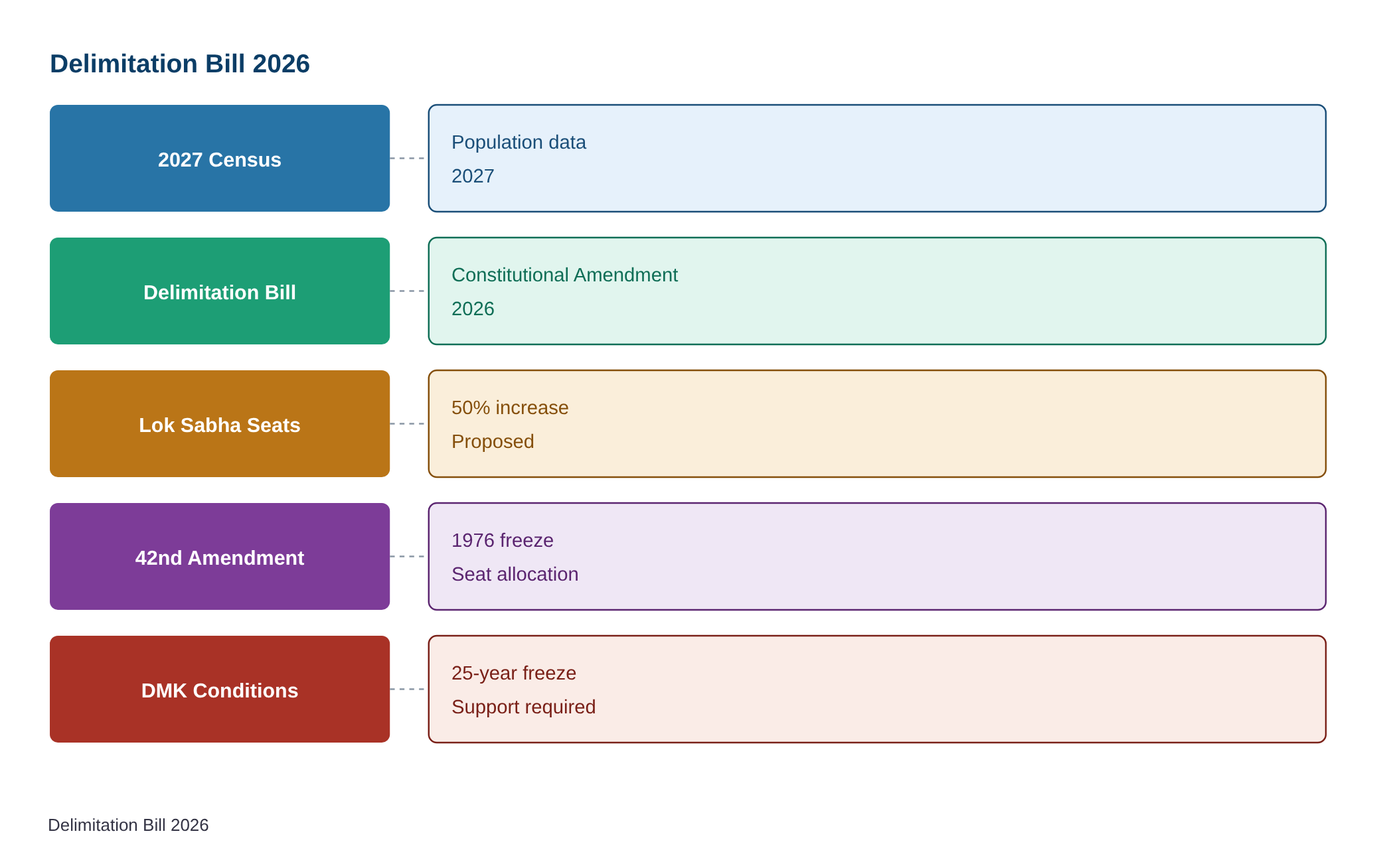
The DMK’s conditional support to the Centre’s proposed Delimitation Bill (Constitution (131st Amendment) Bill 2026) has introduced a critical political and constitutional dynamic in Parliament. The Bill seeks to revise seat allocation in the Lok Sabha based on the 2027 Census, but the DMK’s demands—including a 25-year extension of the 1976 freeze on seat allocation and a 50% blanket increase in Lok Sabha seats—highlight the intersection of federalism, electoral representation, and constitutional amendments. This development is significant as the government lacks the requisite two-thirds majority and must secure Opposition support, particularly from regional parties like the DMK, to pass the Bill.
Background
- The constitutional freeze on seat allocation, introduced via the 42nd Amendment Act, 1976, was based on the 1971 Census and has remained in effect since then, preventing reallocation of Lok Sabha seats despite population changes.
- The 2026 Delimitation Bill aims to conduct a fresh delimitation exercise based on the 2027 Census, which is expected to conclude by 2027, necessitating early legislative action to avoid delays in seat redistribution.
- The Bill was defeated on the floor of the Lok Sabha in April 2026.
- The DMK’s demand for a 50% blanket increase in Lok Sabha seats reflects its concern over the potential reduction in Tamil Nadu’s relative share of seats due to demographic shifts in northern states.
- The government’s outreach to Opposition parties, including the Congress, underscores the need for consensus-building to secure the two-thirds majority required for constitutional amendments.
- The political situation has changed since April 17, when the Constitution (131st Amendment) Bill was defeated.
What is Delimitation and the Constitution (131st Amendment) Bill 2026?
- Delimitation refers to the process of redrawing the boundaries of parliamentary and assembly constituencies to reflect changes in population, ensuring equitable representation. It is conducted by the Delimitation Commission, a statutory body established under the Delimitation Act, 2002.
- The Constitution (131st Amendment) Bill 2026 proposes to amend Articles 81, 82, and related provisions to enable a fresh delimitation exercise based on the 2027 Census, replacing the current freeze imposed by the 42nd Amendment Act, 1976.
- The DMK’s demand for a 25-year extension of the 1976 freeze is rooted in concerns over the potential loss of Tamil Nadu’s political weight in the Lok Sabha due to demographic shifts favoring northern states like Uttar Pradesh and Bihar.
- Constitutional amendments under Article 368 require a two-thirds majority in both Houses of Parliament and ratification by at least half of the State Legislatures, making Opposition consensus critical for passage.
- The Delimitation Commission, once constituted, would be responsible for redrawing constituency boundaries while ensuring that the number of seats allocated to each State aligns with the revised Schedule.
- The Bill’s passage is contingent on political negotiations, with the government needing to balance the demands of regional parties like the DMK against broader Opposition opposition to constitutional amendments for delimitation.
Key Features
| Feature | Significance |
|---|---|
| Constitutional freeze on seats (1971 Census) | Ensures stability in seat allocation until the next Census, preventing frequent changes that could disrupt political representation. |
| 50% blanket increase in Lok Sabha seats | Proposes a proportional expansion of Parliament to accommodate population growth while maintaining regional balance. |
| DMK’s demand for State-wise seat schedule | Seeks transparency and predictability in seat allocation, reducing uncertainty for political parties and states. |
| Government’s outreach to Opposition | Indicates attempts to build consensus on a contentious constitutional amendment, highlighting political negotiation dynamics. |
| INDIA bloc’s numerical strength in Lok Sabha | Determines the feasibility of passing the Bill, as the government lacks a two-thirds majority independently. |
Why it Matters
Constitutional and Governance
- The delimitation exercise is a constitutional mechanism to redraw electoral boundaries based on population changes, as mandated by Article 82 and the Delimitation Act, 2002.
- A freeze on seat allocation ensures continuity in representation but may delay necessary adjustments to reflect demographic shifts.
- The proposed 50% increase in Lok Sabha seats requires a constitutional amendment, as the total number of seats is fixed by the Constitution (Article 81).
- Political consensus is critical, as the government lacks the requisite two-thirds majority in the Lok Sabha to pass the amendment unilaterally.
Political and Electoral
- The DMK’s conditions reflect regional aspirations, particularly in Tamil Nadu, where population growth has not translated into proportional political representation.
- Support from regional parties like the DMK could strengthen the government’s position, but ideological and numerical constraints remain significant.
- The INDIA bloc’s opposition to the Bill underscores broader ideological divides on federalism, representation, and constitutional amendments.
- The government’s outreach to the Opposition highlights the need for cross-party collaboration in passing contentious legislation.
Demographic and Representational
- Population growth since the 1971 Census has led to demands for a more equitable distribution of Lok Sabha seats across states.
- A blanket 50% increase in seats could address underrepresentation but risks diluting the principle of proportionality based on population density.
- The freeze on seat allocation (1971 Census) has been criticized for perpetuating disparities between states with varying population growth rates.
Institutional and Procedural
- The Delimitation Commission, constituted under the Delimitation Act, 2002, is responsible for redrawing boundaries, but its recommendations require parliamentary approval.
- A constitutional amendment is necessary to alter the total number of seats in the Lok Sabha, as the ceiling is fixed by Article 81.
- The government’s inability to secure a two-thirds majority in the Lok Sabha demonstrates the challenges of coalition politics in passing major reforms.
Challenges
1. Lack of Two-Thirds Majority
- The government currently lacks the required two-thirds majority (360 seats) in the Lok Sabha to pass the constitutional amendment unilaterally.
- Even with DMK support (22 seats), the government would still fall short by 14 seats, necessitating abstentions or additional support from other parties.
- The Rajya Sabha presents a more favorable numerical landscape, but the Lok Sabha remains the primary hurdle due to the government’s slender majority.
UPSC Link: Parliament and State Legislatures
2. Regional Disparities in Representation
- Southern states, including Tamil Nadu, argue that the freeze on seat allocation (1971 Census) has led to underrepresentation relative to their population growth.
- The DMK’s demand for a 50% blanket increase in seats aims to address this imbalance but risks exacerbating disparities between high- and low-growth states.
- Balancing proportional representation with regional equity remains a contentious issue in delimitation debates.
UPSC Link: Federalism and Centre-State Relations
3. Political Opposition and Ideological Divides
- The INDIA bloc’s opposition to the Bill reflects broader ideological differences on constitutional amendments and federalism.
- Regional parties like the DMK may prioritize state-specific demands over national consensus, complicating the passage of the Bill.
- The government’s outreach to the Opposition highlights the need for compromise but also underscores the fragility of political alliances.
UPSC Link: Pressure Groups and Formal/Informal Associations
4. Constitutional and Legal Hurdles
- Any amendment to the total number of Lok Sabha seats requires a constitutional amendment, which is procedurally complex and politically sensitive.
- The Delimitation Act, 2002, mandates that the next Census data be used for delimitation, but the government seeks to extend the freeze for another 25 years.
- Legal challenges could arise if the proposed changes are perceived as violating the principles of federalism or proportional representation.
UPSC Link: Constitutional Amendments
5. Operational and Logistical Challenges
- The Census, scheduled for completion in 2027, is a prerequisite for delimitation, but the government seeks to delay this process to align with political priorities.
- Redrawing electoral boundaries requires extensive administrative and technical coordination, which could delay the implementation of the Bill.
- Ensuring transparency and fairness in seat allocation is critical to prevent allegations of gerrymandering or political bias.
UPSC Link: Government Policies and Interventions
Challenges — UPSC Perspective
| Issue | Concern |
|---|---|
| Two-Thirds Majority | Government lacks sufficient numbers in the Lok Sabha to pass the constitutional amendment without Opposition support. |
| Regional Representation | Southern states argue that the 1971 Census freeze has led to underrepresentation relative to population growth. |
| Political Opposition | The INDIA bloc’s resistance to the Bill complicates consensus-building and risks legislative gridlock. |
| Constitutional Amendment | Altering the total number of Lok Sabha seats requires a constitutional amendment, which is procedurally complex. |
| Census Timelines | The next Census (2027) is a prerequisite for delimitation, but the government seeks to extend the freeze, creating a conflict between legal and political timelines. |
Way Forward
- The government must engage in sustained negotiations with the DMK and other Opposition parties to secure their support for the Bill, focusing on addressing regional demands.
- A detailed schedule of seat allocations for each state should be provided in the legislative package to enhance transparency and reduce uncertainty.
- The government should consider a phased approach to delimitation, balancing the need for representation with the procedural requirements of the Census and legal frameworks.
- Parliamentary debates and select committee reviews should be leveraged to build consensus and address concerns raised by regional parties and the Opposition.
- The government must clarify the rationale behind the 50% blanket increase in seats, ensuring it aligns with constitutional principles of proportional representation.
- Efforts to strengthen the government’s numerical position in the Lok Sabha, such as abstentions or cross-party support, should be prioritized to meet the two-thirds majority threshold.
- The Delimitation Commission should be constituted promptly to initiate preparatory work, ensuring that the process remains aligned with constitutional and legal requirements.
UPSC Value Addition
Keywords for Mains Answer-Writing
Delimitation Commission · Constitution (131st Amendment) Bill · Lok Sabha seat allocation · 1971 Census freeze · Dravida Munnetra Kazhagam (DMK) political stand · Federalism and Centre-State relations · Parliamentary procedures for constitutional amendments · Opposition unity and INDIA bloc · Two-thirds majority requirement · Representation of States in Parliament
Constitutional & Policy Linkages
- [‘Article 81’, ‘Total seats in Lok Sabha’]
- [‘Article 82’, ‘Readjustment of seats after Census’]
Concept Flow
Population growth since 1971 Census → Demand for proportional representation in Lok Sabha seats → Government proposes delimitation Bill with 50% blanket increase in seats → DMK demands freeze extension and seat schedule → Government lacks two-thirds majority in Lok Sabha → Outreach to Opposition for support → Opposition (INDIA bloc) opposes constitutional amendment → Political negotiations and consensus-building → Delimitation Commission’s role (Article 324) → Legal and procedural requirements for seat allocation → Constitutional amendment (Article 81) → Passage of Bill requires two-thirds majority in Parliament → Implementation of delimitation → Redrawing of electoral boundaries and potential changes in political representation
Prelims Practice Questions
Q1. Consider the following statements regarding the Delimitation Commission in India:
1. The Delimitation Commission is a statutory body established under the Delimitation Act, 2002.
2. The primary function of the Delimitation Commission is to determine the number and boundaries of constituencies in India.
3. The Delimitation Commission operates independently of the Election Commission of India.
4. The latest delimitation exercise in India was based on the 2011 Census.
How many of the above statements are correct?
- Only one
- Only two
- Only three
- All
Answer: Only three — Statements 1 and 2 are correct. The Delimitation Commission is indeed a statutory body under the Delimitation Act, 2002, and its primary function is to determine constituency boundaries. Statement 3 is incorrect as the Delimitation Commission works in coordination with the Election Commission. Statement 4 is incorrect because the latest delimitation exercise was based on the 1971 Census, with a freeze until the 2026 Census.
Q2. Assertion (A): The Constitution (131st Amendment) Bill, 2026, aims to increase the total number of Lok Sabha seats by 50%.
Reason (R): The Bill seeks to revise the freeze on seat allocation based on the 1971 Census, which currently limits the number of seats per state.
In the context of the above two statements, which one of the following is correct?
- Both A and R are true, and R is the correct explanation of A.
- Both A and R are true, but R is not the correct explanation of A.
- A is true, but R is false.
- A is false, but R is true.
Answer: A is true, but R is false. — Assertion (A) is true as the Bill proposes a 50% blanket increase in Lok Sabha seats. Reason (R) is also true as it seeks to revise the 1971 Census freeze, but the increase in seats is not directly explained by the revision of the freeze alone; it is a separate provision.
Q3. Match the following provisions of the Constitution with their respective Articles:
Column I (Provision) | Column II (Article)
1. Power of the President to grant pardons | A. Article 161
2. Executive power of the Union | B. Article 53
3. Power of the Governor to grant pardons | C. Article 72
4. Council of Ministers to aid and advise the President | D. Article 74
Select the correct match:
- 1-C, 2-B, 3-A, 4-D
- 1-A, 2-B, 3-C, 4-D
- 1-D, 2-C, 3-A, 4-B
- 1-B, 2-A, 3-D, 4-C
Answer: 1-C, 2-B, 3-A, 4-D — The correct matches are: 1-C (Article 72), 2-B (Article 53), 3-A (Article 161), and 4-D (Article 74).
Mains Practice Question
✍ The Constitution (131st Amendment) Bill, 2026, seeks to amend the freeze on Lok Sabha seat allocation based on the 1971 Census and introduce a 50% blanket increase in seats. Critically examine the implications of this Bill for federalism, representation, and parliamentary procedures in India. (15 Marks)
Approach: MODEL-ANSWER SKELETON:
1. **Context and Provisions of the Bill**:
– Briefly outline the Bill’s objectives: ending the 1971 Census freeze, increasing Lok Sabha seats by 50%, and DMK’s conditions (e.g., 25-year freeze extension, seat allocation schedule).
– Mention the constitutional amendment requirement (two-thirds majority in Parliament) and the current political dynamics (INDIA bloc, DMK’s stance).
2. **Federalism and Centre-State Relations**:
– **Representation**: Discuss how the freeze has historically favoured certain states (e.g., southern states) and the potential impact of a blanket increase on smaller states vs. larger states.
– **State Autonomy**: Critique whether the Bill centralises power by altering seat allocation without broader consultation with states.
– **Constitutional Scheme**: Reference Articles 81 and 82 (original provisions on seat allocation) and the 42nd Amendment (freeze till 2000, extended via 84th Amendment).
3. **Representation and Democratic Principles**:
– **Population vs. Equity**: Evaluate the tension between population-based representation (Article 81) and equitable representation for smaller states (e.g., Article 330 for SC/ST reservations).
– **Delimitation Commission’s Role**: Explain its composition (judicial member, Election Commission, and state representatives) and independence.
– **Impact on Voter-Constituency Ratio**: Discuss how seat increases may dilute the value of each vote in larger states.
4. **Parliamentary Procedures and Political Dynamics**:
– **Constitutional Amendment Process**: Outline the requirements under Article 368 (special majority + ratification by states if affecting federal balance).
– **Opposition Stance**: Analyse the INDIA bloc’s opposition and DMK’s conditional support, including their demands for transparency (seat allocation schedule).
– **Government’s Strategy**: Discuss the Centre’s outreach to Opposition parties (e.g., meetings with Rahul Gandhi) and the challenges in securing two-thirds majority.
5. **Critique and Way Forward**:
– **Alternatives**: Propose a phased increase in seats (e.g., 25% now, 25% later) or a formula-based allocation (e.g., combining population and equity).
– **Judicial Scrutiny**: Reference judicial precedents (e.g., *S.R. Bommai v. Union of India*) on federalism and Centre-State relations.
– **Public Discourse**: Emphasise the need for wider consultations with states, civil society, and constitutional experts to build consensus.
**Balanced View**:
– Acknowledge the need for modernising Parliament’s composition to reflect demographic changes.
– Highlight risks of politicisation, lack of consensus, and potential erosion of federal trust if the Bill is pushed without broader agreement.
Source: The Hindu
Generated by AanyaAi for educational purpose.

- UPSC Civil Services (Main) Examination 2026 — Commerce and Accountancy Optional Paper II: Question Paper | Plutus IAS - September 21, 2026
- UPSC Civil Services (Main) Examination 2026 — Philosophy Optional Paper II: Questions with Model Answers | Plutus IAS - September 21, 2026
- कर्नाटक हाईकोर्ट ने KPSC घोटाले की जांच के लिए डीजीपी अलोक कुमार की अध्यक्षता में SIT गठित की - September 21, 2026

No Comments