


07 Aug DMK’s Conditions for Supporting Delimitation Bill: Key UPSC Polity Insights
✎ The 1976 freeze on delimitation, enacted via the 42nd Amendment, prevents frequent redrawing of constituency boundaries to maintain political stability, but its expiry post-2027 necessitates a constitutional amendment to avoid…
Subject Relevance — Where This Topic Fits
- GS Paper II — Polity and Governance: Constitutional Amendments, Federalism, and Parliamentary Procedures | GS Paper III — Government Policies and Interventions: Electoral Reforms and Representation
- Prelims: Delimitation Commission, Constitutional Amendment Bills, Lok Sabha Seats Allocation, 1976 Freeze on Delimitation, Federalism and State Representation, Parliamentary Procedures for Amendments
- Essay: Federalism in India: Balancing Unity and Diversity, Electoral Reforms and Democratic Representation in a Changing India
Quick Revision: The 1976 freeze on delimitation, enacted via the 42nd Amendment, prevents frequent redrawing of constituency boundaries to maintain political stability, but its expiry post-2027 necessitates a constitutional amendment to avoid legal and demographic vacuums.
Why is this in the news?
The Dravida Munnetra Kazhagam (DMK) has publicly articulated specific conditions for supporting the Government of India’s proposed Delimitation Bill, 2026, which seeks to redraw Lok Sabha constituency boundaries. The Bill’s introduction follows renewed efforts by the Centre to secure Opposition support amid shifting parliamentary arithmetic. The DMK’s stance—demanding a 25-year extension of the 1976 freeze on delimitation, a 50% blanket increase in Lok Sabha seats, and a pre-legislative schedule of state-wise seat allocations—highlights the intersection of federal bargaining, electoral arithmetic, and constitutional reform.
Background
- The current Lok Sabha seat allocation is based on the 1971 Census, with the number of seats frozen under the 42nd Constitutional Amendment, 1976, to prevent frequent redistributions that could disrupt political stability.
- The freeze is set to expire after the 2027 Census, necessitating a potential delimitation exercise to realign constituencies with population changes, particularly in states with higher demographic growth.
- The political landscape has since evolved, with the INDIA bloc gaining numerical strength, altering the arithmetic for constitutional amendments requiring a two-thirds majority in Parliament.
- The DMK, a key ally in the INDIA bloc, holds 22 Lok Sabha seats and has emerged as a pivotal player in negotiations over the Bill’s passage.
What is the Delimitation Bill, 2026?
- The Bill seeks to replace the current seat allocation, which is frozen at 1971 Census levels, with a new framework that accounts for population changes over five decades.
- The DMK’s conditions—extension of the freeze, seat increase, and a pre-legislative schedule—reflect concerns over potential loss of southern states’ representation due to higher population growth in northern states.
- The Bill requires a two-thirds majority in Parliament and ratification by at least half of the State Legislatures, making consensus-building critical for its passage.
- The Government’s outreach to Opposition parties, including the Congress and DMK, underscores the Bill’s political sensitivity and the need for cross-party support to avoid procedural defeats.
Key Features
| Feature | Significance |
|---|---|
| Constitutional freeze on seat allocation (1976 amendment) | Prevents reallocation of Lok Sabha seats based on population changes, ensuring stability in representation until 2027. |
| Proposed 50% blanket increase in Lok Sabha seats | Aims to expand the House size by half, addressing long-standing demands for greater representation while maintaining demographic balance. |
| DMK’s demand for a Schedule of seats per State | Seeks transparency in seat distribution, ensuring equitable allocation aligned with population projections and political consensus. |
| Government’s outreach to Opposition parties | Demonstrates attempts to secure two-thirds majority for constitutional amendment, highlighting political negotiation dynamics. |
| INDIA bloc’s opposition to delimitation | Reflects ideological resistance to altering seat distribution, potentially delaying or complicating legislative passage. |
Why it Matters
Constitutional and Legal
- The delimitation exercise, if enacted, would require a constitutional amendment under Article 82, necessitating a two-thirds majority in Parliament and ratification by at least half of the State Legislatures.
- The 1976 freeze (42nd Amendment) on seat allocation, originally intended to last until 2001, has been extended multiple times, reflecting the sensitivity of demographic representation in Indian federalism.
Political and Governance
- The DMK’s conditional support underscores the role of regional parties in shaping national legislation, particularly on issues affecting federal balance and electoral representation.
- The government’s outreach to the Opposition highlights the necessity of consensus-building in a fragmented parliamentary landscape, where no single party holds a majority.
Electoral and Representational
- A 50% increase in Lok Sabha seats would expand the House from 543 to 815 members, potentially altering the electoral calculus for future general elections and coalition dynamics.
- The freeze on seat allocation based on the 1971 Census has led to disproportionate representation, with southern States arguing for safeguards against further dilution of their political voice.
Federalism and State Autonomy
- The DMK’s demand for a State-wise seat schedule reflects concerns over federal equity, particularly in the context of southern States’ demographic stability compared to northern States with higher population growth.
Challenges
1. Constitutional Amendment Hurdles
- The government lacks a two-thirds majority in the Lok Sabha, requiring cross-party negotiations to secure the necessary 360 votes for passage.
- Opposition from the INDIA bloc, including the Congress, complicates consensus-building, as the party has explicitly opposed any constitutional amendment for delimitation.
UPSC Link: GS-II: Parliament and State Legislatures
2. Federal Disputes on Representation
- Southern States, including Tamil Nadu, argue for protection against seat reduction due to lower population growth, while northern States may resist dilution of their demographic advantage.
- The DMK’s demand for a 25-year extension of the freeze and a blanket 50% increase in seats risks alienating other States with differing demographic trajectories.
UPSC Link: GS-II: Federalism and Centre-State Relations
3. Political Polarisation and Negotiation Fatigue
- The INDIA bloc’s opposition to delimitation reflects broader ideological differences with the ruling dispensation, making consensus-building a protracted process.
- The government’s delayed outreach to the DMK, despite renewed efforts, suggests a lack of cohesive strategy in managing Opposition expectations.
UPSC Link: GS-II: Role of Opposition in Parliament
4. Logistical and Administrative Challenges
- The Census 2027, which will inform the next delimitation exercise, faces delays and resource constraints, potentially disrupting the timeline for legislative action.
- Expanding the Lok Sabha by 50% would require significant logistical adjustments, including seating arrangements, electoral rolls, and administrative infrastructure.
UPSC Link: GS-II: Constitutional and Non-Constitutional Bodies
5. Risk of Electoral Distortions
- A blanket 50% increase in seats without proportional adjustments could exacerbate existing disparities in representation, particularly favoring States with lower population growth.
- The absence of a clear formula for seat allocation risks accusations of political favoritism, undermining public trust in the electoral process.
UPSC Link: GS-II: Electoral Reforms and Representation
Challenges — UPSC Perspective
| Issue | Concern |
|---|---|
| Two-thirds majority requirement | Government lacks sufficient votes to pass the constitutional amendment, necessitating Opposition support. |
| Federal equity in seat allocation | Southern States seek protection against seat reduction, while northern States may resist dilution of their demographic advantage. |
| Opposition from INDIA bloc | Congress and allies oppose delimitation, complicating consensus-building and legislative passage. |
| Census 2027 delays | Potential disruptions to the delimitation timeline due to administrative or logistical challenges in conducting the Census. |
| Logistical adjustments for expanded Lok Sabha | Significant infrastructure and administrative changes required to accommodate a 50% increase in seats. |
Way Forward
- The government must initiate formal negotiations with the DMK and other Opposition parties to address their concerns, particularly on the freeze extension and seat allocation formula.
- A bipartisan committee, including representatives from the ruling dispensation and Opposition, should be constituted to draft a consensus-based constitutional amendment.
- The government should clarify the methodology for the 50% blanket increase in seats, ensuring it aligns with principles of federal equity and demographic representation.
- Parliamentary Affairs Minister should continue high-level outreach to Opposition leaders, including Rahul Gandhi, to secure their support or abstention during voting.
- A detailed schedule for Census 2027 should be published to reassure States of the delimitation timeline and mitigate logistical uncertainties.
- The government must address the DMK’s demand for a State-wise seat schedule, potentially incorporating it into the constitutional amendment to enhance transparency.
- Efforts should be made to isolate the INDIA bloc’s opposition by engaging with regional parties like the AAP, TMC, or BJD, which may have differing stances on delimitation.
- Public consultations and expert committees should be convened to deliberate on the long-term implications of delimitation, including its impact on electoral democracy.
UPSC Value Addition
Keywords for Mains Answer-Writing
Delimitation Commission · Constitution (131st Amendment) Bill · Lok Sabha seat allocation · 1971 Census freeze · Dravida Munnetra Kazhagam (DMK) · Constitutional amendment process · Federalism and Centre-State relations · Lok Sabha strength increase · Indira Gandhi’s 42nd Amendment · Parliamentary procedure for constitutional amendments · Political consensus in delimitation · Census and representation · Tamil Nadu’s political stance on delimitation
Constitutional & Policy Linkages
- Article 82: Provision for delimitation of constituencies by an authority and manner prescribed by Parliament.
- Article 170: Composition of State Legislative Assemblies, linked to delimitation principles.
- Article 324: Role of the Election Commission in conducting elections and delimitation.
- Part XIV: Services Under the Union and the States, relevant for administrative adjustments post-delimitation.
Concept Flow
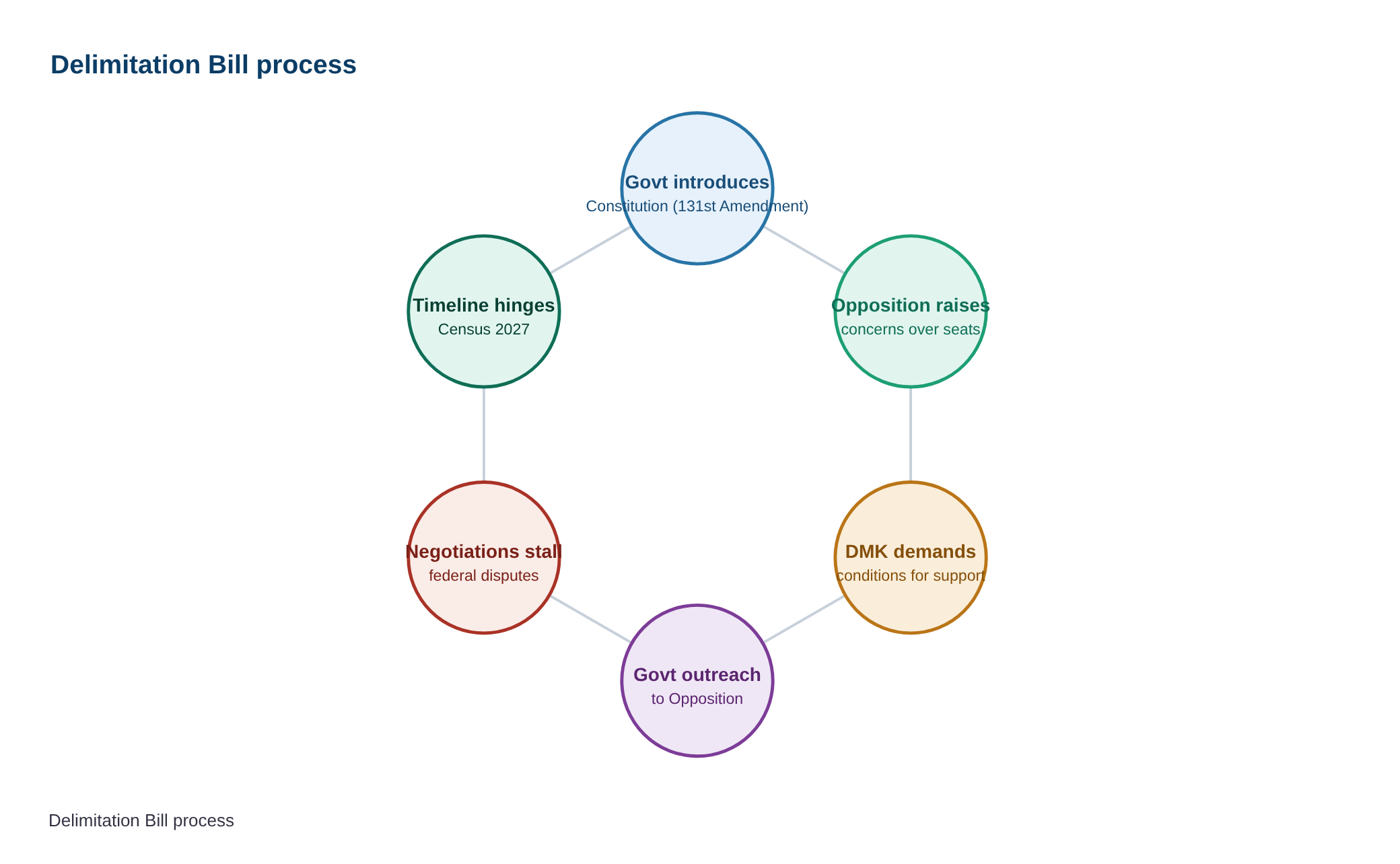
Government introduces Constitution (131st Amendment) Bill → Opposition, including DMK, raises concerns over seat allocation and freeze extension → DMK lays down conditional support for the Bill → Government engages in outreach to secure Opposition backing → Political negotiations stall due to federal disputes and ideological differences → Delimitation timeline hinges on Census 2027 and consensus-building → Legislative passage remains uncertain without two-thirds majority.
Prelims Practice Questions
Q1. Consider the following statements regarding the delimitation process in India:
1. The current freeze on Lok Sabha seat allocation is based on the 1971 Census.
2. The Constitution (131st Amendment) Bill seeks to increase the total number of Lok Sabha seats by 50%.
3. The delimitation process is conducted by the Election Commission of India.
4. The 42nd Constitutional Amendment Act, 1976, froze the seat allocation based on the 1971 Census for 25 years.
How many of the above statements are correct?
- Only one
- Only two
- Only three
- All four
Answer: Only three — Statements 1 and 4 are correct. The freeze on seat allocation is based on the 1971 Census, extended by the 42nd Amendment. Statement 2 is incorrect as the Bill seeks a blanket increase but not necessarily 50%. Statement 3 is incorrect as delimitation is conducted by a Delimitation Commission, not the Election Commission.
Q2. Assertion (A): The Constitution (131st Amendment) Bill, 2026, aims to amend the freeze on Lok Sabha seat allocation based on the 1971 Census.
Reason (R): The freeze was introduced by the 42nd Constitutional Amendment Act, 1976, and is set to expire after the 2027 Census.
Options:
A. Both A and R are true, and R is the correct explanation of A.
B. Both A and R are true, but R is not the correct explanation of A.
C. A is true but R is false.
D. A is false but R is true.
Answer: ? — Both A and R are true. The Bill seeks to extend the freeze, and the freeze was indeed introduced by the 42nd Amendment, which is set to expire after the 2027 Census. R correctly explains A.
Q3. Match the following pairs related to the delimitation process in India:
Column I
1. Delimitation Commission
2. 42nd Constitutional Amendment Act
3. Census year for current seat freeze
4. Proposed increase in Lok Sabha seats
Column II
A. 1971
B. 50%
C. 1976
D. Constitutionally mandated body
- 1-D, 2-C, 3-A, 4-B
- 1-A, 2-B, 3-C, 4-D
- 1-C, 2-D, 3-A, 4-B
- 1-B, 2-A, 3-D, 4-C
Answer: 1-D, 2-C, 3-A, 4-B — The correct match is: 1-D (Delimitation Commission is a constitutionally mandated body), 2-C (42nd Amendment introduced the freeze in 1976), 3-A (freeze is based on the 1971 Census), 4-B (proposed increase is 50%).
Mains Practice Question
✍ Critically examine the constitutional and political implications of extending the freeze on Lok Sabha seat allocation based on the 1971 Census for another 25 years. Also, discuss the challenges this poses to the principles of federalism and representative democracy in India. (15 Marks)
Approach: MODEL-ANSWER SKELETON:
1. **Constitutional Context**:
– Reference to Article 82 and the 42nd Constitutional Amendment Act, 1976, which froze seat allocation based on the 1971 Census.
– Explanation of the rationale behind the freeze: to prevent frequent changes in seat allocation due to population shifts and ensure stability.
– Mention of the 84th Amendment Act, 2001, which extended the freeze until the first Census after 2026.
2. **Proposed Extension**:
– Analysis of the DMK’s demand to extend the freeze for another 25 years.
– Reference to the Constitution (131st Amendment) Bill, 2026, and its provisions.
– Explanation of the proposed 50% blanket increase in Lok Sabha seats for all states.
3. **Federalism and Representation**:
– **Federalism**: Discussion on how the freeze impacts the federal structure by not accounting for population growth disparities among states. States with higher population growth (e.g., Bihar, Uttar Pradesh) are underrepresented, while states with lower growth (e.g., Kerala, Tamil Nadu) are overrepresented.
– **Representative Democracy**: Critique of the freeze’s impact on the principle of ‘one person, one vote’ and fair representation. Highlight the demographic shifts since 1971 and the need for periodic adjustments.
4. **Political Implications**:
– Analysis of the DMK’s stance: protection of Tamil Nadu’s political clout and resistance to perceived dilution of southern states’ representation.
– Discussion on the Centre’s rationale: ensuring stability and avoiding frequent redistricting.
– Mention of the political consensus required for constitutional amendments and the challenges in achieving it.
5. **Challenges and Alternatives**:
– Challenges posed by the freeze: demographic distortions, underrepresentation of faster-growing states, and potential for political discontent.
– Alternatives: phased delimitation, weighted representation based on population growth, or periodic reviews.
6. **Conclusion**:
– Balanced view: While the freeze provides stability, it risks undermining democratic principles of fair representation. A compromise solution, such as phased delimitation, may be more equitable.
Source: The Hindu
Generated by AanyaAi for educational purpose.

- केरल लोक सेवा आयोग ने उच्च न्यायालय में दायर किया मामला, सदस्यों के खिलाफ मामला रद्द करने की मांग - September 23, 2026
- KPSC Challenges Prosecution Sanction in Kerala High Court: Key UPSC Polity Insight - September 23, 2026
- केरल में एंटीमाइक्रोबियल रेजिस्टेंस: सरकारी रिपोर्ट में चौंकाने वाले आँकड़े सामने - September 23, 2026

No Comments