


07 Aug DMK’s Key Conditions for Supporting Delimitation Bill in Lok Sabha
✎ The Dravida Munnetra Kazhagam (DMK) has publicly articulated conditional support for the Centre’s proposed Delimitation Bill (2026), contingent upon three critical amendments: (1) extending the constitutional freeze on Lok Sabha…
Subject Relevance — Where This Topic Fits
- GS Paper II — Parliament and State Legislatures — Structure, Functioning, Conduct of Business, Powers & Privileges and Issues Arising out of these | GS Paper II — Federalism: Issues and Challenges | GS Paper III — Electoral Reforms and Representation of People’s Act
- Prelims: Delimitation Commission, Constitutional Amendment Bill, 131st Amendment Bill, Lok Sabha seat freeze (1971 Census), INDIA bloc, Rajya Sabha two-thirds majority, Parliamentary Affairs Minister, Schedule of seats for States
- Essay: Federalism and Centre-State Relations: The Delimitation Dilemma, Electoral Reforms and Democratic Representation: Balancing Equity and Efficiency
Why is this in the news?
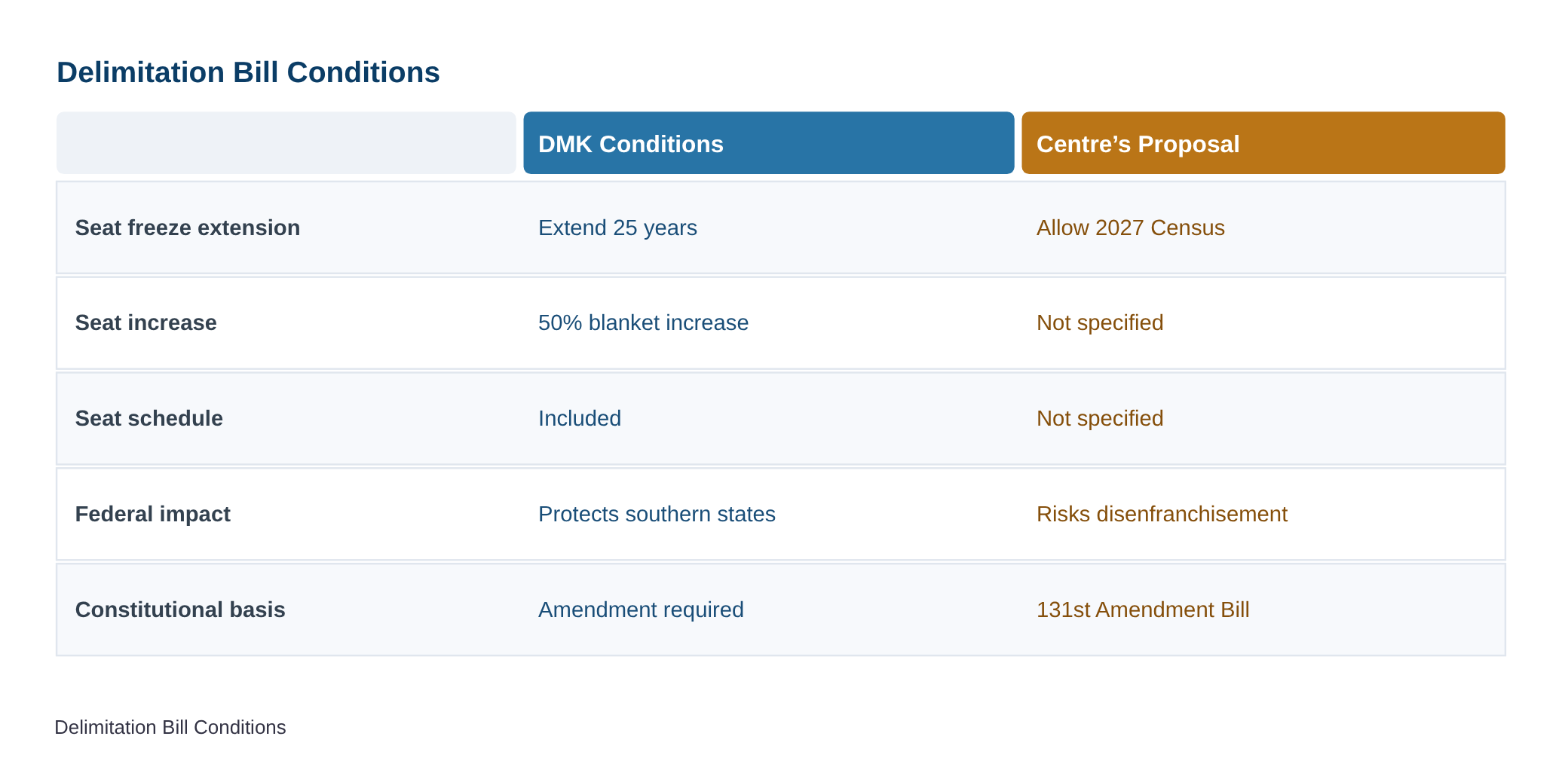
The Dravida Munnetra Kazhagam (DMK) has publicly articulated conditional support for the Centre’s proposed Delimitation Bill (2026), contingent upon three critical amendments: (1) extending the constitutional freeze on Lok Sabha seat allocation based on the 1971 Census for another 25 years; (2) introducing a blanket 50% increase in Lok Sabha seats for all States; and (3) incorporating a Schedule specifying the number of seats per State in the legislative package. These conditions, articulated amid renewed Centre-Opposition outreach, underscore the Bill’s constitutional, political, and federal dimensions, making it a pivotal subject for UPSC Civil Services Examination preparation.
Background
- The constitutional freeze on Lok Sabha seat allocation, based on the 1971 Census, was introduced under the 42nd Amendment Act (1976) and is set to expire after the completion of the 2027 Census, necessitating a legislative or constitutional response.
- The Delimitation Commission, constituted under Article 82 of the Constitution, is tasked with redrawing electoral boundaries to reflect population changes, ensuring equitable representation in the Lok Sabha and State Legislative Assemblies.
- The Centre’s proposal to amend the Constitution via the 131st Amendment Bill (2026) seeks to revive the delimitation process, which has been dormant since the 1971 Census due to the freeze.
- Political opposition to the Bill stems from concerns over potential disenfranchisement of States with lower population growth rates, particularly in southern India, and the perceived dilution of federal principles.
- The INDIA bloc, led by the Congress, has reiterated its opposition to any constitutional amendment for delimitation, citing risks to democratic representation and federal balance.
- The DMK’s conditions reflect its strategic calculus to balance regional interests with national electoral dynamics, particularly in the context of Tamil Nadu’s demographic and political significance.
What is the Delimitation Bill 2026?
- The delimitation process, governed by Articles 82 and 170 of the Constitution, involves redrawing electoral boundaries to reflect population changes, ensuring fair and equitable representation in legislative bodies.
- The freeze on delimitation was initially introduced to prevent frequent changes in electoral boundaries, which could disrupt political stability and administrative continuity.
- The Bill’s passage requires a two-thirds majority in both Houses of Parliament, making it a high-stakes legislative endeavour with significant political implications.
- The DMK’s conditions highlight the Bill’s federal dimensions, as States with lower population growth rates (e.g., southern States) risk losing political representation if seat allocation is based solely on recent population trends.
Key Features
| Feature | Significance |
|---|---|
| Constitutional freeze on seat allocation (1976 amendment) | Ensures stability in electoral representation by preventing frequent changes in seat distribution based on census data, thereby maintaining demographic consistency. |
| 50% blanket increase in Lok Sabha seats | Proposes a proportional expansion of the House to accommodate population growth while maintaining federal balance; aims to address underrepresentation of states with high population growth. |
| Schedule of seats per State in legislative package | Provides clarity on seat distribution across states, reducing ambiguity and facilitating informed political negotiations. |
| DMK’s conditional support to delimitation Bill | Demonstrates the Opposition’s strategic leverage in shaping legislative outcomes through negotiations, highlighting federalism dynamics. |
| Government’s outreach to Opposition parties | Reflects the necessity of consensus-building in a multi-party democracy, especially for constitutional amendments requiring supermajorities. |
Why it Matters
Political
- Underscores the role of regional parties like DMK in influencing national legislative processes, particularly in matters concerning federalism and electoral representation.
- Highlights the evolving dynamics of the Opposition bloc (INDIA alliance) and its potential to alter the government’s legislative strategy.
- Illustrates the tension between centralising reforms (e.g., delimitation) and state-level autonomy, a recurring theme in Indian federalism.
Constitutional
- Reaffirms the primacy of the constitutional framework in electoral reforms, where amendments require supermajorities and consensus among diverse political stakeholders.
- Demonstrates the interplay between census-based seat allocation and constitutional amendments, a critical aspect of democratic representation.
Electoral
- Potential to rebalance Lok Sabha representation by accommodating population growth, particularly in states with high demographic expansion.
- Raises questions about the impact of delimitation on vote share distribution and political power dynamics across states.
Challenges
1. Achieving Supermajority for Constitutional Amendment
- The Bill requires a two-thirds majority in both Houses of Parliament, which the government currently lacks, necessitating cross-party negotiations.
- Opposition parties, including the Congress, have expressed reservations about the delimitation process, complicating consensus-building.
UPSC Link: Polity > Constitutional Amendments > Majority Requirements
2. Federal Tensions in Seat Distribution
- Southern states, including Tamil Nadu, fear a reduction in their relative share of Lok Sabha seats due to population growth in northern states, necessitating safeguards.
- The DMK’s demand for a 50% blanket increase in seats reflects concerns over demographic shifts and their electoral implications.
UPSC Link: Polity > Federalism > Centre-State Relations
3. Negotiation and Consensus-Building
- The government’s outreach to Opposition parties, including the DMK and Congress, highlights the challenges of securing legislative support in a fragmented polity.
- Informal or formal reluctance from key parties to engage in discussions could delay or derail the delimitation process.
UPSC Link: Polity > Parliamentary Procedures > Opposition Role
4. Census Data and Timelines
- The freeze on seat allocation based on the 1971 Census is set to expire after the 2027 Census, creating a temporal urgency for the delimitation exercise.
- Delays in census data collection or political disagreements over its interpretation could further complicate the process.
UPSC Link: Polity > Constitutional Provisions > Census
5. Political Polarisation and Opposition Unity
- The INDIA bloc’s evolving unity and strategy could either facilitate or obstruct the government’s efforts to secure the required majority.
- Internal disagreements within the Opposition on the delimitation Bill may weaken their collective bargaining power.
UPSC Link: Polity > Political Parties > Opposition Dynamics
Challenges — UPSC Perspective
| Issue | Concern |
|---|---|
| Supermajority requirement | Government lacks the two-thirds majority in Lok Sabha to pass the constitutional amendment unilaterally. |
| Federal imbalance in seat distribution | Southern states risk losing relative political weight due to population growth in northern states. |
| Opposition resistance | Congress and other parties oppose the delimitation process, complicating consensus-building. |
| Timing of census data | Expiry of the 1976 freeze necessitates timely completion of the 2027 Census to avoid delays. |
| Negotiation fatigue | Repeated outreach to Opposition parties may not yield tangible results, delaying legislative progress. |
Way Forward
- The government must intensify formal and informal consultations with the DMK and other Opposition parties to address their concerns, particularly on seat distribution and the freeze period.
- A detailed schedule of proposed seat allocations per state should be released to build trust and facilitate informed discussions.
- Parliamentary Affairs Minister should continue engaging with the Congress and other key Opposition leaders to explore potential compromises on the delimitation framework.
- The government could consider a phased approach to delimitation, such as incremental seat increases over multiple elections, to mitigate federal tensions.
- Legal and constitutional experts should be consulted to draft amendments that balance population growth with regional equity, ensuring the Bill withstands judicial scrutiny.
- Public consultations and expert committees could be constituted to assess the socio-political implications of delimitation and propose inclusive solutions.
- The government should clarify the timeline for census data collection and its integration into the delimitation process to avoid procedural bottlenecks.
UPSC Value Addition
Keywords for Mains Answer-Writing
Delimitation Commission · Constitution (131st Amendment) Bill · Lok Sabha seat allocation · 1971 Census freeze · Dravida Munnetra Kazhagam (DMK) · Federalism and Centre-State relations · Parliamentary procedures for constitutional amendments · Opposition coordination and INDIA bloc · Constitutional provisions on delimitation · Representation of States in Parliament
Constitutional & Policy Linkages
- Article 82: Provision for readjustment of seats in Lok Sabha and State Assemblies after each census.
- Article 170: Composition of State Legislative Assemblies, linked to delimitation.
- Article 324: Role of the Election Commission in conducting elections and delimitation.
- Part XV: Elections, which includes constitutional provisions for delimitation.
Concept Flow
Population growth and demographic shifts → Need for electoral representation adjustment → Proposal for delimitation exercise → Government introduces Constitution (131st Amendment) Bill → Opposition parties, including DMK, demand conditions → Negotiations and conditional support → Potential amendments to Bill → Legislative passage requiring supermajority → Implementation post-2027 Census.
Prelims Practice Questions
Q1. Consider the following statements regarding the delimitation of Lok Sabha constituencies in India:
1. The current freeze on the total number of seats in the Lok Sabha is based on the 1971 Census.
2. The Constitution (131st Amendment) Bill, 2026 seeks to increase the number of Lok Sabha seats by 50% uniformly across all States.
3. The delimitation process is conducted by the Election Commission of India.
4. The DMK has demanded that the freeze on seats be extended for another 25 years.
How many of the above statements are correct?
- Only one
- Only two
- Only three
- All four
Answer: Only three — Statements 1, 2, and 4 are correct. Statement 3 is incorrect because the delimitation process is conducted by the Delimitation Commission, not the Election Commission of India.
Q2. Assertion (A): The Constitution (131st Amendment) Bill, 2026 aims to amend the freeze on the total number of Lok Sabha seats based on the 1971 Census.
Reason (R): The DMK has demanded that the freeze be extended for another 25 years to maintain equitable representation.
Options:
A. Both A and R are true, and R is the correct explanation of A.
B. Both A and R are true, but R is not the correct explanation of A.
C. A is true, but R is false.
D. A is false, but R is true.
Answer: ? — Both A and R are true, but R is not the correct explanation of A. The Bill aims to amend the freeze, but the DMK’s demand for extension is a separate condition for their support.
Q3. Match the following provisions with their respective constitutional sources:
Column I (Provision) | Column II (Constitutional Source)
1. Freeze on Lok Sabha seats based on 1971 Census | A. Article 82
2. Delimitation of constituencies | B. Article 334
3. Reservation of seats for Scheduled Castes and Scheduled Tribes | C. Article 324
4. Election Commission of India | D. Article 330
Choose the correct match:
- 1-A, 2-B, 3-D, 4-C
- 1-B, 2-A, 3-D, 4-C
- 1-B, 2-C, 3-D, 4-A
- 1-A, 2-D, 3-B, 4-C
Answer: 1-B, 2-A, 3-D, 4-C — 1-B (Article 334), 2-A (Article 82), 3-D (Article 330), 4-C (Article 324).
Mains Practice Question
✍ ‘The delimitation of Lok Sabha constituencies is a politically sensitive process that intersects with federalism, representation, and constitutional amendments.’ Critically analyse the challenges posed by the Constitution (131st Amendment) Bill, 2026 in this context. Also, examine the implications of the DMK’s conditions for supporting the Bill. (15 Marks)
Approach: MODEL-ANSWER SKELETON:
1. **Introduction (2 marks)**: Define delimitation and its constitutional basis (Articles 82, 334, 324). Highlight the significance of the freeze on seats based on the 1971 Census and its impending expiry post-2027 Census.
2. **Key provisions of the Constitution (131st Amendment) Bill, 2026 (3 marks)**:
– Proposed 50% blanket increase in Lok Sabha seats.
– Potential impact on federal balance and State-wise representation.
– Procedural requirements for constitutional amendments (Article 368).
3. **Challenges and political sensitivities (4 marks)**:
– Centre-State relations: Federalism concerns over uniform seat increase vs. population-based allocation.
– Opposition dynamics: INDIA bloc’s stance and the DMK’s conditions (freeze extension, seat schedule).
– Legal and constitutional hurdles: Two-thirds majority requirement in Parliament and Rajya Sabha dynamics.
4. **DMK’s conditions and their implications (3 marks)**:
– Extension of the 1971 Census freeze for 25 years.
– Guaranteed seat allocation schedule for States.
– Impact on Tamil Nadu’s representation and regional aspirations.
5. **Broader implications for Indian democracy (3 marks)**:
– Ensuring equitable representation while balancing federal principles.
– Role of the Delimitation Commission and judicial oversight.
– Lessons from past delimitation exercises (e.g., 2002-2008).
Conclude with a balanced view on whether the Bill addresses representation concerns or exacerbates federal tensions.
Source: The Hindu
Generated by AanyaAi for educational purpose.

- हिमाचल में डिजिटल भुगतान क्रांति: बिलासपुर अव्वल, महिलाओं की भागीदारी 93% तक पहुंची - September 23, 2026
- Himachal Pradesh Leads in Digital Payments: Bilaspur Tops, Women’s Role Rises - September 23, 2026
- केरल लोक सेवा आयोग ने उच्च न्यायालय में दायर किया मामला, सदस्यों के खिलाफ मामला रद्द करने की मांग - September 23, 2026

No Comments