


07 Aug DMK’s Key Conditions for Supporting Delimitation Bill: UPSC Analysis
✎ The DMK seeks to extend the freeze based on the 1976 amendment to the Constitution for another 25 years while demanding a 50% blanket increase in seats to address federal equity concerns.
Subject Relevance — Where This Topic Fits
- GS Paper II — Polity and Governance (Constitutional Amendments, Federalism) | GS Paper II — Indian Constitution (Delimitation Commission, Census, Representation of People’s Act)
- Prelims: Delimitation Commission, Constitutional (131st) Amendment Bill, Freezing of seats (1976), Lok Sabha seat increase, 1971 Census, INDIA bloc, Two-thirds majority in Parliament, Rajya Sabha vs Lok Sabha dynamics
- Essay: Federalism and Centre-State Relations in India, Representation and Democracy: Balancing Population and Equity
Quick Revision: The DMK seeks to extend the freeze based on the 1976 amendment to the Constitution for another 25 years while demanding a 50% blanket increase in seats to address federal equity concerns.
Why is this in the news?
The DMK’s conditional support to the Centre’s delimitation Bill introduces a critical juncture in India’s constitutional and political landscape. The Bill, aimed at redrawing Lok Sabha constituencies based on updated census data, faces opposition from regional parties over concerns of reduced representation for southern States. The DMK’s demands—extending the seat freeze, a blanket 50% increase in Lok Sabha seats, and a pre-scheduled allocation of seats—highlight the tension between demographic changes, federal equity, and parliamentary arithmetic. This development is significant as it underscores the challenges of constitutional amendments requiring supermajorities and the evolving dynamics of Opposition unity.
Background
- The Constitution (131st Amendment) Bill is for a fresh delimitation exercise.
- A constitutional freeze on seat allocation, based on the 1971 Census, is set to expire post-2027 Census.
- The DMK’s demand for a 25-year extension of the freeze and a 50% blanket increase in Lok Sabha seats reflects concerns over potential loss of representation for southern States, which have lower population growth rates.
- The Bill was introduced in the Lok Sabha in April but faced defeat on April 17 due to lack of Opposition support. The political landscape has since shifted with changes in the INDIA bloc’s strength.
- The Centre’s renewed outreach to Opposition parties, including the Congress, indicates efforts to secure the two-thirds majority required for constitutional amendments.
What is the Delimitation Bill and its Constitutional Context?
- The Delimitation Bill proposes to amend the Constitution to enable a fresh delimitation exercise, which involves redrawing the boundaries of parliamentary and assembly constituencies based on updated Census data.
- The Bill could reallocate seats based on the 2027 Census, potentially altering the balance of power between States.
- The DMK’s demand for a 25-year extension of the freeze and a 50% blanket increase in Lok Sabha seats is rooted in the fear that southern States, with lower population growth, may lose seats to northern States, which have higher growth rates.
- The Bill’s passage requires a two-thirds majority in both Houses of Parliament, making Opposition support critical.
- The DMK’s conditions also include a Schedule outlining the number of seats allocated to each State, reflecting demands for transparency and predictability in the delimitation process.
Key Features
| Feature | Significance |
|---|---|
| Constitutional freeze on seat allocation (1976 amendment) | Prevents reallocation of Lok Sabha seats based on population changes, ensuring stability in representation until the freeze is lifted. |
| Proposed 50% blanket increase in Lok Sabha seats | Aims to expand parliamentary representation while maintaining the existing distribution formula, addressing concerns of under-representation. |
| DMK’s demand for a Schedule of seats per State | Seeks clarity on the exact number of seats allocated to each State, reducing ambiguity in the delimitation process. |
| Government’s outreach to Opposition parties | Demonstrates a strategic effort to secure support for the Bill amid numerical uncertainties in Parliament. |
| INDIA bloc’s opposition to constitutional amendment | Highlights the political fragmentation and challenges in achieving consensus on delimitation reforms. |
Why it Matters
Political
- The DMK’s conditional support underscores the importance of regional parties in shaping national legislative agendas, particularly in coalition-dependent scenarios.
- A successful delimitation Bill could alter the balance of power in Parliament, favoring States with higher population growth, potentially benefiting northern States.
- The government’s outreach to the Opposition reflects a pragmatic approach to governance, acknowledging the need for bipartisan consensus in constitutional matters.
Constitutional
- Delimitation is a constitutional process governed by Articles 81 and 82, which mandate periodic readjustment of electoral boundaries based on Census data.
- The 1976 freeze on seat allocation was introduced to prevent frequent changes that could disrupt political stability, a principle now being reconsidered.
- Any amendment to the freeze requires a two-thirds majority in Parliament and ratification by at least half of the State Legislatures, ensuring federal consensus.
Representational
- The proposed 50% increase in Lok Sabha seats aims to address the issue of under-representation of States with high population growth, such as Uttar Pradesh and Bihar.
- A freeze extension could disproportionately benefit southern States, where population growth has slowed, potentially reducing their relative political influence.
- The demand for a Schedule of seats per State seeks to ensure transparency and predictability in the delimitation process, reducing speculative concerns.
Challenges
1. Political Fragmentation
- The government lacks the two-thirds majority required to pass a constitutional amendment, necessitating Opposition support or abstentions.
- The INDIA bloc’s opposition to the Bill complicates efforts to secure the necessary numerical strength in Parliament.
- Regional parties like the DMK hold significant leverage, making their conditional support critical but uncertain.
UPSC Link: GS-II: Role of regional parties in national politics
2. Constitutional Hurdles
- Amending the freeze on seat allocation requires a two-thirds majority in Parliament and ratification by State Legislatures, a process fraught with delays.
- The Bill’s passage through the Rajya Sabha may face resistance, as the Upper House often reflects a different political composition.
- Legal challenges could arise if the delimitation process is perceived as violating the principle of federalism or proportional representation.
UPSC Link: GS-II: Constitutional amendment process
3. Representational Equity
- Extending the freeze could exacerbate disparities between States with high and low population growth, raising concerns about demographic justice.
- A blanket increase in seats may not address the core issue of under-representation, as the current distribution formula remains unchanged.
- The lack of a clear formula for seat allocation risks political backlash from States that perceive themselves as losing influence.
UPSC Link: GS-II: Principles of electoral representation
Challenges — UPSC Perspective
| Issue | Concern |
|---|---|
| Lack of two-thirds majority | The government may struggle to pass the Bill without Opposition support or abstentions, delaying or derailing the delimitation process. |
| Opposition from INDIA bloc | The Congress-led alliance’s opposition to the Bill creates a significant roadblock in securing the required votes in Parliament. |
| Regional party leverage | Parties like the DMK hold disproportionate influence, making their conditional support uncertain and conditional. |
| Federal ratification requirement | The need for State Legislatures to ratify the amendment introduces additional delays and potential resistance. |
| Demographic representation concerns | Extending the freeze could unfairly advantage States with slower population growth, raising questions about equity. |
Way Forward
- The government should engage in formal and informal consultations with the DMK and other Opposition parties to address their concerns and secure conditional support.
- A detailed Schedule of seat allocations per State should be published to provide transparency and reduce speculative opposition.
- Parliamentary Affairs Minister should continue outreach to Opposition leaders, including Rahul Gandhi, to build consensus on the Bill’s substance.
- The government may consider introducing the Bill in the Rajya Sabha first, where the two-thirds majority threshold may be easier to achieve.
- Legal experts should review the Bill to ensure compliance with constitutional principles, particularly federalism and proportional representation.
- State Legislatures should be briefed on the Bill’s implications to facilitate smoother ratification if the amendment proceeds.
- A public awareness campaign should be launched to explain the need for delimitation and its potential benefits for under-represented States.
UPSC Value Addition
Keywords for Mains Answer-Writing
Delimitation Commission · Constitution (131st Amendment) Bill · Lok Sabha seat increase · 1976 Census freeze · DMK political stance · Parliamentary procedures for constitutional amendments · Federalism and Centre-State relations · Opposition unity in Parliament · Two-thirds majority requirement · Representation of States Act, 1950
Constitutional & Policy Linkages
- Article 81: Composition of the Lok Sabha and delimitation principles.
- Article 82: Readjustment of seats after each Census.
- Article 368: Procedure for constitutional amendments, including ratification by States.
Concept Flow
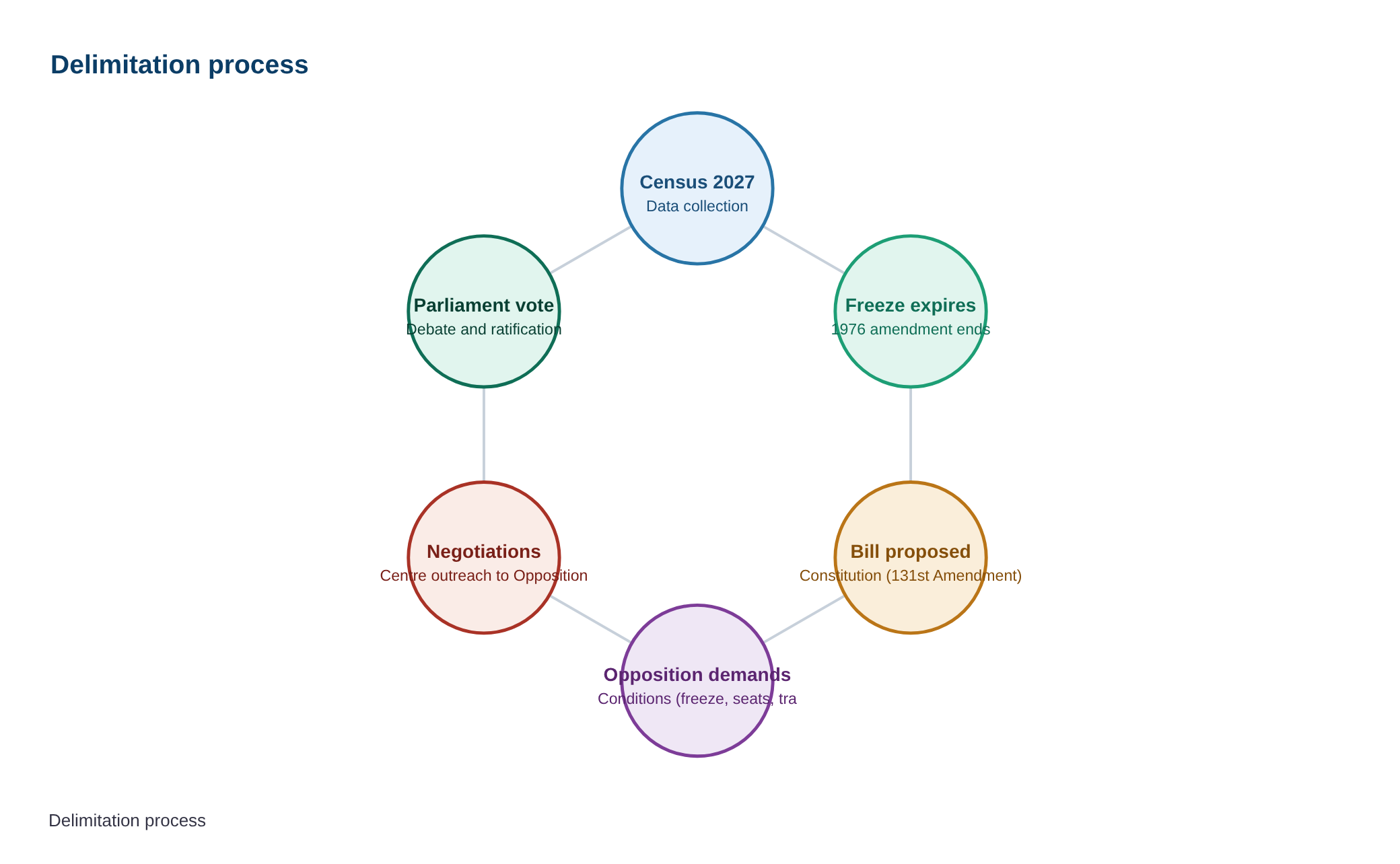
Census data collection (2027) → Freeze on seat allocation (1976 amendment) expires → Government proposes delimitation Bill (Constitution (131st Amendment) Bill) → DMK and Opposition demand conditions (freeze extension, seat increase, transparency) → Political negotiations and outreach to secure support → Parliamentary debate and voting → Potential ratification by State Legislatures → Implementation of delimitation.
Prelims Practice Questions
Q1. Consider the following statements regarding the delimitation process in India: 1. The current freeze on Lok Sabha seats is based on the 1971 Census. 2. The Constitution (131st Amendment) Bill seeks to increase Lok Sabha seats by 50% across all States. 3. The delimitation process is conducted by the Election Commission of India. 4. The freeze on seats is constitutionally mandated to prevent frequent changes in representation. How many of the above statements are correct?
- Only one
- Only two
- Only three
- All four
Answer: Only three — Statements 1 and 2 are correct. Statement 3 is incorrect because delimitation is conducted by the Delimitation Commission, not the Election Commission. Statement 4 is incorrect as the freeze is not constitutionally mandated but is a statutory provision under the Representation of the People Act, 1950.
Q2. Assertion (A): The Constitution (131st Amendment) Bill requires a two-thirds majority in Parliament to be passed. Reason (R): Constitutional amendments in India necessitate a special majority as per Article 368 of the Constitution.
- Both A and R are true, and R is the correct explanation of A
- Both A and R are true, but R is not the correct explanation of A
- A is true but R is false
- A is false but R is true
Answer: Both A and R are true, but R is not the correct explanation of A — Both the assertion and reason are correct. The Constitution (131st Amendment) Bill is a constitutional amendment bill, and Article 368 mandates a two-thirds majority in Parliament for its passage, making R the correct explanation of A.
Q3. Match the following pairs related to delimitation and constitutional amendments in India:
Column I
A. Delimitation Commission
B. Census freeze
C. Two-thirds majority
D. Article 368
Column II
1. Conducts delimitation exercises
2. Prevents frequent changes in seat allocation
3. Required for constitutional amendments
4. Governs the process of amending the Constitution
- A-1, B-2, C-3, D-4; A-2, B-1, C-3, D-4; A-1, B-3, C-2, D-4; A-4, B-2, C-3, D-1
- answer_list_indexes_to_show_answer_as_list_indexes_only_in_answer_field_inside_json_answer_field_inside_json_answer_field_inside_json_answer_field_inside_json_answer_field_inside_json_answer_field_inside_json_answer_field_inside_json_answer_field_inside_json_answer_field_inside_json_answer_field_inside_json_answer_field_inside_json_answer_field_inside_json_answer_field_inside_json_answer
Answer: ? — A matches with 1 (Delimitation Commission conducts delimitation exercises). B matches with 2 (Census freeze prevents frequent changes in seat allocation). C matches with 3 (Two-thirds majority is required for constitutional amendments). D matches with 4 (Article 368 governs the process of amending the Constitution).
Mains Practice Question
✍ The Constitution (131st Amendment) Bill, 2026, seeks to amend the freeze on Lok Sabha seat allocation based on the 1971 Census and introduce a blanket 50% increase in seats across States. Critically examine the constitutional, political, and federal implications of this Bill. Also, analyse the conditions laid down by the DMK for its support and their implications for Centre-State relations. (15 Marks)
Approach: MODEL-ANSWER SKELETON:
1. **Constitutional Implications**:
– Article 82 and 170(3) of the Constitution mandate delimitation based on the latest Census.
– The 1976 amendment froze seat allocation until the 2001 Census; the current freeze is based on the 1971 Census (Representation of the People Act, 1950).
– A blanket 50% increase in seats requires constitutional amendment under Article 368, necessitating a two-thirds majority in Parliament and ratification by half the State Legislatures.
– Discuss the rationale behind the freeze (preventing frequent changes, ensuring stability) vs. the need for expansion (growing population, representation deficit).
2. **Political Implications**:
– The Bill’s passage hinges on Opposition support, particularly from the DMK and Congress, given the lack of a two-thirds majority.
– The DMK’s conditions: (a) extending the 1976 freeze for 25 more years, (b) a 50% blanket increase in seats, and (c) a pre-committed schedule of seats for States.
– Analyse the DMK’s stance in the context of Tamil Nadu’s political dynamics and its alliance with the INDIA bloc.
– Discuss the Centre’s outreach to Opposition parties (e.g., meetings with Rahul Gandhi) and the challenges in securing consensus.
3. **Federal Implications**:
– Delimitation and seat allocation are contentious issues in Centre-State relations, as they directly impact State representation in Parliament.
– The DMK’s demand for a pre-committed schedule of seats reflects concerns over perceived Centre bias in seat allocation.
– Examine the federal principle of equal representation vs. the need for proportional representation based on population.
– Discuss the role of the Delimitation Commission (constituted under the Delimitation Act, 2002) in ensuring impartiality.
4. **Broader Context and Consequences**:
– Compare with past delimitation exercises (e.g., 2002-2008) and their political fallout.
– Highlight the consequences of failing to pass the Bill: continued under-representation of States with high population growth (e.g., Bihar, Uttar Pradesh) vs. over-representation of States with stagnant populations (e.g., Kerala, Tamil Nadu).
– Discuss the potential for judicial intervention if the Bill is perceived as violating federal principles or constitutional provisions.
5. **Conclusion**:
– Weigh the constitutional validity of the DMK’s demands against the Centre’s objectives.
– Argue for a balanced approach that addresses both population growth and federal equity, possibly through phased seat increases or State-specific adjustments.
Source: The Hindu
Generated by AanyaAi for educational purpose.

- केरल लोक सेवा आयोग ने उच्च न्यायालय में दायर किया मामला, सदस्यों के खिलाफ मामला रद्द करने की मांग - September 23, 2026
- KPSC Challenges Prosecution Sanction in Kerala High Court: Key UPSC Polity Insight - September 23, 2026
- केरल में एंटीमाइक्रोबियल रेजिस्टेंस: सरकारी रिपोर्ट में चौंकाने वाले आँकड़े सामने - September 23, 2026

No Comments