


07 Aug DMK’s Stance on Delimitation Bill: Key Implications for UPSC & State PCS
Subject Relevance — Where This Topic Fits
- GS Paper II — Parliament and State Legislatures — Structure, Functioning, Conduct of Business, Powers & Privileges and Issues Arising out of these | GS Paper III — Government Budgeting and Fiscal Policy
- Prelims: Delimitation Commission, Article 82, Representation of the People Act, 1950, Lok Sabha seat increase, Southern states’ demographic concerns
- Essay: Federalism and Centre-State Relations: The Case of Delimitation, Balancing Representation and Equity in Democratic Institutions
Background
- The Delimitation Commission is a statutory body constituted under the Delimitation Act, 2002, to readjust the boundaries of parliamentary and assembly constituencies based on the latest census data.
- The last delimitation exercise was conducted in 2002–2008, based on the 2001 Census, and froze the number of Lok Sabha seats at 543 until the first census after 2026.
- The Representation of the People Act, 1950, and the Delimitation Act, 2002, govern the delimitation process, ensuring fair and equitable representation while accounting for population changes.
- Southern states, particularly Tamil Nadu, Kerala, Karnataka, and Andhra Pradesh, have historically expressed concerns about the impact of delimitation on their political representation due to lower population growth rates compared to northern states.
- The DMK, a regional party from Tamil Nadu, has historically opposed delimitation proposals that it perceived as detrimental to southern states’ representation, as evidenced by its 2002 stance.
What is the Delimitation Bill 2026?
- The Bill proposes to readjust constituency boundaries based on the latest census data, ensuring proportional representation while accounting for demographic changes across states.
- The DMK’s cautious approach reflects its historical scepticism towards delimitation, particularly regarding the potential marginalisation of southern states in the Lok Sabha.
- The Bill’s passage is contingent upon parliamentary approval, with political parties likely to scrutinise its provisions closely, especially regarding federalism and state autonomy.
Key Features
| Feature | Significance |
|---|---|
| Population-based delimitation | Ensures equitable representation by adjusting constituencies based on latest census data, preventing over-representation of declining-population states. |
| Increase in Lok Sabha seats | Proposed expansion from 543 to 816 seats aims to accommodate demographic growth and reduce overcrowding in existing constituencies. |
| Regional representation parity | Aims to maintain proportional representation of all states, including southern states, despite varying population growth rates. |
| Political consensus requirement | Delimitation requires constitutional amendment and parliamentary approval, necessitating multi-party negotiation. |
| Historical DMK stance | DMK’s past opposition to delimitation stems from concerns over perceived marginalisation of southern states in national politics. |
Why it Matters
Political
- Alters electoral arithmetic by redistributing seats, potentially benefiting parties with stronger regional presence in southern states.
- DMK’s delayed stance reflects strategic caution to avoid premature commitment without assessing bill’s provisions.
- Southern states’ apprehension stems from fear of reduced political influence due to lower population growth compared to northern states.
Constitutional
- Delimitation is a constitutional process under Article 82 and the Delimitation Act, 2002, requiring census data and parliamentary approval.
- Any amendment to increase Lok Sabha seats necessitates a constitutional amendment under Article 81(2), requiring two-thirds majority in Parliament.
Demographic
- Southern states exhibit lower population growth rates, raising concerns about proportional representation in a population-based delimitation model.
- Census data (2021) forms the basis for delimitation, though its delayed release has deferred the process.
Federalism
- Delimitation impacts federal balance by redistributing seats, potentially altering the Centre-state power dynamics in Parliament.
- Southern states’ demand for safeguards reflects concerns over federal equity in national decision-making.
Challenges
1. Regional Representation Disparity
- Southern states fear reduced political influence due to lower population growth, risking marginalisation in national politics.
- Historical data shows southern states’ share in Lok Sabha seats declining from 35% in 1952 to ~25% in 2019 despite higher per capita representation.
UPSC Link: GS-II: Federalism
2. Constitutional Amendment Hurdles
- Increasing Lok Sabha seats from 543 to 816 requires a constitutional amendment under Article 81(2), demanding broad political consensus.
- Opposition parties may resist due to perceived electoral disadvantages or ideological objections to delimitation.
UPSC Link: GS-II: Parliament
3. Census Data Delay
- Delayed release of 2021 Census data has deferred delimitation, creating uncertainty in electoral planning and governance.
- Legal deadlines for delimitation (Article 82) are contingent on census data availability.
UPSC Link: GS-II: Constitutional Bodies
4. Political Polarisation
- Delimitation debates often polarise political discourse, with parties adopting region-specific or ideological stances.
- Southern parties like DMK may adopt a wait-and-watch approach to avoid alienating regional voter base.
UPSC Link: GS-II: Political Parties
5. Administrative Logistics
- Redrawing constituency boundaries requires extensive administrative coordination, including boundary delineation and voter enumeration.
- Potential for disputes over territorial adjustments, especially in states with complex demographic distributions.
UPSC Link: GS-II: Governance
Challenges — UPSC Perspective
| Issue | Concern |
|---|---|
| Population Growth Variance | Southern states’ slower growth may reduce their seat share despite higher per capita representation. |
| Constitutional Amendment | Requires two-thirds majority, posing a challenge to achieve consensus in a fragmented polity. |
| Census Data Delay | Delays in census publication stall delimitation, creating governance and electoral uncertainties. |
| Political Opposition | Parties may resist delimitation to protect electoral interests, complicating consensus-building. |
| Boundary Disputes | Redrawing constituencies may trigger territorial conflicts, especially in ethnically or linguistically diverse regions. |
| Voter Enumeration | Accurate voter rolls post-delimitation require meticulous administrative effort to avoid disenfranchisement. |
Way Forward
- Conduct a bipartisan parliamentary committee to review the delimitation bill’s provisions and address southern states’ concerns.
- Ensure timely release of 2021 Census data to enable constitutionally mandated delimitation process.
- Incorporate safeguards in the bill to maintain proportional representation of southern states, such as capped seat adjustments.
- Engage regional parties like DMK in pre-legislative consultations to build consensus and reduce polarisation.
- Pilot delimitation in select states to assess administrative feasibility and address logistical challenges before nationwide implementation.
- Strengthen voter education campaigns to ensure smooth transition post-delimitation, minimising disenfranchisement risks.
- Explore constitutional amendments to streamline delimitation processes, reducing dependency on census data delays.
UPSC Value Addition
Keywords for Mains Answer-Writing
Delimitation Commission · Representation of States Act, 1950 · Article 82 of the Constitution · Parliamentary Democracy · Federal Structure · Southern States’ Political Representation · Lok Sabha Seat Increase · Proportional Representation · Dravida Munnetra Kazhagam (DMK) · Political Strategy on Delimitation · Constitutional Provisions on Delimitation · Geographical Distribution of Seats · Electoral Reforms · Federalism and Asymmetric Federalism
Constitutional & Policy Linkages
- {‘Article 81(2)’: ‘Parliamentary seats increase requires constitutional amendment’}
- {‘Article 82’: ‘Delimitation based on census data’}
- {‘Seventh Schedule’: ‘Distribution of powers between Centre and states in delimitation process’}
- {‘Article 324’: ‘Role of Election Commission in delimitation’}
Concept Flow
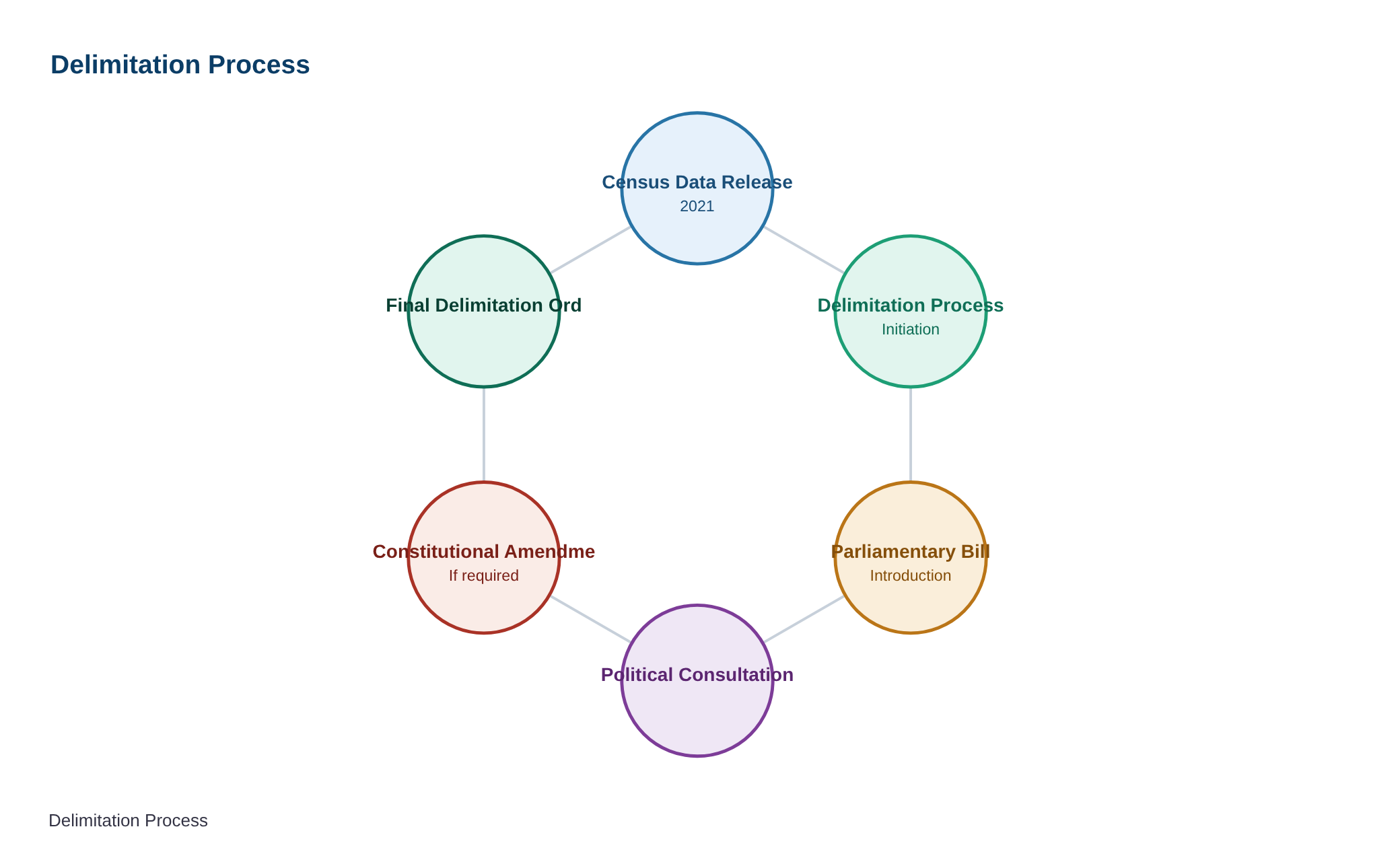
Census Data Release (2021) → Delimitation Process Initiation → Parliamentary Bill Introduction → Political Consultations → Constitutional Amendment (if required) → Final Delimitation Order → Electoral Redistribution → Impact on Regional Representation
Prelims Practice Questions
Q1. Consider the following statements regarding the Delimitation Commission in India:
1. The Delimitation Commission is a statutory body established under the Representation of the People Act, 1950.
2. The Commission is tasked with the delimitation of constituencies for the Lok Sabha and State Legislative Assemblies.
3. The orders of the Delimitation Commission are subject to judicial review by the Supreme Court of India.
4. The Delimitation Commission can only be constituted by the President of India on the advice of the Election Commission of India.
How many of the above statements are correct?
- Only one
- Only two
- Only three
- All
Answer: Only three — Statements 1 and 2 are correct as the Delimitation Commission is indeed a statutory body under the Representation of the People Act, 1950, and is responsible for delimiting constituencies. Statements 3 and 4 are incorrect because the orders of the Delimitation Commission are final and binding and cannot be challenged in a court of law, and the Commission is constituted by the President on the basis of the Delimitation Act.
Q2. Assertion (A): The principle of proportional representation in the Lok Sabha is enshrined in the Constitution of India.
Reason (R): The Constitution mandates that the number of seats allocated to each state in the Lok Sabha must be proportional to its population as determined by the Census.
In the context of the above two statements, which one of the following is correct?
- Both A and R are true, and R is the correct explanation of A.
- Both A and R are true, but R is not the correct explanation of A.
- A is true, but R is false.
- A is false, but R is true.
Answer: ? — The principle of proportional representation is not explicitly enshrined in the Constitution. The Constitution (Article 81) provides for the allocation of seats in the Lok Sabha based on population, but it does not mandate proportional representation in the strict sense. The Representation of the People Act, 1950, and subsequent Delimitation Acts govern the actual delimitation process.
Q3. Match the following pairs related to the delimitation process in India:
Column I (Constitutional Provision/Act)
A. Article 82
B. Representation of the People Act, 1950
C. Delimitation Act, 2002
D. 42nd Amendment Act, 1976
Column II (Description)
1. Provides for the readjustment of seats in the Lok Sabha and State Legislative Assemblies after each Census.
2. Established the Delimitation Commission to oversee the delimitation process.
3. Froze the delimitation of constituencies until the first Census after 2000.
4. Mandates the delimitation of constituencies for the Lok Sabha and State Legislative Assemblies.
Select the correct match:
- A-1, B-4, C-2, D-3
- A-4, B-1, C-2, D-3
- A-2, B-4, C-1, D-3
- A-3, B-1, C-4, D-2
Answer: A-1, B-4, C-2, D-3 — The correct matches are: A-1 (Article 82 mandates readjustment of seats after each Census), B-4 (Representation of the People Act, 1950, mandates delimitation), C-2 (Delimitation Act, 2002, established the Delimitation Commission), and D-3 (42nd Amendment Act, 1976, froze delimitation until the first Census after 2000).
Mains Practice Question
✍ ‘The proposed increase in the number of Lok Sabha seats and the potential impact on the representation of southern states raise critical questions about the federal balance in India.’ Critically examine the constitutional and political implications of the delimitation process in this context. (15 Marks)
Approach: MODEL-ANSWER SKELETON:
1. **Introduction (2 marks)**
– Define delimitation: The process of redrawing the boundaries of parliamentary and assembly constituencies based on the latest census data to ensure equal representation.
– Constitutional basis: Article 82 (readjustment of seats after each census) and the Representation of the People Act, 1950.
– Context: The proposed increase in Lok Sabha seats from 543 to 816 and its potential impact on southern states like Tamil Nadu, whose seats may increase from 39 to 59 but with a proportional decrease in overall share.
2. **Constitutional and Legal Framework (3 marks)**
– **Article 81**: Provides for the allocation of seats in the Lok Sabha based on population, with a cap of 550 elected members plus 2 nominated Anglo-Indians (now removed).
– **Delimitation Commission**: A statutory body under the Delimitation Act, 2002, tasked with readjusting constituency boundaries. Its orders are final and not subject to judicial review (Article 329(b)).
– **42nd Amendment Act, 1976**: Froze delimitation until the first Census after 2000, leading to a prolonged delay in readjustment.
3. **Federal Implications (4 marks)**
– **Representation of States**: Southern states, with lower population growth rates, fear a dilution of their political voice despite an absolute increase in seats. Tamil Nadu’s share in the Lok Sabha would remain at 7.2%, but its relative bargaining power may decline.
– **Asymmetric Federalism**: The concerns highlight the tension between numerical representation and the principle of federal balance. Southern states have historically argued for a more equitable distribution of political power.
– **Political Strategy**: Parties like the DMK demand a review of the delimitation formula to ensure that states with lower population growth are not disproportionately affected. This reflects broader debates on federalism and regional autonomy.
4. **Political and Strategic Dimensions (3 marks)**
– **Partisan Politics**: The delimitation process is often viewed through the lens of political strategy. Southern states, with strong regional parties, may resist changes that dilute their influence.
– **Centre-State Relations**: The issue underscores the need for consultations with state governments before finalizing delimitation, as enshrined in the spirit of cooperative federalism (Article 263).
– **Recent Developments**: The DMK’s cautious stance reflects broader apprehensions about the potential marginalization of southern states in the national polity.
5. **Conclusion (3 marks)**
– Summarize the dual challenge: balancing demographic representation with the preservation of federal balance.
– Highlight the need for a transparent and consultative process to address the concerns of southern states.
– Emphasize that any delimitation exercise must align with the principles of justice, equity, and federalism enshrined in the Constitution.
Source: amarujala.com
Generated by AanyaAi for educational purpose.

- पेरियार टाइगर रिजर्व में 6 नई प्रजातियाँ खोजी गईं, जानिए क्या हैं विशेषताएँ - September 22, 2026
- Six New Species Discovered in Periyar Tiger Reserve: UPSC & PCS Key Biodiversity Insights - September 22, 2026
- तमिलनाडु में बस किराए में संशोधन: सरकार को चार सप्ताह और समय मिला, उच्च न्यायालय का फैसला - September 22, 2026

No Comments