


07 Aug DMK’s Stance on Delimitation Bill: Key Implications for UPSC & State PCS Aspirants
✎ The Delimitation Bill 2026 seeks to increase Lok Sabha seats, but its potential to reduce southern states' relative representation in Parliament remains a critical constitutional and political concern.
Subject Relevance — Where This Topic Fits
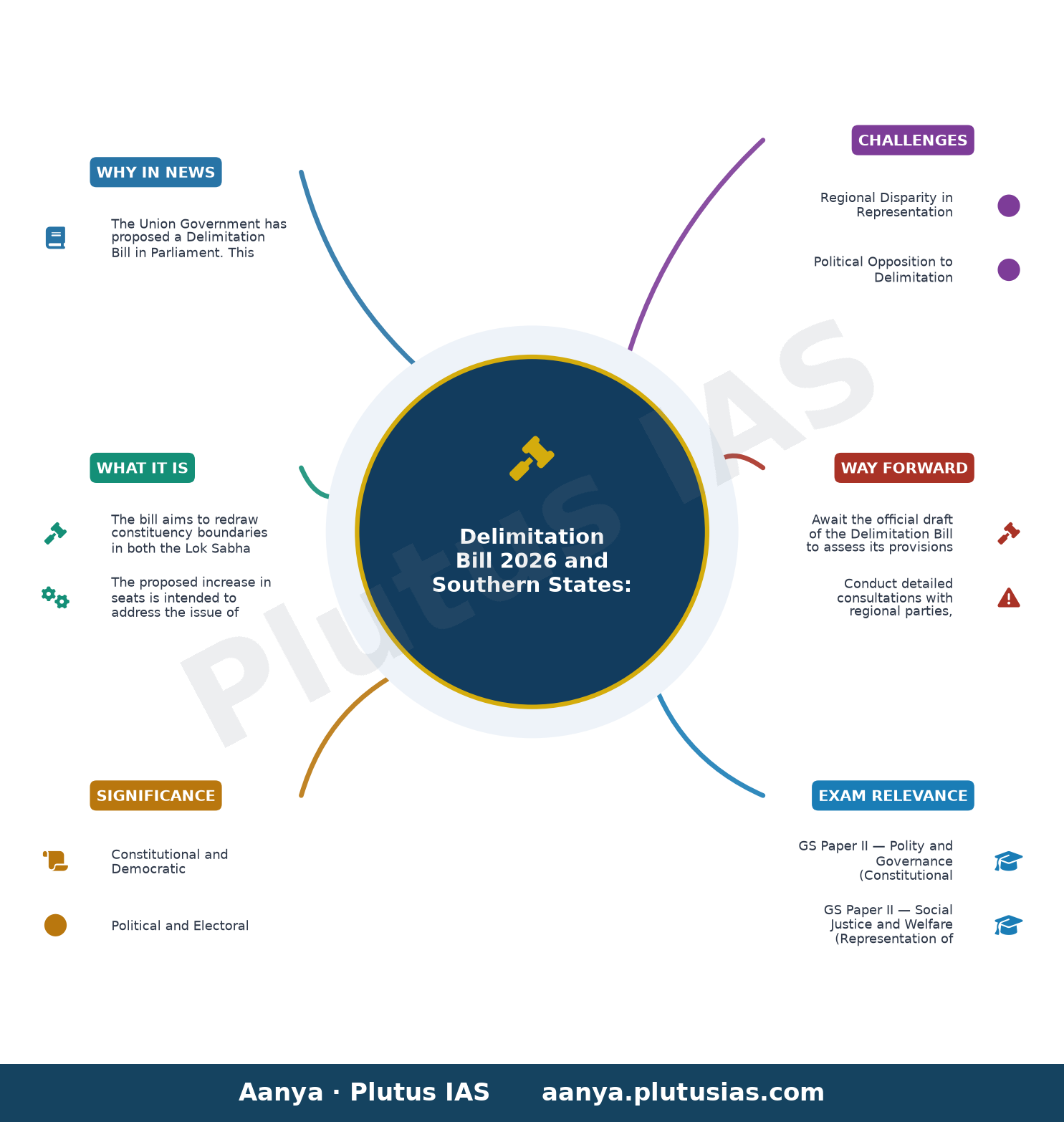
- GS Paper II — Polity and Governance (Constitutional Provisions, Federalism) | GS Paper II — Social Justice and Welfare (Representation of Marginalised Groups) | GS Paper III — Economic and Social Development (Demographic Trends and Regional Disparities)
- Prelims: Delimitation Commission, Article 82 and 170 of the Constitution, Population vs. Representation Debate, Southern States Demographic Trends, Lok Sabha Seat Increase Proposal (543 to 816), Dravidian Politics and Federalism
- Essay: Federalism in India: Balancing Unity and Diversity, Demographic Change and Political Representation: A Case for Southern States
Quick Revision: The Delimitation Bill 2026 seeks to increase Lok Sabha seats, but its potential to reduce southern states’ relative representation in Parliament remains a critical constitutional and political concern.
Why is this in the news?
The Union Government has proposed a Delimitation Bill in Parliament. This has triggered political and demographic concerns, particularly in southern states like Tamil Nadu, where the DMK has deferred its stance pending the official draft. The bill raises critical questions about proportional representation, federalism, and the potential marginalisation of southern states in national politics.
Background
- The Constitution of India mandates delimitation of constituencies after every census under Articles 82 and 170, which govern the readjustment of seats in the Lok Sabha and State Legislative Assemblies respectively.
- The last delimitation exercise was conducted in 2002–2008 based on the 2001 Census, and the next was deferred until after the 2031 Census due to the 2011 Census data not being used for political representation.
- Southern states, including Tamil Nadu, Kerala, Karnataka, and Andhra Pradesh, have historically argued for population-based representation to prevent demographic shifts from reducing their political weight in Parliament.
- The Union Government’s proposal to increase Lok Sabha seats has been justified as a measure to accommodate population growth, but it has sparked fears of a relative decline in southern states’ representation.
- The DMK’s cautious approach reflects broader political apprehensions about the bill’s potential to alter the federal balance and marginalise southern states in national policymaking.
What is the Delimitation Bill 2026?
- The bill aims to redraw constituency boundaries in both the Lok Sabha and State Legislative Assemblies to ensure equitable representation, as mandated by the Constitution.
- The proposed increase in seats is intended to address the issue of over-representation in smaller states and under-representation in larger states, a long-standing concern in India’s electoral system.
- The bill has been justified by the Union Government as a necessary step to modernise the electoral framework and align it with contemporary demographic realities, particularly in light of India’s status as the world’s most populous country.
- However, critics argue that the bill could disproportionately benefit northern and central states, where population growth has been higher, thereby reducing the relative political weight of southern states in Parliament.
- The DMK’s stance highlights the tension between population-based representation and the principle of federalism, where southern states have historically argued for a balance to protect their political voice.
- The bill also raises questions about the methodology of delimitation, including whether it will account for migration patterns, urbanisation, and the socio-economic diversity of regions.
- The Union Government has asserted that the bill will not reduce the proportional representation of southern states, but this claim remains contested among political analysts and regional parties.
Key Features
| Feature | Significance |
|---|---|
| Population-based Delimitation | Ensures equitable representation in Lok Sabha by adjusting seat allocation based on decennial Census data, preventing malapportionment. |
| Increase in Lok Sabha Seats | Proposal to expand Lok Sabha from 543 to 816 seats to accommodate demographic changes and maintain representational parity. |
| Regional Representation | Potential impact on southern states’ share in Lok Sabha, where lower population growth rates may reduce relative seat allocation under new delimitation norms. |
| Political Stance of DMK | Party’s cautious approach—awaiting official draft of the Bill before committing to support or opposition, reflecting strategic political positioning. |
| Historical Context of Delimitation | Last delimitation exercise in 1971 (based on 1971 Census) was deferred until 2001 Census due to political sensitivities, highlighting the contentious nature of the process. |
Why it Matters
Constitutional and Democratic
- Delimitation is constitutionally mandated under Article 82 and the Delimitation Act, 2002, to ensure fair and proportional representation in Parliament.
- Expansion of Lok Sabha seats addresses the issue of ‘population explosion’ while maintaining the principle of ‘one person, one vote, one value’.
- Southern states’ apprehensions stem from the fear of reduced political influence due to lower population growth rates compared to northern states.
Political and Electoral
- DMK’s delayed stance reflects the party’s attempt to balance regional interests with national political dynamics, avoiding premature commitments.
- The Bill’s passage could alter electoral strategies, particularly in states like Tamil Nadu, where DMK holds significant political capital.
- Potential realignment of political alliances if the Bill is perceived as disproportionately benefiting or penalizing certain regions.
Legal and Administrative
- The Delimitation Commission, a statutory body, is tasked with redrawing constituency boundaries based on Census data, ensuring transparency and impartiality.
- Legal challenges may arise if the Bill is perceived as violating the principle of federalism or disproportionately affecting states with lower population growth.
Challenges
1. Regional Disparity in Representation
- Southern states fear a decline in their Lok Sabha seat share due to lower population growth rates, which may reduce their political bargaining power.
- This could exacerbate inter-state tensions, particularly between high-growth northern states and low-growth southern states.
- The challenge lies in balancing demographic growth with equitable representation without undermining federal principles.
UPSC Link: GS-II: Federalism
2. Political Opposition to Delimitation
- Parties like DMK may oppose the Bill if it fails to address their concerns regarding seat allocation, leading to legislative gridlock.
- Opposition parties could frame the Bill as a ‘north versus south’ issue, complicating its passage in Parliament.
- The need for consensus-building across party lines to ensure smooth implementation without political backlash.
UPSC Link: GS-II: Parliament
3. Administrative and Logistical Hurdles
- Conducting a fresh delimitation exercise requires updated Census data, which may face delays or inaccuracies in enumeration.
- Redrawing constituency boundaries involves complex administrative processes, including stakeholder consultations and legal scrutiny.
- Potential delays in the legislative process due to political disagreements or legal challenges.
UPSC Link: GS-II: Constitutional Bodies
4. Constitutional Validity Concerns
- The Bill’s alignment with constitutional provisions (Articles 81, 82, and 327) must be scrutinized to avoid judicial intervention.
- Any perceived violation of federal principles could invite challenges under Article 13, leading to judicial review.
- The need for the Bill to pass the test of ‘reasonableness’ and ‘proportionality’ to withstand constitutional scrutiny.
UPSC Link: GS-II: Constitutional Framework
Challenges — UPSC Perspective
| Issue | Concern |
|---|---|
| Regional Representation | Fear of reduced Lok Sabha seats for southern states due to lower population growth rates. |
| Political Opposition | Parties like DMK may oppose the Bill if their concerns are not addressed, leading to legislative delays. |
| Administrative Delays | Potential bottlenecks in Census data collection and delimitation process. |
| Constitutional Scrutiny | Risk of judicial intervention if the Bill is perceived as violating federal principles or constitutional provisions. |
| Electoral Impact | Alteration in electoral strategies and political alliances due to changes in seat allocation. |
Way Forward
- Await the official draft of the Delimitation Bill to assess its provisions and implications for southern states.
- Conduct detailed consultations with regional parties, particularly DMK, to address their concerns and secure political consensus.
- Ensure transparency in the delimitation process by involving state governments and independent experts in boundary delineation.
- Strengthen administrative preparedness by finalizing Census data collection mechanisms and timelines.
- Engage in proactive legislative strategy to preempt opposition and facilitate smooth passage of the Bill in Parliament.
- Monitor constitutional validity by seeking legal opinion to ensure the Bill aligns with Articles 81, 82, and 327.
- Communicate the Bill’s benefits to stakeholders, emphasizing its role in maintaining equitable representation and democratic principles.
UPSC Value Addition
Keywords for Mains Answer-Writing
Delimitation Bill 2026 · Representation of States in Lok Sabha · Proportional Representation · Dravidian Politics and Federalism · Constitutional Provisions for Delimitation · Article 82 and 170 of the Constitution · Federalism and Asymmetric Federalism · Political Economy of Southern States · Parliamentary Sovereignty · Federal Bargaining and Centre-State Relations
Constitutional & Policy Linkages
- Article 81: Composition of the House of the People.
- Article 82: Readjustment after each Census.
- Article 327: Power of Parliament to make provisions for elections.
Concept Flow
Demographic changes (population growth disparities) → Need for delimitation → Proposal to expand Lok Sabha seats → Potential reduction in southern states’ seat share → Political apprehensions (DMK’s cautious stance) → Legislative process (Bill introduction and scrutiny) → Constitutional validity and judicial review → Implementation and stakeholder consultations.
Prelims Practice Questions
Q1. Consider the following statements regarding the delimitation process in India:
1. The delimitation of constituencies is conducted by the Election Commission of India.
2. The number of seats in the Lok Sabha is frozen at 543 until 2026 as per the 42nd Amendment.
3. The Delimitation Commission is a statutory body constituted under the Delimitation Act, 2002.
4. The delimitation process aims to ensure proportional representation based on the 2031 Census.
How many of the above statements are correct?
- Only one
- Only two
- Only three
- All
Answer: Only three — Statements 1 and 3 are correct. Statement 2 is incorrect as the freeze on the number of seats was until 2001, not 2026. Statement 4 is incorrect as the delimitation process is based on the latest Census, which is yet to be conducted.
Q2. Assertion (A): The Delimitation Bill 2026 proposes to increase the total number of Lok Sabha seats from 543 to 816.
Reason (R): The increase is to accommodate the growing population of northern states while maintaining proportional representation.
In the context of the above two statements, which one of the following is correct?
- Both A and R are true, and R is the correct explanation of A.
- Both A and R are true, but R is not the correct explanation of A.
- A is true but R is false.
- A is false but R is true.
Answer: A is false but R is true. — Assertion (A) is true as the Delimitation Bill 2026 proposes to increase the Lok Sabha seats to 816. However, Reason (R) is false because the increase is not solely to accommodate northern states but to reflect the population distribution across all states.
Mains Practice Question
✍ Critically examine the constitutional and political implications of the proposed Delimitation Bill 2026, with particular reference to its impact on the federal balance and the representation of southern states in the Lok Sabha. (15 Marks)
Approach: MODEL-ANSWER SKELETON:
1. Constitutional Framework: Cite Article 82 (readjustment of seats) and Article 170 (composition of Legislative Assemblies) of the Constitution; mention the role of the Delimitation Commission under the Delimitation Act, 2002.
2. Proposed Changes: Highlight the increase in Lok Sabha seats from 543 to 816 and the projected seat allocation for Tamil Nadu (39 to 59) as per government projections.
3. Federalism Concerns: Discuss the apprehensions of southern states regarding reduced proportional representation despite population growth, and the principle of ‘one person, one vote’ vs. ‘one vote, one value’.
4. Political Economy: Link to the Dravidian political tradition (DMK) and its emphasis on federalism and state autonomy; reference the historical context of the 1976 freeze on delimitation.
5. Legal and Institutional Safeguards: Examine whether the proposed bill includes provisions to address these concerns (e.g., cap on seat increase, special provisions for southern states).
6. Comparative Perspective: Briefly contrast India’s approach with other federal democracies (e.g., USA, Germany) where delimitation or redistricting is periodic and population-based.
7. Conclusion: Weigh the necessity of demographic representation against the need to preserve federal balance and regional equity; suggest a balanced approach.
Source: amarujala.com
Generated by AanyaAi for educational purpose.

- उत्तराखंड में असिस्टेंट प्रोफेसर भर्ती: यूकेपीएससी करेगा चयन, जानिए बदलाव - September 22, 2026
- UKPSC to Recruit Assistant Professors in Uttarakhand Aided Colleges: Draft Policy - September 22, 2026
- हिमाचल में नदियों से रेत-बजरी निकालने पर सरकार ने लगाई रोक, जानिए नए नियम - September 22, 2026

No Comments