


07 Aug DMK’s Stance on Delimitation Bill: Key Implications for UPSC & State PCS Aspirants
✎ The Delimitation Bill 2026 seeks to increase Lok Sabha seats, but its impact on proportional representation remains a contentious issue.
Subject Relevance — Where This Topic Fits
- GS Paper II — Constitutional Framework and Statutory Bodies | GS Paper III — Federalism and Centre-State Relations
- Prelims: Delimitation Commission, Article 82, Census 2021, Lok Sabha seat increase, Southern States’ representation
- Essay: Federalism in India: Balancing Unity and Diversity, Representation and Governance: The Case of Delimitation
Quick Revision: The Delimitation Bill 2026 seeks to increase Lok Sabha seats, but its impact on proportional representation remains a contentious issue.
Why is this in the news?
The Delimitation Bill 2026 has sparked political debate, particularly regarding its potential impact on the representation of southern states in the Lok Sabha. The DMK has adopted a cautious stance, awaiting the official draft of the bill before finalising its position, citing the need for a detailed review of its provisions to assess its implications for Tamil Nadu and other southern states.
Background
- The Delimitation Commission is a statutory body constituted under Article 82 of the Constitution to readjust the boundaries of parliamentary and assembly constituencies based on the latest census data.
- The last delimitation exercise was conducted in 2002, based on the 2001 Census, and was frozen until 2026.
- Southern states have raised concerns that the new delimitation model may reduce their proportional representation in the Lok Sabha due to demographic shifts.
- The DMK, a key political player in Tamil Nadu, has historically opposed delimitation proposals that it perceives as detrimental to the state’s interests, as evidenced by its previous opposition to delimitation.
What is the Delimitation Bill 2026?
- The Delimitation Bill 2026 is a legislative proposal aimed at redrawing the boundaries of parliamentary and assembly constituencies in India to ensure equitable representation.
- The proposed increase in Lok Sabha seats is intended to address the growing population and ensure that each vote carries equal weight, though critics argue it may dilute the influence of states with slower population growth.
- The bill also includes mechanisms for public consultation and stakeholder engagement to ensure transparency and address regional concerns.
- The outcome of the delimitation exercise will have long-term implications for federalism, political representation, and the balance of power between northern and southern states.
Key Features
| Feature | Significance |
|---|---|
| Proportional Representation Principle | Ensures legislative seats reflect population distribution, balancing demographic equity across regions. |
| Delimitation Commission | Constitutional body tasked with redrawing electoral boundaries based on census data and legal provisions. |
| Lok Sabha Seat Expansion | Proposal to increase total seats from 543 to 816, altering the legislative framework of representation. |
| Regional Representation Concerns | Fear among southern states of disproportionate reduction in political voice due to demographic shifts. |
| DMK’s Conditional Stance | Party’s strategy to evaluate the official draft before committing to support or opposition, ensuring alignment with regional interests. |
Why it Matters
Political Representation
- Alters the balance of power between northern and southern states in Parliament, potentially affecting policy priorities and federal dynamics.
- Impacts seat allocation for Tamil Nadu, Kerala, Karnataka, and Andhra Pradesh, influencing regional political narratives.
- May exacerbate inter-state tensions if perceived as undermining the democratic principle of equitable representation.
Constitutional Framework
- Triggers the application of Articles 81, 82, and 170, which govern the composition and delimitation of the Lok Sabha and State Legislative Assemblies.
- Requires adherence to the 84th Amendment Act, 2002, which froze delimitation until post-2026 census, necessitating legal validation for any changes.
Federalism and Governance
- Tests the Centre-State relationship, particularly in matters of electoral autonomy and demographic justice.
- May lead to demands for compensatory mechanisms (e.g., special status) if southern states perceive marginalisation in the new framework.
Challenges
1. Regional Perception of Marginalisation
- Southern states fear reduced political influence due to lower population growth rates compared to northern states.
- Risk of political alienation, fueling separatist or autonomy movements if perceived as systemic bias.
- Potential for inter-state disputes over seat redistribution formulas.
UPSC Link: GS-II: Federalism
2. Legal and Constitutional Hurdles
- Delimitation requires census data post-2026, but the 84th Amendment’s freeze complicates immediate implementation.
- Need for parliamentary consensus to amend constitutional provisions governing seat allocation.
- Judicial review may be sought if the process is perceived as violating the principle of proportional representation.
UPSC Link: GS-II: Constitutional Provisions
3. Political Polarisation
- Risk of deepening North-South divide, with southern parties (e.g., DMK, AIADMK) adopting adversarial stances.
- Potential for coalition instability at the Centre if regional parties withdraw support over perceived injustices.
- Media and public discourse may amplify regional grievances, complicating governance.
UPSC Link: GS-II: Pressure Groups
4. Operational Delays and Implementation Gaps
- Extended legislative process due to the need for detailed scrutiny of the delimitation draft.
- Challenges in synchronising census data with electoral roll updates, risking disenfranchisement.
- Logistical hurdles in redrawing constituency boundaries, including boundary disputes and administrative coordination.
UPSC Link: GS-II: Government Policies
Challenges — UPSC Perspective
| Issue | Concern |
|---|---|
| Demographic Justice | Fear of disproportionate reduction in southern states’ political voice due to lower population growth. |
| Constitutional Validity | Potential conflict with the 84th Amendment’s freeze on delimitation until post-2026 census. |
| Federal Tensions | Risk of Centre-State disputes over electoral autonomy and representation principles. |
| Political Backlash | Likelihood of southern parties (e.g., DMK) opposing the bill, leading to legislative gridlock. |
| Administrative Bottlenecks | Delays in census data processing and constituency boundary redrawing, delaying elections. |
Way Forward
- Conduct a detailed comparative analysis of the proposed delimitation draft against DMK’s historical suggestions to identify alignment or divergence.
- Engage in multi-party consultations to build consensus on the delimitation process, ensuring regional inclusivity.
- Strengthen institutional mechanisms (e.g., Delimitation Commission) with transparent methodologies to address public apprehensions.
- Initiate public awareness campaigns to educate stakeholders on the implications of delimitation and proportional representation.
- Explore compensatory mechanisms (e.g., special status, additional seats) for southern states if marginalisation is substantiated.
- Monitor judicial precedents on delimitation to ensure constitutional compliance and avoid litigation risks.
- Develop a phased implementation roadmap to synchronise census data updates with electoral roll revisions.
UPSC Value Addition
Keywords for Mains Answer-Writing
Delimitation Commission · Representation of States Act, 1950 · Article 82 of the Constitution · Article 170 of the Constitution · Southern States’ Demographic Concerns · One Nation One Election · Federalism in India · Political Representation and Justice · Parliamentary Sovereignty · Constitutional Provisions on Delimitation
Constitutional & Policy Linkages
- Article 81: Composition of the Lok Sabha.
- Article 82: Readjustment of seats after each census.
- Article 170: Composition of State Legislative Assemblies.
- 84th Amendment Act, 2002: Freeze on delimitation until post-2026 census.
Concept Flow
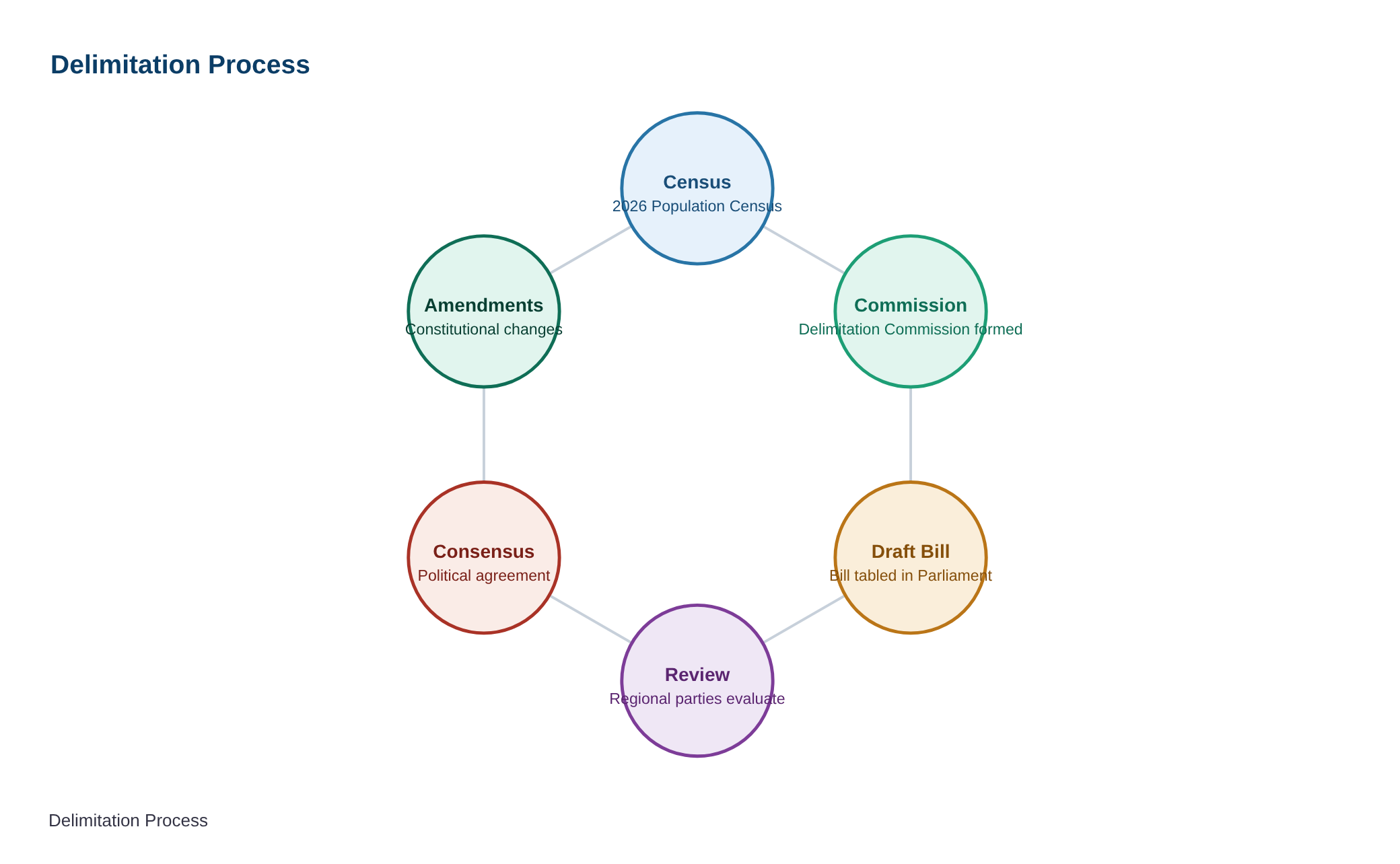
Population Census (2026) → Delimitation Commission constituted → Draft Bill tabled in Parliament → Regional Parties (e.g., DMK) evaluate draft → Political consensus or opposition → Constitutional amendments (if required) → Final delimitation order → Redrawing of electoral boundaries → Impact on seat allocation → Regional representation dynamics.
Prelims Practice Questions
Q1. Consider the following statements regarding the Delimitation Commission in India:
1. The Delimitation Commission is a statutory body established under the Representation of the People Act, 1950.
2. The primary objective of the Delimitation Commission is to readjust the division of territorial constituencies in India.
3. The Delimitation Commission operates independently of the Parliament and cannot be influenced by political considerations.
4. The orders of the Delimitation Commission are final and cannot be challenged in any court of law.
How many of the above statements are correct?
- Only one
- Only two
- Only three
- All
Answer: Only three — Statements 1 and 2 are correct. The Delimitation Commission is indeed a statutory body under the Representation of the People Act, 1950, and its primary role is to readjust territorial constituencies. Statement 3 is incorrect because the Commission’s composition includes members from the Election Commission, whose decisions can be politically influenced. Statement 4 is incorrect as the orders of the Delimitation Commission can be challenged in the Supreme Court under Article 329(b) of the Constitution.
Q2. Assertion (A): The Delimitation Commission in India is tasked with ensuring fair representation of all states in the Lok Sabha.
Reason (R): The Delimitation Commission operates under the provisions of Article 82 of the Constitution, which mandates periodic readjustment of constituencies based on census data.
Options:
A. Both A and R are true, and R is the correct explanation of A.
B. Both A and R are true, but R is not the correct explanation of A.
C. A is true, but R is false.
D. A is false, but R is true.
Answer: ? — Both the Assertion (A) and Reason (R) are correct. The Delimitation Commission is indeed tasked with ensuring fair representation, and it operates under Article 82, which mandates readjustment based on census data. However, the Reason (R) is not the sole explanation for the Assertion (A), as the Commission’s role is broader and includes addressing demographic changes and ensuring equitable representation.
Mains Practice Question
✍ The proposal to increase the number of Lok Sabha seats from 543 to 816 through delimitation has reignited debates on federalism, representation, and the balance of power between the Centre and the States. Critically examine the constitutional provisions, historical context, and contemporary political implications of delimitation in India. (15 Marks)
Approach: MODEL-ANSWER SKELETON:
1. **Constitutional Provisions and Legal Framework**:
– Article 82 and Article 170 of the Constitution empower Parliament to readjust the number of seats in the Lok Sabha and State Legislative Assemblies after each census.
– The Representation of the People Act, 1950, and the Delimitation Act, 2002, provide the legal framework for delimitation.
– The Delimitation Commission, a statutory body, is responsible for the actual readjustment.
2. **Historical Context and Evolution**:
– The first delimitation exercise was conducted in 1952, followed by subsequent exercises in 1963, 1973, and 2002.
– The 42nd Amendment (1976) froze delimitation until after the 2001 census to prevent frequent changes.
– The 84th Amendment (2001) extended this freeze until 2026, allowing the next delimitation to be based on the 2031 census.
3. **Contemporary Political Implications**:
– **Federalism and State Representation**: Southern states, including Tamil Nadu, express concerns over potential dilution of their representation due to demographic shifts favoring northern states.
– **Political Strategy and Alliances**: Parties like the DMK adopt cautious stances, awaiting the draft bill to assess its impact on their political fortunes.
– **Centralisation vs. Decentralisation**: The debate reflects tensions between the Centre’s authority to redraw boundaries and the States’ demand for equitable representation.
4. **Challenges and Criticisms**:
– **Demographic Shifts**: The north-south divide in population growth raises questions about the fairness of a uniform delimitation model.
– **Political Interference**: Critics argue that delimitation can be influenced by political considerations, undermining its objectivity.
– **Judicial Scrutiny**: The Supreme Court’s role in reviewing delimitation orders under Article 329(b) ensures constitutional safeguards but also introduces legal complexities.
5. **Conclusion**:
– Delimitation is a necessary but contentious process that must balance demographic realities with constitutional principles.
– The current proposal to increase seats must be accompanied by mechanisms to address regional imbalances and ensure fair representation.
Source: amarujala.com
Generated by AanyaAi for educational purpose.

- फिल्म महोत्सवों के लिए सेंसर छूट बन गई बाधा: 31 फिल्में हुईं प्रभावित - September 21, 2026
- Censor Exemption Denial: How Film Festivals Face Roadblocks in India - September 21, 2026
- कस्तूरीरंगन रिपोर्ट लागू करने की मांग: पश्चिमी घाट संरक्षण पर सरकार से अपील - September 20, 2026

No Comments