


07 Aug DMK’s Stance on Delimitation Bill: South States’ Political Implications for UPSC
✎ The Delimitation Bill 2026 seeks to redraw parliamentary constituencies based on updated population data; southern states like Tamil Nadu face potential underrepresentation, prompting cautious scrutiny by regional parties like…
Subject Relevance — Where This Topic Fits
- GS Paper II — Constitutional and Non-Constitutional Bodies (Election Commission of India) | GS Paper II — Functions and Responsibilities of the Union and the States | GS Paper III — Government Budgeting and Financial Management
- Prelims: Delimitation Commission, Article 82, Article 170, Lok Sabha seat allocation, Southern States’ demographic representation
- Essay: Federalism in India: Balancing Regional Aspirations with National Integration, Demographic Shifts and Electoral Representation: A Case for Delimitation Reform
Quick Revision: The Delimitation Bill 2026 seeks to redraw parliamentary constituencies based on updated population data; southern states like Tamil Nadu face potential underrepresentation, prompting cautious scrutiny by regional parties like the DMK.
Why is this in the news?
The DMK has adopted a cautious stance on the proposed Delimitation Bill 2026, refusing to disclose its position until the official draft is tabled in Parliament. This reticence stems from apprehensions regarding potential underrepresentation of southern states in the Lok Sabha following delimitation based on population data. The bill has reignited debates on federal equity and the constitutional mandate for periodic delimitation.
Background
- The Constitution of India mandates delimitation of parliamentary and assembly constituencies to reflect population changes, as per Articles 82 and 170, after each decennial Census.
- The last delimitation exercise was conducted in 2002–2008, freezing seat allocations until the first Census post-2026.
- Southern states, including Tamil Nadu, have historically expressed concerns over delimitation models that may dilute their proportional representation due to lower population growth rates compared to northern states.
- The DMK’s reluctance to endorse the bill without a detailed review aligns with its past opposition to delimitation exercises perceived as marginalising southern interests.
- The Election Commission of India (ECI) is constitutionally empowered to conduct delimitation, though Parliament retains the authority to alter the delimitation process via legislation.
What is the Delimitation Bill 2026?
- The Delimitation Bill 2026 is a legislative proposal aimed at redrawing the boundaries of parliamentary and state assembly constituencies to reflect the most recent population data, post the 2021 Census.
- Southern states fear that the new formula could reduce their relative political weight, as their population growth rates have decelerated compared to northern states.
- The DMK’s conditional support hinges on whether the bill incorporates its past recommendations, such as safeguarding the representation of Scheduled Castes and Scheduled Tribes in southern states.
Key Features
| Feature | Significance |
|---|---|
| Population-based delimitation | Ensures equitable representation in the Lok Sabha by adjusting constituencies in proportion to demographic changes. |
| Increase in total Lok Sabha seats | Proposal to raise seats from 543 to 816, aimed at accommodating population growth and reducing over-representation. |
| South India’s seat retention | Government claims proportional representation for southern states will remain unchanged despite population growth disparities. |
| DMK’s conditional stance | Party will decide support or opposition only after examining the official draft, reflecting strategic caution. |
| Historical opposition to delimitation | DMK previously opposed delimitation in 2002 due to perceived threats to regional political influence. |
Why it Matters
Political Implications
- Alters power dynamics in Parliament by potentially increasing the number of seats, which may benefit parties with broader national presence over regional ones.
- Southern states fear reduced proportional representation despite government assurances, risking political alienation and electoral disadvantage.
- DMK’s conditional stance highlights the need for consensus-building before legislative passage, ensuring democratic deliberation.
Constitutional and Legal
- Delimitation is constitutionally mandated under Article 82 and governed by the Delimitation Commission Act, 2002, ensuring procedural legitimacy.
- The proposed increase in seats requires constitutional amendment (Article 81) to adjust the maximum strength of the Lok Sabha beyond 550.
Demographic and Representational
- Population-based delimitation aims to correct disparities in constituency sizes, ensuring fairer representation for all citizens.
- Southern states’ lower population growth rates may lead to a relative decline in seat share, despite absolute seat increases.
Challenges
1. Regional Representation Disparity
- Southern states risk losing proportional political influence due to lower population growth compared to northern states.
- Perceived marginalisation may fuel regionalist sentiments and political instability in states like Tamil Nadu.
UPSC Link: GS-II: Federalism
2. Partisan Political Resistance
- Opposition parties like DMK may oppose the bill if their demands (e.g., inclusion of past suggestions) are not addressed.
- Lack of consensus could delay legislative passage, undermining governance efficiency.
UPSC Link: GS-II: Parliament
3. Constitutional Amendment Hurdles
- Increasing Lok Sabha seats to 816 requires a constitutional amendment (Article 81), necessitating a two-thirds majority in Parliament.
- State legislatures must ratify the amendment, introducing federal complexities.
UPSC Link: GS-II: Constitutional Amendments
Challenges — UPSC Perspective
| Issue | Concern |
|---|---|
| Population Growth Disparities | Northern states with higher growth may gain disproportionate seats, altering political balance. |
| Regional Political Alienation | Southern states fear reduced influence, potentially exacerbating federal tensions. |
| Legislative Consensus | Opposition parties may stall the bill unless their concerns are addressed. |
| Constitutional Feasibility | Amending Article 81 to expand Lok Sabha seats faces procedural and political challenges. |
| Administrative Burden | Delimitation process requires extensive data verification and public consultation, delaying implementation. |
Way Forward
- Parliament must table the official Delimitation Bill with detailed provisions to enable informed debate.
- Government should proactively engage with southern states to address concerns and incorporate viable suggestions.
- Constitutional amendments (Article 81) must be introduced with bipartisan support to ensure smooth passage.
- Delimitation Commission should publish demographic projections and rationale for seat adjustments to build public trust.
- Opposition parties, including DMK, should conduct independent analyses of the bill’s impact on regional representation.
- States must be consulted through the Inter-State Council to mitigate federal disputes.
- Legislative timelines should allow for thorough scrutiny, avoiding rushed passage that could undermine legitimacy.
UPSC Value Addition
Keywords for Mains Answer-Writing
Delimitation Commission · Constitutional provisions for delimitation (Articles 81, 82, 330, 332) · Representation of States Act, 1950 · DMK stance on delimitation bill · South India’s political representation · Lok Sabha seat increase from 543 to 816 · One Nation, One Election debate · Federalism and regional aspirations · Parliamentary sovereignty vs federal balance · Constitutional morality and political consensus
Constitutional & Policy Linkages
- Article 81: Maximum strength of the Lok Sabha
- Article 82: Readjustment of constituencies after each census
- Article 324: Role of the Election Commission in delimitation
Concept Flow
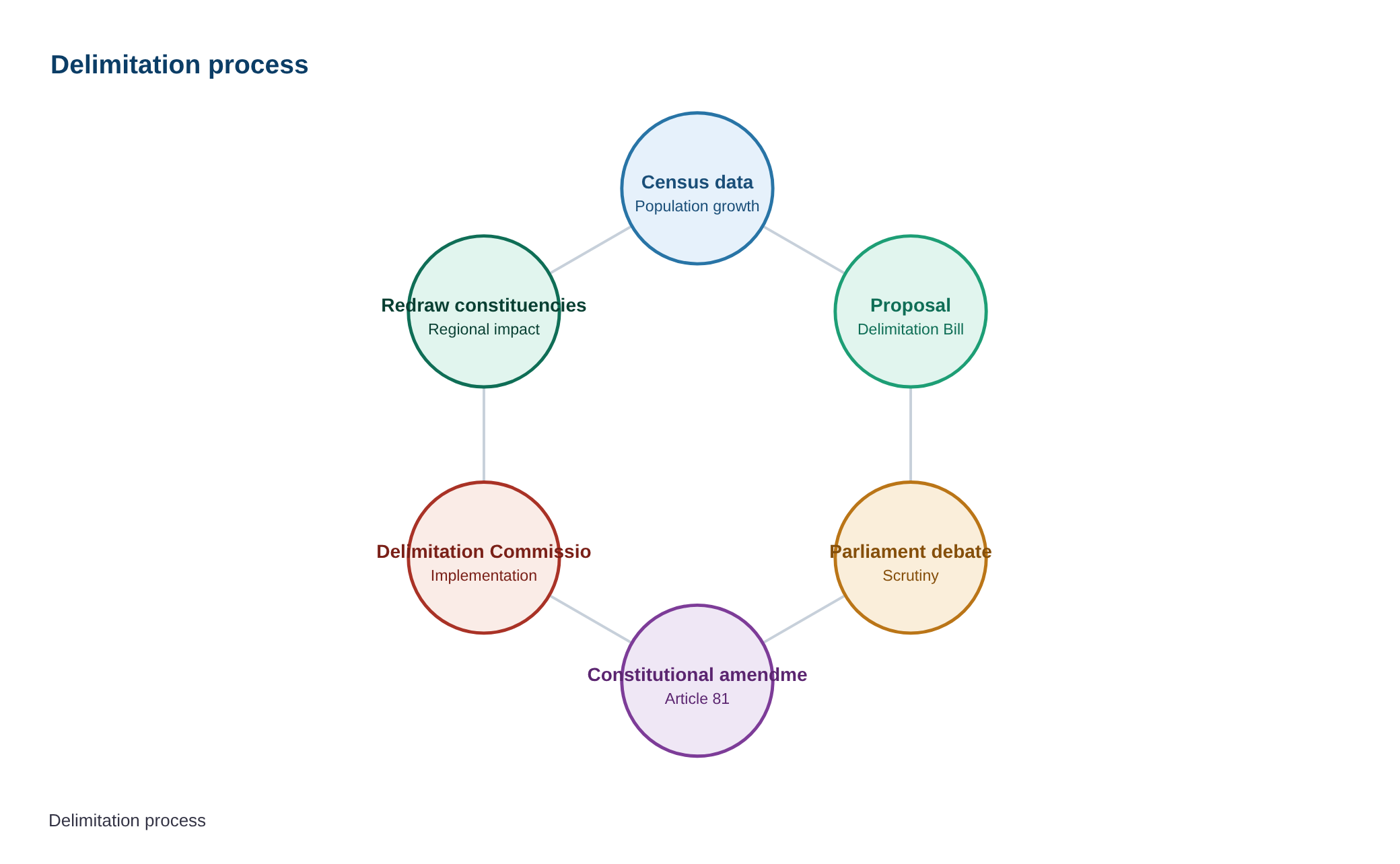
Census data collection → Population growth disparities → Proposal for delimitation → Legislative drafting of Delimitation Bill → Parliamentary debate and scrutiny → Constitutional amendment (Article 81) → Delimitation Commission implementation → Redrawing of constituencies → Impact on regional representation → Political consensus or resistance
Prelims Practice Questions
Q1. Consider the following statements regarding the Delimitation Commission in India: 1. It is a statutory body established under the Representation of the People Act, 1950. 2. The Commission is responsible for determining the boundaries of parliamentary and assembly constituencies. 3. The Delimitation Commission operates under the superintendence and directions of the Election Commission of India. 4. The orders of the Delimitation Commission cannot be challenged in any court of law. How many of the above statements are correct?
- Only one
- Only two
- Only three
- All four
Answer: Only three — Statements 1 and 2 are correct. The Delimitation Commission is indeed a statutory body under the Representation of the People Act, 1950, and it determines constituency boundaries. Statement 3 is incorrect as the Commission operates under the superintendence of the Election Commission but not under its directions. Statement 4 is incorrect as the orders of the Delimitation Commission can be challenged in the High Court under Article 226 of the Constitution.
Q2. Assertion (A): The Delimitation Act, 2002 mandates that the number of seats in the Lok Sabha cannot exceed 550. Reason (R): This limit is prescribed to maintain the federal balance and prevent over-representation of any state in the Parliament.
- Both A and R are true, and R is the correct explanation of A
- Both A and R are true, but R is not the correct explanation of A
- A is true, but R is false
- A is false, but R is true
Answer: A is false, but R is true — Assertion (A) is true as the Delimitation Act, 2002 does prescribe a maximum of 550 seats in the Lok Sabha. However, Reason (R) is false because the limit is not primarily to maintain federal balance but to balance representation and administrative efficiency. The Constitution (One Hundred and Fifth Amendment) Act, 2021, temporarily removed this cap to allow for delimitation based on the 2031 census.
Q3. Match the following provisions with their respective constitutional articles: Column I: A. Article 81 (Representation of States in Parliament) | B. Article 82 (Readjustment after each census) | C. Article 330 (Reservation of seats for Scheduled Castes in Lok Sabha) | D. Article 332 (Reservation of seats for Scheduled Tribes in State Legislatures). Column II: 1. Reservation of seats | 2. Readjustment of constituencies | 3. Composition of Lok Sabha | 4. Reservation in State Legislatures
- A-3, B-2, C-1, D-4
- A-2, B-3, C-4, D-1
- A-1, B-4, C-2, D-3
- A-4, B-1, C-3, D-2
Answer: A-3, B-2, C-1, D-4 — The correct match is: A (Article 81) – 3 (Composition of Lok Sabha), B (Article 82) – 2 (Readjustment of constituencies), C (Article 330) – 1 (Reservation of seats for SCs in Lok Sabha), D (Article 332) – 4 (Reservation of seats for STs in State Legislatures).
Mains Practice Question
✍ Critically examine the constitutional and political implications of the proposed increase in the number of Lok Sabha seats from 543 to 816, with particular reference to the concerns raised by southern states regarding their political representation. (15 Marks)
Approach: MODEL-ANSWER SKELETON:
1. **Constitutional Framework**:
– Articles 81, 82, and 330-332 of the Constitution governing the composition and readjustment of the Lok Sabha.
– Role of the Delimitation Commission (Constitution (One Hundred and Fifth Amendment) Act, 2021).
– Temporary removal of the 550-seat cap under the Delimitation Act, 2002.
2. **Proposed Changes and Data**:
– Lok Sabha seat increase from 543 to 816 (as per April 2026 legislative package).
– Tamil Nadu’s seat increase from 39 to 59, with a 7.2% share maintained.
– Proportional allocation vs. population-based allocation.
3. **Political and Federal Concerns**:
– Southern states’ apprehension of reduced proportional representation despite seat increases.
– Historical context: 1976-2008 freeze on delimitation to protect southern states’ interests.
– DMK’s stance: Demand for inclusion of past suggestions in the delimitation bill.
4. **Balancing Views**:
– Government’s argument: New model ensures proportional representation for southern states.
– Counter-argument: Population-based delimitation may still reduce the relative share of southern states due to lower population growth rates.
5. **Federalism and Political Consensus**:
– Need for consensus among states to uphold constitutional morality.
– Role of parliamentary sovereignty vs. federal balance.
– Potential consequences: Erosion of trust in federal institutions, political polarization.
6. **Conclusion**:
– The delimitation process must balance demographic changes with federal principles.
– A consultative approach involving all states is essential to maintain political stability and constitutional integrity.
Source: amarujala.com
Generated by AanyaAi for educational purpose.

- पेरियार टाइगर रिजर्व में 6 नई प्रजातियाँ खोजी गईं, जानिए क्या हैं विशेषताएँ - September 22, 2026
- Six New Species Discovered in Periyar Tiger Reserve: UPSC & PCS Key Biodiversity Insights - September 22, 2026
- तमिलनाडु में बस किराए में संशोधन: सरकार को चार सप्ताह और समय मिला, उच्च न्यायालय का फैसला - September 22, 2026

No Comments