


07 Aug DMK’s Stance on Delimitation Bill: Strategy After Parliament’s Decision
✎ The Delimitation Bill 2026 aims to redraw Lok Sabha and assembly constituencies based on the 2026 Census, with a 50% increase in seats to 816, while ensuring proportional representation for southern states to prevent erosion of…
Subject Relevance — Where This Topic Fits
- GS Paper II — Polity — Constitutional Provisions, Parliament and State Legislatures | GS Paper III — Economy — Impact of Delimitation on Resource Allocation
- Prelims: Delimitation Commission, Article 82, Fourth Schedule, Lok Sabha seat allocation, Census 2021, Representation of the People Act, 1950
- Essay: Federalism and Centre-State Relations in India: The Case of Delimitation, Demographic Dividend and Political Representation: Balancing Equity and Efficiency
Quick Revision: The Delimitation Bill 2026 aims to redraw Lok Sabha and assembly constituencies based on the 2026 Census, with a 50% increase in seats to 816, while ensuring proportional representation for southern states to prevent erosion of their political voice.
Why is this in the news?
The DMK’s refusal to disclose its stance on the Delimitation Bill 2026 until the official draft is tabled in Parliament has reignited debates over the bill’s potential impact on southern states’ political representation. The bill, which proposes an increase in Lok Sabha seats from 543 to 816, has raised concerns among southern states about disproportionate seat allocation, despite government assurances to the contrary. The DMK’s cautious approach underscores the political sensitivities surrounding delimitation and the need for a nuanced understanding of its constitutional and demographic implications.
Background
- The Delimitation Commission is a statutory body constituted under the Delimitation Act, 2002, to redraw the boundaries of parliamentary and assembly constituencies based on the latest census data.
- The last delimitation exercise was conducted in 2002, based on the 2001 Census, and froze seat allocations until the 2026 Census.
- Southern states, including Tamil Nadu, have historically argued for a balanced approach to delimitation to prevent erosion of their political representation, given their demographic stability and lower population growth rates.
- The proposed increase in Lok Sabha seats to 816 is intended to accommodate population growth but has sparked debates over its impact on federal equity and the principle of ‘one person, one vote’.
What is the Delimitation Bill 2026?
- The Delimitation Bill 2026 seeks to redraw the boundaries of parliamentary and assembly constituencies in India based on the 2026 Census data, as mandated by Article 82 of the Constitution.
- The bill includes provisions for the formation of a Delimitation Commission, comprising retired judges and election commissioners, to oversee the process and ensure transparency and fairness.
- The bill mandates that seat allocations for states be based on their population share, with adjustments to account for demographic changes, urbanization, and migration patterns.
- The bill also includes safeguards to prevent gerrymandering, such as the prohibition of seat adjustments that could disproportionately benefit or disadvantage any political party or region.
- The bill is expected to be tabled in Parliament during the monsoon session, following which it will be referred to a parliamentary standing committee for detailed scrutiny.
- The bill’s passage is contingent on consensus among political parties, particularly those representing southern states, to avoid constitutional challenges and political backlash.
Key Features
| Feature | Significance |
|---|---|
| Proportional Representation Adjustment | Ensures Lok Sabha seats reflect demographic shifts while maintaining federal balance. |
| Southern States’ Seat Increase | Proposed increase in Tamil Nadu’s seats from 39 to 59, preserving proportional share at 7.2%. |
| DMK’s Deliberative Approach | Party’s decision deferred until official draft is tabled, ensuring evidence-based stance. |
| Political Safeguards | Inclusion of past DMK suggestions may influence support, demonstrating inter-party negotiation. |
| Legal Framework | Delimitation Commission’s role in redrawing boundaries under Article 82 and 330 of the Constitution. |
Why it Matters
Political
- Realigns power dynamics between northern and southern states, potentially altering coalition arithmetic.
- DMK’s stance will shape regional bloc responses, influencing national opposition unity.
- May trigger realignment of Dravidian parties’ electoral strategies in Tamil Nadu and Puducherry.
Constitutional
- Reinforces federal principles by ensuring equitable representation without marginalising high-literacy states.
- Tests the balance between parliamentary sovereignty and federal safeguards under Article 330.
Administrative
- Demands robust data verification to prevent demographic distortions in seat allocation.
- Requires transparent public consultation to mitigate political backlash from affected regions.
Challenges
1. Regional Disparity Anxiety
- Southern states fear proportional representation may dilute their political influence despite seat increases.
- Historical grievances over ‘one-size-fits-all’ policies fuel resistance to centralised delimitation.
UPSC Link: GS-II: Federalism
2. Data Integrity Concerns
- Reliance on outdated or incomplete census data could skew seat distribution.
- Risk of political manipulation in demographic projections to favour specific regions.
UPSC Link: GS-II: Governance
3. Opposition Fragmentation
- DMK’s conditional support may fracture anti-BJP alliances, complicating national opposition strategies.
- Regional parties’ divergent stances could weaken collective bargaining in Parliament.
UPSC Link: GS-II: Pressure Groups
4. Legal Ambiguity
- Unclear criteria for seat adjustments may invite judicial review, delaying implementation.
- Potential conflict between Delimitation Commission’s autonomy and parliamentary oversight.
UPSC Link: GS-II: Judiciary
5. Implementation Logistics
- High administrative burden of redrawing constituencies within tight timelines.
- Need for extensive voter education to prevent confusion during transition.
UPSC Link: GS-II: Public Administration
Challenges — UPSC Perspective
| Issue | Concern |
|---|---|
| Southern States’ Representation | Perceived dilution of political voice despite seat increases. |
| Data Reliability | Potential inaccuracies in census data distorting seat allocation. |
| Opposition Cohesion | Risk of DMK’s conditional support fragmenting anti-BJP alliances. |
| Judicial Intervention | Likelihood of legal challenges delaying delimitation process. |
| Administrative Capacity | Logistical hurdles in executing large-scale constituency redrawing. |
Way Forward
- Await official draft of the Delimitation Bill to assess inclusion of DMK’s past suggestions.
- Conduct comparative analysis of proposed seat adjustments with 2011 Census data to identify anomalies.
- Engage in cross-party consultations to build consensus on safeguards for southern states.
- Strengthen data verification mechanisms to ensure demographic accuracy in seat allocation.
- Publicise transparent criteria for delimitation to mitigate regional apprehensions.
- Prepare contingency plans for potential judicial scrutiny of the Bill’s provisions.
- Leverage federal forums (e.g., Inter-State Council) to address state-specific concerns.
- Monitor opposition unity dynamics to preempt fragmentation in Parliament.
UPSC Value Addition
Keywords for Mains Answer-Writing
Delimitation Commission · Representation of States Act, 1950 · Article 82 of the Constitution · Lok Sabha seat augmentation · Southern states’ political representation · DMK stance on delimitation · Population-based delimitation · Constitutional provisions for delimitation · Federalism and territorial representation · Parliamentary democracy and electoral reforms
Constitutional & Policy Linkages
- Article 82: Readjustment of seats after each Census.
- Article 330: Reservation of seats for Scheduled Castes and Scheduled Tribes.
- Seventh Schedule: Division of powers between Union and States.
Concept Flow
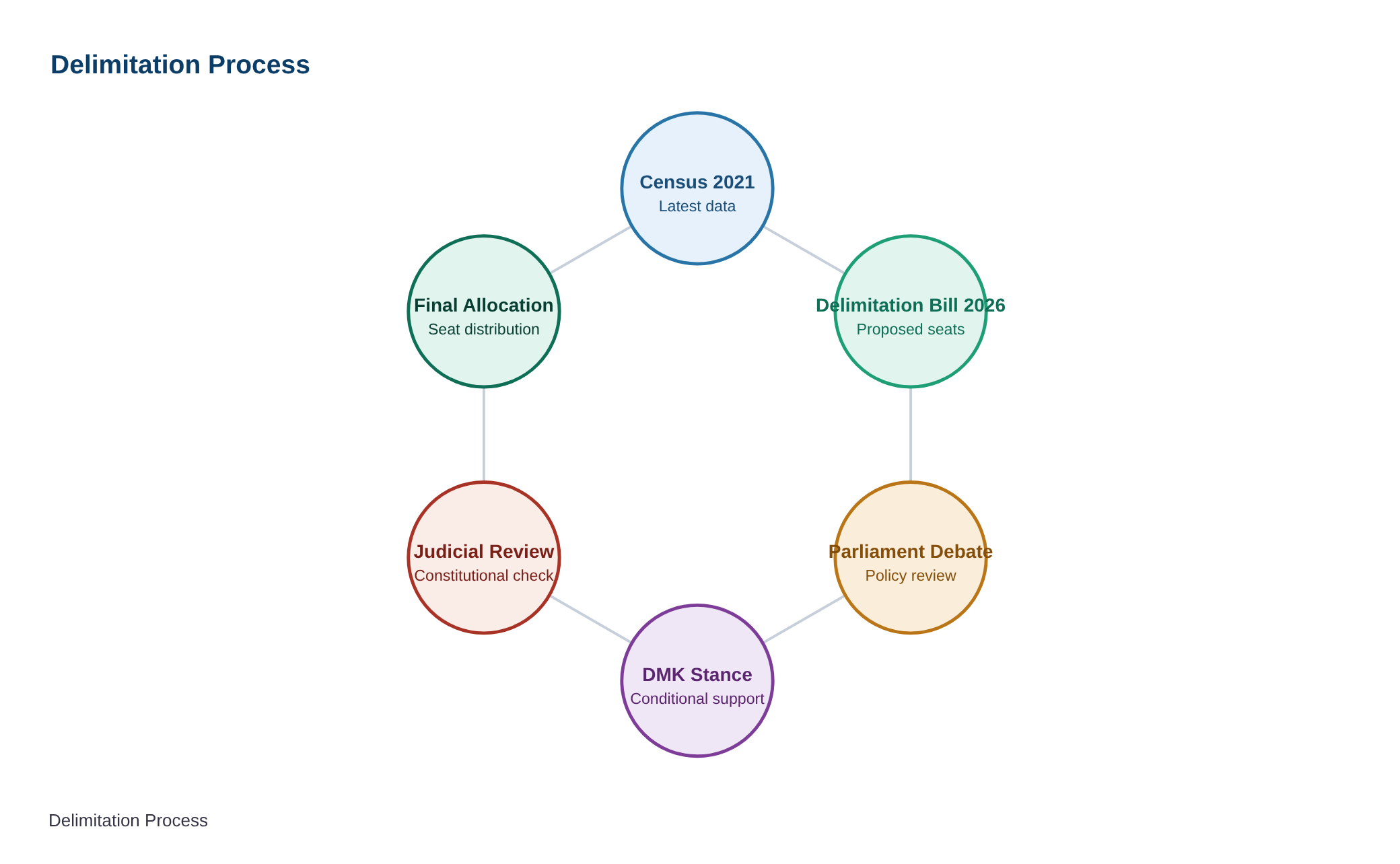
Demographic shifts → Census 2021 data → Delimitation Bill 2026 → Parliamentary debate → DMK’s conditional support → Potential judicial review → Final seat allocation → Federal balance assessment.
Prelims Practice Questions
Q1. Consider the following statements regarding the Delimitation Commission in India:
1. The Delimitation Commission is a permanent body established by the Constitution.
2. The Commission determines the boundaries of territorial constituencies in India.
3. The Commission’s orders come into force after final publication in the Gazette of India.
4. The Commission is headed by the Chief Election Commissioner of India.
How many of the above statements are correct?
- Only one
- Only two
- Only three
- All four
Answer: Only three — Statements 2 and 3 are correct. The Delimitation Commission is a temporary body constituted under the Delimitation Act, 2002, and its orders are legally binding after publication in the Gazette of India. Statement 1 is incorrect as it is not a permanent body; Statement 4 is incorrect as the Commission is headed by a retired Supreme Court judge.
Q2. Assertion (A): The Constitution of India mandates that the number of seats in the Lok Sabha shall not exceed 552.
Reason (R): Article 81(1) of the Constitution specifies that the maximum number of seats in the Lok Sabha shall be 552, including seats reserved for Scheduled Castes and Scheduled Tribes.
- Both A and R are true, and R is the correct explanation of A
- Both A and R are true, but R is not the correct explanation of A
- A is true, but R is false
- A is false, but R is true
Answer: Both A and R are true, but R is not the correct explanation of A — Both the Assertion (A) and Reason (R) are true. Article 81(1) of the Constitution explicitly limits the maximum number of seats in the Lok Sabha to 552, including reserved seats. The Reason (R) correctly explains the Assertion (A).
Q3. Match the following provisions with their respective constitutional articles:
Column I (Provision)
A. Composition of the Delimitation Commission
B. Reservation of seats for Scheduled Castes and Scheduled Tribes
C. Procedure for delimitation of constituencies
D. Maximum number of seats in the Lok Sabha
Column II (Article)
1. Article 330
2. Article 81
3. Article 82
4. Article 243B
- A-3, B-1, C-2, D-4
- A-4, B-1, C-3, D-2
- A-2, B-3, C-1, D-4
- A-3, B-2, C-4, D-1
Answer: A-4, B-1, C-3, D-2 — A-3 (Article 82 empowers Parliament to determine the delimitation of constituencies), B-1 (Article 330 provides for reservation of seats for Scheduled Castes and Scheduled Tribes in the Lok Sabha), C-2 (Article 81 specifies the maximum number of seats in the Lok Sabha, which is relevant to delimitation), D-4 (Article 243B relates to the composition of Municipalities, not delimitation).
Mains Practice Question
✍ Critically examine the constitutional and political implications of the proposed delimitation of Lok Sabha constituencies, with particular reference to the concerns raised by southern states. Also, assess how the Delimitation Commission’s methodology may impact federal principles in India. (15 Marks)
Approach: MODEL-ANSWER SKELETON:
1. **Constitutional Framework for Delimitation**
– Article 82: Parliament’s power to readjust seats after each census.
– Article 330: Reservation of seats for SCs/STs.
– Delimitation Act, 2002: Composition of the Delimitation Commission (retired Supreme Court judge, Chief Election Commissioner, and respective state Election Commissioners).
– Role of the President in notifying delimitation orders.
2. **Proposed Changes and Political Context**
– Government’s proposal to increase Lok Sabha seats from 543 to 816 (as per April 2026 legislative package).
– Claims of maintaining proportional representation for southern states (e.g., Tamil Nadu’s seats increasing from 39 to 59 but share remaining at 7.2%).
– DMK’s stance: Awaiting official draft; historical opposition to delimitation (e.g., 2002 and 2008 exercises).
3. **Concerns of Southern States**
– **Federalism and Representation**: Fear of reduced proportional share due to lower population growth rates compared to northern states.
– **Demographic Shift**: Southern states argue that population-based delimitation disadvantages them despite higher human development indices.
– **Political Implications**: Potential loss of political clout for parties like DMK, which have historically opposed delimitation.
4. **Methodological Debates**
– **Population vs. Other Criteria**: Constitution mandates delimitation based on the 2001 census (last census data used for 2008 delimitation). Should additional criteria (e.g., literacy, human development) be considered?
– **One Nation, One Poll**: Linkage to simultaneous elections and its potential impact on delimitation.
– **Judicial Precedents**: Reference to Supreme Court judgments on delimitation (e.g., *Jammu & Kashmir Reorganisation Act, 2019* and its delimitation provisions).
5. **Federal Principles and Equity**
– **Cooperative Federalism**: Need for consensus between Centre and states on delimitation methodology.
– **Equitable Representation**: Balancing population growth with regional equity (e.g., Uttar Pradesh vs. Kerala).
– **Constitutional Morality**: Whether delimitation should prioritize numerical equality over socio-economic equity.
6. **Way Forward**
– **Consultative Process**: Involving state governments and opposition parties in drafting the delimitation bill.
– **Data Transparency**: Ensuring census data and delimitation formulas are publicly verifiable.
– **Legal Safeguards**: Strengthening judicial review to address grievances of states.
**Balance of Views**:
– **Pro-Delimitation**: Argues for demographic fairness and alignment with constitutional provisions.
– **Anti-Delimitation**: Highlights risks to federalism, regional autonomy, and political representation of southern states.
Source: amarujala.com
Generated by AanyaAi for educational purpose.

- पेरियार टाइगर रिजर्व में 6 नई प्रजातियाँ खोजी गईं, जानिए क्या हैं विशेषताएँ - September 22, 2026
- Six New Species Discovered in Periyar Tiger Reserve: UPSC & PCS Key Biodiversity Insights - September 22, 2026
- तमिलनाडु में बस किराए में संशोधन: सरकार को चार सप्ताह और समय मिला, उच्च न्यायालय का फैसला - September 22, 2026

No Comments