


07 Aug DMK’s Stance on Delimitation Bill: UPSC Perspective for South States
✎ The Delimitation Bill 2026 seeks to increase Lok Sabha seats from 543 to 816 while preserving proportional representation for southern states; DMK’s stance hinges on the Bill’s final provisions, reflecting broader federal…
Subject Relevance — Where This Topic Fits
- GS Paper II — Polity and Governance — Constitutional Provisions, Parliament and State Legislatures | GS Paper III — Economy — Sectoral Development and Representation
- Prelims: Delimitation Commission, Article 82, Census, Representation of People Act 1950, 42nd Amendment Act, Lok Sabha seat increase, Southern states representation, Dravidian parties, DMK stance
- Essay: Federalism and Centre-State Relations in India: Balancing Representation and Equity, Demographic Shifts and Electoral Democracy: The Case of Delimitation
Quick Revision: The Delimitation Bill 2026 seeks to increase Lok Sabha seats from 543 to 816 while preserving proportional representation for southern states; DMK’s stance hinges on the Bill’s final provisions, reflecting broader federal tensions.
Why is this in the news?
The Union Government is set to introduce the Delimitation Bill 2026 in Parliament, triggering political discourse on its potential impact on southern states. The Dravida Munnetra Kazhagam (DMK), a key regional party from Tamil Nadu, has deferred its decision on supporting or opposing the Bill until the official draft is tabled, citing the need for a detailed review of its provisions. This delay reflects broader apprehensions among southern states regarding possible dilution of their political representation in the Lok Sabha.
Background
- The last delimitation exercise was conducted in 2002–2008, based on the 2001 Census, and froze the number of Lok Sabha seats at 543 until the first census after 2026.
- Southern states, particularly Dravidian parties, have historically opposed delimitation on grounds of demographic shifts favouring northern states, citing concerns over reduced political representation.
- The DMK’s cautious stance underscores the political sensitivity surrounding delimitation, which intersects with federalism, linguistic identity, and electoral equity.
What is the Delimitation Bill 2026?
- The Delimitation Bill 2026 is a legislative proposal aimed at redrawing the boundaries of parliamentary and assembly constituencies across India, based on the most recent population data.
- The Bill includes provisions for the formation of a Delimitation Commission, tasked with redrawing constituency boundaries while adhering to constitutional and statutory guidelines, including the preservation of administrative convenience and local ties.
- The Bill incorporates safeguards to prevent the arbitrary alteration of constituency boundaries that could disenfranchise specific communities or regions, as mandated by the Supreme Court in landmark judgments.
- The Bill’s passage is contingent upon parliamentary approval, with potential amendments to address regional apprehensions, particularly from southern states.
Key Features
| Feature | Significance |
|---|---|
| Proposed increase in Lok Sabha seats from 543 to 816 | Expands representation but raises concerns over demographic balance and federal structure. |
| Population-based delimitation model | Ensures proportional representation but may reduce the relative share of southern states due to lower population growth rates. |
| DMK’s conditional stance on the Bill | Reflects political caution and emphasis on safeguarding regional interests before endorsing the proposal. |
| Tamil Nadu’s seat increase from 39 to 59 | Maintains proportional representation but does not address fears of reduced political influence in a larger House. |
| Centre’s assurance on southern states’ representation | Aims to mitigate apprehensions but lacks detailed mechanisms to ensure proportionality in practice. |
Why it Matters
Political
- Alters the balance of power in Parliament by increasing the total number of seats, potentially diluting the influence of southern states.
Federalism
- Raises questions about the balance between population-based representation and the federal principle of equal state representation.
Demographic
- Southern states, with lower population growth, may see a relative decline in their share of seats despite absolute increases.
Electoral
- Could reshape electoral strategies and alliances, particularly for parties like DMK that rely on regional strongholds.
Challenges
1. Reduced Relative Representation of Southern States
- Population-based delimitation may lead to a lower share of seats for southern states despite absolute increases.
- Tamil Nadu’s seat increase from 39 to 59 maintains proportional representation but does not address fears of reduced political influence in a larger House.
UPSC Link: GS-II: Federalism
2. Political Opposition and Regional Sentiments
- DMK’s cautious stance reflects broader regional apprehensions about centralised policies affecting state interests.
- Lack of transparency in the delimitation process may fuel distrust among southern states.
UPSC Link: GS-II: Centre-State Relations
3. Implementation Challenges
- Ensuring proportional representation while addressing concerns of over-representation in high-growth states.
- Balancing the need for increased representation with the risk of political fragmentation.
UPSC Link: GS-II: Representation of States
4. Constitutional and Legal Hurdles
- The delimitation process must adhere to constitutional provisions, including Article 82 and the 42nd Amendment Act.
- Potential legal challenges if the process is perceived as biased or unfair.
UPSC Link: GS-II: Constitutional Provisions
Challenges — UPSC Perspective
| Issue | Concern |
|---|---|
| Population Growth Disparities | Southern states may lose relative political influence despite seat increases. |
| Federalism vs. Proportional Representation | Conflict between state equality and demographic representation. |
| Regional Political Sentiments | Fear of centralised policies undermining state autonomy. |
| Transparency in Delimitation | Lack of clarity in the process may lead to distrust and opposition. |
| Electoral Strategy Disruptions | Parties like DMK may need to recalibrate their electoral strategies. |
| Legal and Constitutional Compliance | Ensuring the process adheres to constitutional safeguards. |
Way Forward
- Conduct a detailed study of the draft Delimitation Bill to assess its impact on southern states.
- Engage in multi-party consultations to address regional concerns and ensure a consensus-based approach.
- Publish a white paper outlining the methodology and rationale behind the proposed seat increases.
- Strengthen federal institutions like the Inter-State Council to facilitate dialogue between the Centre and states.
- Explore phased implementation of the delimitation process to mitigate sudden disruptions.
- Enhance transparency by sharing draft proposals with state governments and opposition parties for feedback.
- Monitor demographic trends to ensure the delimitation process remains fair and equitable over time.
- Incorporate safeguards to protect the political interests of states with lower population growth rates.
UPSC Value Addition
Keywords for Mains Answer-Writing
Delimitation Commission · Representation of States Act, 1950 · Article 82 of the Constitution · Lok Sabha seat allocation · Southern States’ political representation · DMK stance on delimitation · Constitutional provisions for delimitation · Federalism and Centre-State relations · Proportional representation · Election Commission of India
Constitutional & Policy Linkages
- {‘Article 82’: ‘Readjustment of seats in the House of the People.’}
Concept Flow
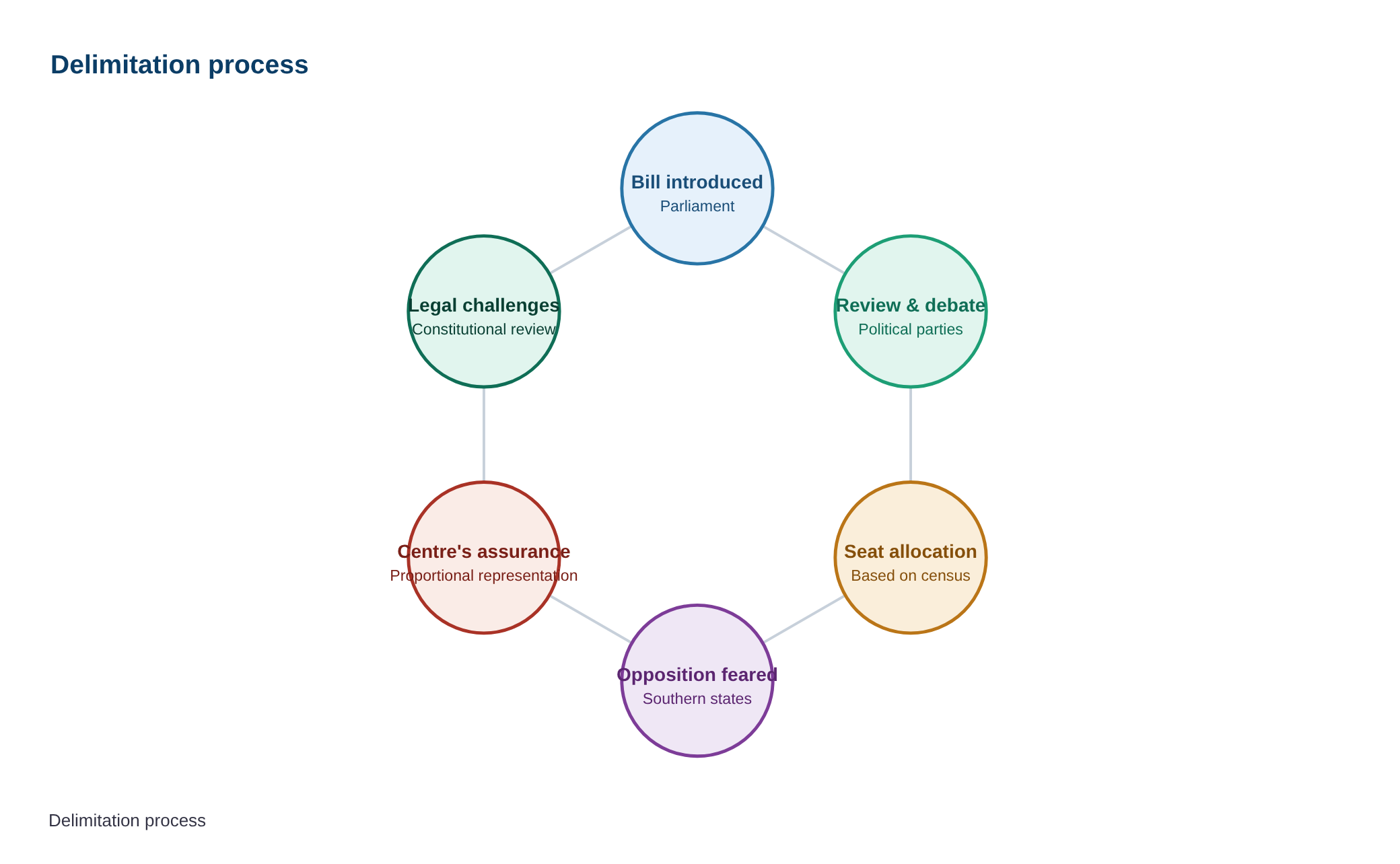
Population growth disparities → Proposed increase in Lok Sabha seats → Fear of reduced relative representation in southern states → Regional political opposition (e.g., DMK) → Centre’s assurance on proportional representation → Need for transparent and inclusive delimitation process → Potential legal and constitutional challenges → Way forward: consensus-building and safeguards.
Prelims Practice Questions
Q1. Consider the following statements regarding the Delimitation Commission in India: 1. The Delimitation Commission is a statutory body established under the Representation of the People Act, 1950. 2. The Commission is tasked with the delimitation of constituencies for the Lok Sabha and State Legislative Assemblies. 3. The orders of the Delimitation Commission are subject to judicial review by the Supreme Court of India. 4. The Delimitation Commission can be constituted by the President of India only after the Census is conducted. How many of the above statements are correct?
- Only one
- Only two
- Only three
- All
Answer: Only three — Statements 1 and 2 are correct. The Delimitation Commission is indeed a statutory body under the Representation of the People Act, 1950, and its primary function is to delimit constituencies for the Lok Sabha and State Legislative Assemblies. Statement 3 is incorrect as the orders of the Delimitation Commission are final and cannot be challenged in any court. Statement 4 is incorrect because the Commission can be constituted by the President even before the Census is conducted, as seen in the 2026 delimitation exercise.
Q2. Assertion (A): The principle of proportional representation ensures that the political representation of states in the Lok Sabha is directly proportional to their population. Reason (R): The Delimitation Commission uses the latest census data to allocate seats to states in the Lok Sabha.
- Both A and R are true, and R is the correct explanation of A.
- Both A and R are true, but R is NOT the correct explanation of A.
- A is true, but R is false.
- A is false, but R is true.
Answer: A is true, but R is false. — Assertion (A) is true in principle, as proportional representation aims to reflect population distribution. However, Reason (R) is not the correct explanation of (A) because the Delimitation Commission’s role is to delimit constituencies based on population data, but the principle of proportional representation is broader and includes other factors like geographical contiguity and administrative convenience.
Mains Practice Question
✍ The proposed Delimitation Bill 2026 seeks to increase the total number of Lok Sabha seats from 543 to 816, with a significant expansion in the representation of southern states. Critically examine the constitutional, political, and federal implications of this proposal, particularly in the context of the apprehensions raised by southern states regarding their political representation. (15 Marks)
Approach: MODEL-ANSWER SKELETON:
1. **Constitutional Framework**:
– Article 82 of the Constitution mandates delimitation of constituencies after every census.
– The Representation of the People Act, 1950, provides the legal framework for delimitation.
– The Delimitation Commission, a statutory body, is responsible for this exercise.
2. **Proposed Changes in Delimitation Bill 2026**:
– Increase in total Lok Sabha seats from 543 to 816.
– Expansion of seats in southern states (e.g., Tamil Nadu from 39 to 59) while maintaining proportional representation.
– Potential impact on the balance of power between northern and southern states.
3. **Federalism and Centre-State Relations**:
– Federalism requires equitable representation of all states, irrespective of population size.
– Southern states argue that their political voice may be diluted due to the proposed changes, despite proportional representation.
– The principle of federalism is enshrined in the Constitution (e.g., Article 1, Seventh Schedule).
4. **Political Implications**:
– The DMK’s stance reflects broader political apprehensions about the Centre’s role in delimitation.
– The Bill may alter the political dynamics between states and the Centre, particularly in coalition governance.
– The expansion of seats could lead to a more fragmented Lok Sabha, impacting governance.
5. **Counterarguments and Government’s Position**:
– The government asserts that the new model will not reduce the proportional share of southern states.
– The Bill aims to reflect the demographic changes post-2021 Census.
– The Centre argues that the expansion is necessary to accommodate population growth and maintain democratic representation.
6. **Conclusion**:
– The proposal raises critical questions about the balance between demographic representation and federal principles.
– A nuanced approach is required to address the concerns of southern states while ensuring fair representation for all regions.
Source: amarujala.com
Generated by AanyaAi for educational purpose.

- यूपी हाईकोर्ट ने स्कूल बस सुरक्षा पर दिया सख्त आदेश, डीएम को 1 माह में रिपोर्ट देने का निर्देश - September 22, 2026
- UP High Court Directs DM & Chief Secretary on School Vehicle Safety: Key Facts for UPSC/PCS - September 22, 2026
- पेरियार टाइगर रिजर्व में 6 नई प्रजातियाँ खोजी गईं, जानिए क्या हैं विशेषताएँ - September 22, 2026

No Comments