


07 Aug DMK’s Stand on Delimitation Bill: Key Implications for UPSC & State PCS Aspirants
✎ The Delimitation Bill 2026 seeks to redraw parliamentary and assembly constituencies, but its final impact on southern states’ representation remains a subject of intense political and constitutional debate.
Subject Relevance — Where This Topic Fits
- GS Paper II — Parliament and State Legislatures — Structure, Functioning, Conduct of Business, Powers & Privileges and Issues Arising out of these | GS Paper II — Federalism, Devolution of Powers and Finances up to Local Levels and Challenges Therein
- Prelims: Delimitation Commission, Article 82, Article 170, Lok Sabha Seats, Federalism, Representation of States, Constitutional Provisions on Delimitation
- Essay: Federalism in India: Balancing Unity and Diversity, Representation and Democracy: The Case for Inclusive Electoral Reforms
Quick Revision: The Delimitation Bill 2026 seeks to redraw parliamentary and assembly constituencies, but its final impact on southern states’ representation remains a subject of intense political and constitutional debate.
Why is this in the news?
The Delimitation Bill 2026 has sparked political debate, particularly regarding its potential impact on southern states’ representation in the Lok Sabha. The Dravida Munnetra Kazhagam (DMK) has adopted a cautious stance, deferring any decision until the official draft is tabled in Parliament, citing the need for detailed scrutiny of the bill’s provisions and alignment with its earlier suggestions to the government.
Background
- Delimitation refers to the process of redrawing the boundaries of parliamentary and assembly constituencies based on the latest census data to ensure equitable representation.
- The last delimitation exercise was conducted in 2002–2008, based on the 2001 Census, and froze the number of Lok Sabha seats at 543 until the first census after 2026.
- The Constitution (84th Amendment) Act, 2002, provided for the postponement of delimitation until after the first census post-2026, which is now imminent.
- Southern states, including Tamil Nadu, have historically expressed concerns over the potential dilution of their political representation in Parliament due to demographic shifts and the methodology of seat allocation.
- The proposed increase in Lok Sabha seats from 543 to 816 has intensified debates over federal principles and the equitable distribution of political power among states.
- The DMK, a key regional party in Tamil Nadu, has historically opposed delimitation unless it aligns with its demands for greater state autonomy and proportional representation.
What is the Delimitation Bill 2026?
- The Delimitation Bill 2026 proposes to redraw the boundaries of parliamentary and assembly constituencies across India, as mandated by the Constitution.
- Critics argue that the proposed model may disproportionately benefit northern states with higher population growth rates, potentially reducing the political weight of southern states in Parliament.
- The DMK has demanded that its earlier suggestions be incorporated into the bill to safeguard Tamil Nadu’s interests, particularly in terms of seat allocation and reservation policies.
- The bill also addresses the delimitation of assembly constituencies, which will impact state-level representation and electoral dynamics in southern states.
- The Constitution empowers Parliament to determine the authority responsible for delimitation, typically through a Delimitation Commission, to ensure impartiality and transparency.
Key Features
| Feature | Significance |
|---|---|
| Population-based delimitation | Reallocates Lok Sabha seats to reflect demographic changes, potentially altering state-wise representation. |
| Increase in total seats | Proposal to raise Lok Sabha seats from 543 to 816, expanding the House’s size and altering the electoral landscape. |
| Southern states’ representation | Risk of perceived reduction in proportional share if northern states grow faster demographically, despite government assurances. |
| DMK’s conditional stance | Party awaits official draft to assess alignment with prior suggestions before finalising support or opposition. |
| Political bargaining tool | Delimitation bill serves as leverage for regional parties to negotiate for safeguards in electoral representation. |
Why it Matters
Constitutional & Electoral
- Delimitation is constitutionally mandated under Article 82 and the Delimitation Act, 2002, to ensure fair representation based on population.
Federalism & Regional Balance
- Southern states fear erosion of their political voice due to faster population growth in northern states, threatening the federal balance.
Governance & Representation
- Expanded Lok Sabha size (816 seats) may improve representation but risks dilution of individual voter influence if seat growth outpaces population growth.
Political Strategy
- DMK’s wait-and-watch approach reflects tactical caution, prioritising electoral calculus over ideological rigidity in a coalition-dependent polity.
Demographic Shifts
- India’s population dynamics—higher fertility rates in northern states—could reshape electoral geography, influencing party strategies nationwide.
Challenges
1. Perceived erosion of southern states’ representation
- Southern states, including Tamil Nadu, risk losing proportional share in Lok Sabha despite government assurances of no adverse impact.
- Historical data shows southern states have maintained higher per-capita representation; future shifts may reverse this trend.
UPSC Link: GS-II: Federalism
2. Political polarisation over delimitation
- Regional parties, particularly in the South, may oppose the bill to safeguard their electoral interests, leading to legislative gridlock.
UPSC Link: GS-II: Parliament
3. Administrative feasibility of large-scale delimitation
- Conducting delimitation at the scale proposed (816 seats) requires extensive logistical planning, data verification, and public consultation.
UPSC Link: GS-II: Constitutional Bodies
4. Ensuring equitable representation for marginalised groups
- Delimitation must balance population-based reallocation with safeguards for Scheduled Castes and Scheduled Tribes under Article 330 and 332.
UPSC Link: GS-II: Representation
5. Public perception and trust deficit
- Lack of transparency in the delimitation process may fuel scepticism among political parties and citizens, undermining the bill’s legitimacy.
UPSC Link: GS-II: Governance
Challenges — UPSC Perspective
| Issue | Concern |
|---|---|
| Southern states’ representation | Fear of reduced proportional share due to demographic shifts in northern states. |
| Political bargaining | Regional parties may oppose the bill to extract concessions on other issues. |
| Logistical complexity | Large-scale delimitation requires meticulous data collection and verification. |
| Constitutional safeguards | Risk of diluting protections for marginalised communities under Articles 330 and 332. |
| Public trust | Lack of transparency may lead to widespread scepticism and resistance. |
Way Forward
- Await the official draft of the Delimitation Bill to assess its provisions and alignment with DMK’s prior suggestions.
- Conduct detailed consultations with regional parties to address concerns about representation and safeguards.
- Ensure transparency in the delimitation process by publishing draft proposals and inviting public feedback.
- Re-examine constitutional safeguards under Articles 330 and 332 to prevent dilution of marginalised group representation.
- Engage in inter-state dialogue to build consensus on the delimitation model, balancing demographic shifts with federal principles.
- Prepare contingency plans for potential legislative gridlock, including alternative mechanisms for representation adjustments.
- Monitor demographic trends to anticipate future shifts and proactively address regional disparities.
UPSC Value Addition
Keywords for Mains Answer-Writing
Delimitation Bill 2026 · Representation of States in Lok Sabha · Proportionality principle in delimitation · Dravida Munnetra Kazhagam (DMK) stance on delimitation · South India’s political representation · Lok Sabha seat increase to 816 · Tamil Nadu’s Lok Sabha seats · Constitutional provisions on delimitation · Federalism and demographic representation · Parliamentary debates on delimitation
Constitutional & Policy Linkages
- Article 82: Provision for delimitation of constituencies.
- Article 330: Reservation of seats for Scheduled Castes in the Lok Sabha.
- Article 332: Reservation of seats for Scheduled Tribes in the Lok Sabha.
- Delimitation Act, 2002: Legal framework governing the delimitation process.
Concept Flow
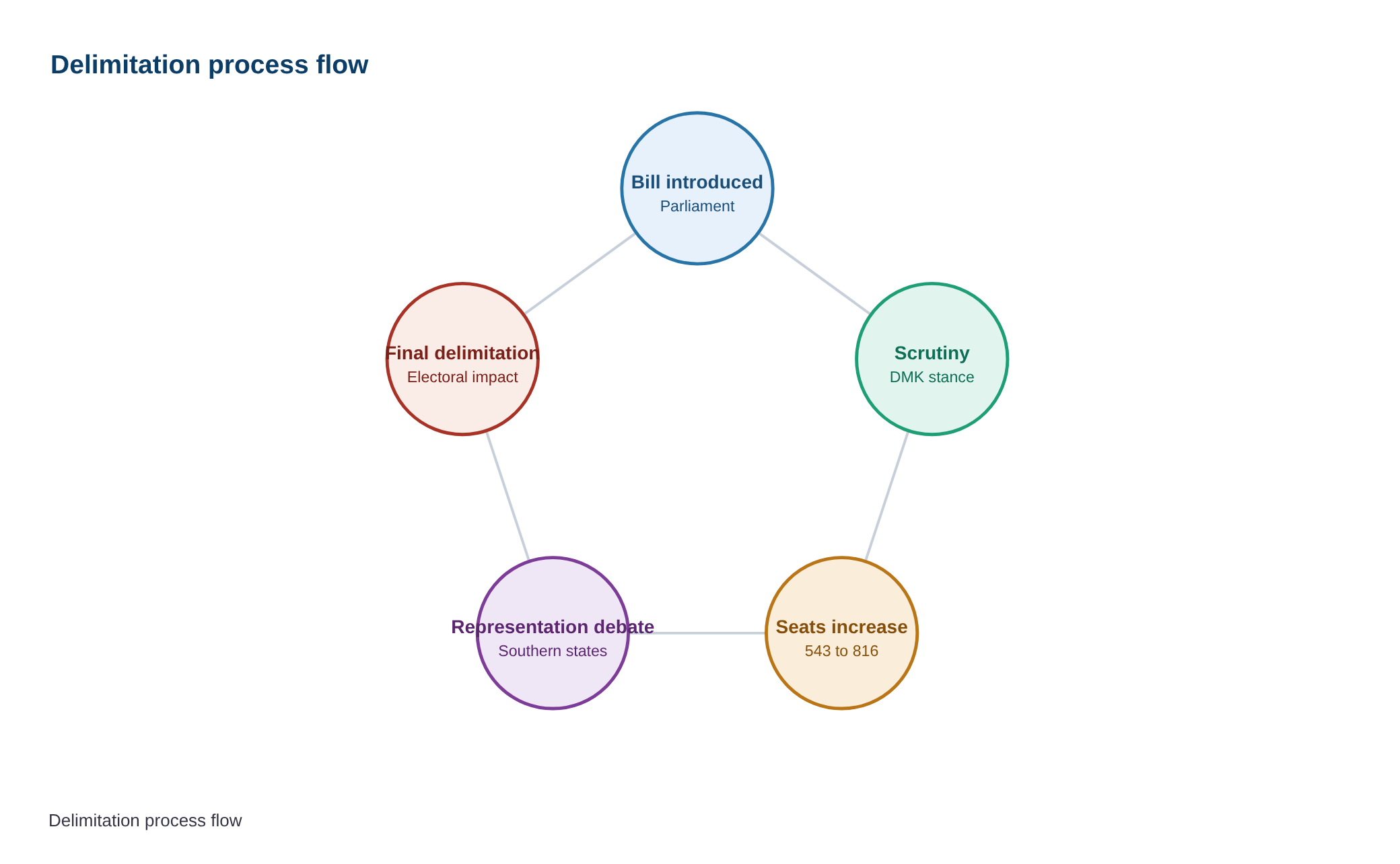
Population growth disparities across states → Demand for population-based delimitation → Government proposes increase in Lok Sabha seats (543 to 816) → Southern states express concerns over representation → DMK adopts conditional stance awaiting official draft → Political bargaining and potential opposition → Legislative process and public consultation → Final delimitation and impact on electoral geography.
Prelims Practice Questions
Q1. Consider the following statements regarding the Delimitation Commission in India:
1. The Delimitation Commission is a permanent constitutional body.
2. Its orders cannot be challenged in any court of law.
3. The Commission is responsible for the delimitation of constituencies for the Lok Sabha and State Legislative Assemblies.
4. The first delimitation exercise after the 1971 Census was deferred until after the 2001 Census.
How many of the above statements are correct?
- Only one
- Only two
- Only three
- All
Answer: Only three — Statement 1 is incorrect: The Delimitation Commission is a temporary body constituted by the President under Article 82 of the Constitution. Statement 2 is correct: The orders of the Delimitation Commission have the force of law and are not subject to judicial review under Article 329(b). Statement 3 is correct: The Commission delimits constituencies for the Lok Sabha and State Legislative Assemblies. Statement 4 is incorrect: The first delimitation after the 1971 Census was deferred until after the 2001 Census due to the 42nd Amendment.
Q2. Assertion (A): The principle of proportionality in delimitation ensures that the representation of states in the Lok Sabha is directly proportional to their population.
Reason (R): The Delimitation Act, 2002 mandates that the allocation of seats to states in the Lok Sabha is based on the census figures of 1971, frozen until the first census after 2026.
In the context of the above two statements, which one of the following is correct?
- Both A and R are true, and R is the correct explanation of A
- Both A and R are true, but R is NOT the correct explanation of A
- A is true, but R is false
- A is false, but R is true
Answer: A is false, but R is true — Assertion (A) is true: The principle of proportionality in delimitation aims to ensure that representation in the Lok Sabha is proportional to population. However, Reason (R) is false: The allocation of seats is based on the 1971 census figures, which are frozen until the first census after 2026, but this does not directly explain the principle of proportionality. The principle is applied within the frozen seat allocation framework.
Mains Practice Question
✍ The proposed Delimitation Bill 2026 seeks to increase the total number of Lok Sabha seats from 543 to 816, with a corresponding increase in seats for southern states like Tamil Nadu. Critically examine the constitutional and federal implications of this delimitation exercise, particularly in the context of the concerns raised by political parties from South India. (15 Marks)
Approach: MODEL-ANSWER SKELETON:
1. Constitutional Framework of Delimitation:
– Article 82 and 170: Constitution empowers Parliament to readjust seats after each census.
– Article 329(b): Bar on judicial review of delimitation orders.
– 42nd and 84th Amendments: Froze seat allocation based on 1971 census until 2026.
2. Proposed Changes in Delimitation Bill 2026:
– Increase in total seats from 543 to 816.
– Tamil Nadu’s seats increase from 39 to 59; proportional share remains 7.2%.
– Methodology: Population-based delimitation while maintaining state-wise proportionality.
3. Federal Implications and Concerns:
– Perceived threat to federal balance: Southern states fear loss of relative representation due to lower population growth rates.
– Dravidian parties (e.g., DMK) demand inclusion of their past suggestions in the draft bill.
– Constitutional principle of ‘proportionality’ vs. ‘equal representation’: Debate on whether population or geographical area should dominate.
4. Legal and Political Dimensions:
– Role of Delimitation Commission: Temporary body with statutory powers.
– Judicial safeguards: Article 329(b) limits judicial intervention.
– Political bargaining: Southern states demand safeguards to protect their representation.
5. Comparative Perspective:
– Contrast with the U.S. system: House of Representatives seats are reallocated based on census, but no fixed ceiling.
– India’s unique federal model: Balance between national integration and regional aspirations.
6. Conclusion:
– Delimitation must balance demographic changes with federal equity.
– Need for consensus among states to preserve trust in the federal structure.
– Role of Parliament in ensuring transparency and inclusivity in the process.
Source: amarujala.com
Generated by AanyaAi for educational purpose.

- यूपी हाईकोर्ट ने स्कूल बस सुरक्षा पर दिया सख्त आदेश, डीएम को 1 माह में रिपोर्ट देने का निर्देश - September 22, 2026
- UP High Court Directs DM & Chief Secretary on School Vehicle Safety: Key Facts for UPSC/PCS - September 22, 2026
- पेरियार टाइगर रिजर्व में 6 नई प्रजातियाँ खोजी गईं, जानिए क्या हैं विशेषताएँ - September 22, 2026

No Comments