


07 Aug DMK’s Stand on Delimitation Bill: Key Implications for UPSC & State PCS
✎ The Delimitation Bill 2026 aims to redraw Lok Sabha constituencies based on the latest census.
Subject Relevance — Where This Topic Fits
- GS Paper II — Constitutional and Non-Constitutional Bodies (Election Commission of India) | GS Paper III — Government Budgeting and Policies
- Prelims: Delimitation Commission, Article 82 of the Constitution, Representation of the People Act, 1950, Lok Sabha seat allocation, Southern states’ demographic concerns
- Essay: Federalism and Centre-State Relations in India, Demographic Shifts and Political Representation
Quick Revision: The Delimitation Bill 2026 aims to redraw Lok Sabha constituencies based on the latest census.
Why is this in the news?
The DMK has adopted a cautious approach regarding the Delimitation Bill 2026, stating that its stance will be finalised only after the official draft is tabled in Parliament. This development is significant as the bill proposes an increase in Lok Sabha seats, with potential implications for the political representation of southern states, including Tamil Nadu, where the DMK holds substantial influence. The party’s reluctance to commit without reviewing the bill underscores the broader political and demographic sensitivities surrounding delimitation.
Background
- The Delimitation Commission is a statutory body constituted under the Delimitation Act, 2002, to redraw the boundaries of parliamentary and assembly constituencies based on the latest census data.
- The last delimitation exercise was conducted in 2002–2008, freezing seat allocations until the first census after 2026, as per the 84th Constitutional Amendment Act, 2001.
- Southern states, including Tamil Nadu, have historically expressed concerns about potential underrepresentation due to lower population growth rates compared to northern states.
- The DMK has previously opposed delimitation efforts, citing fears of reduced political influence for southern states in the Parliament.
- The Election Commission of India plays a pivotal role in the delimitation process, ensuring fairness and adherence to constitutional provisions.
What is the Delimitation Bill 2026?
- The Delimitation Bill 2026 seeks to redraw the boundaries of parliamentary and assembly constituencies in India, based on the latest census data, to ensure equitable representation.
- The bill is framed under the constitutional provisions of Article 82, which empowers Parliament to enact laws for delimitation, and the Representation of the People Act, 1950.
- The Delimitation Commission, a statutory body, will oversee the implementation of the bill, ensuring that the exercise is conducted in a transparent and impartial manner.
- The bill aims to address disparities in political representation arising from demographic shifts, particularly the slower population growth in southern states.
- Critics argue that the bill could disproportionately benefit northern states with higher population growth, potentially marginalising southern states in the Parliament.
- The DMK’s cautious stance reflects broader political apprehensions about the potential impact of delimitation on the electoral prospects of southern parties.
Key Features
| Feature | Significance |
|---|---|
| Population-based delimitation | Ensures equitable representation in the Lok Sabha by adjusting seat allocation to reflect demographic changes across states. |
| Increase in Lok Sabha seats | Proposal to raise the total seats from 543 to 816, necessitating a re-evaluation of electoral boundaries and representation norms. |
| South India’s seat share | Rumored reduction in proportional representation for southern states (e.g., Tamil Nadu’s seats rising from 39 to 59 but share remaining 7.2%) due to demographic shifts. |
| DMK’s conditional stance | Party awaits the official draft of the Delimitation Bill before finalizing its position, emphasizing thorough scrutiny of provisions. |
| Political bargaining lever | Delimitation serves as a tool for parties to negotiate regional representation, particularly in states with strong regional identities. |
Why it Matters
Political Representation
- Delimitation directly impacts the federal balance by altering seat distribution among states, influencing electoral outcomes and coalition dynamics.
- Southern states, with lower population growth rates, face the risk of reduced proportional representation, potentially diluting their political voice.
- Regional parties like DMK must strategize to protect their electoral base, especially in states with high linguistic and cultural identity.
Constitutional Framework
- The process is governed by Articles 81 and 82 of the Constitution, which mandate periodic delimitation based on census data.
- The Delimitation Commission, a statutory body, is tasked with redrawing boundaries while ensuring fair and balanced representation.
- The 42nd Amendment (1976) froze delimitation until 2000, later extended to 2026, highlighting the political sensitivity of the issue.
Demographic Implications
- Northern states with higher population growth (e.g., Uttar Pradesh, Bihar) stand to gain seats, while southern states (e.g., Kerala, Tamil Nadu) may see stagnation or marginal gains.
- The shift could exacerbate inter-state disparities in political influence, raising concerns over equity in federal governance.
Challenges
1. Regional Representation Paradox
- Southern states risk a decline in their share of Lok Sabha seats despite economic and social advancements, due to lower population growth rates.
- This could fuel regional discontent, particularly in states with strong sub-national identities like Tamil Nadu.
UPSC Link: GS-II: Federalism
2. Political Polarisation
- Delimitation debates often become polarising, with parties leveraging the issue to mobilise regional sentiments against the Centre.
- The DMK’s cautious stance reflects broader apprehensions about perceived marginalisation of southern interests.
UPSC Link: GS-II: Centre-State Relations
3. Administrative Delays
- The Delimitation Commission’s work is time-bound and data-dependent, relying on census figures that may lag behind demographic realities.
- Delays in publishing census data or drafting the bill could disrupt electoral timelines, as seen in past exercises.
UPSC Link: GS-II: Constitutional Bodies
4. Legal and Procedural Hurdles
- Any deviation from the constitutional mandate of population-based delimitation could invite judicial scrutiny, as witnessed in the *Jammu & Kashmir Reorganisation Act, 2019*.
- The need for consensus among political stakeholders complicates the process, often leading to prolonged negotiations.
UPSC Link: GS-II: Judiciary
Challenges — UPSC Perspective
| Issue | Concern |
|---|---|
| Population vs. Representation | Southern states may lose proportional share despite higher development indices due to lower fertility rates. |
| Centre-State Tensions | Perceived bias in seat allocation could exacerbate federal tensions, particularly in coalition governments. |
| Data Lag | Census data used for delimitation may not reflect current demographic trends, leading to inequities. |
| Political Manipulation | Ruling parties may influence delimitation to consolidate power, as seen in historical precedents. |
| Implementation Costs | Redrawing electoral boundaries entails logistical and financial burdens for the Election Commission. |
Way Forward
- The government must release the official Delimitation Bill draft at the earliest to enable all stakeholders to conduct a line-by-line analysis.
- Parliament should constitute a bipartisan committee to review the bill, incorporating inputs from regional parties and demographic experts.
- Southern states should commission independent studies to project future demographic trends and advocate for safeguards in seat allocation.
- The Election Commission must ensure transparency in the delimitation process, including public consultations and grievance redressal mechanisms.
- Political parties should depoliticise the debate by focusing on constitutional principles rather than short-term electoral gains.
- Civil society and academia should monitor the process to prevent gerrymandering and ensure adherence to equity benchmarks.
- The Centre must address concerns of southern states through data-driven assurances, such as maintaining a minimum seat threshold for educationally advanced states.
UPSC Value Addition
Keywords for Mains Answer-Writing
Delimitation Commission · Representation of States in Parliament · Article 82 and 170 · One Nation One Election · Federalism in India · Dravidian Politics · Southern States’ Political Assertion · Constitutional Provisions on Delimitation · Lok Sabha Seat Increase Proposal · Federal Balance and Centre-State Relations
Constitutional & Policy Linkages
- Article 81: Composition of the House of the People (Lok Sabha).
- Article 82: Readjustment of seats after each census.
- Article 330: Reservation of seats for Scheduled Castes and Scheduled Tribes in the Lok Sabha.
- Part XV: Elections (Articles 324–329), which governs the electoral process.
Concept Flow
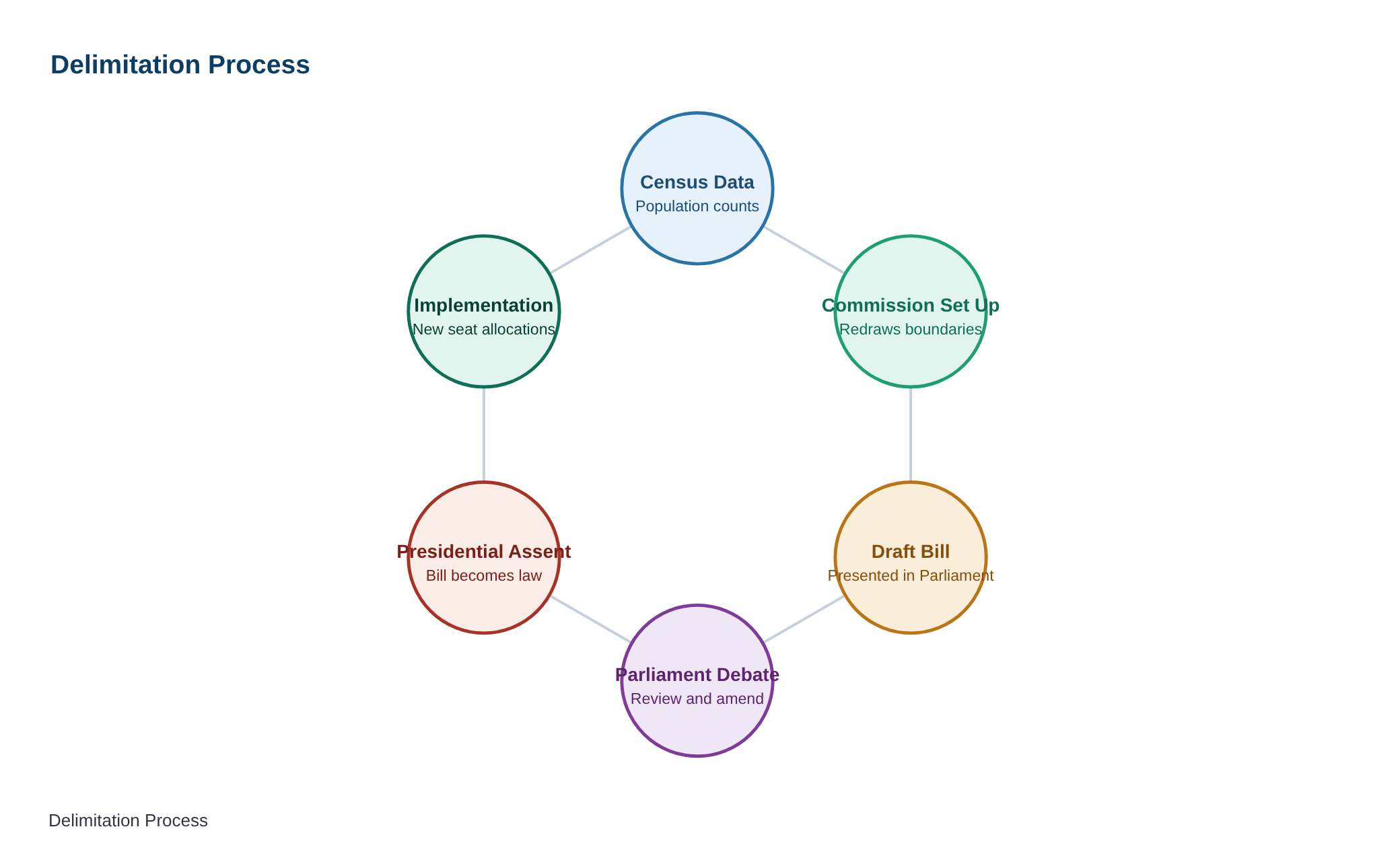
Census Data Collection → Population Growth Disparities → Delimitation Commission Constituted → Draft Bill Prepared → Parliamentary Debate → Presidential Assent → Implementation → Electoral Reallocation → Southern States’ Demographic Trends → Political Concerns → Regional Parties’ Stance (DMK) → Centre-State Negotiations → Bill Finalisation → Judicial Review (if challenged) → Lok Sabha Seat Increase Proposal → Seat Reallocation Formula → Impact Assessment → Southern States’ Protests → Centre’s Reassurances → Bill Passage → Electoral Boundary Redrawing → Constitutional Mandate (Articles 81 & 82) → Delimitation Freeze (42nd Amendment) → Expiry of Freeze (2026) → New Delimitation Exercise → Political Contestations → Final Redistribution → Delimitation Bill Introduction → DMK’s Conditional Support → Parliamentary Scrutiny → Opposition from Southern States → Centre’s Clarifications → Bill Passage → Implementation Challenges → Population-based Representation → Inter-State Equity Debate → Southern States’ Fear of Marginalisation → DMK’s Strategic Delay → Centre’s Attempts to Address Concerns → Final Political Settlement
Prelims Practice Questions
Q1. Consider the following statements regarding the delimitation process in India:
1. The Delimitation Commission is appointed by the President of India.
2. The first delimitation exercise was conducted in 1952.
3. The 84th Amendment Act, 2001 froze the delimitation of Lok Sabha and State Assembly constituencies till 2026.
4. The Delimitation Act, 2002 governs the current delimitation process.
How many of the above statements are correct?
- Only one
- Only two
- Only three
- All
Answer: All — Statements 1, 2, and 4 are correct. Statement 3 is incorrect as the 84th Amendment Act, 2001 froze delimitation till 2026, not the 84th Amendment Act itself.
Q2. Assertion (A): The Delimitation Commission is a statutory body.
Reason (R): The Delimitation Act, 2002 empowers the Government of India to constitute the Delimitation Commission.
Options:
A. Both A and R are true, and R is the correct explanation of A.
B. Both A and R are true, but R is not the correct explanation of A.
C. A is true, but R is false.
D. A is false, but R is true.
Answer: ? — The Delimitation Commission is a statutory body constituted under the Delimitation Act, 2002, making both A and R true. R correctly explains A as the Act provides the legal framework for its constitution.
Q3. Match the following provisions with their respective constitutional articles:
Column I (Provision)
A. Composition of the Delimitation Commission
B. Freezing of delimitation till 2026
C. Representation of States in Parliament
D. Reservation of seats for Scheduled Castes and Scheduled Tribes
Column II (Article)
1. Article 82
2. Article 330
3. Article 243ZD
4. Article 84th Amendment Act, 2001
Options:
A. A-3, B-4, C-1, D-2
B. A-3, B-1, C-4, D-2
C. A-2, B-4, C-1, D-3
D. A-1, B-3, C-2, D-4
Answer: ? — A matches with Article 243ZD (Composition of Delimitation Commission for Panchayats, but analogous for Parliament), B matches with the 84th Amendment Act, 2001 (freezing delimitation), C matches with Article 82 (Representation of States in Parliament), and D matches with Article 330 (Reservation of seats for SCs/STs in Lok Sabha).
Mains Practice Question
✍ Critically examine the constitutional and political implications of the proposed delimitation exercise in India, particularly in the context of federalism and the representation of southern states. Also, analyse how the stance of political parties like the DMK reflects broader concerns about federal balance and regional autonomy. (15 Marks)
Approach: MODEL-ANSWER SKELETON:
1. Constitutional Framework:
– Articles 82 and 170: Basis for delimitation (population-based representation).
– 84th Amendment Act, 2001: Freezing of delimitation till 2026.
– Delimitation Commission: Composition, functions, and statutory basis under the Delimitation Act, 2002.
– One Nation One Election debate: Link to delimitation and federalism.
2. Federalism and Representation:
– Southern states’ demographic trends vs. northern states: Impact on seat allocation.
– Proposed increase in Lok Sabha seats from 543 to 816: Data on Tamil Nadu (39 to 59 seats) and other southern states.
– Fear of reduced proportional representation: Centre’s claim vs. regional apprehensions.
3. Political Stance and Regional Assertion:
– DMK’s position: Delayed stance, demand for review of draft bill, and historical opposition to delimitation.
– Dravidian politics: Federalism, linguistic identity, and regional autonomy.
– Broader implications: Rise of regional parties, coalition politics, and centre-state tensions.
4. Critique and Balanced View:
– Arguments for delimitation: Democratic representation, demographic changes.
– Arguments against: Federal imbalance, erosion of regional voice, political manipulation risks.
– Judicial oversight: Role of the Supreme Court in delimitation disputes.
5. Conclusion:
– Need for consensus: Balancing federalism with democratic representation.
– Role of Parliament: Ensuring transparency and inclusivity in the delimitation process.
Source: amarujala.com
Generated by AanyaAi for educational purpose.

- यूपी हाईकोर्ट ने स्कूल बस सुरक्षा पर दिया सख्त आदेश, डीएम को 1 माह में रिपोर्ट देने का निर्देश - September 22, 2026
- UP High Court Directs DM & Chief Secretary on School Vehicle Safety: Key Facts for UPSC/PCS - September 22, 2026
- पेरियार टाइगर रिजर्व में 6 नई प्रजातियाँ खोजी गईं, जानिए क्या हैं विशेषताएँ - September 22, 2026

No Comments