


08 Sep Door-to-Door Leprosy Survey in Visakhapatnam: UPSC Exam Focus
✎ Leprosy is preventable and curable through early diagnosis and free multidrug therapy (MDT); active case detection via door-to-door surveys is a critical component of the National Leprosy Eradication Programme (NLEP) to prevent…
Subject Relevance — Where This Topic Fits
- GS Paper II — Health, Human Resources and Issues Relating to Poverty | GS Paper III — Issues Relating to Development and Management of Social Sector/Services relating to Health
- Prelims: Leprosy (Elimination), Multidrug Therapy (MDT), National Leprosy Eradication Programme (NLEP), ASHA workers, Primary Health Centre (PHC), Disability Prevention, Sensory Loss, Early Diagnosis, Public Health Surveillance
- Essay: Public Health as a Determinant of Human Development, The Role of Community-Based Interventions in Achieving Sustainable Health Outcomes
Quick Revision: Leprosy is preventable and curable through early diagnosis and free multidrug therapy (MDT); active case detection via door-to-door surveys is a critical component of the National Leprosy Eradication Programme (NLEP) to prevent disability and achieve elimination.
Why is this in the news?
The Visakhapatnam district administration has announced a fortnight-long door-to-door leprosy detection survey commencing on September 11, 2026, aimed at early identification and treatment of leprosy cases to prevent disability. This initiative aligns with the National Leprosy Eradication Programme’s (NLEP) strategy of active case detection and underscores the importance of community-based surveillance in public health.
Background
- Leprosy remains a significant public health challenge in India despite its elimination as a public health problem in 2005, defined as a prevalence rate of less than 1 case per 10,000 population.
- The disease disproportionately affects marginalised communities due to socio-economic determinants such as poverty, poor sanitation, and limited access to healthcare.
- Leprosy is caused by Mycobacterium leprae and primarily affects the skin and peripheral nerves, leading to sensory loss, deformities, and social stigma if untreated.
- The World Health Organization (WHO) recommends multidrug therapy (MDT) for all leprosy patients, which has been provided free of cost in India since 2005 under the NLEP.
What is Leprosy and the Integrated Leprosy Control Strategy?
- Leprosy is a chronic infectious disease caused by Mycobacterium leprae, affecting the skin, peripheral nerves, and mucous membranes, leading to sensory loss and potential deformities if untreated.
- The disease is classified into two main types: Paucibacillary (PB) and Multibacillary (MB), based on the bacterial load and clinical presentation, which determines the duration of multidrug therapy (MDT).
- Multidrug Therapy (MDT) is the cornerstone of leprosy treatment, combining dapsone, rifampicin, and clofazimine for 6 months in PB cases and 12 months in MB cases, ensuring high cure rates and preventing transmission.
- The National Leprosy Eradication Programme (NLEP) operates under the Ministry of Health and Family Welfare and employs a multi-pronged strategy including active case detection, treatment, disability prevention, and rehabilitation.
- Active case detection involves systematic screening of populations, particularly in high-burden districts, to identify undiagnosed cases and interrupt transmission chains.
- Leprosy control also addresses stigma and discrimination through awareness campaigns, as social barriers often delay treatment-seeking behaviour despite the availability of free healthcare.
- The integration of leprosy services with general health infrastructure, including Primary Health Centres (PHCs) and ASHA workers, ensures accessibility and continuity of care in rural and underserved areas.
Key Features
| Feature | Significance |
|---|---|
| Door-to-door survey mechanism | Ensures universal coverage and early detection by reaching every household, reducing missed cases in marginalised populations. |
| ASHA and male health worker teams | Leverages existing community health infrastructure to enhance trust and accessibility during screening. |
| Suspicion criteria (sensory loss in skin patches) | Uses a simple, non-invasive clinical indicator to identify potential leprosy cases efficiently. |
| Referral to Primary Health Centres (PHCs) | Creates a structured pathway from community screening to diagnostic confirmation and treatment initiation. |
| Provision of multidrug therapy (MDT) on diagnosis | Ensures immediate treatment to halt disease progression and prevent permanent disability. |
Why it Matters
Public Health
- Demonstrates a proactive approach to eliminating leprosy as a public health problem by targeting subclinical and early-stage cases.
- Reduces the burden of advanced leprosy, which is associated with higher treatment costs, prolonged morbidity, and social stigma.
- Aligns with the WHO’s Global Leprosy Strategy (2021–2030) to reduce new cases with grade-2 disability by 75% by 2030.
Administrative Governance
- Highlights the role of district-level authorities in implementing targeted health interventions under the National Leprosy Eradication Programme (NLEP).
- Showcases inter-departmental coordination between district administration, health officials, and community health workers.
- Illustrates the use of mass awareness campaigns (posters, banners) to enhance community participation and reduce misinformation.
Social Equity
- Addresses barriers to healthcare access for vulnerable groups, including tribal populations, rural communities, and individuals with limited mobility.
- Promotes inclusivity by ensuring free screening and treatment, thereby mitigating financial barriers to healthcare.
Challenges
1. Stigma and Misdiagnosis
- Leprosy remains highly stigmatised, leading to underreporting or concealment of symptoms due to fear of social ostracisation.
- Misdiagnosis by untrained personnel may result in delayed or incorrect referrals, undermining the survey’s objectives.
UPSC Link: GS2: Health – Social Determinants
2. Logistical and Resource Constraints
- Ensuring consistent availability of trained ASHA workers and male health workers across all households may pose challenges in densely populated or remote areas.
- Maintaining the cold chain for multidrug therapy (MDT) and diagnostic reagents during door-to-door operations requires robust supply chain management.
UPSC Link: GS2: Health – Infrastructure
3. Sustainability of Follow-up Care
- Ensuring adherence to the full course of MDT and regular follow-up examinations is critical to prevent relapse and drug resistance.
- Monitoring post-treatment outcomes and preventing reinfection requires long-term engagement, which may be difficult to sustain.
UPSC Link: GS2: Health – Service Delivery
4. Data Privacy and Ethical Concerns
- Collecting sensitive health data during door-to-door surveys necessitates strict adherence to data protection norms to prevent misuse or breaches.
- Balancing public health needs with individual privacy rights requires clear protocols and consent mechanisms.
UPSC Link: GS2: Health – Ethics
Challenges — UPSC Perspective
| Issue | Concern |
|---|---|
| Community awareness | Low awareness about leprosy symptoms and curability may reduce participation and cooperation. |
| Geographical accessibility | Remote or hilly terrains may hinder the reach of survey teams, leading to incomplete coverage. |
| Health worker attrition | High turnover rates among ASHA workers could disrupt the continuity of survey operations. |
| Supply chain disruptions | Delays in procuring MDT or diagnostic kits may halt treatment initiation for confirmed cases. |
| Cultural barriers | Local beliefs or superstitions about leprosy may discourage individuals from reporting symptoms. |
Way Forward
- Strengthen community awareness campaigns through local influencers, schools, and religious leaders to reduce stigma and improve participation.
- Conduct pre-survey training for ASHA workers and male health workers to standardise diagnostic protocols and reduce misdiagnosis.
- Integrate leprosy screening with existing health programmes (e.g., Ayushman Bharat, TB elimination) to leverage existing infrastructure.
- Establish a robust referral mechanism with PHCs to ensure seamless transition from screening to treatment and follow-up care.
- Monitor and address logistical gaps in real-time using digital tools (e.g., mobile apps) to track survey progress and supply chain status.
- Collaborate with NGOs and civil society organisations to enhance trust and accessibility in marginalised communities.
- Develop a post-survey evaluation framework to assess the impact on leprosy prevalence and disability rates.
UPSC Value Addition
Keywords for Mains Answer-Writing
Leprosy · National Leprosy Eradication Programme · Multidrug therapy · Public health surveillance · Early disease detection · Primary Health Centres · ASHA workers · Preventive healthcare · Disability prevention · WHO guidelines on leprosy · Vector-borne diseases control · Community-based screening · Sustainable Development Goals · Universal Health Coverage · National Health Mission
Concept Flow
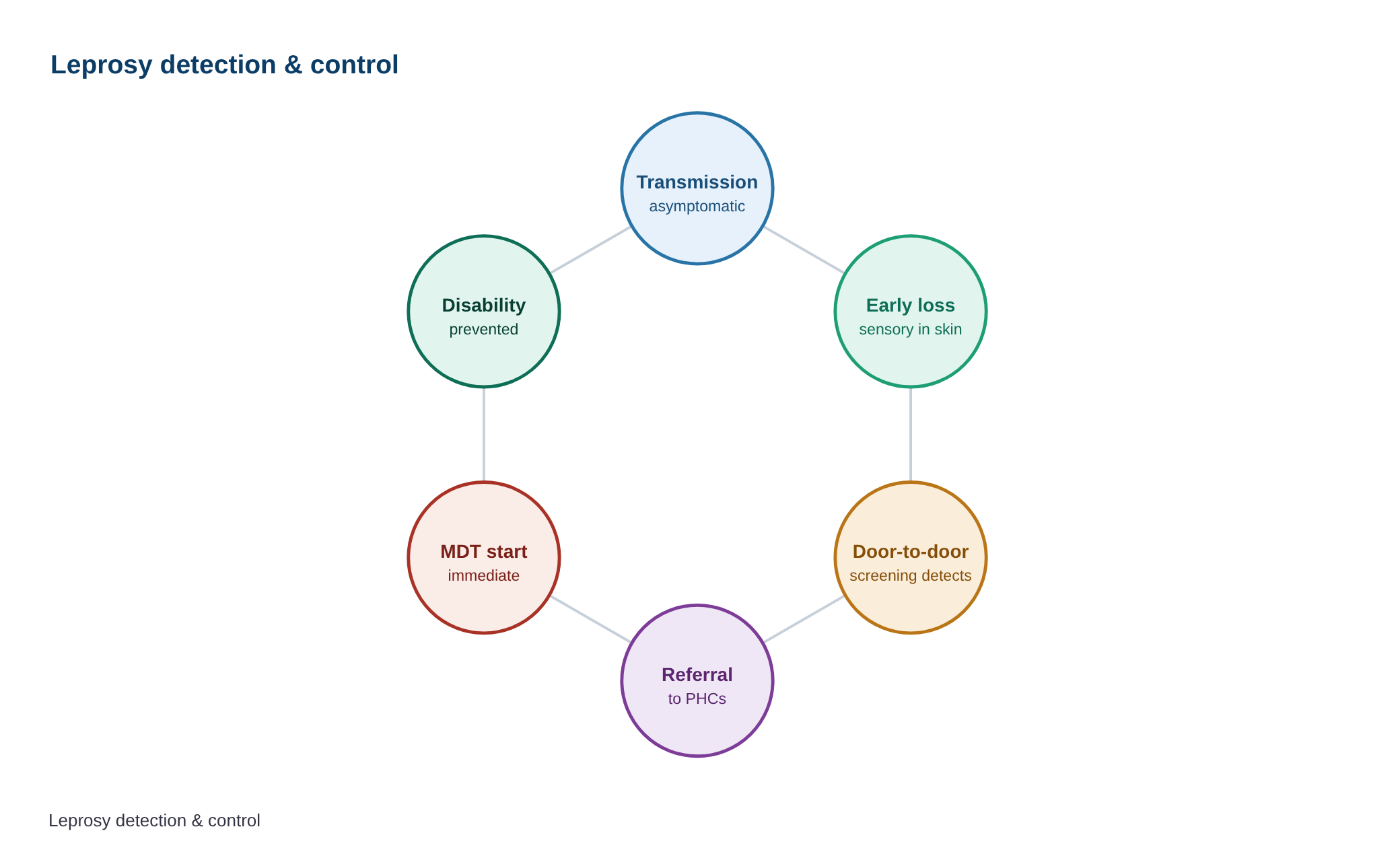
Leprosy transmission → Asymptomatic incubation → Early sensory loss in skin patches → Door-to-door screening detects cases → Referral to PHCs for confirmation → Immediate MDT initiation → Prevention of disability and transmission → Reduction in disease burden.
Prelims Practice Questions
Q1. Consider the following statements regarding leprosy in India:
1. Leprosy is classified as a vector-borne disease under the National Vector Borne Disease Control Programme.
2. The National Leprosy Eradication Programme (NLEP) aims to achieve zero new leprosy cases among children by 2027.
3. Multidrug therapy (MDT) is the standard treatment regimen for leprosy as recommended by the World Health Organization.
How many of the above statements are correct?
- Only one
- Only two
- All three
- None
Answer: All three — Statement 1 is incorrect: Leprosy is not classified as a vector-borne disease; it is caused by Mycobacterium leprae, a bacterium. Statement 2 is correct: NLEP targets zero new child cases by 2027. Statement 3 is correct: MDT is the WHO-recommended treatment for leprosy.
Q2. Assertion (A): The National Leprosy Eradication Programme (NLEP) in India provides free multidrug therapy (MDT) to all diagnosed leprosy patients.
Reason (R): Leprosy is a notifiable disease under the Epidemic Diseases Act, 1897, mandating free treatment.
Options:
A) Both A and R are true, and R is the correct explanation of A.
B) Both A and R are true, but R is NOT the correct explanation of A.
C) A is true, but R is false.
D) A is false, but R is true.
Answer: ? — Assertion (A) is true: NLEP provides free MDT. Reason (R) is false: Leprosy is not notifiable under the Epidemic Diseases Act, 1897; it is covered under the National Leprosy Eradication Programme guidelines.
Q3. Match the following initiatives with their respective objectives:
Column I (Initiative) | Column II (Objective)
— | —
1. National Leprosy Eradication Programme (NLEP) | A. Early detection and treatment of leprosy to prevent disability
2. National Health Mission (NHM) | B. Comprehensive primary healthcare delivery through community health workers
3. ASHA workers | C. Implementation of government health schemes at the grassroots level
4. Sustainable Development Goal 3 | D. Ensuring healthy lives and promoting well-being for all at all ages
Options:
A) 1-A, 2-B, 3-C, 4-D
B) 1-B, 2-A, 3-D, 4-C
C) 1-C, 2-D, 3-A, 4-B
D) 1-D, 2-C, 3-B, 4-A
Answer: ? — Correct match: 1-A (NLEP focuses on leprosy eradication), 2-B (NHM aims at comprehensive primary healthcare), 3-C (ASHA workers implement health schemes at grassroots), 4-D (SDG 3 targets healthy lives and well-being).
Mains Practice Question
✍ The adoption of door-to-door leprosy detection surveys represents a shift towards proactive public health surveillance in India. Critically examine the significance of such community-based screening initiatives in achieving the goals of the National Leprosy Eradication Programme (NLEP). Also, discuss the challenges in scaling up such initiatives across diverse geographical and socio-economic contexts in India. (15 Marks)
Approach: MODEL-ANSWER SKELETON:
1. **Introduction (2 marks)**
– Define leprosy as a chronic infectious disease caused by Mycobacterium leprae and its public health significance in India.
– Mention NLEP’s objectives: reduction in disease burden, prevention of disability, and elimination of stigma.
– Contextualise the door-to-door survey as part of NLEP’s strategy to achieve SDG 3.3 (end communicable diseases) and Universal Health Coverage.
2. **Significance of Community-Based Screening (5 marks)**
– Early detection and treatment: Prevents permanent disability (e.g., loss of sensation, deformities) and reduces transmission.
– Reduces stigma and social exclusion: Early diagnosis counters misconceptions and promotes social reintegration.
– Leverages existing health infrastructure: Utilises ASHA workers and PHCs, aligning with NHM’s community-based approach.
– Data-driven decision-making: Enables real-time surveillance and targeted interventions in high-burden districts.
– WHO’s Global Leprosy Strategy (2021–2030): Emphasises active case-finding and integrated health services.
3. **Challenges in Scaling Up (5 marks)**
– Geographical diversity: Remote and tribal areas face logistical barriers (e.g., difficult terrain, lack of transport).
– Socio-economic barriers: Stigma, low awareness, and migration patterns hinder participation.
– Resource constraints: Requires trained personnel, diagnostic kits, and uninterrupted supply of MDT.
– Coordination challenges: Multi-stakeholder collaboration (state, district, NGOs) is essential but often fragmented.
– Ethical concerns: Ensuring informed consent and confidentiality in sensitive health conditions.
4. **Way Forward (3 marks)**
– Strengthening primary healthcare: Integrate leprosy screening with Ayushman Bharat and NHM.
– Digital tools: Use of mobile health (mHealth) applications for real-time reporting and tracking.
– Community engagement: Involve local leaders, self-help groups, and NGOs to build trust.
– Periodic training: Capacity-building for ASHA workers and PHC staff on leprosy diagnosis and referral.
– Monitoring and evaluation: Regular audits to assess coverage and outcomes.
Source: The Hindu
Generated by AanyaAi for educational purpose.
Related guides on our sites
- Current affairs for upsc 2026
- Best PSIR optional coaching for upsc
- Best economics optional coaching for upsc
- Best PSIR optional teacher for upsc

- केरल उच्च न्यायालय ने 2016 पुट्टिंगल आतिशबाजी दुर्घटना मामले की सुनवाई पर रोक लगाई - September 8, 2026
- Kerala HC Stays Puttingal Fireworks Case Trial: Key UPSC Polity Insights - September 8, 2026
- 11 सितंबर से शुरू होगा पूरे ज़िले में कुष्ठ रोग का घर-घर सर्वेक्षण - September 8, 2026

No Comments