


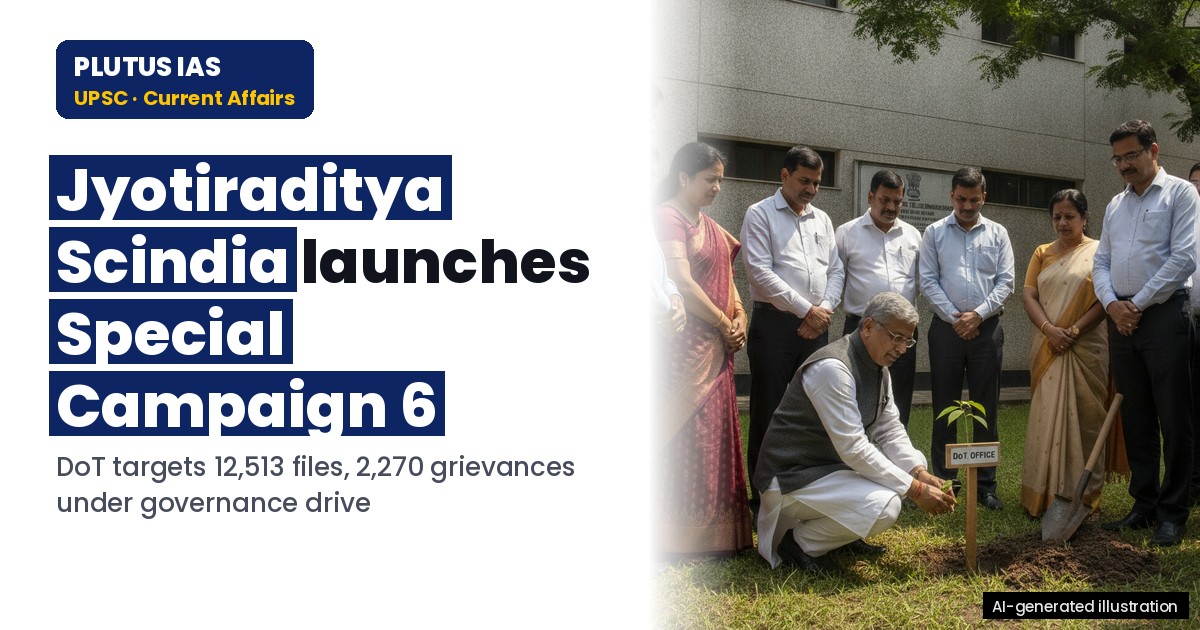
02 Oct DoT Launches Special Campaign 6: Key Goals for UPSC & State PCS
✎ Special Campaign 6 is a time-bound government initiative to dispose of pending matters, including public grievances and administrative backlogs, while promoting cleanliness and efficiency in government offices.
Subject Relevance — Where This Topic Fits
- GS Paper II — Government Policies and Interventions for Development | GS Paper III — Science and Technology (E-governance and Digital Initiatives)
- Prelims: Special Campaign 6, Department of Telecommunications (DoT), Lok Shikayat (Public Grievance), Parliamentary Assurances, E-waste Management, Digital India, Swachhata Hi Seva 2026
- Essay: Governance and Public Service Delivery: The Role of Special Campaigns in Transforming Bureaucracy
Quick Revision: Special Campaign 6 is a time-bound government initiative to dispose of pending matters, including public grievances and administrative backlogs, while promoting cleanliness and efficiency in government offices.
Why is this in the news?
The Department of Telecommunications (DoT) has initiated the implementation phase of Special Campaign 6 on 2 October 2026, following the conclusion of the ‘Swachhata Hi Seva – 2026’ campaign. This initiative aims to address pending public grievances, parliamentary assurances, and other administrative backlogs while promoting a clean and efficient workplace through the disposal of physical files, scrap, and e-waste across its field offices and PSUs. The campaign underscores the government’s commitment to governance reform and citizen-centric service delivery.
Background
- Special Campaign 6 is part of a broader government initiative to expedite the disposal of pending matters in government departments through focused, time-bound campaigns.
- The Department of Telecommunications (DoT) is a key regulator and service provider in India’s telecom sector, overseeing policies, licensing, and public grievance redressal.
- The campaign aligns with the broader ‘Swachhata Hi Seva’ initiative, which emphasizes cleanliness, waste management, and administrative efficiency.
- Pending public grievances, parliamentary assurances, and VIP references are common challenges in government functioning, often leading to delays in service delivery.
- The DoT has identified over 450 campaign sites across its institutions, field offices, and PSUs to streamline operations and improve governance outcomes.
- E-waste and physical file disposal are critical components of the campaign, reflecting India’s push for digital transformation and sustainable governance.
What is Special Campaign 6?
- Special Campaign 6 is a government-wide initiative launched to expedite the disposal of pending matters, including public grievances, parliamentary assurances, and administrative backlogs.
- The campaign is structured into two phases: identification (completed by 30 September 2026) and implementation (02 October 2026 to 31 October 2026).
- The Department of Telecommunications (DoT) is actively participating by setting specific targets for resolving pending cases, such as 55 VIP references, 2,270 public grievances, and 640 grievance appeals.
- The DoT aims to review and dispose of 12,513 physical files and clear identified scrap and e-waste to promote a clean and efficient workplace.
- The campaign emphasizes the disposal of physical files, scrap, and e-waste to enhance administrative efficiency, revenue generation, and employee productivity.
- Special Campaign 6 is part of a broader governance reform agenda, aligning with initiatives like ‘Digital India’ and ‘Swachhata Hi Seva’ to improve public service delivery.
- The campaign involves field offices, PSUs, and autonomous bodies under the DoT, ensuring a decentralized yet coordinated approach to governance reform.
- The DoT has committed to measurable outcomes, with a focus on transparency, accountability, and citizen-centric service delivery.
Key Features
| Feature | Significance |
|---|---|
| Implementation Phase of Special Campaign 6 (02.10.2026–31.10.2026) | Demonstrates institutional commitment to time-bound disposal of pending public grievances and administrative backlog under a centrally mandated governance initiative. |
| Disposal Targets for Pending Cases | Quantifies specific objectives (e.g., 2,270 public grievances, 640 appeals) to ensure measurable accountability and transparency in administrative processes. |
| Physical File Review and E-Waste Management | Aims to clear 12,513 physical files and dispose of scrap/e-waste across 450+ identified nodal sites, aligning with environmental sustainability and office space optimization. |
| Multi-Stakeholder Coordination (PSUs, Field Offices) | Engages all attached entities of the Department of Telecommunications (DoT) to ensure uniform implementation and shared ownership of outcomes. |
Why it Matters
Governance and Public Administration
- Institutionalises a structured, time-bound mechanism for reducing pendency in public grievance redressal and inter-governmental references, thereby enhancing citizen-centric service delivery.
- Strengthens the principles of ‘Minimum Government, Maximum Governance’ by promoting efficiency, transparency, and accountability in administrative functioning.
- Provides a replicable model for other ministries and departments to emulate, particularly in sectors with high citizen interface (e.g., telecom, postal services).
Environmental Sustainability
- Integrates waste management (physical and e-waste) into routine administrative processes, contributing to the broader national agenda of ‘Swachh Bharat’ and circular economy principles.
- Encourages systematic inventory and disposal of obsolete assets, reducing environmental hazards and promoting resource efficiency in government operations.
Operational Efficiency
- Optimises office space utilisation by clearing redundant physical files and streamlining record-keeping, thereby reducing operational costs and improving workflow.
- Enhances employee productivity by creating clutter-free, secure, and ergonomically sound work environments, indirectly supporting mental well-being and focus.
Challenges
1. Resource Constraints in Field Offices
- Limited manpower and infrastructure in remote or understaffed field offices may hinder the timely disposal of pending cases and waste management activities.
- Dependence on manual processes in some offices could slow down digitisation and e-waste processing, despite centralised targets.
UPSC Link: GS-II: Governance, e-Governance
2. Data Integrity and Legacy Systems
- Incomplete or outdated records in physical files may pose challenges in accurate assessment and disposal, requiring additional verification efforts.
- Interoperability issues between legacy systems and modern digital platforms could delay the transition to paperless workflows.
UPSC Link: GS-II: Technology in Governance
3. Stakeholder Coordination Across Geographies
- Ensuring uniform implementation across 450+ diverse locations (including PSUs and autonomous bodies) demands robust monitoring and real-time feedback mechanisms.
- Differences in administrative cultures and priorities across regions may lead to uneven progress, necessitating strong central oversight.
UPSC Link: GS-II: Federalism and Centre-State Relations
4. Public Expectations vs. Administrative Realities
- Citizens may expect immediate resolution of grievances, while administrative processes require structured assessment, potentially leading to perception gaps.
- Balancing speed with due diligence in disposal of cases (especially VIP references) could test the integrity of the campaign’s objectives.
UPSC Link: GS-II: Citizen Charter and Grievance Redressal
Challenges — UPSC Perspective
| Issue | Concern |
|---|---|
| Legacy Data Quality | Inaccuracies in historical records may impede efficient disposal and verification of pending cases. |
| Manpower Shortages in PSUs | Understaffed units may struggle to meet disposal targets within the tight timeframe. |
| Regional Disparities in Implementation | Variations in administrative capacity across states could lead to uneven outcomes. |
| E-Waste Disposal Regulations | Strict compliance with e-waste management rules may require specialised infrastructure, delaying execution. |
| Monitoring and Reporting Gaps | Real-time tracking of progress across decentralised units is critical but challenging to maintain. |
Way Forward
- Establish a centralised digital dashboard for real-time tracking of disposal targets across all 450+ nodal sites to ensure transparency and accountability.
- Conduct pre-campaign training sessions for field staff on digital record-keeping, waste segregation, and disposal protocols to bridge knowledge gaps.
- Institute a ‘Zero Pendency’ review mechanism post-campaign to sustain momentum and institutionalise best practices in grievance redressal.
- Collaborate with state governments to align local administrative processes with campaign objectives, ensuring seamless coordination.
- Publish a consolidated report on lessons learned and key takeaways to inform future editions of Special Campaigns across ministries.
- Integrate AI-driven tools for predictive analysis of grievance trends to pre-emptively address recurring issues in telecom-related public complaints.
- Strengthen inter-ministerial coordination to address systemic bottlenecks (e.g., VIP references) that transcend departmental jurisdictions.
UPSC Value Addition
Keywords for Mains Answer-Writing
Special Campaign 6 · Department of Telecommunications · public grievance redressal · e-waste management · office cleanliness drive · Swachhata Hi Seva 2026 · digital governance · public sector undertakings · administrative reforms · bureaucratic efficiency · MP references · parliamentary assurances · VIP references · grievance redressal mechanism · waste reduction · office space optimization
Constitutional & Policy Linkages
- Article 77: Rules of Business of the Government of India (ensures structured administrative processes for grievance disposal).
- Article 300: Suits by or against the Government (governs legal accountability in public grievance redressal).
Concept Flow
Citizen lodges a grievance → Grievance remains pending due to systemic delays → Department identifies backlog under Special Campaign 6 → Targets set for disposal (e.g., 2,270 public grievances) → Field offices review and dispose cases → Physical files cleared (12,513) and e-waste managed → Improved service delivery and environmental sustainability.
Prelims Practice Questions
Q1. Consider the following statements regarding ‘Special Campaign 6’ launched by the Department of Telecommunications (DoT):
1. The campaign aims to dispose of 12,513 physical files and resolve 2,270 pending public grievances.
2. The implementation phase of the campaign is scheduled from 02 October 2026 to 31 October 2026.
3. The campaign includes the identification and disposal of e-waste and scrap materials across DoT offices and PSUs.
4. The campaign is solely focused on the disposal of physical files and does not address digital or e-governance issues.
How many of the above statements are correct?
- Only one
- Only two
- Only three
- All four
Answer: Only three — Statements 1, 2, and 3 are correct as per the PIB release. Statement 4 is incorrect because the campaign also promotes a clean and healthy workplace, which includes digital governance aspects.
Q2. Which of the following is NOT a target of the Department of Telecommunications under ‘Special Campaign 6’?
A. Disposal of 12,513 physical files
B. Resolution of 55 VIP references
C. Resolution of 640 public grievance appeals
D. Implementation of a new telecom policy
- A
- B
- C
- D
Answer: D — The DoT’s targets under Special Campaign 6 include disposal of physical files, resolution of VIP references, and public grievance appeals. Implementing a new telecom policy is not mentioned as a target.
Q3. Assertion (A): The ‘Special Campaign 6’ by the Department of Telecommunications is primarily aimed at reducing the carbon footprint of its offices.
Reason (R): The campaign includes the identification and disposal of e-waste and scrap materials across DoT offices and PSUs.
In the context of the above two statements, which one of the following is correct?
- Both A and R are true, and R is the correct explanation of A
- Both A and R are true, but R is not the correct explanation of A
- A is true, but R is false
- A is false, but R is true
Answer: Both A and R are true, but R is not the correct explanation of A — Both the Assertion and Reason are true. The campaign’s focus on e-waste and scrap disposal is a key strategy to reduce the carbon footprint, making R the correct explanation of A.
Mains Practice Question
✍ The Department of Telecommunications (DoT) has initiated the implementation phase of ‘Special Campaign 6’ with a focus on administrative reforms, public grievance redressal, and workplace cleanliness. Critically examine the significance of such campaigns in enhancing bureaucratic efficiency and citizen-centric governance in India. (15 Marks)
Approach: MODEL-ANSWER SKELETON:
1. **Introduction (2 marks)**
– Define ‘Special Campaign 6’ as a governance initiative under the broader ‘Swachhata Hi Seva 2026’ campaign.
– State its objectives: disposal of physical files, resolution of grievances (MP references, VIP references, public grievances, appeals), and workplace cleanliness including e-waste management.
2. **Bureaucratic Efficiency (4 marks)**
– **Reduction of Pendency**: Explain how the campaign targets disposal of 12,513 physical files and resolution of 2,965 grievances (55 VIP + 2,270 public grievances + 640 appeals), reducing administrative backlog.
– **Process Optimization**: Highlight the identification of 450+ campaign sites across DoT offices, PSUs, and field offices to streamline operations.
– **Resource Utilization**: Discuss how clean and organized workplaces improve employee productivity and focus.
3. **Citizen-Centric Governance (4 marks)**
– **Grievance Redressal Mechanism**: Explain the role of the campaign in addressing long-pending public grievances, ensuring timely resolution, and enhancing trust in government institutions.
– **Transparency and Accountability**: Discuss how such campaigns promote transparency by reducing file backlogs and improving access to information.
– **Digital Governance**: Briefly mention the campaign’s indirect contribution to digital governance by promoting a clutter-free and efficient administrative environment.
4. **Challenges and Limitations (3 marks)**
– **Scale and Sustainability**: Critically examine whether such campaigns are sustainable in the long term or merely symbolic.
– **Implementation Gaps**: Discuss potential challenges in ensuring uniform implementation across diverse field offices and PSUs.
– **Citizen Awareness**: Highlight the need for public awareness to ensure that grievances are filed and tracked effectively.
5. **Conclusion (2 marks)**
– Summarize the campaign’s role in improving bureaucratic efficiency and citizen-centric governance.
– State that while such campaigns are commendable, their long-term impact depends on institutionalizing reforms beyond campaign periods.
**Key Terms to Include**: Public Grievance Redressal Mechanism (PGRM), e-waste management, administrative reforms, citizen-centric governance, bureaucratic efficiency.
Source: PIB (Press Information Bureau)
Generated by AanyaAi for educational purpose.
Related guides on our sites
- Best PSIR optional coaching for upsc
- Best PSIR optional teacher for upsc
- Best teacher of PSIR optional for upsc
- Best PSIR optional coaching in delhi for UPSC

- Gujarat UCC Bill: Key Features for UPSC & State PCS Exam - October 3, 2026
- इंदिरा गांधी प्राणी उद्यान में वन्यजीव सप्ताह का शुभारंभ, जानिए मुख्य गतिविधियां - October 3, 2026
- Sharam Samvad: Govt’s PR Campaign for Labour Codes in Delhi-NCR & Uttarakhand - October 2, 2026

No Comments