


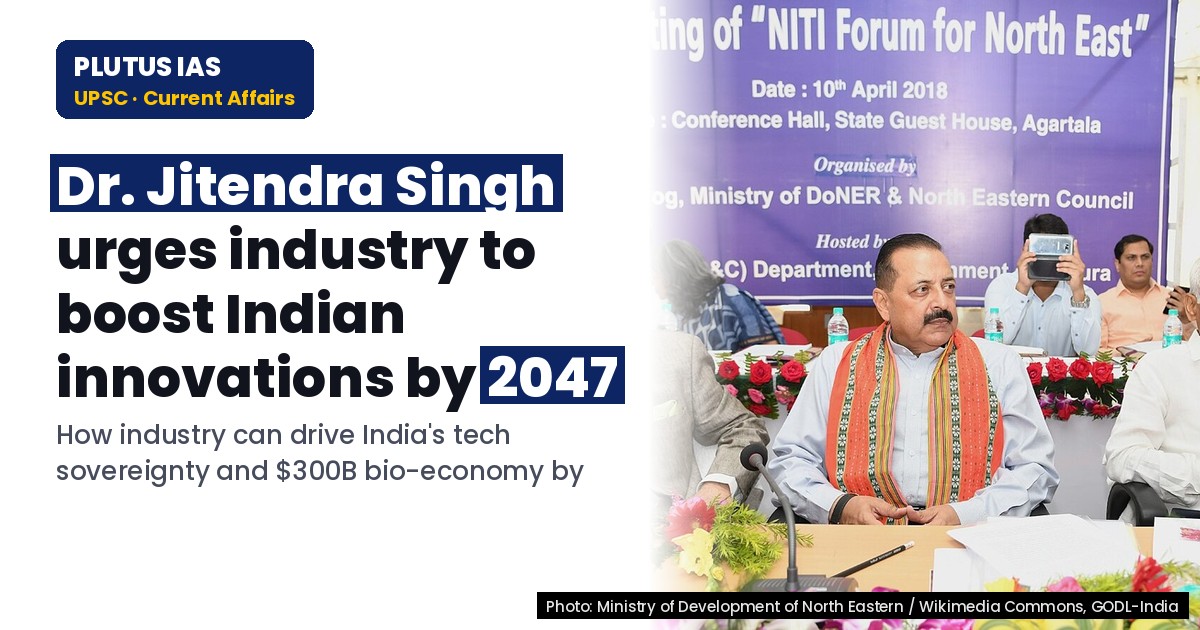
10 Oct Dr. Jitendra Singh Urges Industry to Boost Indian Innovations by 2047
✎ Commercialisation of scientific innovations is the linchpin for translating India’s R&D investments into economic growth, strategic autonomy, and global technological leadership by 2047, necessitating robust public-private…
Subject Relevance — Where This Topic Fits
- GS Paper II — International Relations (Science & Technology Diplomacy) | GS Paper III — Science & Technology, Economic Development, Environment
- Prelims: National Quantum Mission, Bioeconomy, Public-Private Partnership (PPP), Atmanirbhar Bharat, Strategic Autonomy, Quantum-Secure Communication, Ph.D. Chamber of Commerce and Industry (PHDCCI)
- Essay: Technological Self-Reliance and Global Competitiveness in the 21st Century, The Role of Public-Private Partnerships in National Development
Quick Revision: Commercialisation of scientific innovations is the linchpin for translating India’s R&D investments into economic growth, strategic autonomy, and global technological leadership by 2047, necessitating robust public-private partnerships, policy coherence, and institutional synergies.
Why is this in the news?
The Union Minister of State (Independent Charge) for Science & Technology and Earth Sciences, Dr. Jitendra Singh, addressed the 121st Annual Session of the PHD Chamber of Commerce and Industry (PHDCCI) on 10 October 2026, urging industry leaders to accelerate the commercialisation of Indian innovations, expand domestic technological capabilities, and strengthen strategic autonomy by 2047. The address highlighted progress under initiatives such as the National Quantum Mission and the expansion of the bioeconomy, while emphasising the need for collaborative frameworks between government, industry, academia, and research institutions to translate scientific research into commercially viable and globally competitive solutions.
Background
- India’s scientific and technological ecosystem has undergone significant transformation since 2014, marked by policy reforms in sectors such as space, defence, and biotechnology, enabling greater private sector participation.
- The National Quantum Mission (NQM), launched in 2023, aims to seed, nurture, and scale quantum technologies to achieve quantum advantage for India, with a target of 2,000 km quantum-secure communication within eight years.
- The bioeconomy, valued at approximately USD 10 billion in 2014, has grown to around USD 196 billion.
- The expansion of the space sector ecosystem after policy reforms has led to increasing private sector participation in strategic technology areas.
- Public-Private Partnerships (PPPs) have been institutionalised through mechanisms such as the Technology Development Board (TDB), Biotechnology Industry Research Assistance Council (BIRAC), and the Atal Innovation Mission (AIM).
- The Atmanirbhar Bharat initiative underscores the strategic imperative of reducing import dependence in critical technologies while fostering indigenous innovation ecosystems.
What is the Commercialisation of Scientific Innovations and Why Does It Matter?
- Commercialisation refers to the process of converting scientific research, prototypes, or intellectual property into market-ready products, services, or technologies that generate economic value and address societal needs.
- It bridges the ‘valley of death’ between laboratory research and scalable commercial deployment, ensuring that taxpayer-funded R&D yields tangible public and private benefits.
- For India, commercialisation is pivotal to achieving strategic autonomy by 2047, reducing reliance on foreign technologies in critical sectors such as defence, healthcare, energy, and quantum computing.
- The process requires a multi-stakeholder ecosystem involving government (policy and funding), industry (market access and capital), academia (research and talent), and startups (agility and innovation).
- Key enablers include intellectual property rights (IPR) frameworks, venture capital, incubation centres, regulatory sandboxes, and industry-academia collaboration models like joint labs and technology transfer offices.
- Commercialisation enhances global competitiveness by positioning India as a hub for high-tech manufacturing, R&D services, and exports in emerging technologies.
- Challenges include risk aversion in industry, bureaucratic delays, funding gaps in early-stage research, and the need for standardised technology transfer protocols.
- Success stories from India include the development of indigenous vaccines, space launch vehicles, and digital public infrastructure platforms like UPI and Aadhaar.
Key Features
| Feature | Significance |
|---|---|
| Strategic Sovereignty by 2047 | Signifies a long-term national objective to reduce external dependencies in critical technologies, ensuring self-reliance in strategic sectors such as quantum communication and biotechnology. |
| Quantum-Secure Communication Milestone | Achievement of 1,000 km quantum-secure communication in three years under the National Quantum Mission, demonstrating rapid indigenous capability development in cutting-edge technologies. |
| Biotech Sector Growth | Expansion of India’s bio-economy from USD 10 billion in 2014 to USD 196 billion, with a target of USD 300 billion by 2030, highlighting sectoral transformation and economic potential. |
| Public-Private-Partnership (PPP) in R&D | Emphasis on collaborative models between government, industry, academia, and startups to translate scientific research into commercially viable solutions and global competitive technologies. |
| Policy Reforms in Space & Technology Sectors | Demonstrates how regulatory and policy changes (e.g., space sector liberalization) can catalyze private sector participation and innovation in high-technology domains. |
Why it Matters
Economic Growth and Employment
- Acceleration of innovation commercialization can create high-value jobs in emerging sectors like quantum technologies and biotechnology.
- Expansion of the bio-economy and quantum sector aligns with India’s goal of becoming a USD 5 trillion economy by leveraging high-tech industries.
- Strengthening domestic capabilities reduces import dependence, conserving foreign exchange and improving trade balance in strategic sectors.
Strategic Autonomy and National Security
- Development of indigenous quantum-secure communication infrastructure enhances cybersecurity and reduces vulnerability to external disruptions.
- Reduction of reliance on foreign technologies in critical sectors (e.g., biotech, quantum) ensures resilience against geopolitical pressures or supply chain disruptions.
- Long-term vision of 2047 underscores the need for sustained investment in R&D to achieve self-sufficiency in defense, space, and emerging technologies.
Innovation Ecosystem and Startup Culture
- Integration of industry with academia and research institutions fosters a culture of translational research, bridging the gap between lab and market.
- Expansion of biotech and quantum startups demonstrates the potential of India’s startup ecosystem to drive disruptive innovations in global markets.
- Public-private partnerships can de-risk innovation for entrepreneurs while ensuring alignment with national priorities.
Global Competitiveness
- Commercialization of indigenous technologies positions India as a credible player in high-tech industries, competing with global leaders in quantum computing and biopharmaceuticals.
- Achievement of 1,000 km quantum-secure communication demonstrates India’s capability to develop and deploy frontier technologies at scale.
- Targeting USD 300 billion bio-economy aligns with global trends in biotechnology and positions India as a hub for affordable healthcare and agricultural innovations.
Challenges
1. Commercialization of Research Outputs
- Lack of clear pathways from laboratory prototypes to market-ready products due to insufficient industry-academia collaboration.
- Limited venture capital and angel funding for deep-tech startups, particularly in quantum and biotech sectors.
- Regulatory bottlenecks in technology transfer and intellectual property rights (IPR) management can delay commercialization.
UPSC Link: GS3: Science & Tech
2. Skill Gaps in Emerging Technologies
- Shortage of specialized talent in quantum computing, biotechnology, and advanced manufacturing hinders innovation and scaling.
- Need for interdisciplinary training programs to bridge gaps between engineering, science, and business management.
UPSC Link: GS3: Skill Development
3. Policy and Regulatory Hurdles
- Complexity in navigating multiple regulatory frameworks (e.g., for biotech, space, and quantum technologies) can deter private investment.
- Inconsistent implementation of policies across states may create operational challenges for startups and industries.
UPSC Link: GS2: Governance
4. Infrastructure and Funding Constraints
- Inadequate research infrastructure in universities and public labs limits the quality and scale of innovation.
- Limited government funding for high-risk, high-reward R&D projects in emerging technologies.
UPSC Link: GS3: Infrastructure
5. Global Competition and IP Challenges
- Competition from developed nations and China in quantum and biotech sectors poses a challenge to establishing India’s dominance.
- Risk of patent infringement and IP disputes in global markets may hinder the commercialization of indigenous technologies.
UPSC Link: GS3: IPR
Challenges — UPSC Perspective
| Issue | Concern |
|---|---|
| Translational Research Gap | Insufficient mechanisms to convert scientific research into commercially viable products. |
| Funding Ecosystem | Limited access to risk capital for deep-tech startups and high-risk R&D projects. |
| Regulatory Complexity | Multiple approvals and compliance requirements delay innovation and market entry. |
| Talent Shortage | Lack of specialized workforce in emerging technologies like quantum computing and biotech. |
| IPR and Technology Transfer | Challenges in protecting intellectual property and transferring technologies from labs to industries. |
| Infrastructure Deficit | Inadequate research facilities and testing labs in public and private sectors. |
Government Initiatives — Must-Memorise for Prelims
- National Quantum Mission (NQM)
- Atal Innovation Mission (AIM)
Way Forward
- Institutionalize industry-academia collaboration through structured PPP models (e.g., joint R&D labs, co-development programs).
- Expand funding avenues for deep-tech startups via dedicated funds (e.g., National Deep Tech Startup Policy, proposed by DPIIT).
- Strengthen IPR frameworks with faster patent processing and support for startups in IP litigation.
- Develop specialized skill development programs in collaboration with IITs, IISc, and industry partners for quantum and biotech sectors.
- Enhance research infrastructure in public labs and universities through targeted investments (e.g., National Research Foundation).
- Simplify regulatory processes for technology transfer and commercialization (e.g., single-window clearance for biotech and quantum projects).
- Promote global partnerships for technology adoption and joint R&D in strategic sectors (e.g., quantum collaborations with EU, US, or Japan).
- Establish incubation centers focused on high-tech sectors to nurture early-stage innovations and reduce time-to-market.
UPSC Value Addition
Keywords for Mains Answer-Writing
Strategic autonomy · Commercialisation of innovation · Public-Private Partnership in R&D · National Quantum Mission · Bio-economy · Atmanirbhar Bharat in technology · Research, Development and Innovation (RDI) ecosystem · Quantum-secure communication · Technological sovereignty · Startup ecosystem in biotechnology
Concept Flow
Government announces long-term vision for 2047 strategic sovereignty → → Ministry of Science & Technology emphasizes indigenous innovation and PPP in R&D → → National Quantum Mission sets 2,000 km quantum-secure communication target → → Achievement of 1,000 km milestone demonstrates rapid capability development → → Bio-economy growth from USD 10B (2014) to USD 196B (2026) highlights sectoral transformation → → Industry-academia collaboration accelerates commercialization of research → → Strengthened domestic capabilities reduce import dependence and enhance global competitiveness → → Sustainable innovation ecosystem drives economic growth and employment creation.
Prelims Practice Questions
Q1. Consider the following statements regarding the National Quantum Mission (NQM):
1. The NQM aims to develop quantum-secure communication over a distance of 2,000 kilometres within eight years.
2. India has already achieved a milestone of 1,000 kilometres in quantum-secure communication within three years of the mission’s launch.
3. The mission is solely focused on developing quantum computing hardware.
How many of the above statements are correct?
- Only one
- Only two
- All
- None
Answer: Only two — Statements 1 and 2 are correct as per the mission’s objectives and progress. Statement 3 is incorrect because the NQM encompasses quantum communication, computing, and sensing, not hardware alone.
Q2. Which of the following best describes the term ‘Bio-economy’ as discussed in the context of India’s economic goals?
- A. The economy driven exclusively by agricultural exports
- B. An economy where the primary value is derived from biological resources and their sustainable utilisation
- C. The economy focused on the production of pharmaceuticals only
- D. The economy dependent solely on foreign biotechnology imports
Answer: B. An economy where the primary value is derived from biological resources and their sustainable utilisation — Bio-economy refers to an economy where biological resources and their sustainable use contribute significantly to economic output and innovation, encompassing sectors like agriculture, healthcare, and biotechnology.
Q3. Assertion (A): The commercialisation of scientific research is essential for achieving strategic autonomy in technology.
Reason (R): Indigenous technological solutions developed through public-private partnerships can reduce dependence on foreign technologies and enhance national security.
(a) Both A and R are true, and R is the correct explanation of A.
(b) Both A and R are true, but R is not the correct explanation of A.
(c) A is true, but R is false.
(d) A is false, but R is true.
- (a)
- (b)
- (c)
- (d)
Answer: (a) — Both A and R are true, and R correctly explains A as commercialisation reduces reliance on foreign technologies, thereby strengthening strategic autonomy.
Mains Practice Question
✍ Critically examine the role of public-private partnerships (PPPs) in advancing India’s technological sovereignty and commercialisation of innovation. In your answer, substantiate with reference to the National Quantum Mission and the Bio-economy sector. (15 Marks)
Approach: MODEL-ANSWER SKELETON:
1. **Introduction (2 Marks)**
– Define technological sovereignty and commercialisation of innovation in the context of India’s 2047 vision.
– Highlight the necessity of PPPs for bridging the gap between research and market deployment.
2. **PPPs in Technological Sovereignty (4 Marks)**
– **National Quantum Mission (NQM):**
– Objective: Develop quantum-secure communication (2,000 km target in 8 years; 1,000 km achieved in 3 years).
– Role of PPPs: Collaboration between ISRO, DRDO, academic institutions (e.g., IITs), and private firms (e.g., Tata Consultancy Services, Infosys) to develop indigenous quantum technologies.
– Strategic importance: Reduces vulnerability to quantum decryption threats and enhances national security.
– **Policy Framework:**
– Space Sector Reforms (2020): Enabled private sector participation in satellite launches, satellite data utilisation, and space-based services.
– National Mission on Interdisciplinary Cyber-Physical Systems (NM-ICPS): Promotes PPPs in emerging technologies like AI, IoT, and quantum computing.
3. **PPPs in Bio-economy (4 Marks)**
– **Growth Trajectory:**
– Bio-economy value: Increased from ~$10 billion (2014) to ~$196 billion (2026); target of $300 billion by 2030.
– Sectors: Biotechnology, pharmaceuticals, agriculture, and industrial biotechnology.
– **PPP Mechanisms:**
– **Biotechnology Industry Research Assistance Council (BIRAC):** Funds startups and SMEs in biotechnology (e.g., Bharat Biotech’s Covaxin development).
– **Public Sector Undertakings (PSUs):** Collaborations with CSIR labs (e.g., CSIR-CCMB) for drug discovery and vaccine development.
– **Startup Ecosystem:** Over 5,000 biotech startups (e.g., ImmunoACT, Mylab Discovery Solutions) leveraging PPPs for scaling innovations.
4. **Challenges and Critiques (3 Marks)**
– **Challenges:**
– Intellectual Property Rights (IPR) disputes between academia and industry.
– Regulatory hurdles in clinical trials and commercialisation of biotech products.
– Skepticism in private sector due to high R&D costs and long gestation periods.
– **Critique:**
– PPPs may lead to elite capture, where large firms dominate, sidelining MSMEs and startups.
– Need for stronger institutional mechanisms (e.g., Technology Development Board) to streamline funding and commercialisation.
5. **Conclusion (2 Marks)**
– PPPs are indispensable for India’s technological sovereignty and commercialisation goals.
– Recommendations:
– Strengthen IPR frameworks to incentivise private investment.
– Expand funding avenues (e.g., National Research Foundation) and mentorship programs for startups.
– Enhance inter-ministerial coordination (e.g., between Ministry of Science & Technology, Ministry of Commerce, and DPIIT).
**Key Data Points to Include:**
– NQM target: 2,000 km quantum-secure communication in 8 years; 1,000 km achieved in 3 years.
– Bio-economy value: $196 billion (2026); target $300 billion by 2030.
– Number of biotech startups: Over 5,000 (2026).
– Policy reforms: Space sector reforms (2020), NM-ICPS, BIRAC initiatives.
Source: PIB (Press Information Bureau)
Generated by AanyaAi for educational purpose.
Related guides on our sites
- Best PSIR optional coaching for upsc
- Best economics optional coaching for upsc
- Best PSIR optional teacher for upsc
- Best teacher of PSIR optional for upsc

- MP CM hands over Swamitva Yojana land records in Harda - October 10, 2026
- ‘मेरा स्वास्थ्य, मेरा गौरव’ अभियान: 1.06 लाख युवाओं ने नशा मुक्ति का लिया संकल्प - October 10, 2026
- Dr. Jitendra Singh Urges Industry to Boost Indian Innovations by 2047 - October 10, 2026

No Comments