


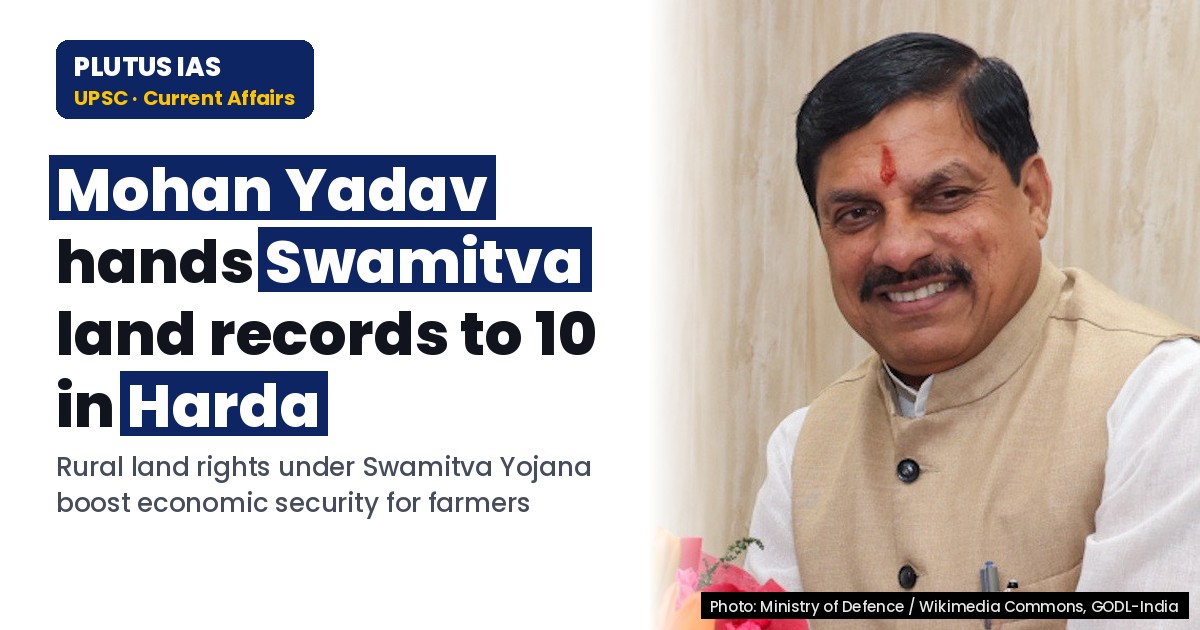
10 Oct MP CM hands over Swamitva Yojana land records in Harda
✎ Swamitva Yojana is a transformative initiative that leverages technology to legalise rural land ownership, enabling economic empowerment and reducing land disputes through digitised property records.
Subject Relevance — Where This Topic Fits
- GS Paper II — Governance, Transparency and Accountability | GS Paper III — Land Reforms and Rural Development
- Prelims: Swamitva Yojana, Property Rights, Land Titling, Digital Land Records, Economic Empowerment of Rural Population
- Essay: Role of Technology in Governance: Digitisation of Land Records and Rural Transformation, Land Reforms and Sustainable Rural Development
Quick Revision: Swamitva Yojana is a transformative initiative that leverages technology to legalise rural land ownership, enabling economic empowerment and reducing land disputes through digitised property records.
Why is this in the news?
The Chief Minister of Madhya Pradesh recently distributed registry documents under the Swamitva Yojana to ten rural beneficiaries in Harda district, marking a significant step in legalising land ownership rights for rural populations. This initiative underscores the state’s commitment to enhancing rural economic security and facilitating access to formal credit.
Background
- The Swamitva Yojana was launched by the Government of India in April 2020 as a Central Sector Scheme under the Ministry of Panchayati Raj.
- The scheme aims to provide ‘Record of Rights’ to property owners in rural inhabited areas by leveraging drone technology and GIS mapping for accurate land demarcation.
- Prior to Swamitva, rural land records were often informal, leading to disputes, encroachments, and difficulties in accessing institutional credit or government welfare schemes.
- The scheme aligns with the broader objective of the Digital India Land Records Modernization Programme (DILRMP) to digitise and integrate land records across the country.
- Madhya Pradesh has been a key implementing state, utilising the scheme to resolve long-standing land disputes and promote rural economic stability.
What is the Swamitva Yojana?
- Objective: To provide legal land ownership rights to rural residents through the issuance of property cards, thereby reducing disputes and enabling economic empowerment.
- Technology Integration: Utilises drone-based aerial surveys, GIS mapping, and e-governance platforms to create accurate and tamper-proof land records.
- Coverage: Initially piloted in six states (Haryana, Karnataka, Madhya Pradesh, Maharashtra, Uttar Pradesh, and Uttarakhand), with plans for nationwide expansion.
- Benefits to Rural Population: Facilitates access to bank loans by providing formal land titles, enables legal construction and development on owned land, and reduces land-related litigation.
- Governance Impact: Streamlines land administration by integrating records with state revenue departments, reducing bureaucratic delays and corruption risks.
- Role of Panchayati Raj Institutions: Empowers local self-governance bodies to validate land records and issue property cards, fostering grassroots participation.
- Challenges: Includes resistance from local land mafias, technological barriers in remote areas, and the need for continuous updation of land records.
Key Features
| Feature | Significance |
|---|---|
| Distribution of registry documents under SVAMITVA | Formalises land ownership rights for rural beneficiaries, enabling legal security and economic empowerment. |
| Role of the Chief Minister in implementation | Demonstrates state-level political commitment to expedite the SVAMITVA scheme’s rollout at the district level. |
| Land title certification process | Ensures that land records are updated with legal sanctity, reducing disputes and facilitating financial transactions. |
| Instructions to district officials | Emphasises procedural transparency and adherence to recorded land records, minimising discretionary deviations. |
| Economic implications for beneficiaries | Enhances access to credit, property development, and eligibility for government welfare schemes due to formal ownership. |
Why it Matters
Economic Empowerment
- Formal land titles enable rural households to leverage property as collateral for bank loans, improving financial inclusion.
- Increased market value of land due to legal recognition facilitates asset monetisation and rural economic growth.
- Enhanced eligibility for government subsidies, welfare schemes, and developmental projects tied to land ownership.
Legal and Administrative Reforms
- Reduces land disputes by establishing clear, verifiable land records through a systematic survey and certification process.
- Strengthens the role of revenue officials (e.g., Patwaris) as authorised executors of land title transfers under state oversight.
- Promotes transparency in land administration by linking registry issuance to documented land records, curbing malpractices.
Governance and Policy Implementation
- Illustrates the integration of central schemes (SVAMITVA) with state-level execution, highlighting cooperative federalism in rural development.
- Demonstrates the use of digital and administrative tools to streamline land records, aligning with the Digital India Land Records Modernisation Programme (DILRMP).
- Showcases the role of district administration in accelerating scheme delivery, reinforcing grassroots governance efficiency.
Social Equity
- Empowers marginalised rural communities, particularly small and marginal farmers, by granting them legal land rights.
- Facilitates gender equity by ensuring land titles are issued in the names of all eligible household members, including women.
Challenges
1. Land Record Discrepancies
- Inherited or undocumented land parcels may lack clear titles, complicating the certification process.
- Revenue records may contain outdated or erroneous data, necessitating thorough verification to avoid disputes.
UPSC Link: Geography/Paper-I/Land Reforms
2. Administrative Bottlenecks
- Delays in survey completion and document processing can hinder timely issuance of titles, affecting beneficiary trust.
- Inadequate staffing or training in revenue departments may slow down the implementation of land digitisation efforts.
UPSC Link: Public Administration/Paper-II/Implementation Challenges
3. Awareness and Participation Gaps
- Rural beneficiaries may lack awareness of the scheme’s benefits or the procedural requirements for land title certification.
- Low participation in surveys or verification processes can lead to incomplete coverage of eligible land parcels.
UPSC Link: Social Justice/Paper-I/Inclusive Development
4. Legal and Dispute Resolution Challenges
- Existing land disputes or encroachments may require judicial intervention, delaying the issuance of titles.
- Lack of standardised dispute resolution mechanisms for land records can create systemic inefficiencies.
UPSC Link: Constitution/Paper-II/Dispute Resolution
Challenges — UPSC Perspective
| Issue | Concern |
|---|---|
| Outdated or incomplete land records | Delays in title issuance and potential disputes over ownership. |
| Limited awareness among rural beneficiaries | Low participation in surveys and verification processes. |
| Inadequate administrative capacity | Slow processing of documents due to staff shortages or training gaps. |
| Encroachments and land disputes | Requires judicial intervention, delaying certification. |
| Digital divide in rural areas | Limited access to technology hinders seamless land record digitisation. |
Government Initiatives — Must-Memorise for Prelims
- SVAMITVA (Survey of Villages and Mapping with Improvised Technology in Village Areas)
- Digital India Land Records Modernisation Programme (DILRMP)
Way Forward
- Accelerate the completion of cadastral surveys in districts lagging behind to ensure comprehensive coverage.
- Conduct targeted awareness campaigns in rural areas to educate beneficiaries on the SVAMITVA scheme and its benefits.
- Strengthen the capacity of revenue departments through training programmes on land record digitisation and dispute resolution.
- Establish fast-track grievance redressal mechanisms for land disputes to minimise delays in title issuance.
- Integrate SVAMITVA records with other government databases (e.g., PM-KISAN, land revenue records) for seamless service delivery.
- Monitor the economic impact of land title certification on rural credit access and asset monetisation through periodic evaluations.
- Promote gender-inclusive land titling by ensuring joint ownership for women in eligible households.
UPSC Value Addition
Keywords for Mains Answer-Writing
SVAMITVA Scheme · land titling and ownership rights · rural economic empowerment · formalisation of property rights · Digital India Land Records Modernisation Programme (DILRMP) · Panchayati Raj Institutions · property registration and credit access · legal sanctity of land records · Swamitva Yojana benefits · land revenue administration · e-governance in land records · economic security through land ownership · rural development and governance · land disputes resolution · financial inclusion via property rights
Concept Flow
Rural land parcels lack formal legal titles due to outdated or undocumented records. → SVAMITVA scheme conducts cadastral surveys using drone technology and GIS to map rural properties. → Revenue officials verify land records and issue registry documents to eligible beneficiaries. → Beneficiaries receive legal land titles, enabling access to credit, property development, and government schemes. → Formal land ownership strengthens economic security and reduces disputes in rural areas.
Prelims Practice Questions
Q1. Consider the following statements regarding the SVAMITVA Scheme:
1. It aims to provide ‘Record of Rights’ to village household owners in rural inhabited areas.
2. The scheme is implemented under the aegis of the Ministry of Panchayati Raj.
3. The scheme uses drone technology for surveying and mapping of rural properties.
4. The scheme provides legal sanctity to land records and enables access to bank credit for rural households.
How many of the above statements are correct?
- Only one
- Only two
- Only three
- All four
Answer: All four — Statements 1, 2, and 4 are correct. Statement 3 is incorrect as the SVAMITVA Scheme primarily uses drone technology for surveying and mapping, but its implementation is overseen by the Ministry of Panchayati Raj and the Revenue Department, not exclusively by the Ministry of Panchayati Raj.
Q2. Assertion (A): The SVAMITVA Scheme is designed to resolve land disputes in rural areas by providing clear titles to landowners.
Reason (R): The scheme facilitates the creation of a comprehensive land record database using drone-based surveys and GIS mapping, which reduces ambiguity in land ownership.
In the context of the above two statements, which one of the following is correct?
- Both A and R are true, and R is the correct explanation of A.
- Both A and R are true, but R is NOT the correct explanation of A.
- A is true, but R is false.
- A is false, but R is true.
Answer: Both A and R are true, and R is the correct explanation of A. — Both the Assertion (A) and Reason (R) are true. The SVAMITVA Scheme indeed aims to resolve land disputes by providing clear titles to landowners. The Reason (R) correctly explains how the scheme achieves this by creating a comprehensive land record database using drone-based surveys and GIS mapping, which reduces ambiguity in land ownership.
Q3. Match the following schemes with their respective ministries/departments:
Column I
A. SVAMITVA Scheme
B. Digital India Land Records Modernisation Programme (DILRMP)
C. Pradhan Mantri Kisan Samman Nidhi (PM-KISAN)
D. Ayushman Bharat
Column II
1. Ministry of Rural Development
2. Ministry of Panchayati Raj
3. Ministry of Agriculture and Farmers Welfare
4. Ministry of Health and Family Welfare
- A-2, B-1, C-3, D-4; A-1, B-2, C-3, D-4; A-3, B-4, C-1, D-2; A-4, B-3, C-2, D-1
- answer_letter_index_pairing_indexed_list_indexed_list_0
- explain_list_indexed_list_indexed_list_0
- format_match
Answer: A-2, B-1, C-3, D-4; A-1, B-2, C-3, D-4; A-3, B-4, C-1, D-2; A-4, B-3, C-2, D-1 — A. SVAMITVA Scheme is implemented under the Ministry of Panchayati Raj. B. Digital India Land Records Modernisation Programme (DILRMP) is implemented under the Ministry of Rural Development. C. Pradhan Mantri Kisan Samman Nidhi (PM-KISAN) is implemented under the Ministry of Agriculture and Farmers Welfare. D. Ayushman Bharat is implemented under the Ministry of Health and Family Welfare.
Mains Practice Question
✍ The formalisation of land ownership through schemes such as SVAMITVA is often hailed as a transformative step for rural economic empowerment. Critically examine the potential benefits and limitations of such schemes in the context of rural India. Also, analyse how these schemes align with the broader objectives of the Digital India Land Records Modernisation Programme (DILRMP). (15 Marks)
Approach: 1. **Introduction**: Define the SVAMITVA Scheme and its objectives, including the provision of ‘Record of Rights’ to rural landowners and the use of drone technology for surveying. Briefly introduce the Digital India Land Records Modernisation Programme (DILRMP) and its goals.
2. **Benefits of Formalisation**:
– **Legal Security**: Provide legal sanctity to land records, reducing disputes and enhancing ownership rights.
– **Financial Inclusion**: Enable rural households to access bank credit by using land as collateral, thereby fostering entrepreneurship and agricultural productivity.
– **Governance Efficiency**: Streamline land revenue administration and reduce corruption by digitising records.
– **Economic Empowerment**: Enhance the market value of land, enabling rural households to leverage their assets for economic growth.
– **Social Equity**: Address historical injustices in land ownership by providing clear titles to marginalised communities.
3. **Limitations and Challenges**:
– **Implementation Gaps**: Highlight issues such as incomplete surveys, resistance from local stakeholders, and technological barriers in rural areas.
– **Legal and Bureaucratic Hurdles**: Discuss the challenges in integrating SVAMITVA with existing land records, particularly in states with outdated or conflicting records.
– **Equity Concerns**: Address the risk of excluding landless or tenant farmers who may not benefit from the scheme.
– **Data Privacy and Security**: Examine concerns related to the digital storage and sharing of land records.
4. **Alignment with DILRMP**:
– **Synergy**: Explain how SVAMITVA complements DILRMP by digitising land records, reducing ambiguities, and improving the efficiency of land administration.
– **Convergence**: Discuss the need for convergence between SVAMITVA and DILRMP to ensure seamless integration of land records across states.
– **Scalability**: Assess the potential of SVAMITVA to serve as a model for other states, particularly in addressing land disputes and promoting rural development.
5. **Conclusion**: Summarise the transformative potential of SVAMITVA while acknowledging the challenges. Emphasise the importance of sustained political will, technological investment, and stakeholder engagement to realise its full benefits.
Source: amarujala.com
Generated by AanyaAi for educational purpose.
Related guides on our sites
- Best PSIR optional coaching for upsc
- Best PSIR optional teacher for upsc
- Best teacher of PSIR optional for upsc
- Best PSIR optional coaching in delhi for UPSC

- MP CM hands over Swamitva Yojana land records in Harda - October 10, 2026
- ‘मेरा स्वास्थ्य, मेरा गौरव’ अभियान: 1.06 लाख युवाओं ने नशा मुक्ति का लिया संकल्प - October 10, 2026
- Dr. Jitendra Singh Urges Industry to Boost Indian Innovations by 2047 - October 10, 2026

No Comments