


20 Jul DU BTech 2026 Round 3 Seat Allotment: Key Deadlines & Steps for Aspirants
Subject Relevance — Where This Topic Fits
- GS Paper II — Education; Government Policies and Interventions for Development in various sectors and issues arising out of their design and implementation | GS Paper III — Science and Technology — Developments and their applications and effects in everyday life
- Prelims: Delhi University (DU), B.Tech. Admissions, Joint Entrance Examination (JEE), Common Seat Allocation System (CSAS), Faculty of Technology, DU, Seat Allotment Process, Document Verification, Fee Payment Deadline, Upgrade Option
- Essay: The Role of Higher Education in National Development and Skill Enhancement, Technological Education and India’s Demographic Dividend: Challenges and Opportunities
Quick Revision: Delhi University’s B.Tech. admissions are conducted through a multi-stage process involving JEE Main scores, online registration, multiple rounds of seat allotment, document verification, and fee payment, with provisions for upgrades and subsequent counselling rounds.
Why is this in the news?
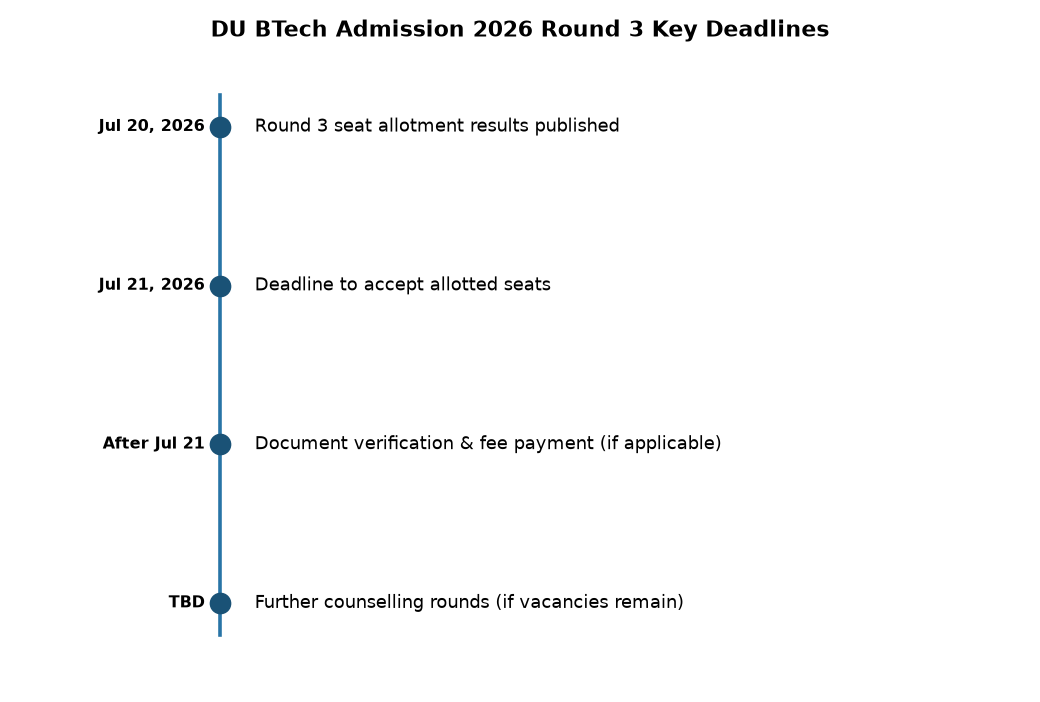
The University of Delhi (DU) has recently released the Round 3 seat allotment results for its Bachelor of Technology (B.Tech.) admissions for the 2026 academic cycle. This announcement initiates a critical phase for prospective students, requiring them to complete seat acceptance, document verification, and fee payment within stipulated deadlines. The university has also indicated the possibility of further counselling rounds to fill any remaining vacancies, underscoring the dynamic nature of the admission process for highly sought-after technical courses.
Background
- Admission to B.Tech. programmes in Delhi University is highly competitive, attracting a large pool of applicants from across India.
- The admission process is primarily based on the scores obtained by candidates in the Joint Entrance Examination (JEE) Main, a national-level engineering entrance examination.
- Delhi University introduced B.Tech. programmes in its Faculty of Technology to expand its offerings in technical education, aligning with national priorities for skill development and technological advancement.
- The Common Seat Allocation System (CSAS) is employed by DU for undergraduate admissions, ensuring a streamlined and transparent process for seat allocation across various courses, including B.Tech.
- Multiple rounds of counselling and seat allotment are conducted to ensure that all available seats are filled efficiently, providing opportunities for candidates to secure admissions based on merit and preference.
- The process includes stages such as online application, merit list generation, seat allocation, document verification, and fee payment, each with specific deadlines to maintain the admission timeline.
Understanding the B.Tech. Admission Process at Delhi University
- The B.Tech. admission process at Delhi University is structured to admit students into its engineering programmes based on their performance in the JEE Main examination.
- Candidates are required to register on the official DU B.Tech. admission portal, providing their JEE Application Number and other relevant details.
- Seat allotment is conducted in multiple rounds, with candidates being allocated seats based on their JEE Main rank, preferences for courses and colleges, and seat availability.
- Upon seat allotment, candidates must ‘accept’ the allotted seat within a specified timeframe, failing which the seat may be forfeited.
- Following seat acceptance, an online document verification process is undertaken by the Faculty of Technology to ensure the authenticity and eligibility of the applicants.
- Successful verification necessitates the payment of the admission fee by the candidate to confirm their enrollment in the B.Tech. programme.
- An ‘upgrade option’ is available for candidates who have already confirmed their admission in earlier rounds and wish to be considered for a higher preferred course or college in subsequent rounds, subject to availability.
- The university reserves the right to conduct additional counselling rounds if vacancies persist after the initial rounds, providing further opportunities for eligible candidates.
Key Features
| Feature | Significance |
|---|---|
| Round 3 Seat Allotment | Marks a critical stage in the admission process for B.Tech programs, indicating progression towards finalising student intake. |
| July 21, 2026, Deadline for Seat Acceptance | Establishes a strict timeline for candidates to confirm their admission, ensuring efficiency in the counselling process and preventing prolonged vacancies. |
| Document Verification and Fee Payment | Essential steps to validate candidate eligibility and secure the allotted seat, ensuring compliance with university regulations. |
| Upgrade Option Availability | Provides flexibility for previously admitted students to improve their program or college choice based on merit and seat availability, enhancing student satisfaction. |
| Provision for Further Counselling Rounds | Indicates a proactive approach by the university to fill all available seats, optimising resource utilisation and expanding access to technical education. |
Why it Matters
Educational Access and Equity
- The structured admission process, including multiple rounds and upgrade options, aims to provide equitable opportunities for a diverse pool of candidates to access higher technical education.
- Ensures transparency and fairness in seat allocation, which is crucial for maintaining public trust in educational institutions.
Human Capital Development
- Admission to B.Tech programs contributes directly to the development of a skilled workforce in engineering and technology, vital for India’s economic growth and innovation.
- Facilitates the pipeline of talent required for various industrial sectors, aligning with national development goals.
Institutional Efficiency and Governance
- The adherence to a strict admission calendar and the provision for subsequent rounds demonstrate effective administrative governance and resource management by the University of Delhi.
- Minimises seat wastage and maximises the utilisation of educational infrastructure, contributing to the overall efficiency of the higher education system.
Challenges
1. Digital Divide and Accessibility
- Candidates from remote areas or those with limited access to reliable internet and digital devices may face difficulties in completing online admission formalities within strict deadlines.
- Ensuring equitable access to information and online services remains a challenge in a diverse country like India.
UPSC Link: Social Justice: Issues relating to development and management of Social Sector/Services relating to Education
2. Administrative Burden and Grievance Redressal
- Managing large-scale online admissions, including document verification and fee payment, can place significant administrative burden on university staff.
- Establishing efficient mechanisms for addressing candidate queries and grievances during the admission process is crucial for maintaining fairness and transparency.
UPSC Link: Governance: Important aspects of governance, transparency and accountability
3. Ensuring Meritocracy and Preventing Malpractices
- The integrity of the admission process must be rigorously maintained to ensure that seats are allocated strictly based on merit, as determined by entrance examinations like JEE.
- Vigilance against fraudulent documents or attempts to manipulate the admission system is essential.
UPSC Link: Ethics, Integrity, and Aptitude: Probity in Governance
4. Infrastructure and Faculty Capacity
- The expansion of technical education programs necessitates adequate infrastructure, including laboratories, classrooms, and faculty.
- Maintaining quality education standards while increasing student intake is a continuous challenge for higher education institutions.
UPSC Link: General Studies Paper 3: Infrastructure: Energy, Ports, Roads, Airports, Railways etc.
Challenges — UPSC Perspective
| Issue | Concern |
|---|---|
| Online Process Reliance | Potential exclusion of candidates lacking digital literacy or internet access, exacerbating the digital divide. |
| Strict Deadlines | Risk of forfeiture for candidates facing technical glitches or unforeseen personal circumstances, despite genuine intent. |
| Document Verification | Challenges in authenticating a large volume of documents efficiently and accurately, prone to errors or delays. |
| Seat Vacancy Management | Balancing the need to fill all seats with the imperative to maintain academic standards and administrative efficiency in subsequent rounds. |
| Upgrade Option Complexity | Ensuring clarity and fairness in the upgrade process, particularly for candidates navigating multiple rounds and choices. |
Way Forward
- Implement robust digital infrastructure and provide technical support to candidates, especially those from underserved regions, to ensure seamless online admission processes.
- Establish clear and accessible grievance redressal mechanisms to promptly address candidate queries and issues during the admission cycle.
- Conduct regular audits of the admission process to ensure transparency, fairness, and adherence to merit-based criteria.
- Invest in faculty development and infrastructure upgrades to accommodate increasing student intake while maintaining high educational quality in B.Tech programs.
- Utilise data analytics to identify bottlenecks and areas for improvement in the admission process, leading to more efficient and student-friendly procedures.
- Collaborate with state governments and NGOs to establish common service centres or help desks in remote areas, facilitating access to online admission services.
- Develop comprehensive FAQs and instructional videos in multiple languages to guide candidates through each stage of the admission process.
UPSC Value Addition
Keywords for Mains Answer-Writing
Higher Education Access · Engineering Education · Admission Processes · Merit-based Admissions · Technological Education · National Education Policy · Digital India Initiatives · Skill Development
Constitutional & Policy Linkages
- {‘article’: ‘Article 21A’, ‘note’: ‘Right to Education implications’}
- {‘article’: ‘Article 46’, ‘note’: ‘Promoting educational interests of weaker sections’}
Concept Flow
JEE Main Examination Performance → Application to DU B.Tech Admission Portal → Centralised Seat Allotment Rounds (e.g., Round 3) → Candidate Seat Acceptance and Document Upload → Online Document Verification by University → Admission Fee Payment and Seat Confirmation → Potential for Further Counselling Rounds (if vacancies remain)
Prelims Practice Questions
Q1. Consider the following statements regarding higher education admissions in India:
1. The Common University Entrance Test (CUET) is mandatory for all undergraduate admissions to central universities.
2. Admission to B.Tech programs in central universities often considers scores from national-level entrance examinations like JEE.
3. The National Education Policy (NEP) 2020 advocates for a flexible and multidisciplinary approach to higher education.
- 1 and 2 only
- 2 and 3 only
- 1 and 3 only
- 1, 2 and 3
Answer: 2 and 3 only — Statement 1 is incorrect; while CUET is widely adopted, some professional courses and institutions may have different admission criteria or specific entrance exams. Statement 2 is correct; JEE (Main) scores are a primary criterion for B.Tech admissions in many central technical institutions. Statement 3 is correct; NEP 2020 emphasizes multidisciplinary education, flexibility, and holistic development.
Q2. Which of the following bodies is primarily responsible for conducting the Joint Entrance Examination (JEE) Main for admission to undergraduate engineering programs in India?
- University Grants Commission (UGC)
- All India Council for Technical Education (AICTE)
- National Testing Agency (NTA)
- Council of Scientific and Industrial Research (CSIR)
Answer: National Testing Agency (NTA) — The National Testing Agency (NTA) is the autonomous organization established by the Ministry of Education to conduct entrance examinations for admission/fellowship in higher educational institutions. It conducts JEE Main, NEET (UG), CUET, and other examinations. UGC is a statutory body for coordination, determination, and maintenance of standards of university education. AICTE is a statutory body for proper planning and coordinated development of the technical education system. CSIR is a premier R&D organization.
Mains Practice Question
✍ Discuss the challenges and opportunities in ensuring equitable access to quality higher education, particularly in technical fields, in India. In light of recent advancements in digital infrastructure, how can technology be leveraged to streamline admission processes and enhance transparency?
Approach: Candidates should begin by outlining the existing challenges in higher education access, such as geographical disparities, socio-economic barriers, and infrastructure deficits, particularly in technical education. Subsequently, they should identify opportunities presented by the National Education Policy 2020 and government initiatives. The second part of the answer should focus on specific technological interventions, including online application systems, digital verification, AI-driven counselling, and secure data management, to improve efficiency, fairness, and transparency in admission procedures. Conclude with a forward-looking perspective on inclusive growth through technological integration.
Source: Times of India
Generated by AanyaAi for educational purpose.

- दिल्ली हाईकोर्ट ने 2030 तक रेबीज़ उन्मूलन के लिए सरकार से जवाब तलब किया - September 9, 2026
- Delhi HC directs govt on rabies elimination plan by 2030: Key UPSC insights - September 9, 2026
- नशा मुक्त भारत अभियान: 10 करोड़ लोगों से राष्ट्रीय प्रतिज्ञा, जानिए कैसे बनें भागीदार - September 9, 2026

No Comments