


22 Jul DU PG Admissions 2026: Revised CSAS Spot Round Schedule Released
Subject Relevance — Where This Topic Fits
- GS Paper II — Governance, Administration and Policies | GS Paper III — Issues Relating to Development and Management of Social Sector/Services relating to Education
- Prelims: Common Seat Allocation System (CSAS), University Grants Commission (UGC) norms on admissions, Delhi University (DU) admissions policy, Spot Round admissions in higher education, Reservation policies in higher education institutions
- Essay: The Role of Regulatory Bodies in Ensuring Transparency in Higher Education Admissions, Equity and Access in India’s Higher Education System: Challenges and Solutions
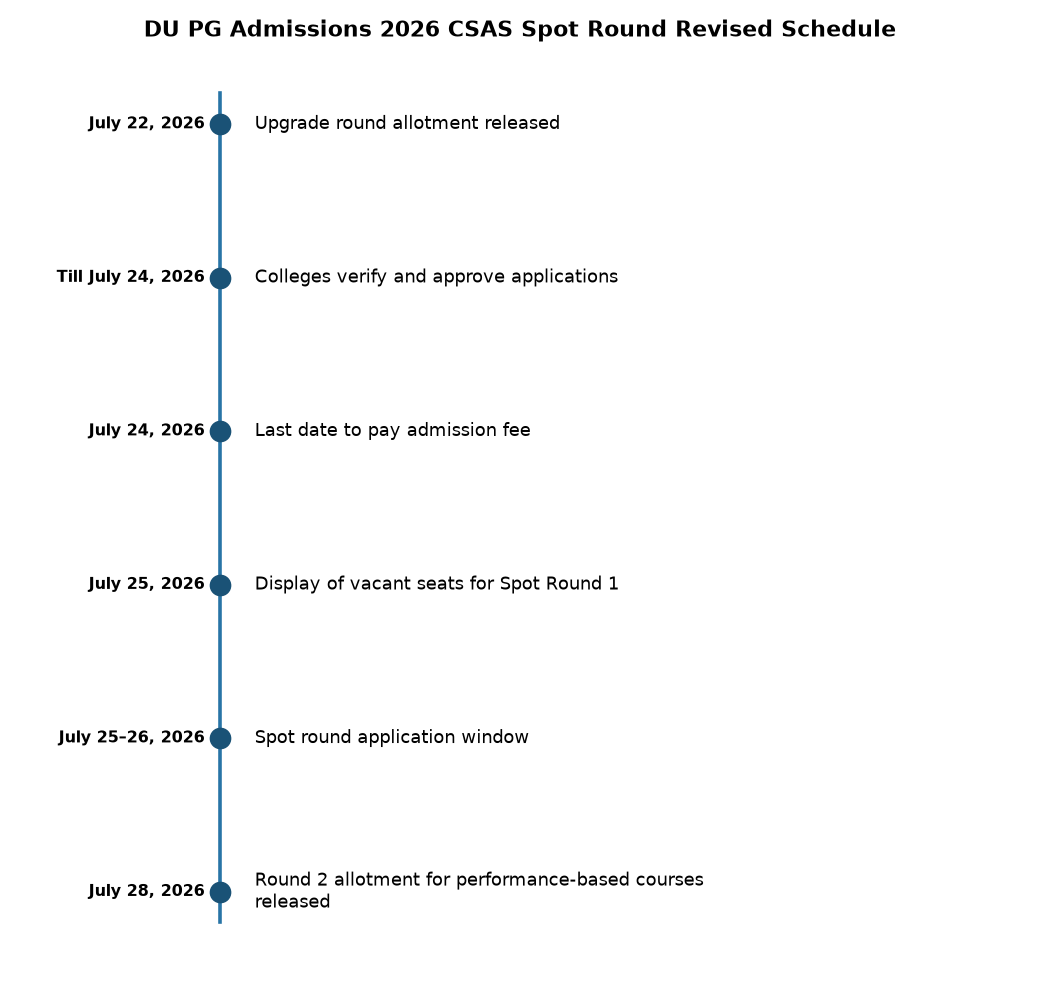
Quick Revision: The DU PG Admission 2026 process under CSAS includes an Upgrade Round (July 22), Spot Round (July 25-26 for application, July 29 for allotment), and performance-based rounds, with strict deadlines for seat acceptance, verification, and fee payment to ensure transparency and optimal seat utilisation.
Why is this in the news?
The University of Delhi (DU) has revised the schedule for Postgraduate (PG) admissions for the academic session 2026-27, introducing a Spot Round to fill vacant seats. This development is significant as it reflects DU’s adaptive response to seat allocation challenges and highlights the operational dynamics of the Common Seat Allocation System (CSAS), which is a critical case study for understanding higher education governance and transparency in India.
Background
- The Common Seat Allocation System (CSAS) was introduced by DU to streamline the admission process for undergraduate and postgraduate programmes, reducing inefficiencies and ensuring merit-based allocation.
- DU, as a premier central university, follows a reservation policy as mandated by the Government of India, including quotas for Scheduled Castes (SC), Scheduled Tribes (ST), Other Backward Classes (OBC), Economically Weaker Sections (EWS), and Persons with Disabilities (PwD).
- The CSAS framework for PG admissions operates in multiple rounds, including an Upgrade Round, Spot Round, and performance-based rounds for specific programmes such as MFA, MA Music, BPEd, and MPEd.
- The revised schedule for DU PG admissions 2026 includes critical deadlines for seat allotment, verification, and fee payment, which are essential for candidates to secure admission.
- The data from DU’s undergraduate CSAS admissions (2026-27) indicates a significant number of candidates opting for the ‘Upgrade’ option, reflecting the competitive nature of admissions and the need for flexibility in seat allocation.
- The introduction of a Spot Round for PG admissions is a response to vacant seats arising from non-acceptance or withdrawal by initially allotted candidates, ensuring optimal utilisation of available seats.
What is the DU PG Admission Process under CSAS?
- The DU PG Admission Process under CSAS is a centralised online system designed to allocate seats to candidates based on merit, reservation categories, and programme preferences.
- The process includes multiple rounds: Upgrade Round (for candidates opting to upgrade their allotted seat), Spot Round (for filling vacant seats), and performance-based rounds for specialised programmes like MFA, MA Music, BPEd, and MPEd.
- Candidates must register on the DU PG Admission Portal (pgadmission.uod.ac.in) and submit their programme and college preferences to participate in the allocation process.
- Seat allocation is conducted in phases, with each round followed by a verification window where colleges validate the documents and eligibility of candidates.
- The Upgrade Round allows candidates who have been allotted a seat to opt for a higher preference if they become eligible through subsequent merit lists, enhancing their chances of securing a preferred programme.
- Candidates allotted seats in any round must complete the admission process, including document verification and fee payment, within the stipulated timelines to secure their seat.
- The CSAS framework is governed by the University Grants Commission (UGC) guidelines and DU’s internal policies, ensuring adherence to transparency, fairness, and meritocracy in admissions.
Key Features
| Feature | Significance |
|---|---|
| CSAS Spot Round | Provides a second opportunity for candidates who did not secure admission in earlier rounds, enhancing inclusivity in higher education access. |
| Upgrade Option | Allows candidates to accept a higher-preference seat while retaining the possibility of upgrading to a preferred choice in subsequent rounds. |
| Revised Schedule | Ensures optimal utilisation of available seats by accommodating late applicants and correcting logistical bottlenecks in the admission cycle. |
| Vacant Seat Display | Transparently lists unfilled seats, enabling candidates to make informed choices during the spot round without prior allocation constraints. |
| Performance-based Courses | Includes specialised programmes like MFA, MA Music, BPEd, and MPEd, which often have limited seats and require specific eligibility criteria. |
Why it Matters
Administrative Efficiency
- The structured multi-round admission process under CSAS streamlines seat allocation, reducing manual intervention and enhancing transparency in DU’s postgraduate admissions.
- Revised schedules ensure adherence to timelines, mitigating delays that could disrupt academic calendars across affiliated colleges.
- Digital verification and fee payment mechanisms reduce physical paperwork, aligning with the government’s Digital India initiative for e-governance.
Educational Equity
- The Spot Round and Upgrade Option provide second chances to marginalised candidates, including those from socio-economically weaker sections who may face initial allocation challenges.
- Performance-based courses (e.g., MFA, BPEd) often have lower participation from underrepresented groups; targeted rounds ensure equitable access.
- Real-time seat vacancy displays empower candidates from diverse backgrounds to compete fairly without prior knowledge constraints.
Institutional Reputation
- A well-organised admission cycle enhances Delhi University’s standing as a premier higher education institution, attracting top talent nationally.
- Efficient seat utilisation reflects robust administrative systems, critical for maintaining DU’s position in global university rankings.
- Timely admissions reduce uncertainty for international students, supporting the university’s goal of internationalisation.
Challenges
1. Logistical Bottlenecks
- Coordinating verification processes across 67 colleges within tight deadlines may lead to delays, particularly in verifying documents for CW quota candidates.
- Ensuring seamless fee payment and seat confirmation for upgraded candidates requires robust IT infrastructure to handle high traffic on the portal.
- Discrepancies in seat vacancy data across colleges could create confusion during the Spot Round, necessitating real-time updates.
UPSC Link: GS-II: Governance, e-governance
2. Equity vs. Merit Trade-offs
- The Upgrade Option may disadvantage candidates who initially secure seats but later lose them to higher-preference candidates, raising concerns about fairness.
- Performance-based courses often have subjective evaluation criteria; ensuring uniformity in assessment across colleges remains a challenge.
- CW quota admissions, while promoting inclusivity, may strain resources in colleges with limited infrastructure for specialised programmes.
UPSC Link: GS-II: Social Justice
3. Data Privacy and Security
- Handling sensitive candidate data (e.g., caste certificates, academic records) requires stringent cybersecurity measures to prevent breaches.
- The centralised CSAS portal must comply with the Digital Personal Data Protection Act, 2023, mandating secure data storage and processing.
- Unauthorised access to the portal during peak admission periods could compromise the integrity of the selection process.
UPSC Link: GS-II: Governance, Fundamental Rights
4. Resource Allocation
- Colleges with limited seats in high-demand courses (e.g., MA Music) may face pressure to accommodate additional candidates during Spot Rounds.
- Inadequate faculty or infrastructure in certain departments could undermine the quality of education for admitted candidates.
- Financial constraints in public universities may limit the expansion of support services (e.g., counselling, hostel facilities) for new admissions.
UPSC Link: GS-II: Education, Public Policy
Challenges — UPSC Perspective
| Issue | Concern |
|---|---|
| Verification Delays | Risk of colleges failing to validate documents within the stipulated timeline, leading to seat forfeiture. |
| Portal Congestion | High traffic during seat allotment or fee payment may crash the CSAS portal, disrupting the admission process. |
| Subjective Evaluation | Performance-based courses rely on subjective assessments, which may introduce bias or inconsistency in admissions. |
| CW Quota Strain | Supernumerary quotas for Children/Widows may overwhelm colleges with limited seats or resources. |
| Data Privacy Risks | Centralised handling of sensitive candidate data increases vulnerability to cyber threats or misuse. |
| Infrastructure Gaps | Colleges with inadequate facilities may struggle to accommodate additional students during Spot Rounds. |
Way Forward
- Strengthen IT infrastructure of the CSAS portal to handle peak loads, including redundant servers and 24/7 technical support.
- Conduct pre-admission orientation sessions for college staff to streamline verification and approval processes.
- Publish a consolidated FAQ document addressing common queries about the Spot Round, Upgrade Option, and CW quota.
- Establish a grievance redressal mechanism with a dedicated helpline for candidates facing technical or administrative issues.
- Collaborate with state agencies to ensure seamless verification of caste certificates and other documents for CW quota candidates.
- Monitor seat utilisation in real-time to identify and resolve discrepancies promptly during the Spot Round.
- Expand counselling services for candidates to clarify doubts about course selection, fee structures, and admission timelines.
- Publish post-admission reports to analyse trends (e.g., most sought-after courses, dropout rates) and improve future cycles.
UPSC Value Addition
Keywords for Mains Answer-Writing
University of Delhi (DU) Postgraduate admissions · Common Seat Allocation System (CSAS) · Spot Round admissions · Upgrade option in admissions · Seat allotment process · Postgraduate education policy · Higher education governance · Admission schedule and deadlines · Freeze and Upgrade options in admissions · Vacant seat allocation in universities
Constitutional & Policy Linkages
- Article 29(2): Prohibition of discrimination in admission on grounds of religion, race, caste, sex, or place of birth.
- Article 15(4): Special provisions for the advancement of socially and educationally backward classes.
Concept Flow
Announcement of DU PG admissions 2026 → Release of CSAS schedule → First round of seat allotment → Candidates opt for ‘Upgrade’ or ‘Freeze’ → Upgrade round allotment → Spot Round announcements → Display of vacant seats → Spot Round applications → Seat allotment and verification → Admission confirmation and fee payment.
Prelims Practice Questions
Q1. Which of the following is a correct statement regarding the DU PG Admissions 2026 Spot Round?
- The Spot Round seat allotment is scheduled for July 22, 2026.
- Candidates can apply for the Spot Round from July 25 to July 26, 2026.
- The display of vacant seats for Spot Round 1 is scheduled for July 28, 2026.
- The last date to pay the admission fee for Spot Round is July 24, 2026.
Answer: Candidates can apply for the Spot Round from July 25 to July 26, 2026. — The Spot Round application window is open from July 25 to July 26, 2026, as per the revised schedule. The other options contain incorrect dates or events.
Q2. Which of the following courses is NOT included in the DU PG Round 2 allotment for performance-based courses?
- Master of Fine Arts (MFA)
- Master of Arts (MA) Music
- Bachelor of Physical Education (BPEd)
- Master of Business Administration (MBA)
Answer: Master of Business Administration (MBA) — The DU PG Round 2 allotment includes performance-based courses such as MFA, MA Music, BPEd, and MPEd, but not MBA, which is not mentioned in the schedule.
Q3. What is the primary purpose of the ‘Upgrade’ option in the DU PG admissions process?
- To allow candidates to freeze their allotted seat permanently.
- To permit candidates to accept a better allotted seat in subsequent rounds if available.
- To enable candidates to withdraw from the admission process entirely.
- To provide candidates with an additional fee payment deadline.
Answer: To permit candidates to accept a better allotted seat in subsequent rounds if available. — The ‘Upgrade’ option allows candidates to accept a better allotted seat in subsequent rounds if available, while retaining the option to revert to their original seat if no upgrade occurs.
Mains Practice Question
✍ The University of Delhi has introduced the ‘Upgrade’ and ‘Freeze’ options in its Postgraduate admissions process under the Common Seat Allocation System (CSAS). Discuss the significance of these options in the context of higher education governance and student mobility. Also, analyse how such mechanisms can impact the overall efficiency of the admission process in large public universities.
Approach: Begin by defining the ‘Upgrade’ and ‘Freeze’ options and their operational role in the DU PG admissions process. Then, examine the significance of these options in enhancing student mobility and flexibility, particularly in a large and diverse university system like DU. Next, analyse how these mechanisms contribute to the efficiency of the admission process by reducing seat wastage and enabling dynamic seat allocation. Conclude by highlighting the broader implications for higher education governance, including transparency, equity, and resource optimisation in public universities.
Source: Times of India
Generated by AanyaAi for educational purpose.

- Karnataka HC: Public Job is Responsibility, Not Leisurely Duty - October 24, 2026
- त्योहारों में हाथियों का उपयोग: वैज्ञानिक समीक्षा की ज़रूरत, जानें पूरा मामला - October 24, 2026
- Kerala Commission Allows Schools to Ban Mobile Phones & Long Hair - October 24, 2026

No Comments