


24 Sep EC Launches Voter List Verification Drive in Uttarakhand’s 5 Districts

✎ The Election Commission of India (ECI) has initiated a cross-state voter verification drive in five districts of Uttarakhand—Dehradun, Haridwar, Pauri Garhwal, Nainital, and Udham Singh Nagar—where voters’ names appearing in both…
Subject Relevance — Where This Topic Fits
- GS Paper II — Polity and Governance (Electoral Reforms, Election Commission of India) | GS Paper III — Internal Security (Electoral Malpractices, Voter Fraud)
- Prelims: Electoral Rolls, Special Summary Revision (SSR), Demographic Similar Entry (DSE), Photographic Similar Entry (PSE), Form 7, Section 17 and 13 of Representation of the People Act, 1950, Boundary Management, Border Districts, Booth Level Officer (BLO), Electoral Registration Officer (ERO)
- Essay: Electoral Integrity and Democratic Governance, Role of Institutions in Ensuring Free and Fair Elections
Why is this in the news?
The Election Commission of India (ECI) has initiated a cross-state voter verification drive in five districts of Uttarakhand—Dehradun, Haridwar, Pauri Garhwal, Nainital, and Udham Singh Nagar—where voters’ names appearing in both Uttarakhand and Uttar Pradesh electoral rolls are being identified and de-duplicated. This measure is part of the final phase of the Special Intensive Revision (SIR) to ensure the purity and exclusivity of electoral rolls, particularly in border districts where inter-state migration and dual enrolment are common.
Background
- Border districts often witness instances of voters being enrolled in multiple electoral rolls due to temporary or seasonal migration, leading to potential duplication and misuse.
- The Election Commission of India conducts periodic Special Summary Revision (SSR) exercises to update and purify electoral rolls, including the removal of duplicate entries.
- The Demographic Similar Entry (DSE) and Photographic Similar Entry (PSE) tools are part of the ECI’s technological interventions to identify and resolve duplicate voter entries efficiently.
- The process involves field verification by Booth Level Officers (BLOs) using the BLO App, followed by the submission of Form 7 for deletion of names from one electoral roll if the voter opts to retain their name in the other.
- The ECI has collaborated with state election authorities across state borders to facilitate cross-verification and de-duplication of voter rolls.
What is the Cross-State Voter Verification and De-duplication Process?
- The process aims to identify voters whose names appear in the electoral rolls of both Uttarakhand and Uttar Pradesh, particularly in border districts, and resolve duplication to ensure a single, exclusive entry in one electoral roll.
- The Demographic Similar Entry (DSE) tool cross-matches voter data based on demographic details such as name, age, and address, while the Photographic Similar Entry (PSE) tool uses facial recognition to identify potential duplicates.
- Booth Level Officers (BLOs) are tasked with field verification using the BLO App, which flags voters with entries in multiple electoral rolls. BLOs visit the voter’s residence to explain the duplication and guide them through the process of retaining their name in one electoral roll.
- The Electoral Registration Officer (ERO) of Uttarakhand sends a formal request to the ERO of Uttar Pradesh to delete the voter’s name from the latter’s electoral roll, ensuring compliance with the Representation of the People Act, 1950.
- The process is conducted under the Special Intensive Revision (SIR) phase, which is a systematic and comprehensive exercise to update and purify electoral rolls before elections.
- The ECI’s initiative is aligned with its broader electoral reforms to enhance the integrity of the electoral process, prevent malpractices, and ensure that each voter is enrolled only once.
Key Features
| Feature | Significance |
|---|---|
| Special Intensive Revision (SIR) Phase | Final stage of systematic voter list purification to eliminate duplication and ensure electoral integrity. |
| Demographic Similar Entry (DSE) with Photographic Similar Entry (PSE) | Automated matching of voter records across state electoral rolls using demographic and photographic data for precise identification. |
| BLO App Integration | Deployment of Booth Level Officer (BLO) mobile application to facilitate real-time verification and on-ground correction of duplicate entries. |
| Form-7 for Deletion | Mandatory form for voters opting to remove their names from one electoral roll to resolve duplication legally. |
| Cross-State Coordination Mechanism | Inter-state communication between Electoral Registration Officers (EROs) to execute deletions across state boundaries. |
Why it Matters
Electoral Integrity
- Ensures one voter-one vote principle by eliminating duplicate entries across state electoral rolls.
- Prevents electoral fraud and maintains the sanctity of the electoral process.
- Strengthens public trust in the democratic system through transparent verification mechanisms.
Administrative Efficiency
- Leverages digital tools (BLO App, DSE-PSE) to streamline voter list purification with minimal manual intervention.
- Facilitates inter-state coordination for seamless resolution of duplication issues.
- Reduces administrative burden on electoral machinery by automating verification processes.
Legal Compliance
- Enforces provisions of the Representation of the People Act, 1950, particularly Section 17 (single entry per voter) and Section 13 (penalties for duplication).
- Provides a structured legal framework for resolving disputes and enforcing deletions.
Challenges
1. Cross-Border Voter Duplication
- High mobility of voters across state borders (e.g., Uttarakhand-Uttar Pradesh) increases the risk of duplicate entries.
- Requires robust inter-state collaboration to ensure accurate and timely resolution.
UPSC Link: Representation of People Act, 1950
2. Digital Divide and Accessibility
- Dependence on digital tools (BLO App) may exclude voters in remote or technologically underserved areas.
- Need for alternative verification methods to ensure inclusivity.
UPSC Link: Digital India Initiatives
3. Public Awareness and Compliance
- Low awareness among voters about the process and implications of duplicate entries.
- Risk of non-compliance or resistance from voters during verification.
UPSC Link: Voter Education Programmes
4. Data Privacy and Security
- Handling sensitive voter data (demographic and photographic) necessitates strict adherence to data protection norms.
- Risk of data breaches or misuse during the verification process.
UPSC Link: Data Protection Laws
Challenges — UPSC Perspective
| Issue | Concern |
|---|---|
| Cross-Border Mobility | Increased duplication due to voter migration between states. |
| Digital Literacy Gaps | Exclusion of voters in areas with limited digital access. |
| Legal Enforcement | Ensuring compliance with penalties for duplication under electoral laws. |
| Inter-State Coordination | Delays or gaps in communication between EROs of different states. |
| Public Participation | Low voter responsiveness to verification notices and deadlines. |
Way Forward
- Expand public awareness campaigns via local media, community leaders, and electoral literacy clubs to educate voters on the SIR process.
- Strengthen inter-state coordination mechanisms between EROs of Uttarakhand and Uttar Pradesh for seamless data sharing and resolution.
- Develop offline verification methods (e.g., paper forms, helplines) to ensure inclusivity for voters without digital access.
- Enhance training for BLOs on using the DSE-PSE tool and handling voter queries with sensitivity and efficiency.
- Establish a grievance redressal system for voters to report discrepancies or seek clarifications during the verification process.
- Monitor and evaluate the SIR phase in real-time to identify bottlenecks and address them proactively.
- Collaborate with civil society organizations to conduct voter education drives in border districts.
- Ensure strict adherence to data privacy norms during the entire verification and deletion process.
UPSC Value Addition
Keywords for Mains Answer-Writing
Electoral Rolls Special Intensive Revision (SIR) · Demographic Similar Entry (DSE) with Photographic Similar Entry (PSE) · Voter List Verification · Double Voting Prevention · Model Code of Conduct · Representation of the People Act, 1950 · Section 17 and Section 13 of RPA 1950 · Boundary Management of Electoral Rolls · Election Commission of India · Border District Voter Verification · Form-7 for Deletion of Name · Electoral Registration Officer (ERO) · Boundary delimitation and voter duplication
Constitutional & Policy Linkages
- Article 325 – Electoral Rolls and Universal Adult Franchise
- Article 326 – Elections to the House of the People and to the Legislative Assemblies
Concept Flow
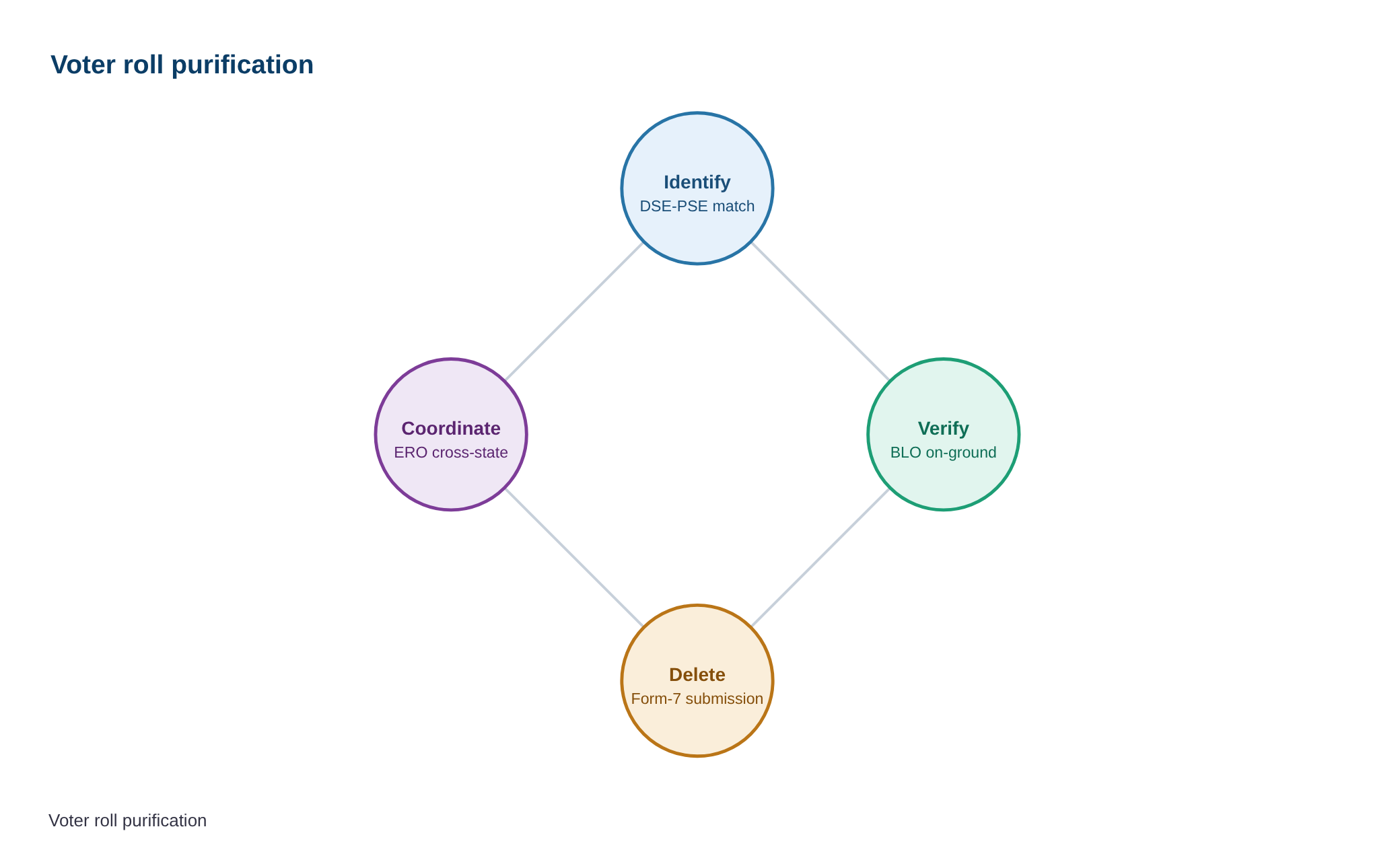
Voter mobility across state borders leads to duplicate entries in electoral rolls. → Election Commission initiates Special Intensive Revision (SIR) to identify and resolve duplication. → DSE-PSE tool matches demographic and photographic data across state rolls to pinpoint duplicates. → BLOs use the BLO App to verify duplicates on-ground and collect Form-7 for deletions. → ERO of one state communicates with ERO of the other state to execute deletions. → Legal provisions (Representation of the People Act, 1950) are enforced to penalize non-compliance. → Final purified electoral roll ensures one voter-one vote principle and electoral integrity.
Prelims Practice Questions
Q1. Consider the following statements regarding the Special Intensive Revision (SIR) of electoral rolls in India:
1. SIR is conducted every five years to update the electoral rolls.
2. The Representation of the People Act, 1950 mandates that no voter’s name can appear in more than one electoral roll for the same constituency.
3. The Election Commission of India (ECI) can suo motu initiate deletion of names from electoral rolls under Section 22 of the RPA, 1950.
4. The ECI has the power to conduct door-to-door verification of voter details during SIR.
How many of the above statements are correct?
- Only one
- Only two
- Only three
- All
Answer: All — Statements 1, 2, and 4 are correct. Statement 3 is incorrect as the ECI cannot suo motu delete names; deletion requires an application or suo motu action under specific provisions of the RPA, 1950.
Q2. Assertion (A): The Election Commission of India (ECI) has initiated a campaign called ‘DSE with PSE’ to verify voter details in border districts of Uttarakhand.
Reason (R): The campaign aims to prevent double voting and ensure the integrity of electoral rolls by matching voter data across state boundaries.
In the context of the above two statements, which one of the following is correct?
- Both A and R are true, and R is the correct explanation of A.
- Both A and R are true, but R is not the correct explanation of A.
- A is true but R is false.
- A is false but R is true.
Answer: Both A and R are true, and R is the correct explanation of A. — Both Assertion (A) and Reason (R) are true, and Reason (R) correctly explains Assertion (A). The campaign ‘DSE with PSE’ is designed to verify voter entries across state boundaries to prevent duplication and ensure electoral integrity.
Q3. Which of the following forms is used to delete a voter’s name from the electoral roll when it is found to be duplicated in another state’s list?
- Form 6
- Form 7
- Form 8
- Form 26
Answer: Form 7 — Form 7 is used for the deletion of a voter’s name from the electoral roll. This form is typically filed when a voter’s name is found to be duplicated or when the voter requests deletion.
Mains Practice Question
✍ The Election Commission of India (ECI) has recently initiated the ‘DSE with PSE’ campaign to verify voter details in border districts of Uttarakhand by matching electoral rolls with those of Uttar Pradesh. In this context, critically examine the constitutional and statutory provisions that govern the integrity of electoral rolls in India. Also, discuss the significance of such verification drives in maintaining the purity of the electoral process. (15 Marks)
Approach: MODEL-ANSWER SKELETON:
1. **Constitutional and Statutory Framework:**
– Article 324 of the Constitution vests the ECI with the superintendence, direction, and control of elections.
– Representation of the People Act, 1950 (RPA, 1950): Sections 17 (prohibition of multiple entries), 22 (correction of entries), and 23 (preparation of electoral rolls).
– Section 13 of RPA, 1950: Punishment for illegal inclusion or omission of names (up to 1 year imprisonment or fine).
– Section 17(1): No voter’s name shall appear in more than one electoral roll for the same constituency.
2. **Role of ECI in Electoral Roll Management:**
– ECI conducts Special Intensive Revision (SIR) periodically to update electoral rolls.
– Use of technology (e.g., BLO App, DSE, PSE) to ensure accuracy and prevent duplication.
– Door-to-door verification and public grievance redressal mechanisms.
3. **Significance of Verification Drives:**
– Prevents double voting and electoral fraud.
– Ensures the purity of the electoral process and upholds democratic principles.
– Enhances public trust in the electoral system.
4. **Challenges and Way Forward:**
– Coordination between states for cross-border verification.
– Awareness campaigns to educate voters about the process.
– Strengthening of grievance redressal mechanisms.
5. **Conclusion:**
– Verification drives like ‘DSE with PSE’ are essential for maintaining the integrity of electoral rolls and ensuring free and fair elections.
Source: amarujala.com
Uttarakhand PCS (UKPSC) — State PCS Practice
Prelims: Which of the following districts of Uttarakhand is NOT included in the recent voter list matching exercise conducted by the Election Commission of India with Uttar Pradesh’s voter lists?
- Dehradun
- Haridwar
- Udham Singh Nagar
- Almora
Answer: Almora — The matching exercise covers five districts: Dehradun, Haridwar, Udham Singh Nagar, Nainital, and Champawat.
Mains: Discuss the significance of the Election Commission of India’s ‘DSE with PSE’ campaign in the context of Uttarakhand’s electoral integrity, highlighting its impact on border districts and steps to ensure voter authenticity.
Generated by AanyaAi for educational purpose.
Related guides on our sites
- Best PSIR optional coaching for upsc
- Best PSIR optional teacher for upsc
- Best teacher of PSIR optional for upsc
- Best PSIR optional coaching in delhi for UPSC

- EC Launches Voter List Verification Drive in Uttarakhand’s 5 Districts - September 24, 2026
- UPSC Civil Services (Main) Examination 2026 — Mechanical Engineering Optional Paper I: Question Paper | Plutus IAS - September 24, 2026
- सुप्रीम कोर्ट ने टीएमसी नाम और चुनाव चिह्न विवाद पर चुनाव आयोग से समयसीमा मांगी, 28 सितंबर को सुनवाई - September 24, 2026

No Comments