


22 Sep ECI Announces Dates for Legislative Council Elections in 4 States: UPSC Exam Insights
✎ Biennial elections to the Legislative Council are conducted under Article 171 to fill one-third of the seats every two years, with graduates and teachers forming key electorates, and the ECI ensures electoral integrity through…
Subject Relevance — Where This Topic Fits
- GS Paper II — Constitutional, Administrative and Judicial Framework | GS Paper II — State Legislatures and State Executive
- Prelims: Legislative Council, Biennial elections, Graduates’ and Teachers’ constituencies, Model Code of Conduct, Election Commission of India, State Legislative Council, Article 171, Article 172, Article 173, Election Commission (Conditions of Service of Election Commissioners and Transaction of Business) Act, 1991
- Essay: Federalism and the role of State Legislatures in India, Electoral reforms and the integrity of democratic processes
Quick Revision: Biennial elections to the Legislative Council are conducted under Article 171 to fill one-third of the seats every two years, with graduates and teachers forming key electorates, and the ECI ensures electoral integrity through the Model Code of Conduct.
Why is this in the news?
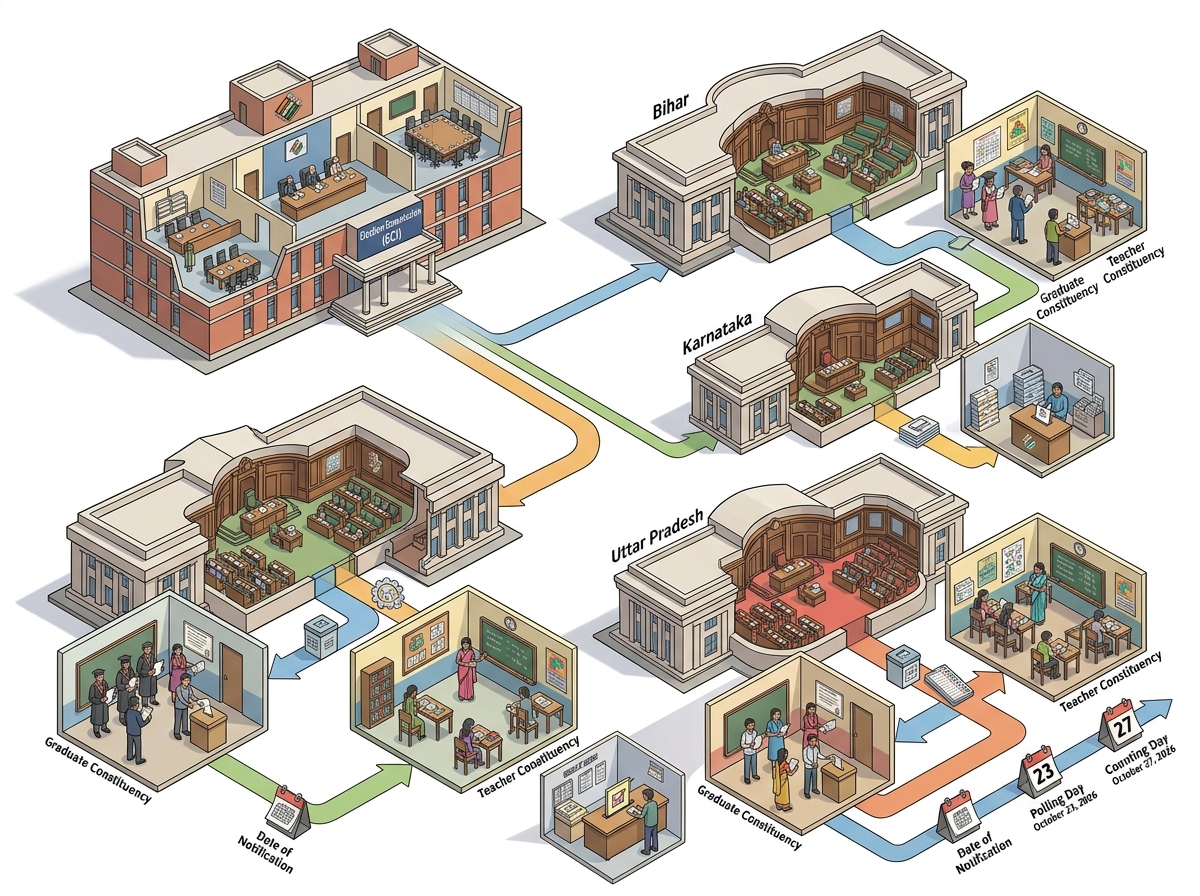
The Election Commission of India (ECI) has announced the schedule for biennial elections to the Legislative Council seats in Bihar, Karnataka, Maharashtra, and Uttar Pradesh, reserved for graduates and teachers. These elections, scheduled for polling on 23 October 2026 and counting on 27 October 2026, are significant as they directly impact the composition of the State Legislative Councils, which play a consultative role in the legislative process. The announcement of dates and the immediate imposition of the Model Code of Conduct underscore the ECI’s commitment to ensuring free, fair, and transparent electoral processes in accordance with constitutional provisions.
Background
- The Legislative Council is the upper house in the bicameral legislatures of certain Indian states, as envisaged under Article 168 of the Constitution of India.
- Article 171 of the Constitution provides for the composition of the Legislative Council, which may include members elected by local authorities, graduates, teachers, and members nominated by the Governor.
- Biennial elections to the Legislative Council are conducted to fill one-third of the seats every two years, ensuring continuity and staggered representation.
- The ECI, as the constitutional authority under Article 324, is responsible for conducting elections to the Legislative Councils in a manner that upholds the principles of electoral democracy.
- The Model Code of Conduct, enforced by the ECI, regulates the conduct of political parties and candidates to ensure a level playing field and prevent misuse of official machinery during elections.
What are Legislative Council Elections?
- The Legislative Council is a permanent body, with one-third of its members retiring every two years, necessitating biennial elections to fill vacancies.
- Elections to the Legislative Council are conducted through indirect elections, where members are elected by specific electorates such as local authorities, graduates, and teachers, or nominated by the Governor.
- Graduates’ constituencies consist of voters who hold a bachelor’s degree or higher, while Teachers’ constituencies include those engaged in teaching at the secondary school level or higher.
- The ECI announces the election schedule, including the notification date, last date for filing nominations, polling date, and counting date, in accordance with the Representation of the People Act, 1951.
- The Model Code of Conduct is enforced from the date of notification until the completion of the election process, ensuring adherence to ethical and fair electoral practices.
- The Legislative Council, while not as powerful as the Legislative Assembly, plays a consultative role in the legislative process, reviewing bills and suggesting amendments.
- The Governor of the state nominates members to the Legislative Council from fields such as arts, science, and social service, adding diversity to the legislative body.
- Biennial elections to the Legislative Council are a constitutional mandate, ensuring that the Council remains representative of the evolving socio-educational landscape of the state.
Key Features
| Feature | Significance |
|---|---|
| Biennial elections to Legislative Council | Ensures continuity in the upper house of state legislatures while allowing periodic renewal of representation. |
| Graduates’ and Teachers’ constituencies | Provides a mechanism for professional and educational segments to directly elect representatives to the Legislative Council. |
| Model Code of Conduct (MCC) | Regulates electoral conduct to ensure fairness, transparency, and a level playing field for all candidates. |
| Notification and candidature process | Structured timeline for candidate filing, scrutiny, and withdrawal, maintaining electoral discipline. |
| Polling and counting schedule | Fixed dates for voting (23 Oct) and counting (27 Oct) ensure predictability and public trust in the process. |
Why it Matters
Institutional
- Maintains the constitutional mandate of a bicameral legislature in states where Legislative Councils exist.
- Facilitates indirect democracy by enabling specific professional groups to participate in state governance.
- Ensures staggered elections to prevent simultaneous disruption of legislative business across multiple states.
Electoral Governance
- Demonstrates the Election Commission of India’s (ECI) role in conducting free, fair, and timely elections for state institutions.
- Highlights the ECI’s authority to enforce the Model Code of Conduct, ensuring a level playing field.
- Showcases the structured electoral process, including notification, candidature, polling, and counting phases.
Representation
- Preserves the principle of proportional representation for graduates and teachers, reflecting their socio-economic influence.
- Provides a platform for professional and educational segments to voice concerns in state policymaking.
- Ensures that state legislatures reflect diverse societal segments beyond territorial constituencies.
Challenges
1. Low Voter Turnout in Graduates’ and Teachers’ Constituencies
- Graduates’ and teachers’ constituencies often witness lower voter turnout due to dispersed electorates and logistical challenges.
- ECI must deploy targeted awareness campaigns and simplify polling processes to improve participation.
- Link: GS-II (State Legislatures – Structure, Functioning, Conduct of Business, Powers & Privileges)
UPSC Link: GS-II (State Legislatures)
2. Enforcement of Model Code of Conduct
- Ensuring strict adherence to the MCC across multiple states with diverse political landscapes is operationally complex.
- ECI must balance enforcement with minimal disruption to governance and public services.
- Link: GS-II (Role of Constitutional Bodies)
UPSC Link: GS-II (Constitutional Bodies)
3. Logistical and Security Arrangements
- Coordinating polling across geographically dispersed constituencies (e.g., Maharashtra’s Aurangabad Graduate Constituency) requires robust logistics.
- ECI must collaborate with state administrations to ensure security, especially in remote or conflict-prone areas.
- Link: GS-III (Disaster Management)
UPSC Link: GS-III (Disaster Management)
4. Candidature Scrutiny and Electoral Disputes
- Ensuring fair scrutiny of nominations and resolving disputes promptly is critical to maintaining electoral integrity.
- ECI must adhere to transparent processes to prevent allegations of bias or procedural lapses.
- Link: GS-II (Election Commission of India)
UPSC Link: GS-II (Election Commission)
5. Public Awareness and Misinformation
- Countering misinformation and ensuring voters are informed about polling dates, procedures, and candidates is essential.
- ECI and state governments must leverage digital and traditional media for effective outreach.
- Link: GS-IV (Ethics in Governance)
UPSC Link: GS-IV (Ethics in Governance)
Challenges — UPSC Perspective
| Issue | Concern |
|---|---|
| Voter Apathy | Low turnout in professional constituencies due to lack of awareness or motivation. |
| MCC Enforcement | Balancing strict enforcement with minimal governance disruption across states. |
| Logistical Challenges | Ensuring smooth polling in geographically dispersed constituencies. |
| Electoral Disputes | Timely resolution of nomination disputes to avoid delays or allegations. |
| Security Arrangements | Ensuring safe polling in remote or conflict-prone areas. |
| Misinformation | Countering false narratives that could influence voter behavior. |
Way Forward
- ECI should conduct targeted voter awareness campaigns in graduates’ and teachers’ constituencies to boost participation.
- State administrations must ensure robust logistical and security arrangements for polling in dispersed constituencies.
- ECI should maintain strict enforcement of the Model Code of Conduct while minimizing disruption to governance.
- Digital platforms (e.g., voter helplines, mobile apps) should be leveraged for real-time grievance redressal and information dissemination.
- Collaborate with educational institutions and professional bodies to enhance voter education and engagement.
- Ensure transparent and timely scrutiny of nominations to prevent disputes and maintain electoral integrity.
- Post-election, conduct a review to identify gaps in the electoral process and propose corrective measures.
- Strengthen inter-state coordination for seamless conduct of biennial elections across multiple states.
UPSC Value Addition
Keywords for Mains Answer-Writing
Legislative Council elections · Election Commission of India · Graduates’ and Teachers’ constituencies · Biennial elections to State Legislative Councils · Model Code of Conduct · Constitutional provisions governing Legislative Councils · Article 171 of the Constitution of India · State Legislature · Electoral process in bicameral legislatures · Role of the Election Commission in State elections
Constitutional & Policy Linkages
- Article 171 (Composition of Legislative Councils)
- Article 172 (Duration of State Legislatures)
- Article 324 (Superintendence, direction and control of elections)
- Seventh Schedule (State List – Entry 40: Elections to the Legislative Council)
Concept Flow
Biennial elections to Legislative Councils are constitutionally mandated under Article 171. → Graduates’ and Teachers’ constituencies are reserved seats, ensuring representation for professional groups. → ECI notifies elections, enforces Model Code of Conduct, and conducts polling and counting. → Voters (graduates/teachers) cast ballots, and elected members take office after the counting process. → Newly elected members participate in state legislative business, influencing policy and governance. → Post-election, the process ensures continuity in the Legislative Council while allowing periodic renewal.
Prelims Practice Questions
Q1. Consider the following statements regarding the Legislative Council in Indian States:
1. The Legislative Council is a permanent body and cannot be abolished by the State Legislature.
2. The strength of the Legislative Council shall not exceed one-third of the total membership of the Legislative Assembly.
3. The members of the Legislative Council are elected by the members of the Legislative Assembly and local bodies.
How many of the above statements are correct?
- Only one
- Only two
- All three
- None
Answer: Only two — Statement 1 is incorrect: The Legislative Council can be abolished by a resolution of the State Legislative Assembly passed by a special majority. Statement 2 is correct: The maximum strength of the Legislative Council is one-third of the Legislative Assembly. Statement 3 is incorrect: Members are elected by a combination of direct election, indirect election, and nomination, not solely by Legislative Assembly members.
Q2. Assertion (A): The Election Commission of India conducts biennial elections to the Legislative Councils of States.
Reason (R): The Legislative Council elections are held to fill seats that become vacant due to the expiry of the term of members.
In the context of the above two statements, which one of the following is correct?
- Both A and R are true, and R is the correct explanation of A
- Both A and R are true, but R is not the correct explanation of A
- A is true, but R is false
- A is false, but R is true
Answer: Both A and R are true, but R is not the correct explanation of A — Assertion (A) is correct: The Election Commission conducts biennial elections to Legislative Councils. Reason (R) is also correct and directly explains why these elections are conducted (to fill vacancies due to term expiry).
Q3. Which of the following States has a Legislative Council as of September 2026?
- Bihar
- West Bengal
- Kerala
- Tamil Nadu
Answer: Bihar — As of September 2026, Bihar, Karnataka, Maharashtra, and Uttar Pradesh have Legislative Councils. West Bengal, Kerala, and Tamil Nadu do not have Legislative Councils.
Mains Practice Question
✍ The biennial elections to the Legislative Councils of States, conducted by the Election Commission of India, are a critical feature of India’s federal democratic structure. Examine the constitutional provisions governing the Legislative Council and analyse the significance of these elections in the context of bicameral legislatures. Also, discuss the implications of the Model Code of Conduct being enforced during such elections. (15 Marks)
Approach: MODEL-ANSWER SKELETON:
1. **Constitutional Provisions (Article 171)**:
– Define the Legislative Council as a permanent body (unless abolished) and outline its composition (one-third elected by Legislative Assembly, one-third by local bodies, one-twelfth by graduates, one-twelfth by teachers, and the remainder nominated by the Governor).
– Highlight the maximum strength (not exceeding one-third of the Legislative Assembly).
– Mention the term of members (6 years, with one-third retiring every two years).
2. **Significance of Biennial Elections**:
– Explain the purpose: to fill vacancies arising from retirements, ensuring continuity and representation of specific constituencies (graduates and teachers).
– Discuss how these elections maintain the federal balance and provide a platform for specialised representation.
– Contrast with the Legislative Assembly (directly elected, more representative of the people).
3. **Role of the Election Commission**:
– Detail the EC’s constitutional mandate (Article 324) to conduct free and fair elections, including biennial Legislative Council polls.
– Explain the election process: notification, nomination, polling, and counting.
4. **Model Code of Conduct (MCC)**:
– Define MCC as a set of guidelines issued by the Election Commission to ensure free and fair elections.
– Discuss its key provisions: restrictions on political parties and candidates (e.g., no promises of public funds, no appeals to caste/religion).
– Explain its immediate enforcement upon announcement of election dates and its role in maintaining electoral integrity.
5. **Implications of MCC Enforcement**:
– Analyze how MCC prevents misuse of official machinery and ensures a level playing field.
– Discuss potential challenges: enforcement in remote areas, balancing free speech vs. electoral fairness.
6. **Conclusion**:
– Summarize the importance of Legislative Council elections in sustaining India’s bicameral system and democratic federalism.
– Emphasize the EC’s role in upholding constitutional democracy through these processes.
Source: amarujala.com
Generated by AanyaAi for educational purpose.
Related guides on our sites
- Current affairs for upsc 2026
- UPSC EPFO syllabus
- Best PSIR optional coaching for upsc
- Best PSIR optional teacher for upsc

- उत्तर तमिलनाडु में विस्तारित स्कूल ब्रेकफास्ट योजना का शुभारंभ, जानें लाभ - September 22, 2026
- केरल में मानव-वन्यजीव संघर्ष मुआवज़े के लिए दिशा-निर्देश तैयार करेगा विशेषज्ञ पैनल - September 22, 2026
- Kerala forms expert panel to streamline wildlife conflict compensation guidelines - September 22, 2026

No Comments