


16 Sep El Niño Impact: Kerala Tea Production Drops 2% in 2026, UPASI Data Reveals
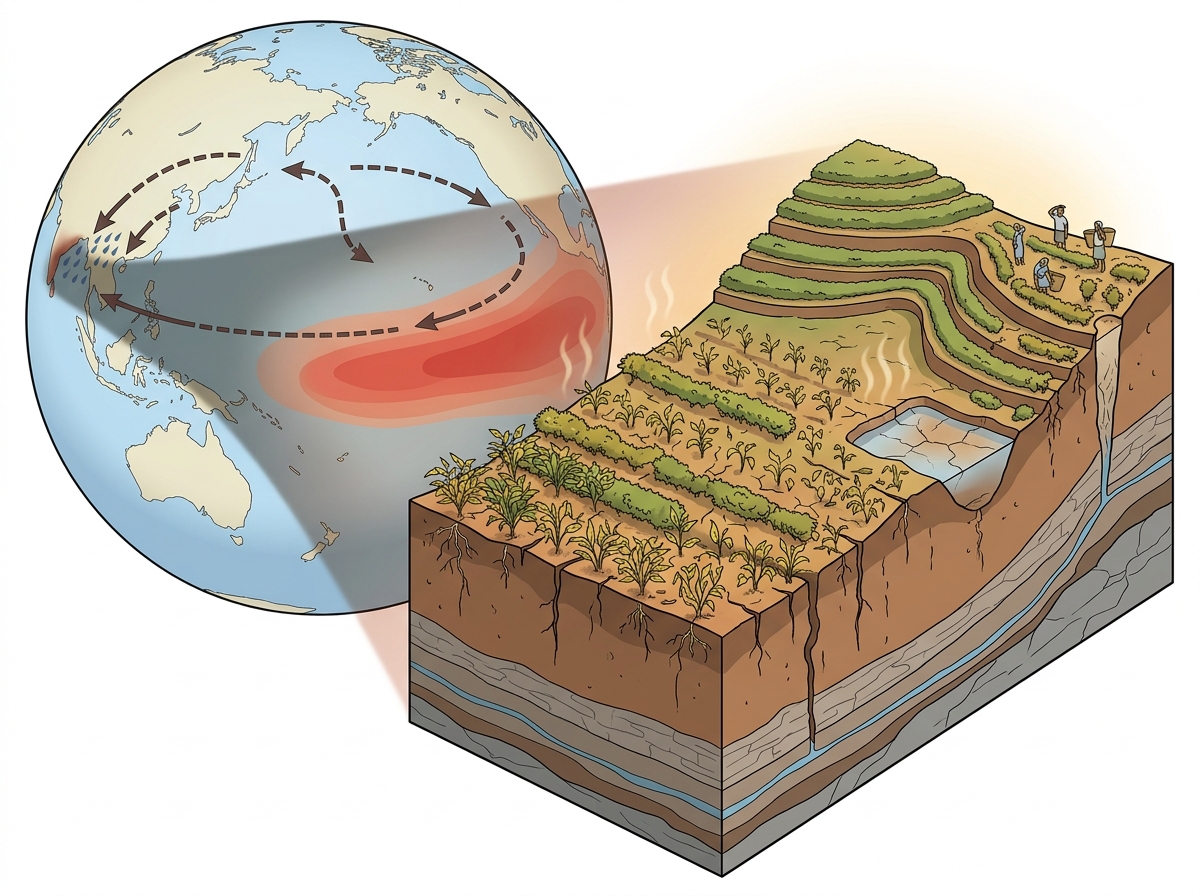
✎ El Niño-induced droughts reduce monsoon rainfall in southern India, directly impacting tea yield and quality, with Wayanad and Nilgiris being the most vulnerable regions due0 to their high dependence on rainfall for irrigation.
Subject Relevance — Where This Topic Fits
- GS Paper III — Agriculture (Climate Change and Agricultural Productivity) | GS Paper III — Environment and Disaster Management (Climate Variability and its Socio-Economic Impacts) | GS Paper III — Indian Economy (Agricultural Sector and Rural Livelihoods)
- Prelims: El Niño, La Niña, Indian Ocean Dipole (IOD), UPASI, Tea Board of India, Agro-climatic Zones, Crop Water Stress Index, Drought Resilience, Plantation Agriculture, Small Tea Growers (STGs), Tea Auction Prices, Climate-Smart Agriculture
- Essay: Climate Change and Agricultural Sustainability: Lessons from India’s Tea Plantations, The Intersection of Climate Policy and Rural Livelihoods in India
Quick Revision: El Niño-induced droughts reduce monsoon rainfall in southern India, directly impacting tea yield and quality, with Wayanad and Nilgiris being the most vulnerable regions due0 to their high dependence on rainfall for irrigation.
Why is this in the news?
The report highlights a 2% decline in tea production in Keralam during January–August 2026, attributed to El Niño-induced drought conditions, with Wayanad district experiencing a 53% rainfall deficit and an 8.11% drop in output. This underscores the vulnerability of plantation agriculture to climate variability and the socio-economic implications for dependent communities, particularly small tea growers and estate workers.
Background
- El Niño is a periodic warming of sea surface temperatures in the central and eastern tropical Pacific Ocean, disrupting global weather patterns, including the Indian monsoon, leading to reduced rainfall in peninsular India.
- Keralam and Tamil Nadu are key tea-producing states in India, contributing significantly to the national output.
- The tea sector in Keralam is a major employer, supporting over 1 million people directly and indirectly, including small tea growers, estate workers, and ancillary industries.
- Climate change projections indicate an increase in frequency and intensity of extreme weather events, including droughts, which pose a long-term threat to plantation agriculture.
What is El Niño and its Impact on Agriculture?
- El Niño is a climatic phenomenon characterized by the abnormal warming of ocean waters in the equatorial Pacific, which disrupts global atmospheric circulation, leading to altered precipitation patterns.
- In India, El Niño is often associated with deficient monsoon rainfall, particularly in southern and western regions, affecting kharif crop sowing and growth.
- The Indian Ocean Dipole (IOD) can modulate El Niño’s impact; a positive IOD may mitigate rainfall deficits, while a negative IOD can exacerbate drought conditions.
- For tea plantations, water stress directly reduces leaf yield and quality, as tea bushes require consistent moisture for optimal growth and plucking cycles.
- El Niño events are often followed by La Niña, which can bring excessive rainfall, posing risks of flooding, soil erosion, and pest outbreaks, further destabilizing tea production.
- The tea sector’s sensitivity to climate variability is heightened by its reliance on specific agro-climatic zones, such as the high-altitude regions of Wayanad, Munnar, and Nilgiris, where microclimatic changes have disproportionate effects.
Key Features
| Feature | Significance |
|---|---|
| El Niño-induced rainfall deficit in Keralam (2026) | Disrupts monsoon patterns, leading to prolonged dry spells and reduced soil moisture critical for tea cultivation. |
| Regional disparity in tea yield decline (Wayanad vs Munnar) | Highlights micro-climatic vulnerabilities; Wayanad’s 53% rainfall deficit and 8.11% yield drop contrast with Munnar’s marginal increase, indicating localized climate resilience or adaptation strategies. |
| UPASI Tea Research Foundation data compilation | Provides empirical evidence for policy and industry responses, enabling targeted interventions in high-impact districts like Wayanad. |
| Direct and indirect employment dependency on tea estates | A 2% production drop threatens livelihoods of plantation workers and ancillary sectors (e.g., transport, processing), amplifying socio-economic risks. |
| Penshurst Estate’s productivity growth (4.4%) | Demonstrates that climate-resilient agricultural practices (e.g., soil moisture conservation, shade management) can mitigate El Niño impacts, offering a model for replication. |
Why it Matters
Economic
- Tea is a major export-oriented cash crop for Keralam, contributing significantly to State GDP; production decline risks foreign exchange earnings and trade balance deterioration.
- Price volatility in global tea markets may exacerbate revenue losses for small and marginal tea growers, who lack price-setting power.
- Downstream industries (e.g., packaging, logistics, hospitality) reliant on tea face input cost inflation due to reduced supply and quality degradation.
Agricultural
- Tea cultivation is highly sensitive to temperature and rainfall; El Niño disrupts the critical ‘flush’ periods (March–May and July–September), reducing yield per hectare.
- Soil erosion and nutrient depletion in drought-affected regions accelerate land degradation, compromising long-term agricultural productivity.
- Increased pest incidence (e.g., tea mosquito bug, red spider mite) thrives in stressed plants, compounding yield losses.
Environmental
- Deforestation for tea plantations in ecologically sensitive Western Ghats regions exacerbates micro-climatic vulnerabilities, creating feedback loops with climate change.
- Reduced evapotranspiration from tea estates alters local hydrological cycles, potentially reducing groundwater recharge and stream flows in downstream regions.
Social
- Plantation workers, predominantly tribal and marginalized communities, face heightened food insecurity and indebtedness due to wage losses and reduced employment days.
- Migration pressures increase as displaced agricultural laborers seek alternative livelihoods, straining urban infrastructure and social services.
Policy and Governance
- The crisis underscores the need for integrated climate adaptation strategies in agriculture, bridging gaps between meteorological forecasts, agricultural extension services, and farmer support systems.
- State and Central governments must align disaster risk reduction (DRR) policies with agricultural resilience frameworks to address climate-induced disruptions.
Challenges
1. Climate Variability and Crop Sensitivity
- El Niño events are projected to intensify under climate change, increasing the frequency of extreme weather events that disrupt tea production cycles.
- Tea’s long gestation period (3–5 years from planting to full yield) limits rapid adaptation responses, necessitating long-term planning.
- Lack of climate-resilient tea varieties adapted to higher temperatures and erratic rainfall patterns hampers mitigation efforts.
UPSC Link: GS3: Climate Change and Agriculture
2. Market and Price Instability
- Global tea prices are influenced by supply shocks in major producing countries (e.g., Sri Lanka, Kenya), amplifying revenue volatility for Indian growers.
- Smallholders lack access to futures markets or price hedging instruments, leaving them vulnerable to price crashes during surplus years.
- Quality degradation due to drought stress reduces the premium value of Indian tea in international markets.
UPSC Link: GS3: Agricultural Marketing and Supply Chain
3. Socio-Economic Vulnerabilities of Plantation Workers
- Plantation laborers are often engaged on daily wage contracts with no social security, exacerbating poverty during production slumps.
- Limited alternative employment opportunities in rural Keralam force workers into informal sectors with lower wages and no protections.
- Health risks increase due to prolonged exposure to heat stress and pesticide residues in drought-stressed plants.
UPSC Link: GS1: Poverty and Development
4. Institutional and Governance Gaps
- Fragmented data on micro-climatic impacts hinders targeted policy responses; UPASI’s data, while valuable, covers only a fraction of the sector.
- Delays in disbursing crop insurance claims (e.g., under PMFBY) leave farmers financially exposed to climate shocks.
- Weak coordination between the India Meteorological Department (IMD), State Agriculture Departments, and tea boards results in delayed advisories.
UPSC Link: GS2: Centre-State Relations and Governance
5. Environmental Degradation and Land Use Pressures
- Expansion of tea plantations into forest fringes in the Western Ghats accelerates biodiversity loss and ecosystem services decline.
- Soil degradation from monoculture practices reduces carbon sequestration potential, contributing to regional greenhouse gas emissions.
- Water-intensive tea cultivation strains local water resources, particularly in water-scarce districts like Wayanad.
UPSC Link: GS3: Conservation and Environmental Pollution
Challenges — UPSC Perspective
| Issue | Concern |
|---|---|
| El Niño-induced rainfall deficit | Prolonged dry spells reduce tea flushes, directly lowering yield per hectare and quality. |
| Regional micro-climatic disparities | Wayanad’s severe deficit contrasts with Munnar’s resilience, complicating uniform policy responses. |
| Market price volatility | Supply shocks in key producing regions destabilize global tea prices, impacting Indian growers’ revenue. |
| Plantation labor vulnerabilities | Daily wage workers face income loss, food insecurity, and health risks during production declines. |
| Institutional data gaps | Lack of granular, real-time data on climate impacts limits evidence-based policymaking. |
| Environmental degradation | Deforestation and soil erosion in tea-growing regions exacerbate climate vulnerabilities and biodiversity loss. |
Government Initiatives — Must-Memorise for Prelims
- Pradhan Mantri Fasal Bima Yojana (PMFBY) – Crop insurance scheme for tea growers to mitigate climate risks.
- National Mission for Sustainable Agriculture (NMSA) – Promotes climate-resilient agricultural practices, including water-efficient irrigation for tea estates.
Way Forward
- Strengthen climate information services for tea growers by integrating IMD forecasts with agricultural extension networks to enable proactive adaptation.
- Promote research and development of drought-resistant tea varieties through collaboration between UPASI, CSIR, and agricultural universities.
- Expand crop insurance coverage under PMFBY for small and marginal tea growers, with simplified claim processes and timely payouts.
- Implement water conservation measures in tea estates, such as drip irrigation, rainwater harvesting, and soil moisture conservation techniques.
- Enhance market linkages for tea growers through cooperative models (e.g., Tea Board’s Tea Development and Promotion Scheme) to stabilize prices and reduce intermediaries.
- Develop agroforestry models in tea-growing regions to restore ecological balance, improve soil health, and enhance carbon sequestration.
- Establish a State-level Climate Resilience Fund for tea sector to finance adaptation projects, including shade management and pest control.
- Integrate climate risk assessments into land-use planning in the Western Ghats to prevent further deforestation and ecosystem degradation.
UPSC Value Addition
Keywords for Mains Answer-Writing
El Niño Southern Oscillation (ENSO) · Impact of climate variability on agriculture · Tea cultivation in India · Climate resilience in plantation sectors · Agro-climatic zones of Kerala · Sustainable agriculture practices · Intergovernmental Panel on Climate Change (IPCC) projections · United Planters’ Association of Southern India (UPASI) · Small Tea Growers (STGs) and large estates · Climate adaptation strategies in agriculture
Concept Flow
El Niño disrupts Indian Ocean Dipole patterns → Alters monsoon rainfall distribution across Keralam → Prolonged dry spells in Wayanad and Central Travancore → Reduced soil moisture and evapotranspiration → Stress in tea plants during critical flush periods → Decline in yield per hectare and quality → Economic losses for growers and workers → Amplification of socio-economic vulnerabilities in plantation communities.
Prelims Practice Questions
Q1. Consider the following statements regarding the El Niño Southern Oscillation (ENSO) phenomenon:
1. El Niño refers to the warming of sea surface temperatures in the central and eastern tropical Pacific Ocean.
2. La Niña is associated with cooler-than-average sea surface temperatures in the same region.
3. ENSO has no significant impact on the Indian monsoon system.
4. The Indian Ocean Dipole (IOD) is a separate ocean-atmosphere phenomenon that can modulate ENSO effects.
How many of the above statements are correct?
- Only one
- Only two
- Only three
- All
Answer: All — Statements 1, 2, and 4 are correct. Statement 3 is incorrect as ENSO significantly influences the Indian monsoon, often leading to droughts during El Niño years.
Q2. Assertion (A): The tea cultivation in Wayanad district of Kerala has experienced an 8.11% decline in production between January and August 2026 compared to the same period in 2025.
Reason (R): This decline is primarily attributed to a 53% rainfall deficit in Wayanad during the same period, exacerbated by El Niño conditions.
Options:
A. Both A and R are true, and R is the correct explanation of A.
B. Both A and R are true, but R is not the correct explanation of A.
C. A is true, but R is false.
D. A is false, but R is true.
Answer: ? — Both the assertion (A) and the reason (R) are factually correct, and the reason (R) directly explains the assertion (A) as the rainfall deficit is the cited cause for the production decline.
Q3. Match the following agro-climatic zones of Kerala with their respective tea production characteristics:
Column I (Zone) Column II (Production Characteristic)
A. Wayanad 1. Slight increase in yield from 1,558 kg/ha to 1,578 kg/ha
B. Munnar 2. Significant decline in yield by 3.8%
C. Peerumade 3. Decline of 100 kg/ha in average output
D. Central Travancore 4. Decline from 1,091 kg/ha to 1,069 kg/ha
Options:
A. A-3, B-1, C-4, D-2
B. A-2, B-3, C-1, D-4
C. A-4, B-2, C-3, D-1
D. A-1, B-4, C-2, D-3
Answer: ? — The correct pairing is: A (Wayanad) – 3 (Decline of 100 kg/ha), B (Munnar) – 1 (Slight increase), C (Peerumade) – 4 (Decline from 1,091 kg/ha to 1,069 kg/ha), D (Central Travancore) – 2 (Decline by 3.8%).
Mains Practice Question
✍ Critically examine the impact of climate variability, particularly the El Niño Southern Oscillation (ENSO), on agricultural productivity in India. Substantiate your arguments with reference to the tea sector in Kerala, highlighting the differential impacts across agro-climatic zones. Also, discuss the policy measures required to enhance climate resilience in plantation agriculture. (15 Marks)
Approach: MODEL-ANSWER SKELETON:
1. **Introduction (2 marks)**
– Define ENSO and its phases (El Niño, La Niña, Neutral).
– Briefly state the global and regional impacts of ENSO on climate patterns.
– Mention the significance of the tea sector in Kerala’s economy and employment.
2. **Mechanism of ENSO Impact on Agriculture (3 marks)**
– Explain how El Niño disrupts the Indian monsoon, leading to reduced rainfall in Kerala.
– Link reduced rainfall to soil moisture deficit, water stress in tea plants, and lower yields.
– Reference UPASI data on production decline in Kerala (e.g., Wayanad’s 8.11% drop, Central Travancore’s 3.8% decline).
3. **Differential Impacts Across Agro-Climatic Zones (4 marks)**
– **Wayanad**: High rainfall deficit (53%) and steep yield decline (100 kg/ha). Discuss vulnerability of small tea growers.
– **Munnar**: Slight yield increase due to microclimatic advantages or better irrigation practices.
– **Peerumade and Central Travancore**: Moderate declines, illustrating regional variability.
– Contrast with Penshurst Estate’s success (4.4% growth) to highlight adaptive practices.
4. **Policy Measures for Climate Resilience (4 marks)**
– **Short-term**: Drought-resistant tea varieties, soil moisture conservation, and irrigation efficiency.
– **Medium-term**: Crop diversification, agroforestry, and weather-indexed crop insurance (e.g., Pradhan Mantri Fasal Bima Yojana).
– **Long-term**: Integration of climate-smart agriculture (CSA) in the National Mission for Sustainable Agriculture (NMSA).
– Role of UPASI and state agencies in research, extension services, and farmer training.
5. **Challenges and Way Forward (2 marks)**
– Financial constraints for small growers, lack of access to technology, and policy fragmentation.
– Need for multi-stakeholder collaboration (government, research institutions, private sector).
– Reference IPCC projections on increasing ENSO frequency/intensity to underscore urgency.
Source: The Hindu
Generated by AanyaAi for educational purpose.
Related guides on our sites
- Best agriculture optional coaching
- Best geography optional coaching
- Best geography optional coaching
- Best geography optional teacher

- डीएफएस विशेष अभियान 6.0: सरकारी कार्यालयों में स्वच्छता और शिकायत निवारण में नया मोड़ - September 17, 2026
- DFSB’s Special Campaign 6.0: Key Achievements & UPSC Relevance (2026) - September 17, 2026
- राजस्थान निकाय चुनावों में ओबीसी आरक्षण: सरकार ने उच्च न्यायालय में प्रस्तुत किए तर्क - September 17, 2026

No Comments