


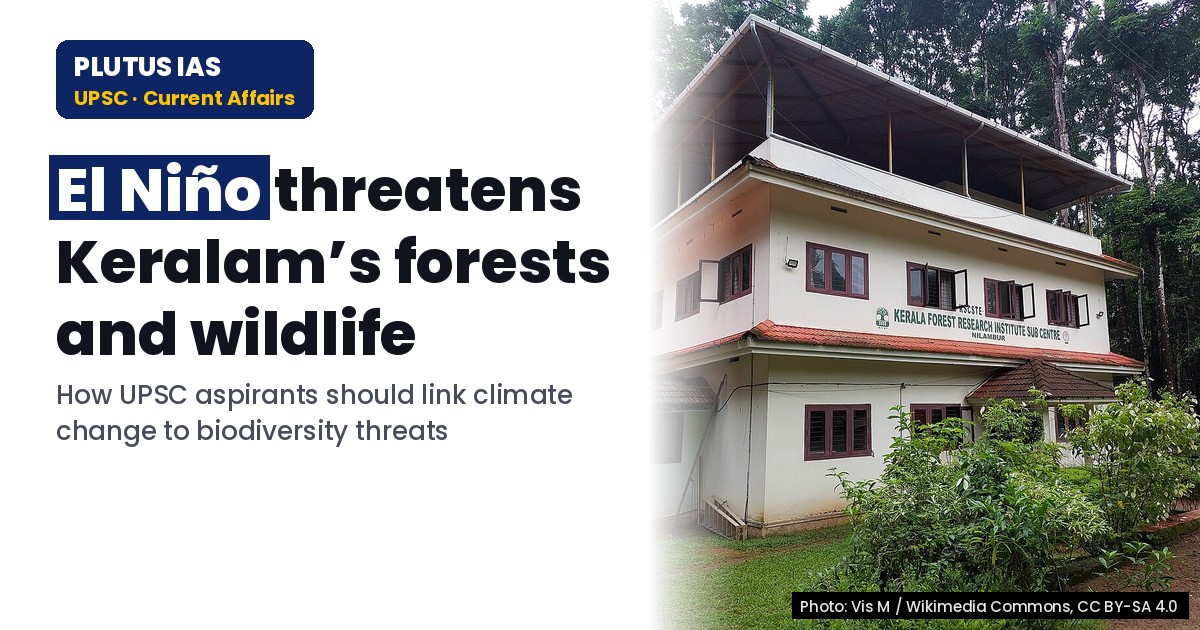
18 Oct El Niño Threatens Keralam’s Forests and Wildlife: Key Concerns for UPSC
✎ El Niño disrupts monsoon patterns, reducing rainfall and soil moisture, thereby intensifying forest fire risks, altering wildlife phenology, and increasing human-wildlife conflicts in Keralam’s fragile forest ecosystems.
Subject Relevance — Where This Topic Fits
- GS Paper III — Environment, Ecology, Biodiversity and Climate Change | GS Paper III — Disaster Management
- Prelims: El Niño-Southern Oscillation (ENSO), Forest Survey of India, Forest phenology, Human-wildlife conflict, Fire lines, Northeast monsoon, Southwest monsoon, Forest fire incidents, Wildlife habitat stress, Soil moisture deficit
- Essay: Climate change as a multiplier of ecological vulnerabilities, The interplay between anthropogenic pressures and natural climate variability in shaping ecosystem resilience
Quick Revision: El Niño disrupts monsoon patterns, reducing rainfall and soil moisture, thereby intensifying forest fire risks, altering wildlife phenology, and increasing human-wildlife conflicts in Keralam’s fragile forest ecosystems.
Why is this in the news?
The developing strong El Niño event in 2026 has raised concerns over its potential to exacerbate dry conditions in Keralam, thereby intensifying forest fire risks, disrupting wildlife habitats, and increasing human-wildlife conflicts. With Keralam already reporting 49 large forest fire incidents in 2026—a figure comparable to the previous year—and facing a 28% deficit in southwest monsoon rainfall, the climatic anomaly poses a significant threat to the state’s forest ecosystems and biodiversity. This development underscores the need for proactive measures to mitigate ecological stress and enhance resilience in forest management practices.
Background
- Keralam, a biodiversity hotspot in the Western Ghats, hosts a mosaic of tropical evergreen, semi-evergreen, and moist deciduous forests, supporting a rich assemblage of flora and fauna, including endemic and endangered species.
- Forest ecosystems in Keralam are highly sensitive to climatic variations, particularly rainfall patterns, due to their dependence on seasonal water availability for soil moisture, stream flow, and groundwater recharge.
- The Forest Survey of India (FSI) monitors forest fire incidents annually, with Keralam consistently reporting high numbers of large fire events, often linked to dry spells and anthropogenic activities.
- El Niño, a phase of the El Niño-Southern Oscillation (ENSO) cycle, is characterised by anomalous warming of sea surface temperatures in the central and eastern equatorial Pacific Ocean, leading to disruptions in global atmospheric circulation and monsoon patterns.
- The southwest monsoon (June–September) and northeast monsoon (October–December) are critical for Keralam’s water security, with deficits in either season exacerbating water stress in forests and wildlife habitats.
What is El Niño and how does it influence forest ecosystems?
- El Niño is a climatic phenomenon associated with the El Niño-Southern Oscillation (ENSO) cycle, marked by the warming of ocean surface temperatures in the central and eastern equatorial Pacific Ocean, which disrupts global weather patterns, including monsoon systems.
- During El Niño events, the Walker Circulation weakens, reducing the intensity of the southwest monsoon over the Indian subcontinent and leading to below-normal rainfall in many regions, including Keralam.
- The northeast monsoon, which is crucial for post-monsoon water availability in Keralam, may also exhibit variability during El Niño years, further exacerbating dry conditions and water stress in forests.
- El Niño-induced dry spells reduce soil moisture, lower groundwater levels, and cause early drying of forest streams and waterholes, directly impacting wildlife that relies on these sources for hydration and habitat maintenance.
- Prolonged dry conditions and elevated temperatures increase the risk of forest fires by creating conducive conditions for ignition and rapid spread, particularly in areas with accumulated dry biomass or anthropogenic ignition sources.
- Forest phenology—the seasonal timing of biological events such as flowering, fruiting, and leaf shedding—is tightly linked to climatic factors like rainfall and temperature. El Niño-induced disruptions can alter phenological cycles, affecting food availability and habitat quality for wildlife.
- Changes in forest phenology and water availability can lead to physiological stress in plants and animals, behavioural shifts in wildlife (e.g., altered movement patterns), and increased susceptibility to diseases or predation.
- The severity of El Niño’s impact on forests varies by ecosystem type (e.g., evergreen vs. deciduous forests), elevation, soil characteristics, and the duration of dry spells, with some species being more drought-tolerant than others.
- Long-term El Niño events can alter forest composition by favouring drought-resistant species, reducing biodiversity, and potentially leading to shifts in ecosystem structure and function.
- Human-wildlife conflict may escalate as wildlife, particularly large herbivores and carnivores, venture closer to human settlements in search of water and food, increasing encounters and conflicts.
Key Features
| Feature | Significance |
|---|---|
| El Niño Southern Oscillation (ENSO) | A quasi-periodic climate pattern involving sea surface temperature anomalies in the tropical Pacific Ocean, influencing global weather systems, including monsoon patterns in India. |
| Forest Phenology | The study of periodic biological phenomena in plants (e.g., flowering, fruiting) linked to climatic factors; critical for understanding ecosystem health and wildlife behaviour. |
| Human–Wildlife Conflict | Increased encounters between wildlife and human settlements due to resource scarcity (e.g., water, food) driven by climatic stress and habitat degradation. |
| Soil Moisture Depletion | Reduction in soil water content due to prolonged dry spells, affecting plant growth, regeneration, and forest ecosystem stability. |
| Forest Fire Incidents | Wildfires triggered by dry conditions, high temperatures, and low humidity, posing threats to biodiversity and forest cover. |
Why it Matters
Ecological Impact
- Disruption of forest phenology, altering food availability for herbivores and frugivores, leading to cascading effects on predator-prey dynamics.
- Increased vulnerability of drought-susceptible species, potentially altering forest composition and reducing biodiversity.
- Prolonged water stress may force wildlife to migrate toward human settlements, escalating human–wildlife conflict and posing risks to both.
Climate Resilience
- Highlights the need for climate-adaptive forest management strategies to mitigate the impacts of extreme weather events on ecosystems.
- Underscores the importance of long-term monitoring of forest health and phenological changes to inform conservation policies.
- Demonstrates the interconnectedness of global climate phenomena (e.g., El Niño) with local ecological stability.
Policy and Governance
- Emphasises the role of state forest departments in proactive risk assessment and preparedness for climate-induced disasters.
- Stresses the necessity of inter-departmental coordination (e.g., forestry, meteorology, wildlife) for integrated disaster management.
- Raises questions about the adequacy of existing forest fire prevention and mitigation frameworks in the context of climate variability.
Challenges
1. Forest Fire Risk Amplification
- Increased frequency and intensity of forest fires due to prolonged dry spells and high temperatures, exacerbated by El Niño.
- Early onset of fire season may overwhelm existing prevention and containment infrastructure.
- Risk of large-scale ecological damage, including loss of critical habitats and species.
UPSC Link: GS3: Disaster Management
2. Water Stress and Wildlife Migration
- Reduction in water availability in forest streams and waterholes, forcing wildlife to seek alternative sources near human settlements.
- Elevated risk of human–wildlife conflict due to resource competition, particularly in forest-fringe areas.
- Potential physiological stress and behavioural changes in wildlife, though field validation is required.
UPSC Link: GS3: Conservation, Environmental Pollution & Degradation
3. Ecosystem Functioning Disruption
- Alterations in forest phenology (e.g., delayed flowering, reduced fruiting) disrupting food chains and pollination networks.
- Long-term decline in forest regeneration and compositional shifts toward drought-tolerant species, altering ecosystem structure.
- Possible irreversible changes in forest health if dry conditions persist, affecting carbon sequestration and climate regulation.
UPSC Link: GS3: Environmental Conservation
4. Climate Data Integration Gaps
- Limited real-time climate monitoring and predictive modelling for localised forest ecosystems to anticipate stress.
- Inadequate integration of climate science with forest management practices, leading to reactive rather than proactive measures.
- Need for enhanced research collaboration between meteorological agencies, forest departments, and academic institutions.
UPSC Link: GS3: Science & Technology
5. Resource Allocation and Preparedness
- Insufficient allocation of funds and manpower for climate-resilient forest management and disaster preparedness.
- Lack of standardised protocols for assessing and mitigating climate-induced risks in forest ecosystems.
- Dependence on short-term measures (e.g., fire lines) rather than long-term adaptation strategies.
UPSC Link: GS2: Governance
Challenges — UPSC Perspective
| Issue | Concern |
|---|---|
| Forest Fire Incidents | Increased risk of large-scale wildfires due to dry conditions and high temperatures, threatening biodiversity and forest cover. |
| Water Scarcity in Forests | Early drying of forest streams and waterholes, forcing wildlife to migrate toward human settlements and increasing conflict. |
| Ecosystem Disruption | Alterations in forest phenology and species composition, potentially leading to irreversible ecological changes. |
| Human–Wildlife Conflict | Escalation in encounters between wildlife and humans due to resource scarcity, posing safety and conservation challenges. |
| Climate Data Gaps | Limited integration of climate science into forest management, hindering proactive risk mitigation. |
Way Forward
- Enhance real-time climate monitoring and predictive modelling for forest ecosystems to anticipate stress and enable early interventions.
- Strengthen inter-departmental coordination between forest departments, meteorological agencies, and wildlife conservation bodies for integrated risk management.
- Develop and implement climate-resilient forest management plans, including adaptive measures for fire prevention, water conservation, and habitat restoration.
- Conduct regular field assessments to monitor forest health, phenological changes, and wildlife behaviour under climate stress.
- Invest in research on drought-tolerant species and ecosystem restoration techniques to enhance forest resilience.
- Raise public awareness and community engagement in forest conservation, particularly in forest-fringe areas prone to human–wildlife conflict.
- Allocate dedicated funds for climate adaptation in forestry, including infrastructure for fire prevention, water harvesting, and habitat enrichment.
- Promote international collaboration on climate science and forest conservation to address transboundary impacts of global phenomena like El Niño.
UPSC Value Addition
Keywords for Mains Answer-Writing
El Niño Southern Oscillation (ENSO) · Climate variability and its ecological impacts · Forest phenology and ecosystem dynamics · Human-wildlife conflict mitigation · Forest fire management and prevention · Monsoon variability and water stress · Wildlife habitat degradation · Kerala Forest Research Institute (KFRI) · Forest Survey of India (FSI) · Climate change adaptation in forest ecosystems · Drought-tolerant species and forest regeneration · Soil moisture and plant physiological stress
Concept Flow
El Niño-induced changes in Pacific Ocean temperatures → Altered global atmospheric circulation → Deficit in southwest monsoon rainfall over India → Reduced soil moisture and water availability in Keralam’s forests → Increased risk of forest fires and early drying of water sources. → Prolonged dry spells and high temperatures → Water stress in forests → Forced migration of wildlife toward human settlements → Escalation in human–wildlife conflict. → Climate stress → Disruption of forest phenology (flowering, fruiting) → Reduced food availability for herbivores and frugivores → Cascading effects on predator-prey dynamics and ecosystem stability. → Sustained water scarcity → Physiological stress and behavioural changes in wildlife → Potential decline in population health and reproductive success. → Long-term drought → Decline in forest regeneration → Shift in species composition toward drought-tolerant varieties → Permanent alteration of forest structure and function.
Prelims Practice Questions
Q1. Consider the following statements regarding the impact of El Niño on forest ecosystems:
1. El Niño typically reduces southwest monsoon rainfall in India, exacerbating water stress in forests.
2. Forest phenology, including flowering and fruiting cycles, is unaffected by El Niño-induced drought conditions.
3. Prolonged drought during El Niño can alter forest composition by favouring drought-tolerant species.
4. The Forest Survey of India (FSI) reports a decrease in large forest fire incidents during El Niño years.
How many of the above statements are correct?
- Only one
- Only two
- Only three
- All
Answer: Only three — Statements 1 and 3 are correct. Statement 2 is incorrect because El Niño-induced drought significantly affects forest phenology. Statement 4 is incorrect as the FSI data cited in the article indicates an increase in forest fire incidents during dry conditions associated with El Niño.
Q2. Assertion (A): El Niño events are associated with a deficit in southwest monsoon rainfall over India.
Reason (R): El Niño disrupts the Walker circulation, leading to a reduction in moisture transport over the Indian subcontinent.
Options:
A) Both A and R are true, and R is the correct explanation of A.
B) Both A and R are true, but R is not the correct explanation of A.
C) A is true, but R is false.
D) A is false, but R is true.
Answer: ? — Both the assertion and reason are correct. El Niño disrupts the Walker circulation, reducing the moisture transport over the Indian subcontinent and leading to a deficit in southwest monsoon rainfall.
Q3. Match the following pairs related to forest management and climate variability:
Column I
1. Forest phenology
2. Forest fire prevention
3. Human-wildlife conflict mitigation
4. Soil moisture conservation
Column II
A. Creation of fire lines along forest boundaries
B. Seasonal timing of flowering and fruiting in plants
C. Ensuring water availability to reduce wildlife movement towards human settlements
D. Mulching and afforestation to retain soil moisture
Options:
A) 1-B, 2-A, 3-C, 4-D
B) 1-A, 2-B, 3-C, 4-D
C) 1-D, 2-C, 3-B, 4-A
D) 1-C, 2-D, 3-A, 4-B
Answer: ? — The correct matches are: 1-B (Forest phenology refers to the seasonal timing of biological events in plants), 2-A (Fire lines are created to prevent forest fires), 3-C (Ensuring water availability mitigates human-wildlife conflict by reducing wildlife movement), and 4-D (Mulching and afforestation help conserve soil moisture).
Mains Practice Question
✍ El Niño events are projected to intensify in frequency and severity under climate change scenarios. Critically examine the potential ecological impacts of El Niño on forest ecosystems in India, with particular reference to forest phenology, water stress, and human–wildlife conflict. (15 Marks)
Approach: MODEL-ANSWER SKELETON:
1. **Introduction**: Define El Niño Southern Oscillation (ENSO) and its global climatic impacts, highlighting its influence on the Indian monsoon system.
2. **Forest phenology**: Explain how El Niño-induced drought disrupts the seasonal timing of biological events (flowering, fruiting, leaf shedding) in forests, citing the Kerala Forest Research Institute (KFRI) study. Reference the concept of ‘phenological mismatch’ and its cascading effects on food chains.
3. **Water stress and ecosystem functioning**: Discuss the reduction in soil moisture, early drying of water sources, and physiological stress on plants and wildlife. Include the role of forest type (evergreen vs. deciduous) and elevation in determining vulnerability.
4. **Human–wildlife conflict**: Analyse how water scarcity forces wildlife to venture into human-dominated landscapes, citing the example of Kerala’s forest fringes. Mention the Forest Survey of India (FSI) data on forest fires as a contributing factor.
5. **Adaptation and mitigation strategies**: Outline measures such as creating fire lines, soil moisture conservation, and community-based conflict mitigation. Reference the National Action Plan on Climate Change (NAPCC) and state-level initiatives.
6. **Conclusion**: Emphasise the need for integrated climate adaptation strategies, combining scientific research (e.g., KFRI’s phenological studies) with policy interventions (e.g., FSI’s forest fire monitoring).
Source: The Hindu
Generated by AanyaAi for educational purpose.
Related guides on our sites
- How to prepare for GS paper 1 for UPSC CSE mains exam
- Best UPSC coaching for IFOS exam
- Best geography optional coaching
- Best geography optional coaching

- Himalayan Glacier Melt & Climate Change: UPSC Analysis - November 7, 2026
- आरबीआई द्वारा 91, 182 और 364 दिनीय ट्रेजरी बिलों की नीलामी: प्रमुख तथ्य - November 7, 2026
- Shram Samvad: Capacity Building on Labour Codes in Ujjain - November 7, 2026

No Comments