


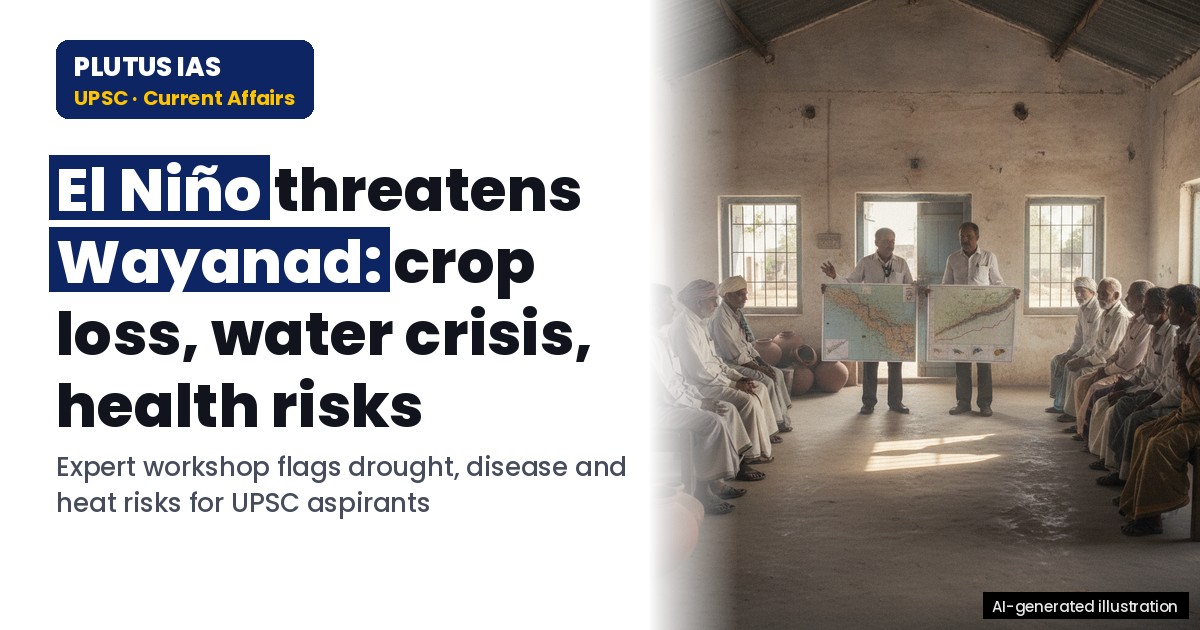
31 Oct El Niño Threatens Wayanad: Crop Loss, Water Crisis & Health Risks
✎ El Niño, a phase of the ENSO cycle, disrupts the southwest monsoon in India, leading to deficient rainfall, elevated temperatures, and cascading impacts on agriculture, water security, and public health.
Subject Relevance — Where This Topic Fits
- GS Paper I — Geography (Climate and Weather Systems) | GS Paper III — Environment and Disaster Management | GS Paper III — Agriculture and Food Security
- Prelims: El Niño-Southern Oscillation (ENSO), Zoonotic diseases, Human-wildlife conflict, Kyasanur Forest Disease (KFD), One Health framework, Monsoon deficit, Vector-borne diseases, Soil moisture and crop yield
- Essay: Climate change and its cascading effects on human and ecological systems, Integrated governance for disaster resilience in India
Quick Revision: El Niño, a phase of the ENSO cycle, disrupts the southwest monsoon in India, leading to deficient rainfall, elevated temperatures, and cascading impacts on agriculture, water security, and public health.
Why is this in the news?
The occurrence of El Niño, a periodic warming of the central and eastern tropical Pacific Ocean, has been linked to severe climatic anomalies in India, including deficient monsoon rainfall and elevated temperatures. Wayanad district in Kerala is currently experiencing heightened vulnerability due to an unprecedented El Niño event, compounded by a monsoon deficit, leading to multi-sectoral challenges such as declining agricultural productivity, water scarcity, increased zoonotic disease outbreaks, and heightened human-wildlife conflict. A multi-stakeholder workshop organised by the M.S. Swaminathan Research Foundation (MSSRF) in collaboration with state and central agencies underscores the need for adaptive governance and integrated mitigation strategies to address these risks.
Background
- El Niño is a phase of the El Niño-Southern Oscillation (ENSO) cycle, characterised by the warming of sea surface temperatures in the central and eastern equatorial Pacific Ocean, disrupting global weather patterns.
- India’s southwest monsoon, which accounts for 75% of annual rainfall, is highly sensitive to ENSO events; El Niño years are statistically associated with below-normal monsoon rainfall, as observed in 2015 and 2018.
- Wayanad, a biodiversity-rich district in Kerala, is part of the Western Ghats, a UNESCO World Heritage Site and a critical ecological zone for India’s monsoon dynamics.
- Historical data indicates that super El Niño years (e.g., 1997–98, 2015–16) have led to severe droughts in Kerala, exacerbating water stress and agricultural losses.
- The One Health framework, endorsed by the WHO, FAO, and OIE, recognises the interconnectedness of human, animal, and environmental health, particularly in the context of climate-induced disease outbreaks.
- Kerala’s vulnerability to zoonotic diseases such as Kyasanur Forest Disease (KFD) and dengue is exacerbated by ecological disruptions, including deforestation and human encroachment into wildlife habitats.
What is El Niño and its climatic impacts?
- El Niño is a climate phenomenon arising from the El Niño-Southern Oscillation (ENSO) cycle, where the warming of central and eastern Pacific Ocean waters disrupts global atmospheric circulation patterns.
- The Southern Oscillation Index (SOI), a measure of the pressure difference between Tahiti and Darwin, Australia, is a key indicator of ENSO phases; negative SOI values typically correspond to El Niño conditions.
- El Niño events are associated with a weakening of the Walker Circulation, leading to reduced convection over the Indian Ocean and, consequently, deficient monsoon rainfall over the Indian subcontinent.
- The impacts of El Niño are not uniform globally; while it often causes droughts in South Asia, it can lead to excessive rainfall and flooding in parts of the Americas and Africa.
- El Niño events typically recur every 2–7 years, with varying intensities; super El Niño events (e.g., 1997–98, 2015–16) are characterised by exceptionally high sea surface temperature anomalies.
- The Indian Meteorological Department (IMD) monitors ENSO conditions and issues seasonal forecasts, which are critical for agricultural planning and disaster preparedness.
- El Niño’s secondary effects include elevated temperatures, increased evaporation rates, and heightened risk of wildfires, particularly in forested and agricultural regions.
Key Features
| Feature | Significance |
|---|---|
| El Niño phenomenon | A naturally occurring climate pattern associated with warming of the central and eastern tropical Pacific Ocean, leading to disruptions in global weather patterns, including altered monsoon behaviour in South Asia. |
| One Health framework | An integrated approach to health that recognises the interconnections between human, animal, and environmental health, particularly relevant for addressing zoonotic diseases and ecosystem disruptions. |
| Multi-stakeholder workshop | A collaborative platform involving farmers, health workers, scientists, and policymakers to co-develop adaptation and mitigation strategies for climate-induced challenges. |
| Zoonotic disease outbreaks | Diseases transmitted from animals to humans, exacerbated by ecological disruptions such as forest degradation, wildlife migration, and climate variability. |
| Monsoon deficit | Reduced rainfall during the monsoon season, critical for agriculture, water security, and ecosystem stability in regions like Wayanad. |
Why it Matters
Agricultural Impact
- Decline in crop yields due to reduced soil moisture and prolonged dry spells, threatening food security and rural livelihoods.
- Increased vulnerability of cash crops (e.g., arecanut, spices) to heat stress and pest infestations, impacting export earnings and farmer incomes.
- Reduced milk production in dairy sectors, affecting both local consumption and agro-industrial value chains.
Public Health Risks
- Elevated risk of heat-related illnesses, particularly among outdoor workers and vulnerable populations such as the elderly and children.
- Surge in vector-borne diseases (e.g., dengue, Kyasanur Forest Disease) due to altered vector breeding patterns in warmer, drier conditions.
- Increased incidence of animal diseases, posing direct threats to livestock health and indirect risks to human health through zoonotic transmission.
Ecological and Environmental Concerns
- Heightened risk of forest fires due to prolonged dry spells and elevated temperatures, leading to biodiversity loss and ecosystem degradation.
- Escalation in human-wildlife conflicts as animals migrate in search of water and food, increasing encounters with human settlements.
- Disruption of hydrological cycles, exacerbating water shortages for domestic, agricultural, and industrial uses.
Socio-Economic Vulnerabilities
- Marginalised communities, including small-scale farmers and tribal populations, face disproportionate impacts due to limited adaptive capacity.
- Disruptions in local economies reliant on agriculture, tourism, and forest-based livelihoods, leading to unemployment and migration pressures.
- Strain on public health infrastructure due to simultaneous outbreaks of multiple diseases and heat-related emergencies.
Governance and Institutional Preparedness
- The workshop highlights the need for integrated, cross-sectoral governance to address climate-induced challenges in a holistic manner.
- Strengthening of early warning systems and community-based adaptation strategies to mitigate risks in real-time.
- Enhancing inter-departmental coordination among agriculture, health, forestry, and disaster management agencies for effective response.
Challenges
1. Climate-Induced Agricultural Degradation
- Reduced soil moisture and increased evapotranspiration leading to crop failures, particularly in rain-fed agricultural systems.
- Proliferation of pests and diseases in crops due to altered microclimatic conditions, reducing yields and quality.
- Financial distress among farmers due to failed harvests, necessitating alternative livelihood strategies.
UPSC Link: GS3: Climate Change and Agriculture
2. Public Health Emergencies
- Increased morbidity and mortality from heat stress, particularly in regions with inadequate cooling infrastructure.
- Outbreaks of zoonotic diseases (e.g., Kyasanur Forest Disease) due to ecological disruptions and wildlife migration.
- Overburdening of healthcare systems with simultaneous management of vector-borne diseases and heat-related illnesses.
UPSC Link: GS2: Health and Family Welfare
3. Forest and Biodiversity Loss
- Elevated risk of forest fires due to dry conditions and high temperatures, leading to loss of flora and fauna.
- Disruption of wildlife habitats, increasing human-wildlife conflicts and threatening endangered species.
- Long-term degradation of ecosystem services, including carbon sequestration and water regulation.
UPSC Link: GS3: Environment and Biodiversity
4. Water Scarcity and Hydrological Stress
- Depletion of groundwater reserves and reduced surface water availability due to deficient monsoon rainfall.
- Competition for water resources among agriculture, domestic, and industrial sectors, exacerbating social tensions.
- Increased energy costs for water pumping and treatment, straining local economies.
UPSC Link: GS3: Water Resources
5. Socio-Economic Disruptions
- Loss of livelihoods in agriculture, dairy, and forest-based sectors, leading to rural-urban migration.
- Increased financial burden on smallholder farmers and marginalised communities due to reduced incomes.
- Strain on local governance systems to provide relief and rehabilitation measures in a timely manner.
UPSC Link: GS2: Governance and Social Justice
6. Institutional and Policy Gaps
- Limited integration of climate adaptation strategies into local and regional development plans.
- Inadequate early warning systems for climate-induced disasters, such as forest fires and disease outbreaks.
- Fragmented governance structures that hinder coordinated responses across sectors.
UPSC Link: GS2: Governance and Public Policy
Challenges — UPSC Perspective
| Issue | Concern |
|---|---|
| Crop Yield Decline | Threat to food security and farmer incomes due to reduced soil moisture and heat stress. |
| Water Scarcity | Depletion of groundwater and reduced surface water availability for agriculture and domestic use. |
| Zoonotic Disease Outbreaks | Increased risk of diseases like dengue and Kyasanur Forest Disease due to ecological disruptions. |
| Forest Fires | Elevated risk of wildfires due to dry conditions and high temperatures, leading to biodiversity loss. |
| Human-Wildlife Conflict | Escalation in conflicts as wildlife migrates in search of food and water, increasing encounters with humans. |
| Healthcare Burden | Simultaneous management of heat-related illnesses and vector-borne diseases straining public health systems. |
Way Forward
- Integrate climate adaptation strategies into local agricultural and land-use policies to enhance resilience.
- Strengthen early warning systems for heatwaves, forest fires, and disease outbreaks with community-based monitoring.
- Promote water-efficient irrigation techniques (e.g., drip irrigation) and rainwater harvesting to mitigate water scarcity.
- Enhance veterinary and public health surveillance to detect and respond to zoonotic diseases promptly.
- Develop community-based disaster management plans, including evacuation routes and emergency shelters.
- Invest in afforestation and ecosystem restoration to improve biodiversity and reduce forest fire risks.
- Provide financial support and insurance mechanisms for farmers to cushion against climate-induced crop failures.
- Foster inter-departmental coordination among agriculture, health, forestry, and disaster management agencies.
UPSC Value Addition
Keywords for Mains Answer-Writing
El Niño Southern Oscillation · climate variability · agro-climatic risks · One Health framework · vector-borne diseases · human-wildlife conflict · food security · climate change adaptation · zonal monsoon variability · agricultural productivity · public health emergencies · ecosystem resilience · inter-sectoral coordination · disaster risk reduction · Kerala agro-climate
Concept Flow
El Niño-induced warming of Pacific Ocean → Alters global weather patterns → Disrupts South-West Monsoon → Reduced rainfall in Wayanad → Decline in soil moisture and water availability → Reduced rainfall and elevated temperatures → Increased evapotranspiration → Soil degradation and crop stress → Decline in agricultural yields → Crop stress and reduced water availability → Shift in wildlife migration patterns → Increased human-wildlife conflicts → Prolonged dry spells and heat stress → Elevated risk of forest fires → Loss of biodiversity and ecosystem services → Drier conditions and ecological disruptions → Proliferation of disease vectors → Surge in vector-borne diseases (e.g., dengue, Kyasanur Forest Disease) → Simultaneous agricultural, ecological, and health crises → Overburdening of local governance and healthcare systems → Increased socio-economic vulnerabilities
Prelims Practice Questions
Q1. Consider the following statements regarding the El Niño Southern Oscillation (ENSO):
1. El Niño is associated with the warming of sea surface temperatures in the central and eastern tropical Pacific Ocean.
2. El Niño events typically result in increased rainfall in the Indian subcontinent.
3. The Southern Oscillation Index (SOI) is a measure of the atmospheric component of ENSO.
4. La Niña is the opposite phase of ENSO and is characterized by cooler-than-average sea surface temperatures in the same region.
How many of the above statements are correct?
- Only one
- Only two
- Only three
- All
Answer: All — Statements 1, 3, and 4 are correct. Statement 2 is incorrect because El Niño events are generally associated with reduced rainfall in the Indian subcontinent due to altered monsoon patterns.
Q2. Assertion (A): The One Health framework integrates human, animal, and environmental health to address zoonotic diseases.
Reason (R): Zoonotic diseases, such as Kyasanur forest disease, require coordinated responses across multiple sectors to mitigate their impact.
Options:
A. Both A and R are true, and R is the correct explanation of A.
B. Both A and R are true, but R is not the correct explanation of A.
C. A is true, but R is false.
D. A is false, but R is true.
Answer: ? — Both the assertion and reason are true, and the reason correctly explains the assertion. The One Health framework is designed to address health challenges at the human-animal-environment interface, particularly for zoonotic diseases.
Q3. Match the following climate phenomena with their characteristic impacts on India:
Column I (Climate Phenomenon) Column II (Impact on India)
A. El Niño 1. Increased rainfall in southern India
B. La Niña 2. Reduced monsoon rainfall
C. Positive Indian Ocean Dipole (IOD) 3. Enhanced monsoon rainfall
D. Negative Indian Ocean Dipole (IOD) 4. Drier conditions in central India
Options:
A. A-2, B-3, C-1, D-4
B. A-3, B-2, C-1, D-4
C. A-2, B-1, C-3, D-4
D. A-1, B-2, C-3, D-4
Answer: ? — The correct matches are: A-2 (El Niño reduces monsoon rainfall), B-3 (La Niña enhances monsoon rainfall), C-1 (Positive IOD increases rainfall in southern India), and D-4 (Negative IOD leads to drier conditions in central India).
Mains Practice Question
✍ El Niño events pose significant agro-climatic and public health challenges to vulnerable regions like Wayanad in Kerala. Critically examine the multi-sectoral impacts of El Niño on agriculture, livestock, and human health, with reference to the One Health framework. Also, outline the institutional mechanisms available in India to mitigate such climate-induced risks. (15 Marks)
Approach: MODEL-ANSWER SKELETON:
1. **Introduction (2 marks)**: Define El Niño and its global/regional climatic impacts, with a brief mention of the Wayanad context.
2. **Agro-climatic impacts (4 marks)**:
– Decline in crop yields due to reduced soil moisture and erratic monsoon patterns.
– Water scarcity and its cascading effects on irrigation and drinking water.
– Heat stress on crops and livestock.
– Cite the National Mission for Sustainable Agriculture (NMSA) and the Pradhan Mantri Krishi Sinchayee Yojana (PMKSY) as institutional responses.
3. **Livestock and animal health impacts (3 marks)**:
– Increased susceptibility to zoonotic diseases (e.g., Kyasanur forest disease).
– Reduced milk production and reproductive challenges in livestock.
– Reference the Department of Animal Husbandry and Dairying (DAHD) and the National Animal Disease Control Programme (NADCP).
4. **Public health emergencies (3 marks)**:
– Rise in vector-borne diseases (dengue, malaria) and heat-related illnesses.
– Human-wildlife conflict due to habitat degradation and resource scarcity.
– Role of the National Centre for Disease Control (NCDC) and the Integrated Disease Surveillance Programme (IDSP).
5. **One Health framework (2 marks)**:
– Explain the concept: integration of human, animal, and environmental health.
– Reference the National One Health Programme for zoonoses and the recent workshop in Wayanad (MSSRF, KSCSTE, DASD).
6. **Institutional mechanisms for mitigation (3 marks)**:
– National Disaster Management Authority (NDMA) and State Disaster Management Authorities (SDMAs).
– Role of the India Meteorological Department (IMD) in seasonal forecasting.
– Community-based adaptation strategies (e.g., climate-resilient agriculture, early warning systems).
7. **Conclusion (1 mark)**: Emphasize the need for inter-sectoral coordination and long-term climate adaptation strategies.
Source: The Hindu
Kerala PCS (Kerala PSC (KAS)) — State PCS Practice
Prelims: Which of the following is a primary challenge posed by El Niño to Wayanad, as highlighted by experts?
- A. Increased rainfall leading to floods
- B. Drought conditions affecting agriculture and water security
- C. Rise in sea levels threatening coastal areas
- D. Decline in tourism due to extreme cold
Answer: B. Drought conditions affecting agriculture and water security — El Niño typically brings reduced monsoon rainfall to Kerala, including Wayanad, leading to drought-like conditions that impact agriculture and water availability.
Mains: Discuss the socio-economic and environmental impacts of El Niño-induced drought conditions in Wayanad, with a focus on Kerala’s preparedness and mitigation strategies.
Generated by AanyaAi for educational purpose.
Related guides on our sites
- Best geography optional coaching
- Best geography optional coaching
- Best geography optional teacher
- Best geography optional teacher

- El Niño Threatens Wayanad: Crop Loss, Water Crisis & Health Risks - October 31, 2026
- राज्यों को केंद्र से मिला ₹1,09,019 करोड़ का कर हस्तांतरण: जानें कैसे बढ़ेगी पूंजीगत खर्च - October 31, 2026
- Quad’s Economic Vision: Boosting Security & Prosperity in 2024 - October 31, 2026

No Comments