


08 Aug Environmental Concerns Over AI Data Centres: Legal & Social Impact Analysis
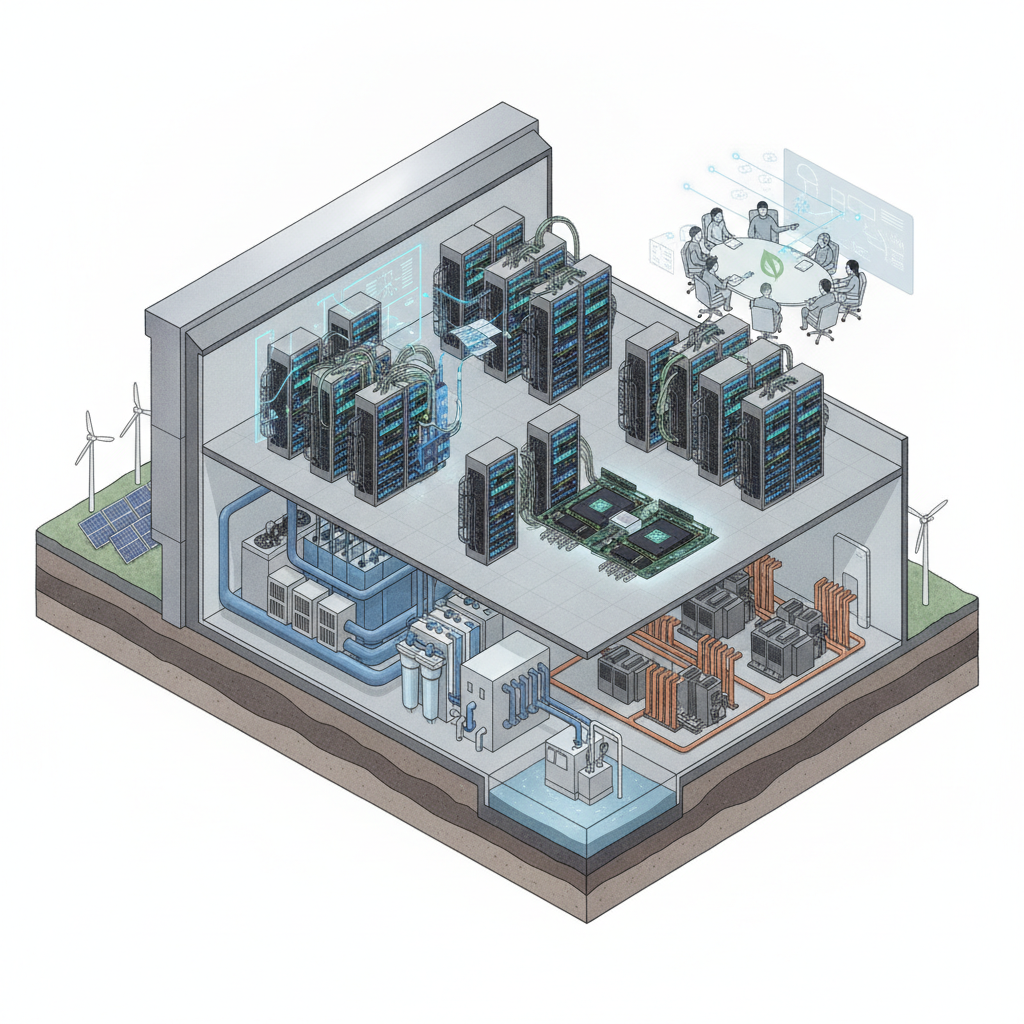
AI data centresHyperscale facilitiesEnergy consumptionWater usage✎ AI data centres pose significant environmental risks due to their energy-intensive operations and water consumption, necessitating strict adherence to constitutional and environmental laws, including mandatory Environmental…
Subject Relevance — Where This Topic Fits
- GS Paper III — Environment, Climate Change and Sustainable Development | GS Paper II — Governance, Constitution and Social Justice
- Prelims: Hyperscale data centres, Environmental Impact Assessment (EIA) 2006, Constitutional provisions under Article 21 (Right to Life and Personal Liberty), Greenhouse Gas Emissions (GHG), Water footprint of data centres, Public Consultation in Environmental Decision-Making
- Essay: Technology and Ethics: Navigating the Moral Dimensions of AI and Data Infrastructure, Sustainable Development vs. Technological Progress: Striking a Balance for Future Generations
Quick Revision: AI data centres pose significant environmental risks due to their energy-intensive operations and water consumption, necessitating strict adherence to constitutional and environmental laws, including mandatory Environmental Impact Assessments and public consultations.
Why is this in the news?
The deliberations organised by Green Visakha in Visakhapatnam highlight the growing scrutiny of hyperscale AI data centres due to their substantial environmental footprints, including high energy and water consumption, land degradation, and potential violations of constitutional and environmental laws. The absence of legislative debate on relevant Government Orders underscores concerns regarding transparency, public participation, and adherence to statutory frameworks in the siting and operation of such facilities.
Background
- Hyperscale data centres, essential for AI training and cloud computing, are proliferating globally due to the exponential growth of digital services and AI applications.
- India’s data centre capacity is projected to reach 18 GW by 2030, with states like Andhra Pradesh, Tamil Nadu, and Maharashtra emerging as key hubs due to policy incentives and infrastructure advantages.
- Constitutional provisions such as Article 21 (Right to Life and Personal Liberty) and Article 48A (Directive Principle of State Policy on environmental protection) provide a legal framework for safeguarding ecological and social justice.
- Data centres are estimated to consume 1-1.5% of global electricity, with cooling systems alone accounting for up to 40% of their energy use, contributing significantly to carbon emissions.
- The water footprint of data centres is substantial, with some facilities consuming millions of litres daily for cooling, raising concerns in water-stressed regions like Andhra Pradesh.
What are AI Data Centres and Why Do They Matter?
- AI data centres are specialised facilities housing servers, storage systems, and networking equipment designed to process, store, and analyse vast datasets for AI model training and cloud computing services.
- These centres operate 24/7, requiring uninterrupted power supply and advanced cooling mechanisms, which collectively drive high energy and water consumption.
- The environmental impact stems from electricity generation (often coal-based in India), e-waste generation, and land-use changes, particularly in ecologically sensitive zones.
- Social implications include displacement of local communities, disruption of livelihoods, and potential health hazards from electromagnetic radiation and air pollution.
- Legal implications arise from non-compliance with environmental laws, lack of transparency in approvals, and inadequate public consultations, as highlighted by the NGO’s concerns.
- The constitutional framework obligates the state to protect the environment and ensure social justice, necessitating rigorous environmental and social impact assessments (ESIA) for such projects.
- Technological advancements in AI exacerbate the demand for data centres, necessitating a balance between innovation and sustainable development.
- International precedents, such as the EU’s Green Deal and the U.S. Inflation Reduction Act, underscore the global shift towards greener data centre operations, including renewable energy integration and water-efficient cooling technologies.
UPSC Value Addition
Keywords for Mains Answer-Writing
Environmental Impact Assessment (EIA) · Hyperscale AI Data Centres · Natural Justice · Social and Environmental Justice · Public Consultation · Environmental Laws · Constitutional Compliance · Land Use Impact · Water and Energy Consumption · Biodiversity Conservation · Environmental Social Governance (ESG) · Right to Information (RTI)
Prelims Practice Questions
Q1. Consider the following statements regarding the environmental implications of hyperscale AI data centres:
1. Hyperscale AI data centres primarily consume electricity and water, impacting local energy grids and water resources.
2. The construction of hyperscale AI data centres does not require Environmental Impact Assessments (EIA) under the Environment Protection Act, 1986.
3. Public consultation is mandatory before granting environmental clearance for such projects under the EIA Notification, 2006.
4. Biodiversity hotspots are exempted from the requirement of environmental clearance if the project size is below a specified threshold.
How many of the above statements are correct?
- Only one
- Only two
- Only three
- All four
Answer: Only three — Statements 1 and 3 are correct. Statement 2 is incorrect as EIA is mandatory for such projects. Statement 4 is incorrect as no exemption exists solely based on project size in biodiversity hotspots.
Q2. Assertion (A): The Right to Information (RTI) Act, 2005 can be invoked to access environmental clearance documents for hyperscale AI data centres.
Reason (R): The RTI Act mandates disclosure of all government-held information, including those related to environmental clearances, subject to exemptions under Section 8.
Options:
A. Both A and R are true, and R is the correct explanation of A.
B. Both A and R are true, but R is not the correct explanation of A.
C. A is true, but R is false.
D. A is false, but R is true.
- A
- B
- C
- D
Answer: A — Both A and R are true. The RTI Act allows access to environmental clearance documents, and R correctly explains A by citing Section 8 exemptions.
Q3. Match the following environmental laws with their primary objectives:
Column I (Law) | Column II (Objective)
——————————–|————————
A. Environment Protection Act, 1986 | 1. Regulates hazardous waste management
B. Water (Prevention and Control of Pollution) Act, 1974 | 2. Governs the prevention, control, and abatement of air pollution
C. Air (Prevention and Control of Pollution) Act, 1981 | 3. Provides for the protection and improvement of the environment
D. Hazardous Waste Management Rules, 2008 | 4. Regulates and controls water pollution
Options:
A. A-3, B-4, C-2, D-1
B. A-1, B-2, C-3, D-4
C. A-2, B-3, C-1, D-4
D. A-4, B-1, C-2, D-3
- A
- B
- C
- D
Answer: A — Correct matches: A-3 (Environment Protection Act, 1986), B-4 (Water Act, 1974), C-2 (Air Act, 1981), D-1 (Hazardous Waste Management Rules, 2008).
Mains Practice Question
✍ The establishment of hyperscale AI data centres raises significant environmental, social, and legal concerns. Critically examine the constitutional and statutory framework governing such projects in India, with particular reference to the principles of natural justice, public participation, and environmental sustainability. Also, analyse the role of judicial review in ensuring compliance with these frameworks. (15 Marks)
Approach: MODEL-ANSWER SKELETON:
1. **Constitutional and Statutory Framework**:
– Article 21 (Right to Life and Personal Liberty) and Article 48A (Directive Principle of State Policy) as foundational principles.
– Environment Protection Act, 1986: Powers of the Central Government to take measures for environmental protection.
– EIA Notification, 2006: Mandatory public consultation and environmental clearance process for projects like hyperscale data centres.
– Water (Prevention and Control of Pollution) Act, 1974 and Air (Prevention and Control of Pollution) Act, 1981: Regulatory oversight on water and air pollution.
– National Green Tribunal Act, 2010: Adjudicatory mechanism for environmental disputes.
2. **Principles of Natural Justice and Public Participation**:
– Right to Information (RTI) Act, 2005: Access to environmental clearance documents.
– Aarhus Convention principles (though not ratified by India, often cited in judicial reasoning): Right to access information, public participation, and access to justice.
– Judicial precedents: MC Mehta v. Union of India (1986) on public interest litigation and environmental justice; Vellore Citizens Welfare Forum v. Union of India (1996) on sustainable development.
3. **Environmental Sustainability Concerns**:
– Energy consumption: Hyperscale data centres are energy-intensive, raising concerns about grid stability and carbon emissions.
– Water usage: Cooling requirements may strain local water resources.
– Land use and biodiversity: Large-scale infrastructure projects often lead to habitat fragmentation.
– ESG (Environmental, Social, and Governance) compliance: Corporate accountability for sustainable practices.
4. **Role of Judicial Review**:
– Judicial review of executive decisions under Articles 14 (Right to Equality) and 21.
– Cases like Alembic Pharmaceuticals Ltd. v. Rohit Prajapati (2020) on environmental clearances and public participation.
– NGT’s role in adjudicating disputes related to environmental clearances and violations.
5. **Balancing Development and Sustainability**:
– Arguments for economic growth and technological advancement vs. environmental preservation.
– Need for transparent, participatory, and scientifically rigorous impact assessments.
– Role of state governments in balancing local development aspirations with environmental safeguards.
Source: The Hindu
Generated by AanyaAi for educational purpose.

- एआई से वैश्विक खतरा: मानवता के लिए गंभीर चुनौती और समाधान - October 2, 2026
- Maharashtra’s ₹10,520 Cr BharatNet Revamp: Key for UPSC & State PCS - October 2, 2026
- गुजरात सरकार द्वारा मालधारियों के स्थानांतरण की घोषणा, जानिए पूरा विवरण - October 2, 2026

No Comments