


08 Aug Environmental Concerns Over AI Data Centres: Legal & Social Implications for UPSC
AI data centresHyperscale data centresDigital infrastructureData centre parks✎ Hyperscale AI data centres must comply with the Environmental Impact Assessment (EIA) 2006, ensure transparent public consultations, and align with constitutional provisions such as Article 21 and Article 48A to balance…
Subject Relevance — Where This Topic Fits
- GS Paper II — Governance, Transparency and Accountability | GS Paper III — Environment and Sustainable Development, Science and Technology
- Prelims: Hyperscale data centres, Environmental Impact Assessment (EIA) 2006, Constitutional provisions under Article 21 (Right to Life), Public Consultation in EIA, Greenhouse Gas Emissions (GHG) from digital infrastructure, National Green Tribunal (NGT), Public Trust Doctrine
- Essay: Technology and Environmental Ethics: Balancing Innovation with Sustainability, Constitutional Governance and Public Participation in Environmental Decision-Making
Quick Revision: Hyperscale AI data centres must comply with the Environmental Impact Assessment (EIA) 2006, ensure transparent public consultations, and align with constitutional provisions such as Article 21 and Article 48A to balance technological advancement with environmental justice.
Why is this in the news?
The recent deliberations organised by the NGO Green Visakha in Visakhapatnam highlight the growing concerns regarding the environmental, social, and legal implications of proposed hyperscale AI data centres. The discussion underscores the need for rigorous environmental and social impact assessments, transparent governance, and adherence to constitutional and statutory frameworks, particularly in the context of land, water, energy, and biodiversity utilisation.
Background
- India’s digital infrastructure is witnessing exponential growth, with hyperscale data centres forming the backbone of AI, cloud computing, and big data services.
- The Ministry of Electronics and Information Technology (MeitY) has been promoting data centre parks under the Digital India initiative, with states like Andhra Pradesh, Tamil Nadu, and Maharashtra emerging as key hubs.
- The Environmental Impact Assessment (EIA) Notification, 2006, under the Environment (Protection) Act, 1986, mandates environmental clearance for projects based on their scale and potential impact.
- The National Green Tribunal (NGT) has repeatedly emphasised the importance of public consultations and adherence to the ‘polluter pays’ principle in environmental governance.
- Constitutional provisions such as Article 21 (Right to Life and Personal Liberty) and Article 48A (Directive Principle of State Policy on environmental protection) provide a legal framework for environmental justice.
- The expansion of data centres raises concerns over high energy consumption, water usage for cooling, and carbon emissions, particularly in water-stressed regions.
What are Hyperscale AI Data Centres?
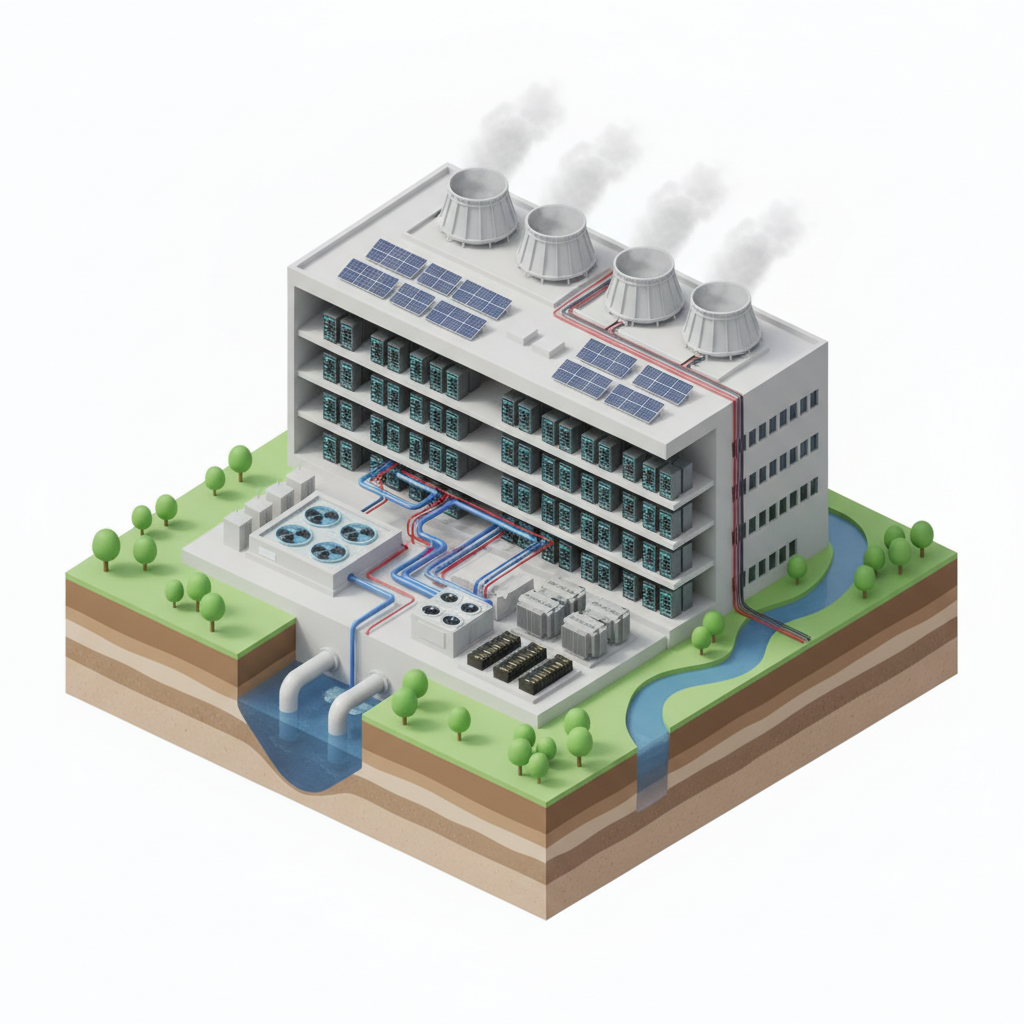
- Hyperscale data centres are large-scale facilities designed to support the computational demands of AI, cloud computing, and big data applications, typically exceeding 5,000 servers.
- These centres utilise advanced cooling systems, high-speed networks, and redundant power supplies to ensure operational efficiency and reliability.
- The energy consumption of hyperscale data centres is substantial, often requiring dedicated power plants or renewable energy sources to meet sustainability goals.
- Water usage for cooling purposes is a critical environmental concern, particularly in regions facing water scarcity, such as parts of Andhra Pradesh and Tamil Nadu.
- The rapid expansion of AI-driven applications, including generative AI, has accelerated the demand for hyperscale data centres, necessitating robust environmental governance.
- Data centres contribute to greenhouse gas (GHG) emissions, primarily through electricity consumption, which in India is still largely derived from fossil fuels.
- The integration of AI in data centres further increases energy demands due to the computational intensity of machine learning workloads.
- Regulatory frameworks for data centres in India are evolving, with the EIA Notification, 2006, and state-level policies playing a pivotal role in their approval and operation.
Key Features
| Feature | Significance |
|---|---|
| Hyperscale AI Data Centres | High-density computational infrastructure requiring substantial land, water, and electricity, with significant environmental footprints. |
| Environmental Impact Assessment (EIA) | Mandatory legal framework to evaluate ecological consequences before project approval, ensuring compliance with environmental justice principles. |
| Public Consultation | Constitutional and statutory requirement for stakeholder engagement to address social and ecological concerns in project planning. |
| Social Justice | Principle mandating equitable distribution of environmental benefits and burdens, particularly in resource-scarce regions. |
| Constitutional Compliance | Adherence to Articles 21, 48A, and 51A(g) ensuring right to life, environmental protection, and fundamental duties. |
Why it Matters
Environmental
- AI data centres contribute to carbon emissions through high energy consumption, exacerbating climate change impacts.
- Water-intensive cooling systems pose risks to local water security, particularly in water-stressed regions like Andhra Pradesh.
- Land-use changes may lead to biodiversity loss and ecosystem degradation, disrupting local ecological balances.
Economic
- Hyperscale data centres attract significant investments, potentially boosting regional GDP and employment.
- Long-term operational costs include high electricity tariffs, straining local energy infrastructure.
- Opportunity costs arise from diverting resources (land, water, power) from agriculture or other sustainable sectors.
Legal and Governance
- Lack of legislative debate on Government Orders raises concerns about transparency and democratic oversight.
- Non-compliance with EIA norms and public consultation mandates may invite judicial review under environmental laws.
- Constitutional provisions (e.g., Article 21) may be invoked to challenge projects violating environmental justice.
Social
- Displacement risks and livelihood impacts on local communities necessitate inclusive decision-making processes.
- Health concerns arise from air and water pollution, affecting vulnerable populations disproportionately.
- Cultural and traditional knowledge systems may be disrupted by large-scale industrial projects.
Challenges
1. Environmental Degradation
- Carbon-intensive operations of AI data centres may undermine India’s Nationally Determined Contributions (NDCs) under the Paris Agreement.
- Excessive water usage for cooling systems could exacerbate drought conditions in semi-arid regions.
- E-waste generation from obsolete hardware poses long-term disposal and toxicity challenges.
UPSC Link: GS3: Environmental Pollution & Degradation
2. Regulatory Gaps
- Absence of sector-specific environmental norms for hyperscale data centres in India’s EIA framework.
- Inadequate enforcement of public consultation requirements under the Environment Impact Assessment Notification, 2006.
- Lack of inter-ministerial coordination between MoEFCC, MEITY, and state governments on data centre policies.
UPSC Link: GS2: Government Policies & Interventions
3. Social Equity Concerns
- Marginalised communities bear disproportionate environmental burdens without commensurate benefits.
- Inadequate compensation mechanisms for land acquisition and livelihood losses.
- Limited awareness among local populations about their rights under environmental and constitutional laws.
UPSC Link: GS1: Social Empowerment & Inclusive Growth
4. Economic Viability
- High operational costs (energy, water, maintenance) may render projects unsustainable in the long term.
- Opportunity costs of diverting public resources to high-energy industries instead of green alternatives.
- Potential for stranded assets if projects fail to meet environmental or social compliance standards.
UPSC Link: GS3: Indian Economy & Infrastructure
5. Technological Dependence
- Over-reliance on foreign AI technologies may compromise data sovereignty and national security.
- Limited domestic capacity for sustainable data centre design and green computing solutions.
- Dependence on imported hardware increases vulnerability to supply chain disruptions.
UPSC Link: GS3: Science & Technology
Challenges — UPSC Perspective
| Issue | Concern |
|---|---|
| Carbon Footprint | AI data centres contribute ~1-2% of global emissions; India’s NDCs may be jeopardised. |
| Water Scarcity | Cooling systems in data centres consume millions of litres annually, straining local aquifers. |
| Land Acquisition | Large-scale projects may lead to displacement and loss of agricultural land. |
| Regulatory Lacunae | No specific EIA norms for data centres; existing frameworks are generic and outdated. |
| Public Participation | Lack of meaningful consultation violates constitutional and statutory rights. |
| E-Waste Management | Obsolete hardware poses toxicity risks; India lacks robust recycling infrastructure. |
Way Forward
- Enact sector-specific environmental norms for hyperscale data centres under the EIA Notification, 2006, incorporating AI-specific impacts.
- Mandate third-party audits of data centre energy and water usage to ensure transparency and compliance.
- Strengthen public consultation processes by institutionalising grievance redressal mechanisms and local stakeholder committees.
- Promote green computing initiatives, such as liquid cooling and renewable energy integration, through fiscal incentives.
- Develop national guidelines for e-waste management tailored to data centre operations, in line with the E-Waste (Management) Rules, 2022.
- Conduct regional feasibility studies to assess cumulative impacts of multiple data centres in water-stressed or ecologically sensitive zones.
- Enhance inter-ministerial coordination between MoEFCC, MEITY, and state governments to harmonise policies.
- Raise public awareness through campaigns on rights under the Environment Protection Act, 1986, and constitutional provisions.
UPSC Value Addition
Keywords for Mains Answer-Writing
AI data centres · environmental governance · Environmental Impact Assessment (EIA) · hyperscale data infrastructure · public consultation · sustainable development · constitutional environmental justice · legislative oversight · Green Visakha · Andhra Pradesh Legislative Assembly · transparency in environmental clearances · biodiversity conservation · energy-water nexus · digital infrastructure and ecology
Constitutional & Policy Linkages
- Article 21: Right to Life (includes right to healthy environment)
- Article 48A: Directive Principle on environmental protection
- Article 51A(g): Fundamental Duty to protect and improve environment
Concept Flow
Rapid expansion of AI → Increased demand for hyperscale data centres → High energy and water consumption → Environmental degradation (carbon emissions, water stress) → Land acquisition for data centres → Displacement of local communities → Social inequity and livelihood losses → Inadequate regulatory frameworks → Lack of EIA compliance → Legal challenges under environmental laws → Public consultation bypassed → Constitutional violations (Articles 21, 48A, 51A(g)) → Judicial interventions → Technological dependence → Data sovereignty risks → National security concerns → E-waste generation → Toxic disposal challenges → Long-term ecological harm → Opportunity costs → Diversion of resources from sustainable sectors → Economic inefficiency
Prelims Practice Questions
Q1. Consider the following statements regarding Environmental Impact Assessment (EIA) in India:
1. The EIA Notification, 2006 mandates public consultation for all developmental projects.
2. The Ministry of Environment, Forest and Climate Change (MoEFCC) is the nodal authority for granting environmental clearances.
3. The EIA process is governed by the provisions of the Water (Prevention and Control of Pollution) Act, 1974.
How many of the above statements are correct?
- Only one
- Only two
- All three
- None
Answer: All three — Statements 1 and 2 are correct. Statement 3 is incorrect as the EIA process is governed by the Environment (Protection) Act, 1986, not the Water Act, 1974.
Q2. Assertion (A): Hyperscale AI data centres require substantial land, water, and electricity resources, often leading to environmental degradation.
Reason (R): The Environmental Impact Assessment (EIA) 2006 Notification exempts hyperscale data centres from mandatory public consultation if they are categorised as ‘infrastructure projects’.
Options:
A. Both A and R are true, and R is the correct explanation of A.
B. Both A and R are true, but R is not the correct explanation of A.
C. A is true, but R is false.
D. A is false, but R is true.
- A
- B
- C
- D
Answer: C — Assertion (A) is true as hyperscale data centres are resource-intensive. Reason (R) is false because the EIA 2006 Notification does not exempt hyperscale data centres from mandatory public consultation; they are subject to the same EIA process as other projects.
Q3. Match the following environmental governance mechanisms in India with their respective legal bases:
Column I
1. Environmental Impact Assessment (EIA)
2. Coastal Regulation Zone (CRZ) Notification
3. National Green Tribunal (NGT) Act
4. Forest (Conservation) Act
Column II
A. Environment (Protection) Act, 1986
B. Water (Prevention and Control of Pollution) Act, 1974
C. Coastal Regulation Zone Notification, 2011
D. Forest (Conservation) Act, 1980
E. National Green Tribunal Act, 2010
- 1-A, 2-C, 3-E, 4-D; 1-B, 2-A, 3-E, 4-D; 1-A, 2-D, 3-E, 4-C; 1-E, 2-C, 3-A, 4-D
Answer: 1-A, 2-C, 3-E, 4-D; 1-B, 2-A, 3-E, 4-D; 1-A, 2-D, 3-E, 4-C; 1-E, 2-C, 3-A, 4-D — The correct matches are: 1-A (EIA is governed by the Environment (Protection) Act, 1986), 2-C (CRZ Notification is a separate notification under the Environment (Protection) Act, 1986), 3-E (NGT Act, 2010), and 4-D (Forest (Conservation) Act, 1980).
Mains Practice Question
✍ The proliferation of hyperscale AI data centres raises significant environmental, social, and legal concerns. Critically examine the adequacy of India’s existing environmental governance framework in addressing these concerns. Also, assess the role of public participation and legislative oversight in ensuring sustainable development. (15 Marks)
Approach: MODEL-ANSWER SKELETON:
1. Introduction (2 marks):
– Define hyperscale AI data centres and their resource-intensive nature (land, water, electricity, biodiversity).
– Highlight the environmental implications: carbon footprint, water consumption, e-waste, and land-use change.
2. Legal and Institutional Framework (4 marks):
– Discuss the Environment (Protection) Act, 1986, and the EIA Notification, 2006, as the primary legal instruments.
– Explain the role of the Ministry of Environment, Forest and Climate Change (MoEFCC) and State Environment Impact Assessment Authorities (SEIAAs).
– Mention the National Green Tribunal (NGT) Act, 2010, and its jurisdiction over environmental disputes.
– Reference the Coastal Regulation Zone (CRZ) Notification, 2011, and Forest (Conservation) Act, 1980, where applicable.
3. Public Participation and Transparency (4 marks):
– Analyse the provisions for public consultation under the EIA Notification, 2006, and their effectiveness.
– Discuss the role of NGOs like Green Visakha in raising awareness and advocating for environmental justice.
– Critique the lack of legislative debate in the Andhra Pradesh Assembly regarding Government Orders for such projects.
– Highlight the importance of the Right to Information (RTI) Act, 2005, in ensuring transparency.
4. Legislative Oversight and Sustainable Development (3 marks):
– Examine the role of the Legislature in scrutinising Executive decisions on environmental clearances.
– Discuss the principle of sustainable development as enshrined in the Constitution (Article 21, 48A, and 51A(g)).
– Reference judicial precedents such as the ‘Vellore Citizens’ Welfare Forum v. Union of India’ (1996) case on sustainable development.
5. Conclusion (2 marks):
– Summarise the gaps in the current framework: lack of sector-specific guidelines for data centres, inadequate public participation, and weak legislative oversight.
– Propose measures: mandatory EIA for hyperscale data centres, stricter compliance with environmental laws, and greater transparency in decision-making.
– Emphasise the need for a balance between technological advancement and environmental sustainability.
Source: The Hindu
Generated by AanyaAi for educational purpose.


No Comments