


27 Jul ESIC Extends ABVKY Scheme: Key Eligibility & Benefits for UPSC Aspirants
Subject Relevance — Where This Topic Fits
- GS Paper II — Governance, Welfare Schemes for Vulnerable Sections | GS Paper III — Employment, Labour Reforms, and Social Security
- Prelims: Atal Bimit Vyakti Kalyan Yojana (ABVKY), Employees’ State Insurance Corporation (ESIC), Direct Benefit Transfer (DBT), Unemployment Insurance, Insured Persons (IPs), Contribution Period, Misconduct and Lockout Provisions, Employees’ State Insurance Act, 1948
- Essay: Social security as a pillar of inclusive growth in India, The role of formal sector employment in mitigating unemployment risks
Quick Revision: ABVKY provides unemployment relief to insured persons in India’s formal sector, requiring 12 months of continuous contributory employment and a minimum of 78 contribution days in one of the preceding 12 months, with benefits disbursed via DBT.
Why is this in the news?
The Employees’ State Insurance Corporation (ESIC) has extended the Atal Bimit Vyakti Kalyan Yojana (ABVKY) for a further period from 01 July 2026 to 30 June 2027, as announced by the Ministry of Labour and Employment. This extension underscores the scheme’s continued relevance in providing unemployment relief to insured persons in India’s formal sector, while also highlighting recent enhancements in claim settlement mechanisms to ensure timely disbursement of benefits.
Background
- The Employees’ State Insurance Corporation (ESIC) operates under the Employees’ State Insurance Act, 1948, providing social security to workers in India’s formal sector.
- ABVKY was launched as a welfare measure to offer cash compensation to insured persons who become unemployed involuntarily, thereby mitigating income loss during joblessness.
- The scheme is a component of India’s broader social security architecture, complementing other initiatives such as the Employees’ Provident Fund Organisation (EPFO) schemes and the Pradhan Mantri Rojgar Protsahan Yojana (PMRPY).
- ESIC’s coverage has expanded over the years, with over 3.5 crore insured persons as of recent estimates, reflecting the growing formalisation of India’s labour market.
- The scheme’s design aligns with international best practices in unemployment insurance, balancing fiscal sustainability with social protection.
- Recent extensions and operational improvements reflect the government’s commitment to strengthening formal employment-linked social security systems.
What is the Atal Bimit Vyakti Kalyan Yojana (ABVKY)?
- ABVKY is a welfare scheme administered by the Employees’ State Insurance Corporation (ESIC) under the Ministry of Labour and Employment, Government of India.
- The scheme provides cash relief to insured persons (IPs) who lose their employment involuntarily, subject to specified eligibility criteria.
- It aims to offer financial support during the period of unemployment, thereby reducing the economic vulnerability of formal sector workers.
- The scheme is funded through contributions made by employers and employees under the Employees’ State Insurance Act, 1948.
- ABVKY operates on a contributory basis, requiring insured persons to have contributed for a minimum period before becoming eligible for benefits.
- The scheme excludes unemployment arising from misconduct, lockouts, voluntary retirement, or fraudulent declarations under the ESI Act.
- Benefits are disbursed through Direct Benefit Transfer (DBT) to the bank accounts of eligible claimants, ensuring transparency and efficiency.
- The scheme’s operational framework includes online claim submission, automated processing, and real-time monitoring to expedite benefit disbursement.
Key Features
| Feature | Significance |
|---|---|
| Duration Extension (01.07.2026–30.06.2027) | Ensures continuity of unemployment benefits for insured workers during the fiscal year 2026-27, maintaining social security coverage. |
| Eligibility Criteria (12-month continuous insurable employment) | Establishes a minimum contribution period to qualify for unemployment benefits, ensuring genuine workforce participation. |
| Minimum Contribution Requirement (78 days in a contribution period) | Prevents misuse while providing a threshold for benefit eligibility, balancing inclusivity and fiscal prudence. |
| Exclusion Clauses (Misconduct, Lockout, Retirement, False Statements) | Safeguards the scheme from abuse and ensures benefits are directed to involuntary unemployment cases. |
| Digital Claim Processing & DBT | Enhances transparency, reduces delays, and ensures timely disbursement of benefits through direct bank transfers. |
| Monitoring Mechanism for Claim Settlement | Institutionalizes accountability in benefit distribution, reducing pendency and improving beneficiary experience. |
Why it Matters
Social Security Framework
- Reinforces India’s commitment to the ILO’s Social Security (Minimum Standards) Convention, 1952, by providing unemployment benefits to formal sector workers.
- Complements the Employees’ State Insurance Act, 1948, by offering a safety net for insured persons during job loss, thereby reducing vulnerability.
- Aligns with Sustainable Development Goal 1 (No Poverty) and SDG 8 (Decent Work and Economic Growth) by mitigating income shocks for workers.
Economic Resilience
- Acts as an automatic stabiliser during economic downturns, preventing a sharp decline in household consumption and aggregate demand.
- Reduces the financial burden on informal support systems (e.g., family networks) by providing a structured unemployment benefit.
- Supports formal employment ecosystems by reducing the risk premium for hiring in sectors with cyclical employment.
Governance & Implementation
- Demonstrates the efficacy of digital governance in social welfare delivery, reducing leakages and improving beneficiary targeting.
- Highlights the role of ESIC as a quasi-autonomous body in administering unemployment benefits under the ESI framework.
- Showcases inter-ministerial coordination between the Ministry of Labour and Employment and the Ministry of Finance for DBT implementation.
Challenges
1. Low Awareness Among Beneficiaries
- Limited outreach to insured workers, particularly in the informalised segments of the formal sector, may exclude eligible individuals.
- Lack of awareness campaigns in regional languages and digital literacy barriers hinder claim filing.
UPSC Link: GS-II: Welfare schemes
2. Fiscal Sustainability
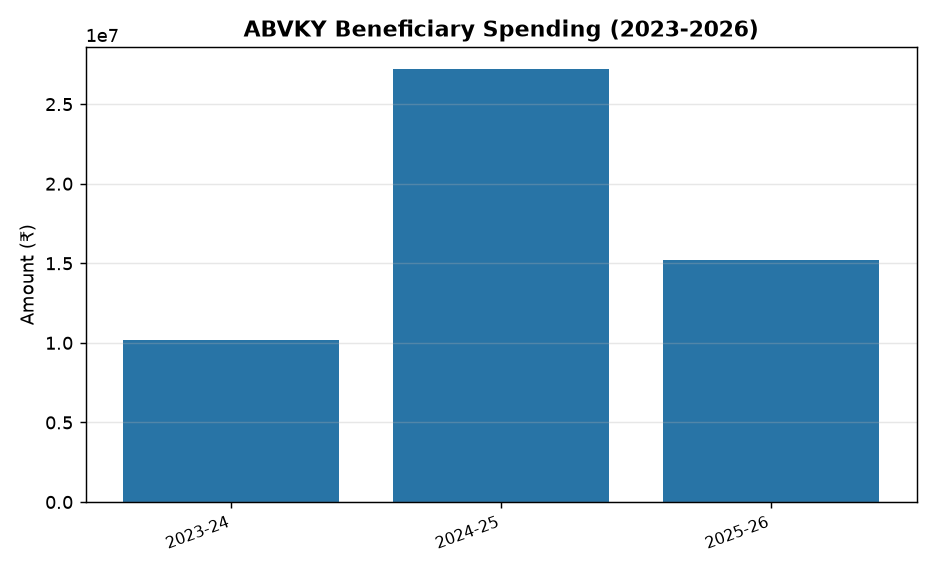
- The scheme’s expenditure has fluctuated (₹1.02 crore in 2023-24, ₹2.72 crore in 2024-25, ₹1.52 crore in 2025-26), raising concerns about long-term funding.
- Dependence on ESIC’s surplus may be unsustainable if unemployment rates rise or contribution collections decline.
UPSC Link: GS-III: Fiscal policy
3. Implementation Gaps
- Delays in claim processing, despite digitalisation, may persist due to manual verification requirements or system bottlenecks.
- Regional disparities in ESIC office efficiency could lead to unequal access to benefits.
UPSC Link: GS-II: Governance
4. Exclusion of Informal Workers
- The scheme covers only insurable employment under the ESI Act, excluding the majority of India’s workforce in the informal sector.
- Gig workers, self-employed individuals, and contractual labourers remain outside the ambit of ABVKY.
UPSC Link: GS-II: Labour reforms
Challenges — UPSC Perspective
| Issue | Concern |
|---|---|
| Coverage Gap | Excludes informal and gig economy workers, limiting the scheme’s inclusivity. |
| Funding Fluctuations | Volatility in annual expenditure may strain ESIC’s financial health. |
| Digital Divide | Beneficiaries in rural or low-literacy areas may face difficulties in claim submission. |
| Verification Bottlenecks | Manual checks for misconduct or false statements may cause delays. |
| Regional Inequities | Variations in ESIC office performance may lead to unequal benefit access. |
Government Initiatives — Must-Memorise for Prelims
- Employees’ State Insurance Scheme (ESIS)
Way Forward
- Expand awareness campaigns through ESIC offices, labour unions, and digital platforms to enhance beneficiary participation.
- Introduce a graded contribution structure for employers to ensure long-term fiscal sustainability of the scheme.
- Strengthen regional ESIC offices with additional staff and training to reduce claim processing delays.
- Pilot a voluntary extension of ABVKY to gig workers and self-employed individuals under a separate framework.
- Integrate ABVKY with other social security schemes (e.g., PM-SYM) to create a unified unemployment insurance system.
- Conduct periodic impact assessments to evaluate the scheme’s effectiveness in reducing poverty and economic distress.
- Explore public-private partnerships for last-mile delivery of benefits, leveraging fintech solutions.
- Harmonise ABVKY with state-level unemployment schemes to ensure portability for migrant workers.
UPSC Value Addition
Keywords for Mains Answer-Writing
Atal Bimit Vyakti Kalyan Yojana (ABVKY) · Employees’ State Insurance Corporation (ESIC) · unemployment insurance · contribution period · Direct Benefit Transfer (DBT) · social security · formal employment · labour welfare · contribution-based benefits · unemployment allowance · ESIC Act 1948 · benefit claim settlement · wage loss compensation · formal sector workers · social protection framework
Constitutional & Policy Linkages
- Directive Principles of State Policy (Article 38, 41, 43)
Concept Flow
Formal employment under ESI Act → Contribution to ESIC fund → Job loss (involuntary) → Eligibility check (12-month employment + 78-day contribution) → Claim submission → Digital processing → DBT to beneficiary → Income support during unemployment → Economic stabilisation.
Prelims Practice Questions
Q1. Which of the following is NOT a condition for eligibility under the Atal Bimit Vyakti Kalyan Yojana (ABVKY)?
- The beneficiary must have been in insurable employment for at least 12 continuous months prior to unemployment.
- The beneficiary must have contributed for at least 78 days in any one full contribution period within the 12 months preceding unemployment.
- Unemployment must have occurred due to misconduct or voluntary retirement.
- The beneficiary must not have been dismissed for reasons specified under the ESIC Act, 1948.
Answer: Unemployment must have occurred due to misconduct or voluntary retirement. — Unemployment due to misconduct, lockout, voluntary retirement, or misstatement under the ESIC Act disqualifies the beneficiary. Hence, unemployment due to misconduct is NOT a valid condition for eligibility.
Q2. Which of the following initiatives has been implemented to expedite claim settlement under the Atal Bimit Vyakti Kalyan Yojana (ABVKY)?
- Mandatory physical submission of claims at ESIC offices.
- Direct Benefit Transfer (DBT) to beneficiaries’ bank accounts.
- Disbursement of benefits only through physical cheques.
- Exclusion of claims submitted online from processing priority.
Answer: Direct Benefit Transfer (DBT) to beneficiaries’ bank accounts. — The scheme mandates online submission and processing of claims, with benefits disbursed via Direct Benefit Transfer (DBT) to ensure timely payment and transparency.
Q3. Under the Atal Bimit Vyakti Kalyan Yojana (ABVKY), the minimum contribution period required for eligibility is:
- 30 days in any one contribution period within the preceding 12 months.
- 78 days in any one contribution period within the preceding 12 months.
- 90 days in any one contribution period within the preceding 12 months.
- 120 days in any one contribution period within the preceding 12 months.
Answer: 78 days in any one contribution period within the preceding 12 months. — The eligibility criterion specifies that the beneficiary must have contributed for at least 78 days in any one full contribution period within the 12 months preceding unemployment.
Mains Practice Question
✍ Examine the significance of the Atal Bimit Vyakti Kalyan Yojana (ABVKY) in the context of India’s social security architecture. How does the scheme address the vulnerabilities of formal sector workers during unemployment? Substantiate your answer with reference to the eligibility criteria, benefit disbursement mechanisms, and recent trends in claim settlement.
Approach: Begin by contextualising ABVKY within India’s broader social security framework, highlighting its role as a contributory unemployment insurance scheme under the Employees’ State Insurance Corporation (ESIC). Analyse the eligibility criteria to demonstrate how they balance inclusivity with fiscal sustainability, particularly the 12-month continuous employment and 78-day contribution requirements. Discuss the administrative reforms, such as online claim submission and DBT, which enhance transparency and efficiency. Conclude by evaluating the scheme’s impact using the provided data on claim settlements from 2023-24 to 2025-26, and suggest measures to further strengthen its effectiveness in mitigating wage loss for formal sector workers.
Source: PIB (Press Information Bureau)
Generated by AanyaAi for educational purpose.

- PM Vishwakarma Yojana Completes 3 Years: 30 Lakh Artisans Registered - September 16, 2026
- डीएफपीडी विशेष अभियान 6: 2 से 31 अक्टूबर 2026 तक स्वच्छता एवं दक्षता अभियान - September 16, 2026
- DFPD’s Special Campaign 6: Key Focus Areas for UPSC & State PCS - September 16, 2026

No Comments