


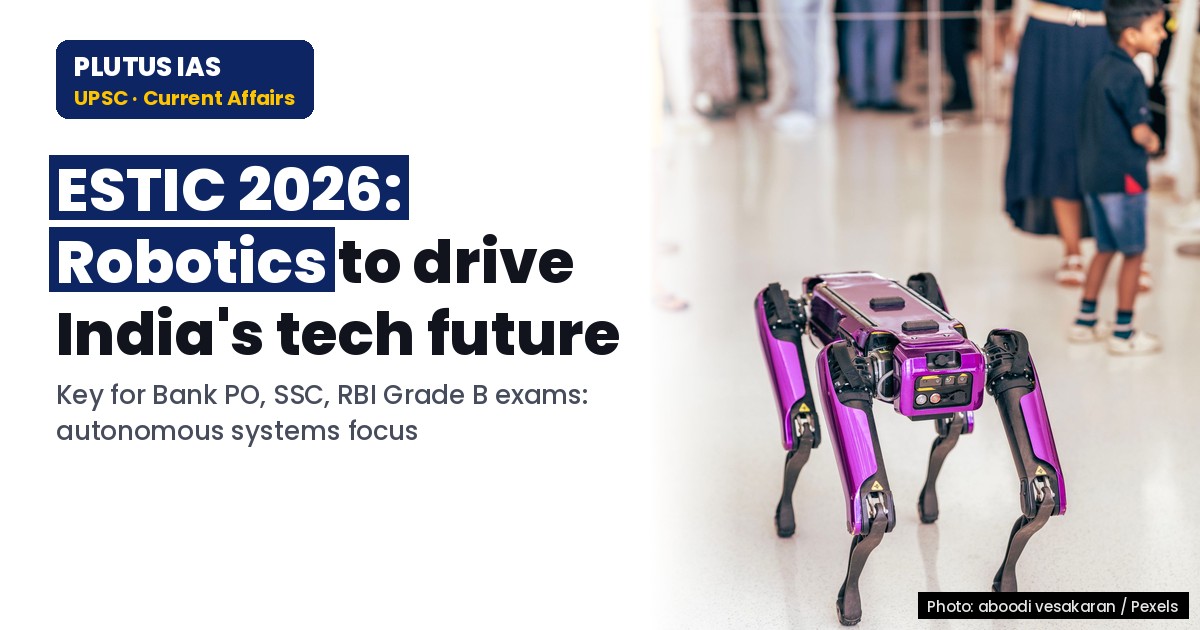
15 Oct ESTIC 2026: Why Autonomous Systems & Robotics Matter for UPSC & State PCS
✎ Autonomous Systems, Physical AI, and Robotics represent the convergence of digital intelligence with physical actuation, requiring a multi-disciplinary governance approach that balances innovation with ethical, safety, and…
Subject Relevance — Where This Topic Fits
- GS Paper III — Science and Technology — Developments and their Applications and Effects in Everyday Life | GS Paper III — Science and Technology — Awareness in the fields of IT, Space, Computers, Robotics, Nano-technology, Bio-technology | GS Paper II — Governance, Transparency and Accountability — Government Policies and Interventions for Development in various sectors | GS Paper III — Security — Challenges to Internal Security through Communication Networks
- Prelims: Autonomous Systems, Physical AI, Robotics, ESTIC 2026, NITI Aayog, National Mission on Interdisciplinary Cyber-Physical Systems (NM-ICPS), Defence Research and Development Organisation (DRDO), Atal Innovation Mission (AIM), Digital India, National AI Strategy
- Essay: The Intersection of Artificial Intelligence and Human Agency: Ethical, Economic, and Strategic Dimensions, India’s Technological Sovereignty: Balancing Innovation with Inclusion in the Age of Autonomous Systems
Quick Revision: Autonomous Systems, Physical AI, and Robotics represent the convergence of digital intelligence with physical actuation, requiring a multi-disciplinary governance approach that balances innovation with ethical, safety, and regulatory considerations.
Why is this in the news?
The curtain-raiser for the ESTIC 2026 (Emerging Science and Technology International Conference) has underscored the critical importance of Autonomous Systems, Physical AI, and Robotics as transformative technologies for India’s future. This emphasis aligns with global trends in Industry 4.0 and the increasing convergence of digital, physical, and biological systems, necessitating a proactive governance framework to harness their potential while mitigating risks.
Background
- The Government of India, through NITI Aayog and the Department of Science and Technology, has been actively promoting research and development in autonomous systems and robotics under the National Mission on Interdisciplinary Cyber-Physical Systems (NM-ICPS), launched in 2018 with a budgetary outlay of ₹3,660 crore.
- The Atal Innovation Mission (AIM) has established Atal Tinkering Labs (ATLs) and Atal Incubation Centres (AICs) to foster grassroots innovation in robotics and AI, with over 10,000 ATLs operational across the country.
- India’s Defence Research and Development Organisation (DRDO) has been developing autonomous defence systems, including unmanned ground vehicles (UGVs) and unmanned aerial vehicles (UAVs), to enhance operational capabilities and reduce human risk in high-risk environments.
- The National AI Strategy, released in 2018, identifies robotics and autonomous systems as key thrust areas for India’s AI ecosystem, aiming to position the country as a global leader in ethical AI deployment.
- The ESTIC series, organised by the Office of the Principal Scientific Adviser to the Government of India, serves as a platform for dialogue between policymakers, industry leaders, and academia to shape India’s science and technology agenda for the coming decade.
What are Autonomous Systems, Physical AI, and Robotics?
- Autonomous Systems refer to machines or networks capable of performing tasks independently, without human intervention, by integrating sensors, actuators, and decision-making algorithms. These systems operate in dynamic environments, requiring real-time data processing and adaptive responses.
- Physical AI is a subset of artificial intelligence that focuses on enabling AI systems to interact with and manipulate the physical world. It bridges the gap between digital algorithms and real-world applications, such as robotic arms in manufacturing or autonomous vehicles in logistics.
- Robotics encompasses the design, construction, operation, and application of robots to perform tasks traditionally carried out by humans. Modern robotics integrates AI, machine learning, and advanced materials to create systems capable of dexterity, mobility, and decision-making.
- Autonomous Systems and Robotics are classified into four broad categories: (a) Industrial Robotics (e.g., robotic arms in manufacturing), (b) Service Robotics (e.g., healthcare assistants or cleaning robots), (c) Autonomous Vehicles (e.g., self-driving cars or drones), and (d) Defence Robotics (e.g., UAVs or unmanned ground systems).
- Physical AI relies on a combination of hardware (e.g., sensors, actuators, and embedded systems) and software (e.g., machine learning models, control algorithms) to enable real-world interaction. Key enabling technologies include computer vision, natural language processing, and reinforcement learning.
- The integration of AI with robotics has led to the development of ‘cobots’ (collaborative robots), which work alongside humans in shared workspaces, enhancing productivity while ensuring safety through advanced sensing and control systems.
- Autonomous Systems are governed by ethical and legal frameworks to ensure accountability, transparency, and human oversight. The IEEE Global Initiative on Ethics of Autonomous Systems and India’s AI Ethics Framework provide guiding principles for responsible deployment.
- The economic potential of these technologies is significant, with the global robotics market projected to reach USD 77.3 billion by 2025, and India’s domestic market expected to grow at a CAGR of 17.4% over the same period, driven by sectors such as manufacturing, healthcare, and agriculture.
Key Features
| Feature | Significance |
|---|---|
| Autonomous Systems | Enable machines to operate independently in dynamic environments, reducing human intervention and enhancing efficiency in sectors like logistics, agriculture, and disaster response. |
| Physical AI | Bridges the gap between digital intelligence and real-world interaction, critical for robotics in manufacturing, healthcare, and infrastructure maintenance. |
| Robotics | Facilitates precision tasks in hazardous or repetitive environments, improving safety and productivity in industries such as mining, construction, and space exploration. |
| Interdisciplinary Integration | Combines AI, robotics, and autonomous systems with domain expertise (e.g., agriculture, healthcare) to drive innovation and address complex challenges. |
| Global Competitiveness | Positions India as a leader in emerging technologies, aligning with global trends in Industry 4.0 and smart automation. |
Why it Matters
Economic Growth
- Enhances productivity and cost-efficiency across industries by automating routine and high-precision tasks, reducing operational expenses.
- Fosters innovation in manufacturing, agriculture, and services, creating high-skilled employment opportunities in emerging tech sectors.
- Attracts foreign direct investment (FDI) and domestic capital into R&D, positioning India as a hub for advanced manufacturing and automation.
Strategic Autonomy
- Reduces dependence on imported technologies in critical sectors like defense, healthcare, and infrastructure through indigenous development.
- Strengthens national security by enabling autonomous systems for surveillance, border monitoring, and disaster management.
- Supports self-reliance (Atmanirbhar Bharat) in high-tech domains, aligning with India’s long-term technological sovereignty goals.
Social and Environmental Impact
- Improves public service delivery in healthcare (e.g., robotic-assisted surgeries) and agriculture (e.g., autonomous farming equipment) for inclusive growth.
- Enables precision resource management in water, energy, and waste sectors, contributing to sustainability and climate resilience.
- Enhances safety in hazardous environments (e.g., mining, chemical industries) by deploying robots for inspection and intervention.
Governance and Policy
- Requires robust regulatory frameworks for safety, ethics, and accountability in autonomous systems, ensuring public trust and compliance.
- Demands cross-sectoral collaboration between government, academia, and industry to accelerate research and commercialization.
- Necessitates investment in STEM education and skill development to build a workforce capable of designing, deploying, and maintaining advanced systems.
Challenges
1. Regulatory and Ethical Concerns
- Lack of standardized regulations for autonomous systems, particularly in areas like liability, data privacy, and algorithmic bias.
- Ethical dilemmas in decision-making by AI-driven systems (e.g., autonomous vehicles, medical diagnostics) requiring clear governance frameworks.
- Need for international cooperation to harmonize standards and prevent regulatory arbitrage in global supply chains.
UPSC Link: GS-III: Science & Tech (Ethics in AI)
2. Technological and Infrastructure Gaps
- Limited indigenous capability in high-end semiconductor manufacturing, which is critical for advanced AI and robotics hardware.
- Inadequate digital infrastructure (e.g., high-speed connectivity, cloud computing) in rural and remote areas hindering deployment.
- High costs of R&D and commercialization, particularly for small and medium enterprises (SMEs) in the automation sector.
UPSC Link: GS-III: Science & Tech (Industry 4.0)
3. Workforce Transformation
- Risk of job displacement in traditional sectors due to automation, necessitating reskilling and upskilling initiatives.
- Shortage of skilled professionals in AI, robotics, and autonomous systems engineering, exacerbated by brain drain and talent gaps.
- Need for multidisciplinary training programs to bridge the gap between technical expertise and domain-specific applications.
UPSC Link: GS-III: Employment & Skill Development
4. Security and Cyber Threats
- Vulnerability of autonomous systems to cyber-attacks, which could disrupt critical infrastructure or compromise sensitive data.
- Risk of misuse of autonomous technologies in warfare, espionage, or criminal activities, requiring robust safeguards.
- Dependence on foreign technologies in certain components (e.g., sensors, processors) raising concerns about supply chain vulnerabilities.
UPSC Link: GS-III: Internal Security (Cyber Threats)
5. Public Acceptance and Trust
- Skepticism among the public regarding the reliability and safety of autonomous systems, particularly in healthcare and transportation.
- Need for transparent communication and demonstration of benefits to build trust in emerging technologies.
- Cultural and societal resistance to automation in certain sectors, requiring targeted awareness campaigns.
UPSC Link: GS-IV: Ethics & Governance
Challenges — UPSC Perspective
| Issue | Concern |
|---|---|
| Regulatory Gaps | Absence of clear legal frameworks for liability, safety, and compliance in autonomous systems. |
| Ethical Dilemmas | Unresolved questions on accountability and fairness in AI-driven decision-making. |
| Infrastructure Deficit | Inadequate digital and physical infrastructure for large-scale deployment of advanced technologies. |
| Skill Shortage | Lack of a trained workforce to design, deploy, and maintain autonomous systems. |
| Cyber Vulnerabilities | Exposure of autonomous systems to hacking, data breaches, and supply chain attacks. |
| Public Skepticism | Low trust in autonomous technologies due to perceived risks and lack of awareness. |
Way Forward
- Establish a National Autonomous Systems Mission under the Ministry of Electronics and Information Technology (MeitY) to coordinate R&D, funding, and policy across sectors.
- Develop a National AI and Robotics Policy to address regulatory gaps, ethical concerns, and standardization for autonomous systems.
- Invest in semiconductor manufacturing and advanced computing infrastructure to reduce dependence on imports and support domestic innovation.
- Launch a National Reskilling Program in collaboration with industry and academia to upskill workers for the automation economy.
- Create a regulatory sandbox for testing autonomous systems in controlled environments to accelerate innovation while ensuring safety.
- Strengthen international partnerships (e.g., with QUAD, EU) to share best practices, harmonize standards, and access cutting-edge technologies.
- Promote public-private partnerships (PPPs) to fund pilot projects in healthcare, agriculture, and disaster management using autonomous systems.
- Enhance STEM education at all levels, with a focus on AI, robotics, and autonomous systems, to build a future-ready workforce.
UPSC Value Addition
Keywords for Mains Answer-Writing
Autonomous Systems · Physical Artificial Intelligence · Robotics · Emerging Technologies · Defence Modernisation · Science & Technology Policy · Institutional Frameworks for R&D · Public-Private Partnerships in Technology · National AI Mission · Ethical Governance of AI · Strategic Autonomy · Make in India in Defence · Defence Research and Development Organisation (DRDO) · Technology Readiness Levels (TRL) · Indigenous Innovation · Global Technology Trends
Concept Flow
Emergence of Autonomous Systems → Advances in AI and Robotics → Need for Physical AI Integration → Policy and Regulatory Gaps → Governance and Ethical Challenges → Public Trust and Acceptance → Framework for Standardization and Safety → National Mission for Scalable Deployment → Economic and Strategic Benefits
Prelims Practice Questions
Q1. Consider the following statements regarding Autonomous Systems and Physical Artificial Intelligence (AI):
1. Autonomous Systems are capable of performing tasks without human intervention.
2. Physical AI integrates AI algorithms with robotic hardware to enable real-world interaction.
3. The Defence Research and Development Organisation (DRDO) has developed indigenous autonomous drones for surveillance.
4. Autonomous Systems are currently limited to software applications and cannot operate in physical environments.
How many of the above statements are correct?
- Only one
- Only two
- Only three
- All four
Answer: Only three — Statements 1, 2, and 3 are correct. Statement 4 is incorrect as Autonomous Systems, particularly when integrated with Physical AI, can operate in physical environments such as drones, robots, and autonomous vehicles.
Q2. Assertion (A): The integration of Physical AI with robotics is essential for achieving strategic autonomy in defence technologies.
Reason (R): Physical AI enables robotic systems to perform complex tasks in dynamic environments without constant human oversight.
Options:
A. Both A and R are true, and R is the correct explanation of A.
B. Both A and R are true, but R is not the correct explanation of A.
C. A is true, but R is false.
D. A is false, but R is true.
Answer: ? — Both Assertion (A) and Reason (R) are true, and Reason (R) correctly explains Assertion (A). Physical AI enhances the capability of robotic systems to operate autonomously, which is critical for strategic autonomy in defence.
Q3. Match the following technological domains with their primary applications in Autonomous Systems and Robotics:
Column I
1. Computer Vision
2. Reinforcement Learning
3. Edge Computing
4. Sensor Fusion
Column II
A. Enables real-time decision-making in robots
B. Processes data locally on robotic hardware
C. Combines data from multiple sensors for navigation
D. Allows machines to interpret visual data from cameras
Options:
A. 1-D, 2-A, 3-B, 4-C
B. 1-C, 2-D, 3-A, 4-B
C. 1-B, 2-A, 3-D, 4-C
D. 1-A, 2-C, 3-B, 4-D
Answer: ? — The correct match is: 1-D (Computer Vision allows machines to interpret visual data from cameras), 2-A (Reinforcement Learning enables real-time decision-making in robots), 3-B (Edge Computing processes data locally on robotic hardware), and 4-C (Sensor Fusion combines data from multiple sensors for navigation).
Mains Practice Question
✍ The integration of Autonomous Systems, Physical Artificial Intelligence (AI), and Robotics is increasingly being recognised as a cornerstone for achieving strategic autonomy in critical sectors such as defence, healthcare, and manufacturing. Critically examine the institutional, technological, and ethical dimensions of this integration in the Indian context. (15 Marks)
Approach: MODEL-ANSWER SKELETON:
1. **Institutional Dimensions** (4 points):
– Role of DRDO, ISRO, and CSIR in developing indigenous autonomous systems and robotics.
– National AI Mission and its focus on Physical AI and robotics.
– Public-Private Partnerships (PPP) and Make in India initiatives in defence and technology sectors.
– Regulatory frameworks: National AI Strategy, AI Ethics Framework, and guidelines for autonomous systems.
2. **Technological Dimensions** (5 points):
– Definition and scope of Autonomous Systems, Physical AI, and Robotics.
– Key technologies: Computer Vision, Sensor Fusion, Edge Computing, Reinforcement Learning, and Human-Robot Interaction.
– Technology Readiness Levels (TRL) in India: indigenous drones, robotic arms, and autonomous vehicles.
– Challenges: Data quality, computational power, interoperability, and scalability.
– Success stories: Examples like DRDO’s autonomous surveillance drones, ISRO’s robotic systems for space exploration, and indigenous robotic arms for manufacturing.
3. **Ethical and Governance Dimensions** (4 points):
– Ethical concerns: Bias in AI, accountability for autonomous decisions, and job displacement.
– Governance frameworks: Need for a robust regulatory mechanism to ensure safety, transparency, and accountability.
– Global best practices: EU AI Act, IEEE Standards for Autonomous Systems, and India’s approach.
– Balancing innovation with ethical considerations: Role of institutions like NITI Aayog and the proposed AI regulatory body.
4. **Strategic Autonomy and Future Outlook** (2 points):
– How integration of these technologies contributes to strategic autonomy in defence, healthcare, and manufacturing.
– Future roadmap: Vision for 2030, including indigenous innovation, skill development, and global collaborations.
Source: PIB (Press Information Bureau)
Generated by AanyaAi for educational purpose.
Related guides on our sites
- Current affairs for upsc 2026
- How to prepare for GS paper 1 for UPSC CSE mains exam
- Best UPSC coaching for IFOS exam
- Best mentorship programme for upsc

- NAMASTE Scheme: Enhancing Sanitation Workers’ Livelihoods & Safety - November 14, 2026
- एमएसएमई का विशेष अभियान 6.0: स्वच्छता और लंबित मामलों का निपटारा - November 14, 2026
- Sea Vigil-26: Coastal Defence Drills Off Visakhapatnam - November 14, 2026

No Comments