


10 Nov EU Budget Dispute Threatens Global Gateway in Southeast Asia
✎ The EU Global Gateway strategy is a significant infrastructure and connectivity initiative aimed at bolstering the EU's global influence and offering a values-based investment alternative, particularly in Southeast Asia, but its…
Subject Relevance — Where This Topic Fits
- GS Paper II — International Relations | GS Paper III — Economy
- Prelims: Global Gateway Strategy, European Union (EU), Association of Southeast Asian Nations (ASEAN), Multiannual Financial Framework (MFF), Geopolitical Competition, Infrastructure Development
- Essay: The evolving landscape of international development cooperation and its geopolitical implications., The role of multilateral institutions in fostering sustainable development and regional connectivity.
Quick Revision: The EU Global Gateway strategy is a significant infrastructure and connectivity initiative aimed at bolstering the EU’s global influence and offering a values-based investment alternative, particularly in Southeast Asia, but its funding is currently jeopardised by internal EU budgetary disputes.
Why is this in the news?
The European Union’s Global Gateway strategy, aimed at strengthening connectivity and infrastructure development in Southeast Asia, faces uncertainty due to an ongoing budget dispute within the EU. Disagreements over the bloc’s Multiannual Financial Framework (MFF) for 2028-2034 threaten the funding allocated for overseas development initiatives, including the substantial Global Europe external financing instrument, potentially impacting the EU’s strategic engagement in the region.
Background
- The Global Gateway strategy was launched by the European Union in 2022 to enhance connectivity, promote green transition projects, and support infrastructure development globally, with a significant focus on Southeast Asia.
- This initiative is designed to offer an alternative source of investment and deepen engagement with the Association of Southeast Asian Nations (ASEAN), a region where China’s economic influence is notably dominant.
- The strategy is backed by a public funding commitment of 10 billion euros through 2027, demonstrating the EU’s ambition to expand its presence and influence.
- The current budgetary impasse revolves around the EU’s 2028-2034 Multiannual Financial Framework (MFF), which is the bloc’s long-term budget.
- The European Commission’s proposal for the MFF included a substantial increase for its Global Europe external financing instrument, from 79.5 billion euros to 200 billion euros.
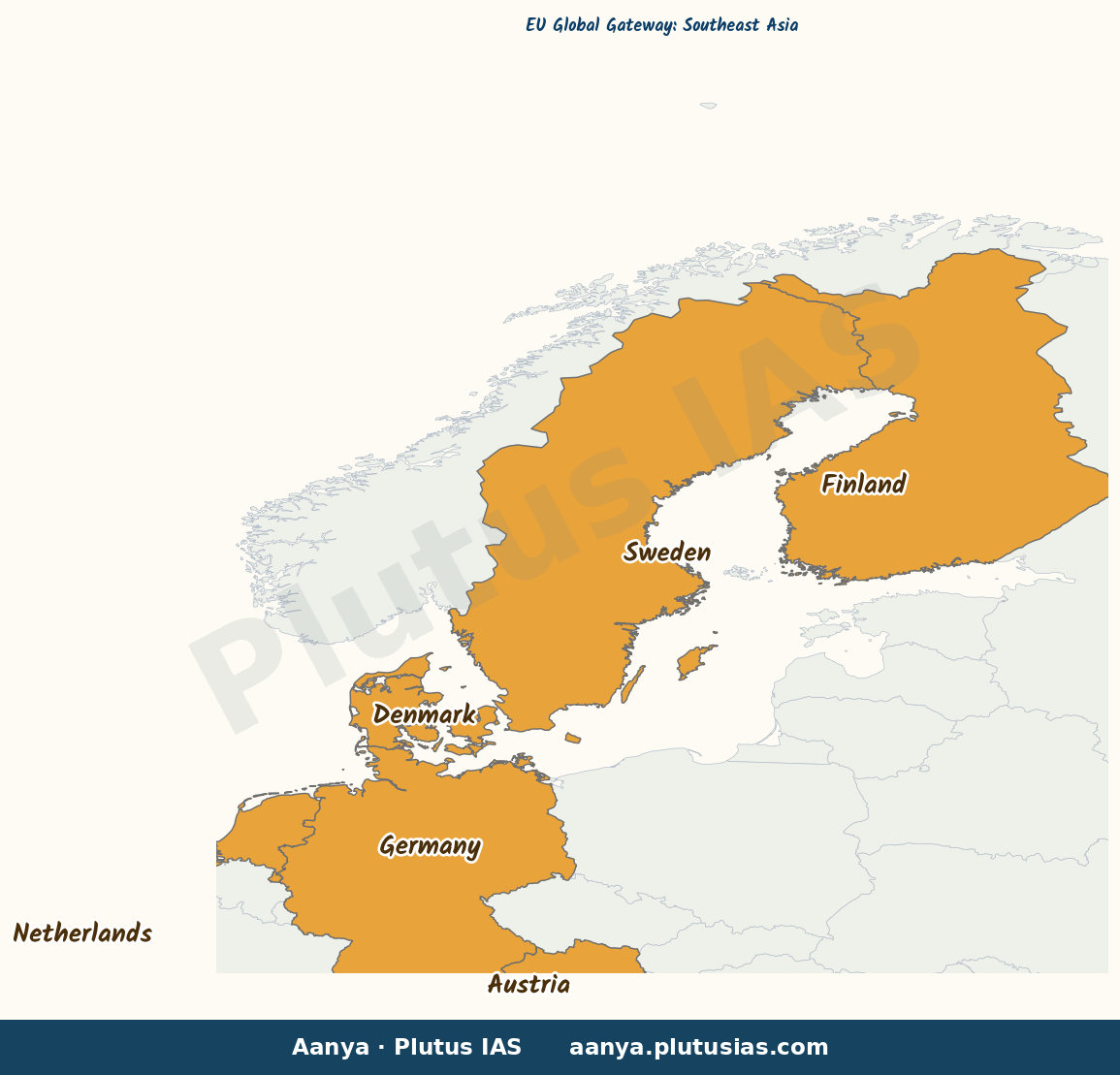
- Several fiscally conservative member states, including Germany, Austria, Denmark, the Netherlands, Finland, and Sweden, have resisted this proposed increase, advocating for significant reductions due to domestic economic pressures and concerns over rising EU spending commitments.
- A compromise proposal from the Irish presidency of the Council of the EU suggests cutting Global Europe funding to 148.9 billion euros, which is approximately 25 per cent below the Commission’s original proposal.
- This proposed reduction has drawn criticism from members of the European Parliament, who argue that diminishing external funding could weaken Europe’s geopolitical influence and capacity for engagement in an increasingly competitive global environment.
What is the EU Global Gateway Strategy?
- The Global Gateway is the European Union’s new strategy to boost smart, clean, and secure connections in digital, energy, and transport sectors, and to strengthen health, education, and research systems across the world.
- It aims to mobilise up to 300 billion euros in investments between 2021 and 2027, leveraging both public and private sector funding.
- The strategy is presented as a values-based alternative to other infrastructure investment models, emphasising transparency, good governance, environmental sustainability, and social and labour rights.
- It is designed to support partner countries in addressing their infrastructure needs while promoting the EU’s strategic interests and values globally.
- The Global Gateway is a key component of the EU’s broader geopolitical agenda, seeking to enhance its influence and foster stronger partnerships in regions like Africa, Latin America, and Asia, particularly Southeast Asia.
- It focuses on five key areas: digital, climate and energy, transport, health, and education and research.
- The initiative seeks to strengthen the EU’s engagement with regional blocs such as ASEAN, providing an alternative to existing dominant economic influences in these regions.
- Funding for the Global Gateway is primarily drawn from the EU’s external financing instruments, including the Neighbourhood, Development and International Cooperation Instrument – Global Europe (NDICI-Global Europe).
Key Features
| Feature | Significance |
|---|---|
| EU-ASEAN Global Gateway Strategy | A flagship initiative launched in 2022 to enhance connectivity, facilitate green transition projects, and support infrastructure development across Southeast Asia. |
| Funding Commitment | Backed by 10 billion euros in public funding through 2027, demonstrating a substantial financial commitment from the EU. |
| Geopolitical Objective | Aims to deepen the European Union’s engagement with the Association of Southeast Asian Nations (ASEAN) and present an alternative investment source to counter dominant economic influences. |
| Multiannual Financial Framework (MFF) | The long-term budget framework of the EU (2028-2034) which determines the allocation of funds for various programmes, including external financing instruments like Global Europe. |
| Global Europe External Financing Instrument | A key component of the MFF, proposed to receive 200 billion euros (initially) to fund the EU’s external development and cooperation initiatives, including the Global Gateway. |
Why it Matters
Geopolitical Significance
- Strengthens the European Union’s strategic presence and influence in Southeast Asia, a region of increasing global importance.
- Offers partner countries a diversified source of investment and development cooperation, fostering economic resilience and strategic autonomy.
- Contributes to a multi-polar global order by enhancing cooperation between major blocs and regions, reducing over-reliance on a single economic power.
Economic Significance
- Facilitates infrastructure development and green transition projects, promoting sustainable economic growth and environmental protection in Southeast Asia.
- Enhances regional connectivity, which can boost trade, investment, and people-to-people exchanges between the EU and ASEAN.
- Creates opportunities for European businesses and expertise in critical sectors, fostering mutual economic benefits.
Developmental Significance
- Supports sustainable development goals in partner countries through investment in critical infrastructure, renewable energy, and digital connectivity.
- Aids in capacity building and knowledge transfer, contributing to long-term socio-economic progress in the region.
- Promotes adherence to international standards and best practices in project implementation, ensuring quality and sustainability.
Challenges
1. Budgetary Constraints and Fiscal Conservatism
- Resistance from fiscally conservative member states to increased EU spending commitments, particularly amidst domestic economic pressures.
- The proposed cuts to the Global Europe funding instrument could significantly reduce the financial capacity of the Global Gateway.
- Disagreements over the Multiannual Financial Framework (MFF) can delay or scale down critical external initiatives.
UPSC Link: International Relations; Government Budgeting
2. Geopolitical Competition and Influence
- Reduced external funding could weaken Europe’s ability to compete with other major global powers in offering development assistance and investment.
- A diminished financial commitment might undermine the EU’s credibility and effectiveness as a strategic partner in Southeast Asia.
- The struggle for influence in key regions could intensify if the EU’s financial instruments are curtailed.
UPSC Link: International Relations; Geopolitics
3. Internal EU Disunity
- Prolonged budget disputes highlight internal divisions within the EU regarding spending priorities and the scope of its global engagement.
- Lack of consensus among member states can hinder the timely implementation of strategic foreign policy initiatives.
- Compromise proposals, while aiming to break deadlocks, may not satisfy all stakeholders, leading to continued friction.
UPSC Link: International Institutions; Regional Groupings
4. Project Implementation and Sustainability
- Uncertainty over funding levels can disrupt the planning and execution of large-scale, long-term infrastructure projects.
- Potential reductions in financial support might necessitate a re-evaluation of project scope and ambition, impacting their overall effectiveness.
- Ensuring the long-term sustainability and impact of projects requires consistent and predictable funding.
UPSC Link: Infrastructure Development; Project Management
Challenges — UPSC Perspective
| Issue | Concern |
|---|---|
| EU Budget Dispute | Threatens funding for overseas development initiatives, including the Global Gateway strategy. |
| Multiannual Financial Framework (MFF) | Disagreements over the 2028-2034 budget, particularly the proposed increase for Global Europe. |
| Fiscally Conservative Member States | Calling for significant reductions in EU spending commitments due to domestic economic pressures. |
| Compromise Proposal | Irish presidency’s proposal to cut Global Europe funding by 25% below the original commission proposal. |
| European Parliament Criticism | Argues that reducing external funding could weaken Europe’s influence amidst geopolitical competition. |
Way Forward
- Foster greater consensus among EU member states on the strategic importance of external financing instruments for global influence.
- Explore innovative financing mechanisms, including public-private partnerships and blended finance, to supplement public funding.
- Prioritize projects with high developmental impact and strategic significance to maximize the effectiveness of available resources.
- Strengthen communication and advocacy efforts to highlight the long-term benefits of global engagement for both the EU and partner countries.
- Streamline bureaucratic processes and enhance project implementation efficiency to ensure optimal utilization of funds.
- Develop flexible budgetary frameworks that can adapt to evolving geopolitical realities and economic conditions.
- Engage in proactive diplomatic efforts with partner countries to manage expectations and ensure continued cooperation despite funding uncertainties.
UPSC Value Addition
Keywords for Mains Answer-Writing
Global Gateway Strategy · EU-ASEAN relations · Multiannual Financial Framework (MFF) · External financing instruments · Geopolitical competition · Infrastructure development · Green transition projects · International development cooperation · Budgetary constraints · Fiscal conservatism
Concept Flow
EU launches Global Gateway strategy to boost presence in Southeast Asia. → Strategy relies on funding from the Global Europe instrument. → Global Europe funding is part of the EU’s Multiannual Financial Framework (MFF). → Dispute arises over the size of the next MFF and Global Europe allocation. → Fiscally conservative member states propose significant budget cuts. → Proposed cuts threaten the scale and implementation of Global Gateway projects. → Potential reduction in EU’s geopolitical influence and development impact.
Prelims Practice Questions
Q1. Consider the following statements regarding the European Union’s Global Gateway strategy:
1. It was launched in 2022 to strengthen connectivity and infrastructure development globally.
2. The initiative aims to offer an alternative source of investment in regions where China’s economic influence is dominant.
3. Funding for the Global Gateway strategy is primarily derived from the EU’s Multiannual Financial Framework (MFF).
How many of the above statements are correct?
- Only one
- Only two
- Only three
- None
Answer: Only three — Statement 1 is correct as the Global Gateway was launched in 2022 with objectives including connectivity and infrastructure. Statement 2 is correct as it aims to counter China’s influence. Statement 3 is correct as the MFF is the EU’s long-term budget, from which external financing instruments like Global Europe (which funds Global Gateway) are drawn.
Q2. Which of the following countries are known for their fiscally conservative stance within the European Union, often advocating for reductions in EU spending commitments?
1. Germany
2. France
3. Austria
4. Spain
5. Sweden
Select the correct answer using the code given below:
- 1, 2 and 4 only
- 1, 3 and 5 only
- 2, 3 and 4 only
- 1, 2, 3, 4 and 5
Answer: 1, 3 and 5 only — Germany, Austria, and Sweden are explicitly mentioned as fiscally conservative member states advocating for spending reductions. France and Spain are not mentioned in this context in the provided news.
Mains Practice Question
✍ Examine the strategic significance of the European Union’s Global Gateway strategy in fostering international development and countering geopolitical influence. Discuss the challenges posed by internal budgetary disputes to its effective implementation. (15 Marks)
Approach: MODEL-ANSWER SKELETON:
1. Introduction: Briefly define the Global Gateway strategy (launch year, objectives like connectivity, green transition, infrastructure).
2. Strategic Significance:
a. Geopolitical Counterbalance: Position as an alternative to dominant economic influences (e.g., China’s Belt and Road Initiative).
b. Deepening Engagement: Strengthening ties with key regions (e.g., ASEAN).
c. Promotion of EU Values: Emphasis on sustainability, good governance, and rule of law in development projects.
d. Economic Benefits: Facilitating trade, investment, and job creation in partner countries and for EU businesses.
3. Challenges from Internal Budgetary Disputes:
a. Multiannual Financial Framework (MFF): Explain its role as the EU’s long-term budget.
b. Fiscally Conservative Member States: Identify countries like Germany, Austria, Denmark, Netherlands, Finland, Sweden, and their concerns over rising EU spending and domestic economic pressures.
c. Proposed Cuts: Mention the proposed reductions to external financing instruments (e.g., Global Europe) and their impact on Global Gateway funding.
d. Weakened Influence: Argument by European Parliament members that reduced funding could diminish Europe’s global standing and geopolitical leverage.
e. Implementation Delays: Uncertainty and delays in project execution due to funding instability.
4. Conclusion: Summarize the dual importance of the Global Gateway and the imperative for internal consensus to ensure its success and maintain EU’s global relevance.
Source: orissapost.com
Generated by AanyaAi for educational purpose.
Related guides on our sites
- Best economics optional coaching for upsc
- Best economics optional teacher for upsc
- How to prepare for GS paper 1 for UPSC CSE mains exam
- Best UPSC coaching for IFOS exam

- EU Budget Dispute Threatens Global Gateway in Southeast Asia - November 10, 2026
- आवधिक श्रम बल सर्वेक्षण: जुलाई-सितंबर तिमाही के प्रमुख निष्कर्ष - November 10, 2026
- SC Directs WhatsApp on Digital Arrest Scam Prevention - November 10, 2026

No Comments