


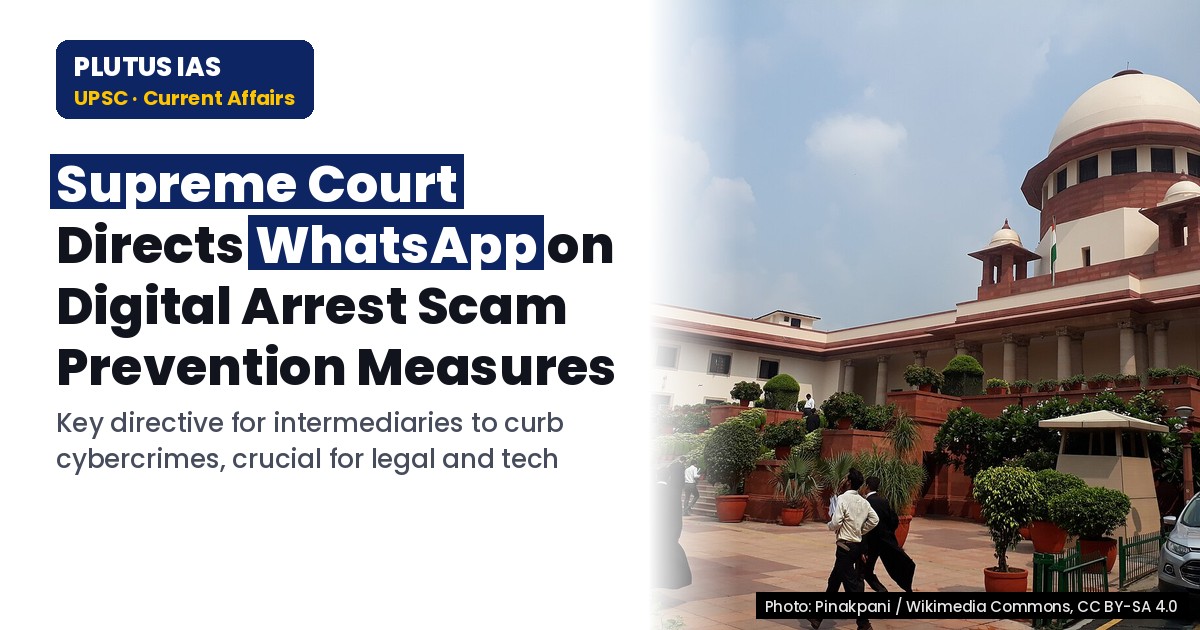
10 Nov SC Directs WhatsApp on Digital Arrest Scam Prevention
✎ The Supreme Court's directive to digital intermediaries to disclose measures against the 'digital arrest scam' underscores the critical need for enhanced cyber security protocols and intermediary accountability in safeguarding…
Subject Relevance — Where This Topic Fits
- GS Paper II — Governance, Constitution, Polity; GS Paper III — Internal Security, Cyber Security, Science and Technology
- Prelims: Digital Arrest Scam, Cybercrime, Intermediaries, Supreme Court, Article 32, Information Technology Act 2000, Data Protection
- Essay: The Digital Frontier: Balancing Innovation with Security and Rights, The Role of Judiciary in Upholding Citizen Safety in the Digital Age
Quick Revision: The Supreme Court’s directive to digital intermediaries to disclose measures against the ‘digital arrest scam’ underscores the critical need for enhanced cyber security protocols and intermediary accountability in safeguarding citizens from online fraud.
Why is this in the news?
The Supreme Court of India has issued a directive to WhatsApp and other digital intermediaries, mandating them to disclose the specific measures implemented to prevent the ‘digital arrest scam’ and other forms of cybercrime. This judicial intervention underscores the escalating concerns regarding online fraud and the imperative for digital platforms to enhance user safety and security protocols.
Background
- The ‘digital arrest scam’ typically involves fraudsters impersonating law enforcement agencies or government officials, coercing individuals into making payments under the threat of arrest or legal action, often through digital communication channels.
- The proliferation of smartphones and internet access has led to a significant increase in online interactions, concurrently facilitating the rise of sophisticated cybercrimes, including phishing, identity theft, and various forms of digital fraud.
- Existing legal frameworks, such as the Information Technology Act, 2000, and its subsequent amendments, aim to regulate digital activities and provide mechanisms for addressing cybercrimes, but their implementation and effectiveness in curbing evolving threats remain a challenge.
- The Supreme Court’s involvement highlights the judiciary’s role in ensuring citizen protection and holding digital entities accountable for their operational impact on public safety.
- The directive aligns with broader global efforts to regulate digital platforms and intermediaries, emphasizing their responsibility in content moderation, user data protection, and crime prevention.
- The issue also touches upon the fundamental rights of citizens, including the right to privacy and the right to a safe digital environment, which are increasingly challenged by cybercriminal activities.
Understanding Digital Arrest Scam and Intermediary Liability
- A ‘digital arrest scam’ is a sophisticated form of cyber fraud where perpetrators impersonate government officials, law enforcement agencies, or even judicial authorities, using digital communication (calls, messages, video calls) to intimidate victims into believing they are implicated in a crime.
- Victims are typically threatened with immediate arrest, legal prosecution, or freezing of assets unless they comply with demands for monetary payments, often through digital transfers or cryptocurrency, under the guise of bail, fines, or legal fees.
- The scam leverages psychological manipulation, creating a sense of urgency and fear to bypass critical thinking and exploit victims’ lack of legal knowledge or digital literacy.
- Digital intermediaries, as defined under the Information Technology Act, 2000, are entities that receive, store, or transmit electronic records or provide any service with respect to such records on behalf of another person. Examples include social media platforms, messaging services, and internet service providers.
- The legal principle of intermediary liability dictates the extent to which these platforms can be held responsible for content or activities occurring on their services. This liability is often conditional on their adherence to due diligence requirements and cooperation with law enforcement.
- The Supreme Court’s directive emphasizes the proactive measures intermediaries are expected to undertake, which may include robust user verification processes, advanced fraud detection algorithms, prompt action on reported suspicious activities, and user awareness campaigns.
- The challenge for intermediaries lies in balancing user privacy and freedom of expression with the imperative to prevent criminal misuse of their platforms, often requiring significant investment in technology and policy development.
- Effective prevention strategies necessitate a multi-stakeholder approach involving government agencies, law enforcement, digital platforms, and public awareness initiatives to educate citizens about common cyber threats and safe online practices.
Key Features
| Feature | Significance |
|---|---|
| Supreme Court Directive | Highlights the judiciary’s proactive role in addressing contemporary societal challenges, particularly those arising from technological advancements. |
| Focus on Digital Arrest Scam | Addresses a specific, emerging cybercrime modus operandi that exploits public fear and lack of digital literacy. |
| Inclusion of Intermediaries (WhatsApp, etc.) | Recognises the crucial role of digital platforms in facilitating communication and, inadvertently, in the perpetration of cybercrimes, necessitating their accountability. |
| Call for Preventive Measures | Emphasises a shift from reactive law enforcement to proactive crime prevention strategies by technology providers. |
| Broader Scope to Cybercrimes | Indicates a comprehensive approach to tackling the wider spectrum of online criminal activities, beyond just the ‘digital arrest’ scam. |
Why it Matters
Governance and Law Enforcement
- The directive underscores the imperative for robust regulatory frameworks to govern digital platforms and ensure their cooperation in combating cybercrime.
- It highlights the evolving nature of crime, necessitating continuous adaptation of law enforcement strategies and technological capabilities.
Social and Public Safety
- Aims to protect citizens, particularly vulnerable populations, from financial fraud and psychological distress caused by sophisticated digital scams.
- Contributes to building public trust in digital communication channels by ensuring greater security and accountability.
Technological and Digital Ecosystem
- Mandates technology intermediaries to enhance their security protocols, user verification mechanisms, and content moderation policies.
- Promotes a collaborative ecosystem where legal institutions, technology companies, and citizens collectively work towards a safer digital environment.
Challenges
1. Jurisdictional Complexities
- Cybercrimes often transcend national borders, making investigation, prosecution, and enforcement of directives challenging.
- Varying legal frameworks across jurisdictions can impede effective international cooperation.
UPSC Link: Internal Security; International Relations
2. Technological Evasion by Criminals
- Perpetrators constantly evolve their methods, utilising advanced encryption, anonymising tools, and social engineering techniques.
- The rapid pace of technological innovation often outstrips the development of regulatory and enforcement mechanisms.
UPSC Link: Science & Technology; Internal Security
3. Balancing Privacy and Security
- Measures to prevent cybercrime, such as monitoring communications, must be carefully balanced against individual privacy rights.
- Over-regulation or intrusive surveillance can infringe upon fundamental freedoms and civil liberties.
UPSC Link: Indian Polity; Internal Security
4. Digital Literacy and Awareness
- A significant portion of the population lacks adequate digital literacy, making them susceptible to sophisticated scams.
- Effective public awareness campaigns require continuous effort and adaptation to new threats.
UPSC Link: Social Justice; Internal Security
5. Resource Constraints
- Law enforcement agencies may lack sufficient trained personnel, advanced forensic tools, and financial resources to combat cybercrime effectively.
- The scale and complexity of cybercrime demand substantial investment in infrastructure and human capital.
UPSC Link: Internal Security; Governance
Challenges — UPSC Perspective
| Issue | Concern |
|---|---|
| Intermediary Accountability | Ensuring digital platforms take proactive responsibility for content and user safety without stifling innovation or free speech. |
| Evolving Cybercrime Tactics | The continuous adaptation of criminal methodologies necessitates dynamic and responsive counter-measures from authorities and platforms. |
| Data Privacy vs. Crime Prevention | Striking an appropriate balance between protecting user data and enabling law enforcement access for crime investigation. |
| Public Awareness Deficit | Many citizens remain unaware of common cyber threats and preventive practices, making them vulnerable targets. |
| Cross-Border Enforcement | The global nature of cybercrime complicates investigation and prosecution, requiring robust international cooperation. |
Way Forward
- Establish a clear legal framework for intermediary liability, balancing platform responsibility with user privacy and freedom of expression.
- Promote enhanced collaboration between law enforcement agencies, technology companies, and cybersecurity experts for real-time threat intelligence sharing.
- Launch sustained, multi-lingual public awareness campaigns to educate citizens on various cybercrime typologies and safe digital practices.
- Invest in capacity building for law enforcement, including training personnel in cyber forensics and providing advanced technological tools.
- Encourage technology intermediaries to implement robust AI-driven content moderation and anomaly detection systems to identify and flag suspicious activities.
- Develop standardised protocols for reporting cybercrimes and ensuring swift action by platforms and law enforcement.
- Foster international cooperation through treaties and agreements to address the cross-border nature of cybercrime effectively.
- Implement a mechanism for regular review and update of cybersecurity policies to keep pace with technological advancements and evolving threats.
UPSC Value Addition
Keywords for Mains Answer-Writing
Digital arrest scam · Cybercrimes · Online fraud · Intermediary liability · Information Technology Act 2000 · Cybersecurity · Consumer protection · Financial fraud · Judicial intervention · Digital literacy · Data protection · Law enforcement
Constitutional & Policy Linkages
- Article 21: Right to life and personal liberty, encompassing the right to privacy and protection from digital harm.
- Article 19(1)(a): Freedom of speech and expression, which must be balanced with reasonable restrictions for public order and security.
- Seventh Schedule (Union List, Entry 31): Posts and telegraphs, telephones, wireless, broadcasting and other like forms of communication, enabling central legislation on digital platforms.
Concept Flow
Rise of Digital Communication Platforms → Emergence of Sophisticated Cybercrime (e.g., Digital Arrest Scam) → Increased Vulnerability of Citizens to Online Fraud → Judicial Intervention and Directives to Intermediaries → Mandate for Proactive Preventive Measures by Platforms → Enhanced Public Safety and Accountability in Digital Space
Prelims Practice Questions
Q1. Consider the following statements regarding ‘Digital Arrest’ scams:
1. In a digital arrest scam, fraudsters impersonate law enforcement agencies or government officials.
2. Victims are typically coerced into transferring funds to avoid fictitious legal action or arrest.
3. Such scams exclusively target individuals with low digital literacy.
How many of the above statements are correct?
- Only one
- Only two
- Only three
- None
Answer: Only two — Statement 1 is correct: Digital arrest scams involve impersonation by fraudsters. Statement 2 is correct: The primary modus operandi involves coercing victims into transferring money. Statement 3 is incorrect: While vulnerable individuals may be targeted, these scams can affect anyone, regardless of their digital literacy level, through sophisticated social engineering tactics.
Q2. Which of the following sections of the Information Technology Act, 2000, primarily deals with the liability of intermediaries for content hosted on their platforms?
- Section 66A
- Section 69
- Section 79
- Section 43A
Answer: Section 79 — Section 79 of the Information Technology Act, 2000, provides a ‘safe harbour’ provision for intermediaries, exempting them from liability for third-party content in certain circumstances, provided they observe due diligence and comply with government directions. Section 66A, which criminalised offensive messages, was struck down by the Supreme Court. Section 69 deals with powers to intercept, monitor, or decrypt information. Section 43A pertains to compensation for failure to protect data.
Mains Practice Question
✍ Examine the challenges posed by ‘digital arrest’ scams and other cybercrimes to India’s digital economy and national security. Discuss the role of intermediaries in mitigating these threats, with reference to relevant legal frameworks and recent judicial pronouncements. (15 Marks)
Approach: MODEL-ANSWER SKELETON:
1. **Introduction**: Define ‘digital arrest’ scams and broadly categorise cybercrimes, highlighting their increasing prevalence and sophistication.
2. **Challenges to Digital Economy**: Discuss impacts such as financial losses to individuals and businesses, erosion of trust in digital transactions, hindrance to digital adoption, and potential for economic instability.
3. **Challenges to National Security**: Address threats like data breaches, espionage, critical infrastructure attacks, radicalisation, and the use of cybercrime for funding illicit activities.
4. **Role of Intermediaries**: Explain their pivotal position as facilitators of digital communication and services. Detail their responsibilities in:
* Proactive content moderation and identification of fraudulent activities.
* Implementing robust security measures and encryption.
* User awareness campaigns and digital literacy promotion.
* Cooperation with law enforcement agencies (LEAs).
* Developing grievance redressal mechanisms.
5. **Relevant Legal Frameworks**:
* **Information Technology Act, 2000**: Specifically mention Section 79 (Intermediary Liability) and its amendments (e.g., IT Rules, 2021).
* **Indian Penal Code (IPC)**: Relevant sections for cheating, fraud, and impersonation.
* **Payment and Settlement Systems Act, 2007**: For financial fraud aspects.
* **Data Protection Bill (proposed/enacted)**: Its implications for data security and privacy.
6. **Recent Judicial Pronouncements**: Refer to the Supreme Court’s recent directive to WhatsApp and other intermediaries, emphasising their accountability and the need for proactive measures to prevent scams. Mention other relevant judgments that have clarified intermediary liability or consumer protection in the digital realm.
7. **Conclusion**: Summarise the multi-faceted nature of the challenge and reiterate the necessity of a collaborative approach involving government, intermediaries, law enforcement, and citizens to build a secure and resilient digital ecosystem.
Source: LiveLaw
Generated by AanyaAi for educational purpose.
Related guides on our sites
- Current affairs for upsc 2026
- Best PSIR optional coaching for upsc
- Best PSIR optional teacher for upsc
- Best teacher of PSIR optional for upsc

- SC Directs WhatsApp on Digital Arrest Scam Prevention - November 10, 2026
- डिजिटल अरेस्ट स्कैम: SC का WhatsApp, बैंकों को निर्देश - November 10, 2026
- MY Bharat’s 100-Week Anti-Drug Campaign: Deepotsav & Youth Parliament - November 10, 2026

No Comments